yorozuyo mo tokiwa naranan kyō no tame iwaite ōsu sono no yomogi wa
For ten thousand ages more Evergreen, I would you be! For today’s Celebration, lushly growing Mugwort in the grounds…
3
Right
そののうちにおふるよもぎのえだしげみすゑさかゆべくみゆるきみかな
sono no uchi ni ouru yomogi no eda shigemi sue sakayubeku miyuru kimi kana
Within the grounds A’growing, the mugwort’s Branches are lush To the very end they flourish, As do you appear to, my Lord!
4
In ancient times, folk arose on this day with the dawn together with the birds and, taking those branches of mugwort from within their grounds that resembled people, dried them in the shade and made medicinal draughts—I wonder, were both Left and Right unaware of this? There is not even a dewdrop’s worth of diction in accordance with the topic, so I must make this round a tie.
かたかたにとるかたもなきよもぎぐさひとかずならぬここちこそすれ
katakata ni toru kata mo naki yomogigusa hito kazu naranu kokochi koso sure
Both sides say Nothing noteworthy about Mugwort plants,so Neither is worth much, I feel!
niwa no omo ni shigerinikerashi yaemugura towade ikuyo noaki kaenuran
All around my grounds How thickly seems to have grown Mugwort in layer after tangled layer; With no visits from him how many times Has autumn come round and round?
tsuyu sugaru niwa no hagiwara irozukinu ika naru hito no omoisomuran
All clung with dew, The bush clover grove in the grounds Has taken on such hues, that I wonder who it is Might have just fallen into passion’s flames?
Chikanari 61
Right (Win)
おく露は秋のならひの萩が枝にあまるや雁の涙なるらん
oku tsuyu wa aki no narai no hagi ga e ni amaru ya kari no namida naruran
Dewdrops falling is Autumn’s custom for The bush clover branches, but Added to them are the goose Tears, perhaps?[1]
Ie’kiyo 62
The Left’s poem has a person’s feelings being dyed by the bush-clover, but I cannot think why this should be? The Right’s poem seems particularly pleasant. Thus, it wins.
[1] An allusive variation on: Composed on the occasion of a poetry competition at Prince Koresada’s house. 秋の夜のつゆをばつゆとおきながらかりの涙やのべをそむらむ aki no yo no / tsuyu oba tsuyu to / okinagara / kari no namida ya / nobe o somuran ‘On Autumn nights / The dew as dewdrops / Falls, but, / Perhaps goose tears / Stain the fields?’ Mibu no Tadamine (KKS V: 258)
miyagino no ko no shitakaze ya suginuran tsuyu ni okururu akihagi no hana
On Miyagi Plain has The breeze beneath the trees Passed by? For Missing the dewfall are The autumn bush clover blooms…
Takasuke 57
Right
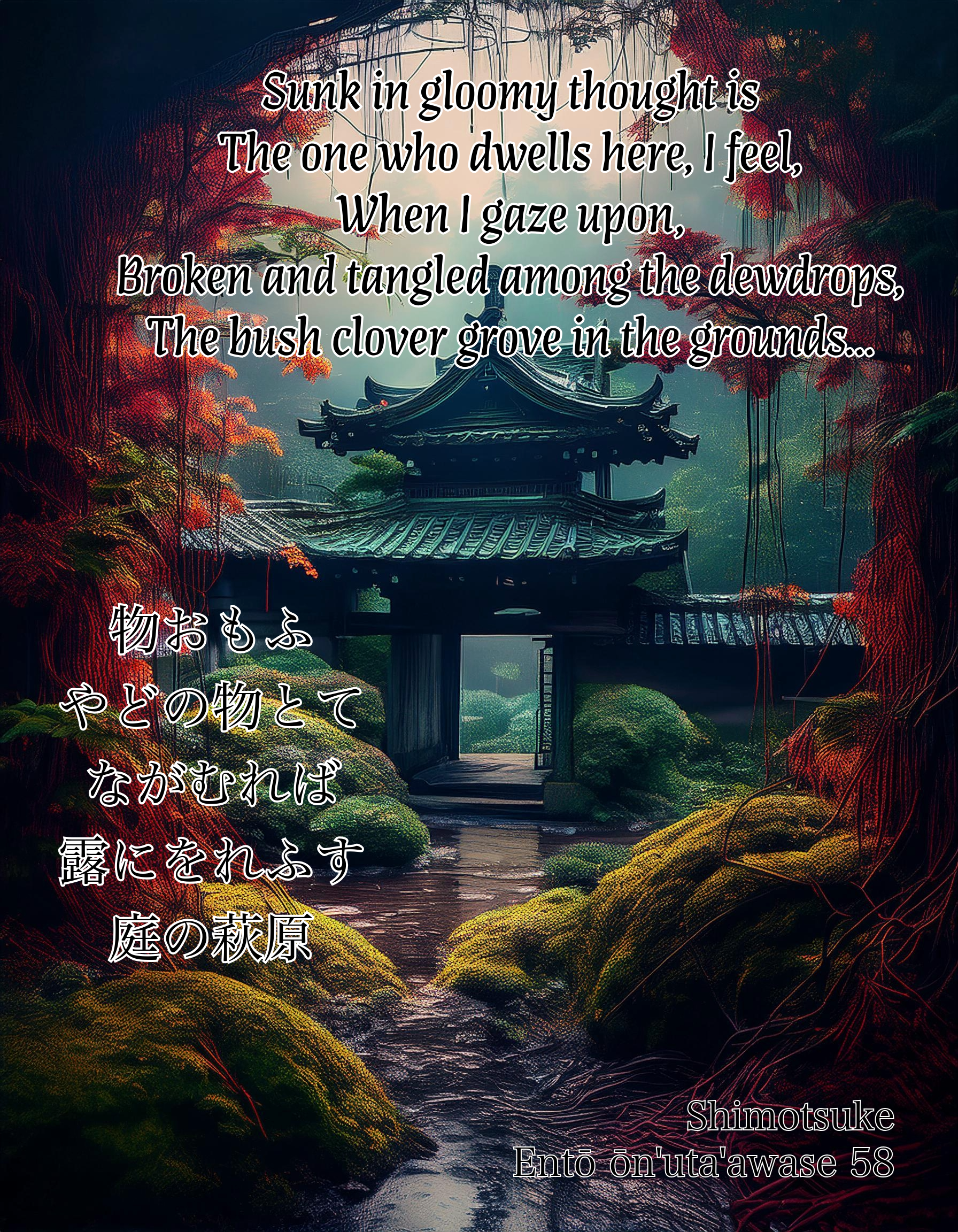
物おもふやどの物とてながむれば露にをれふす庭の萩原
mono’omou yado no mono tote nagamureba tsuyu ni orefusu niwa no hagiwara
Sunk in gloomy thought is The one who dwells here, I feel, When I gaze upon, Broken and tangled among the dewdrops, The bush clover grove in the grounds…
Shimotsuke 58
The Left poem’s ‘Missing the dewfall are the autumn bush clover’ sounds pleasant. The Right poem has no faults either, yet the Left should win.
shigure ni wa iro naranu mi no sodegasa mo nurureba kaoru mono ni zo arikeru
When, amidst a shower My colourless Umbrella of sleeves Is soaked, something scented Does it become!
Lady Shōshō 5
Right (M – Win)
冬くれば散りしく庭のならの葉に時雨音なふみ山べのさと
fuyu kureba chirishiku niwa no nara no ha ni shigure oto nau miyamabe no sato
When the winter comes Scattered and spread across the grounds Are oak leaves, Sounding among the showers On this deep mountain estate…
Lord Masakane 6
Toshiyori states: the first poem has ‘my colourless’—does this mean that the garment the poet is wearing is white? Or that the speaker is lacking in passion? If the garment is white, then it’s difficult to say that it changes colours, while if one is lacking in passion, it’s also difficult to see the connection with an umbrella of sleeves being scented. In general, though, the poem’s style is lacking in fault. The second poem appears to have replicated all the faults of an earlier work. While one can certainly say ‘Oak leaves / Scattered and spread’, saying ‘Scattered and spread / Oak leaves’ gives one the feeling that something is out of sequence. This is a bit unreasonable, but because it’s difficult to avoid the faults of its earlier model, I still feel it should lose.
Mototoshi states: one really wants to know what sort of lack there is. The poem says ‘soaked, something scented’, but doesn’t reference an earlier work which, for example, mentions plum blossom. Still, I feel that ‘Sounding among the showers / On this deep mountain’ is conspicuously good.