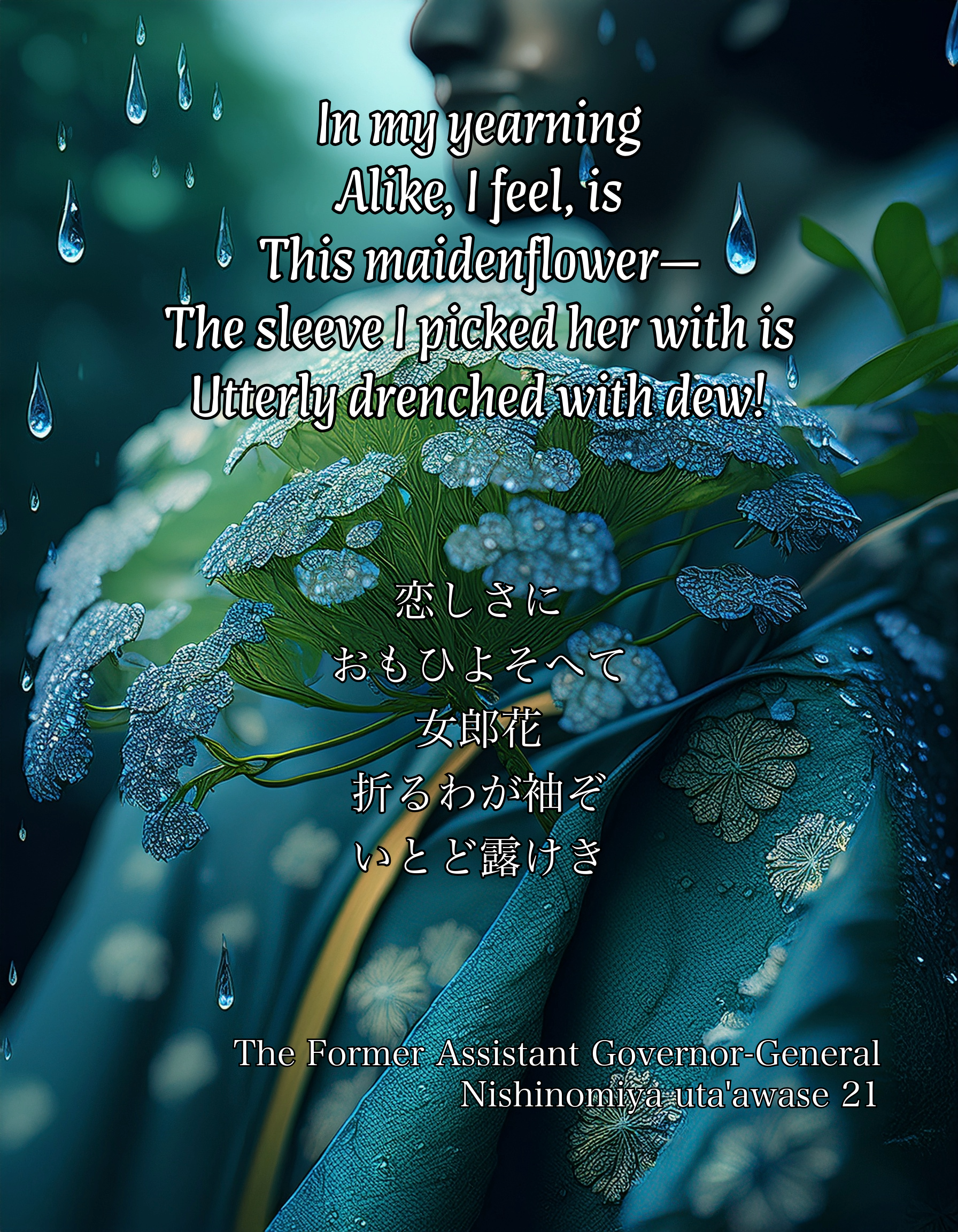
koishisa ni omoi’yosoete ominaeshi oru wa ga sode zo itodo tsuyukeki
In my yearning Alike, I feel, is This maidenflower— The sleeve I picked her with is Utterly drenched with dew!
The Former Assistant Governor-General 21
Right
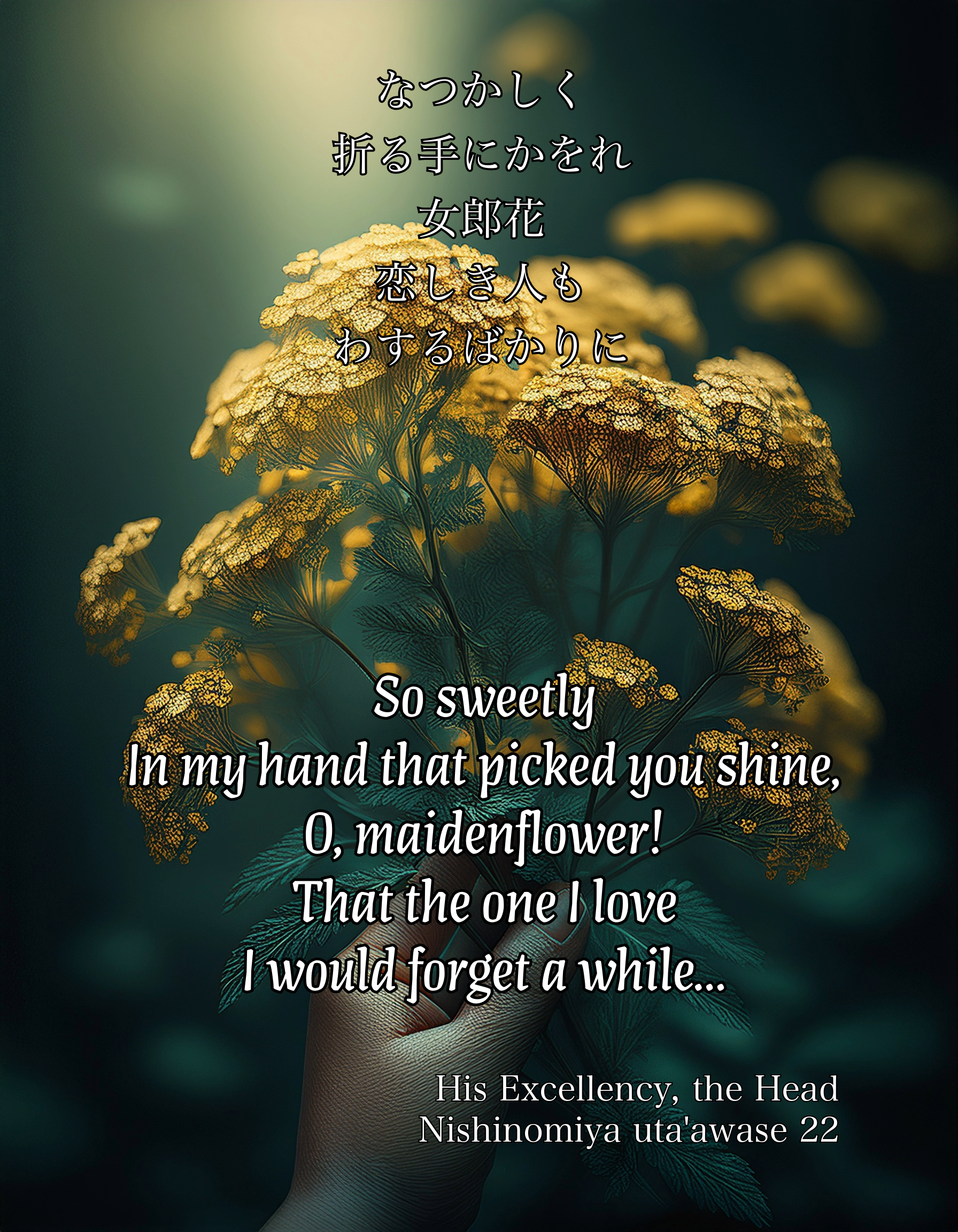
なつかしく折る手にかをれ女郎花恋しき人もわするばかりに
natsukashiku oru te ni kaore ominaeshi koishiki hito mo wasuru bakari ni
So sweetly In my hand that picked you shine, O, maidenflower! That the one I love I would forget a while…
His Excellency, the Head 22
The Left’s ‘sleeve I picked her with is / Utterly drenched with dew’ is a form of words entirely in tune with the topic—it appears charmingly exactly how a poem in a poetry match should be. Then the Right expresses as somewhat shallow and unreliable conception of love that might be forgotten in the face of the shine of a maidenflower picked and held in the hand. Thus, I feel the dew-drenched sleeves are superior here, aren’t they.
ayanashi na tabusa ni zuzu o torinagara omou kokoro ni katsu midaruramu
How strange it is! Within my hand sundry bijoux I hold, yet still My heart and thoughts Are all confused…
Jakunen 149
Right
なにごとをまつとはなしにながらへていつすみよしとおもふべきみぞ
nanigoto o matsu to wa nashi ni nagaraete itsu sumiyoshi to omoubeki mi zo
Nothing in particular Have I to expect, but I live on; O, when, that ‘tis good to live Will I come to think?
Suke 150
The poem of the Left’s final section, saying ‘My heart and thoughts / Are all confused’ seems extremely pleasant. However, then there is ‘Within my hand sundry bijoux’: ‘sundry bijoux’ is an expression of foreign origin and sounds like prose diction. The poem of the Left seems pleasant with its allusion in ‘O, when, that ‘tis good to live’, yet the final section seems lacking in technique. While the Left’s second line gives cause for concern, its final sequencing is truly charming and thus it should win.
Composed on the conception of coming unexpectedly, but being unable to meet, when people were composing ten love poem sequences at the residence of Lord Toshitada.
おもひ草葉末にむすぶしら露のたまたまきては手にもたまらず
omoFigusa Fazue ni musubu siratuyu no tamatama kite Fa te ni mo tamarazu
My passion, to the dayflower’s Leaf-tips clings A silver dewdrop Gem—unexpectedly arriving, It will not fall into my hand…
In judgement: the Right sounds as if the lovers are exceedingly close. The Left, that even when the distance separating you is not that great, it is still painful, is, indeed, the case. Thus, the Left wins.
The Right state: we wonder about the appropriateness of ‘swiftly’ (yagate). The Left state: should one mention a monk in a poem about Love?
In judgement: the configuration of the Left’s ‘In sorrow and despite; the tolling of the bell’ (itou mo kanashi kane no koe) sounds pleasant, so ‘swiftly’ does not seem unsuited. The Left wins.