[i] This poem is included in Fubokushō (VI: 2017), attributed to Kanemori, with the headnote ‘Kerria, Poetry Match held by the Reikeiden Junior Consort, Second Month, Tenryaku 11’.
[ii] This poem is included in Shikashū (I: 46) as an anonymous poem with the headnote ‘Composed for the Poetry Match held at the Residence of the Reikeiden Junior Consort’.
haru no no no wakana wa kimi ga tame ni koso ōku no toshi o tsumamu to wa omoe
In the springtime meadows Fresh herbs, for my Lord’s Sake, indeed, In many a year Will I pick, I feel!
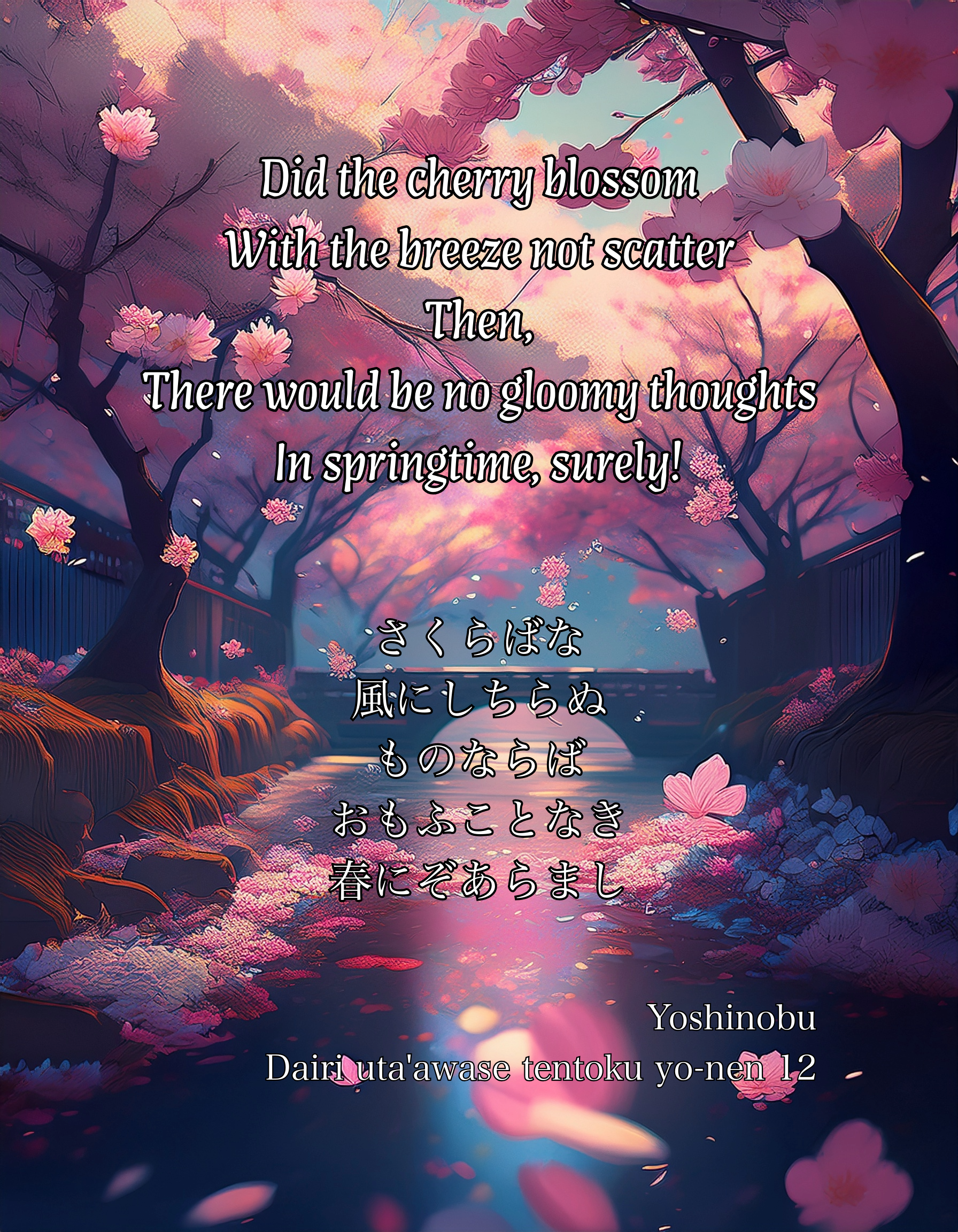
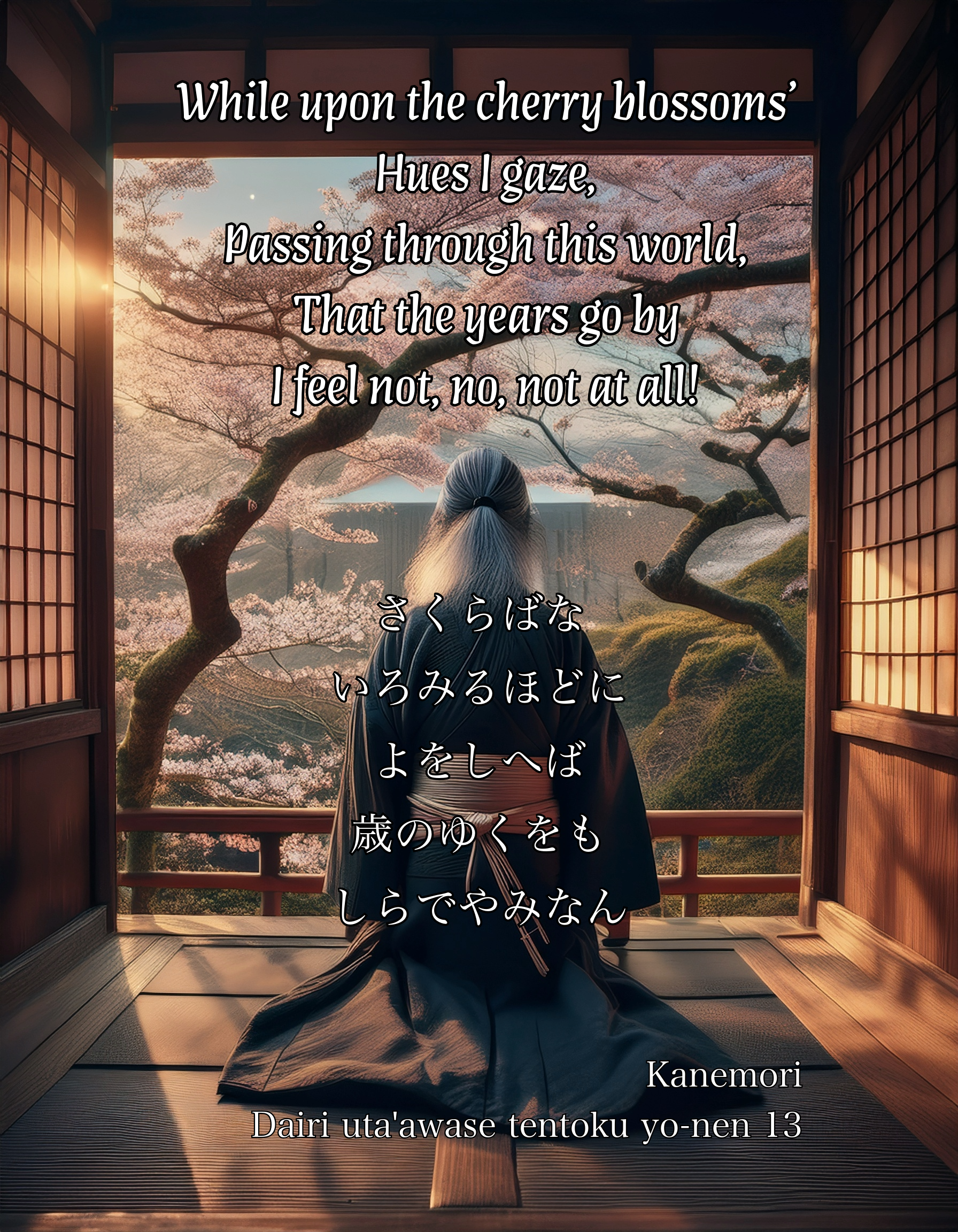
12
The Right’s poem was inferior, but tied as it contained an element of Felicitation.
[i] This poem is included in Shoku gosenshū (I: 34), attributed to Kanemori, with the headnote ‘A poem from the Poetry Match held by the Reikeiden Junior Consort’.
kagamiyama haru kuru kage ya mietsuramu tani no uguisu idete naku nari
Upon Mirror Mountain Signs of coming spring Have appeared, it seems, for In the valleys warblers Have emerged to sing.
8
[i] This poem is included in Shūishū (I: 10), attributed to Middle Counsellor [Fujiwara no] Asatada, with the headnote ‘From a palace poetry match on the 29th day of the Third Month, Tenryaku 10’ [12.5.956]. It is also included in Shūishō (I: 6) as an anonymous poem in some texts, or attributed to Nakatsukasa in others, with the headnote ‘When a poetry match was held at the palace on the 29th day of the Third Month, Tenryaku 10’.
While he was residing at Mount Hiei, and someone asked him for some incense, he sent this, attached to a branch of plum from which the blossom had scattered.
春すぎてちりはてにける梅の花ただかばかりぞ枝にのこれる
Faru sugite tiriFatekeru mume no Fana tada ka bakari zo eda ni nokoreru
Spring is gone and All scattered are The plum blossoms: Only their fragrance Lingers on the branch!
[ii] Kanemori’s poem here can be viewed as a response to the emotions expressed by Ono no Komachi in her famous composition: Topic unknown. 花の色はうつりにけりないたづらにわが身世にふるながめせしまに hana no iro wa / utsurinikeri na / itazura ni / wa ga mi yo ni furu / nagameseshi ma ni ‘The colour of this flower / Has already faded away, / While in idle thoughts / My life goes by, / As I watch the long rains fall.’ (Kokinshū II: 113) (Hagitani and Taniyama 1965, 81)
saohime no ito somekakuru aoyagi o fuki na midari so haru no yamakaze
Princess Sao Has dyed the dangling threads of Green willow— O, don’t blow them into tangles, Spring breeze from the mountains!
Kanemori 9
While the Right’s poem was being recited, the gentlemen of the Left stated, ‘The current willow poem was already recited out of sequence, and yet they desire to recite it again. It seems they have forgotten basic procedure!’ This minor official replied, ‘His Majesty’s ruling has already been granted on this matter following the Left’s request when the poems on bush warblers were recited, so this objection cannot be raised again.’
In the Left’s poem ‘New jewels, / The years seem to spin out / Green willow’ lacks sense. While the Right’s poem has nothing worth mentioning about it, it does not appear to have any faults, and thus it wins.
[i] A variant on this poem is included in Goshūishū (I: 74), as well as in some texts of this match: Composed on willows for the Palace Poetry Match held in Tentoku 4. あらたまのとしをへつつもあをやぎのいとはいづれのはるかたゆべき aratama no / toshi o hetsutsu mo / aoyagi no / ito wa izure no / haru ka tayubeki ‘New jewels, / The years pass ever by with / Green willow / Threads: when might / The spring be that they snap?’ Given Saneyori’s judgement, however, I am following Hagitani and Taniyama (1965, 80) in prioritising this version.
saohime no ito somekakuru aoyagi o fuki na midari so haru no yamakaze
Princess Sao Has dyed the dangling threads of Green willow— O, don’t blow them into tangles, Spring breeze from the mountains!
Kanemori 6
Warblers should have appeared here, but this is a poem about willows, so it loses.
しろたへの雪ふりやまぬ梅がえにいまぞうぐひす花となくなる
shirotae no yuki furiyamanu ume ga e ni ima zo uguisu hana to nakunaru
White as mulberry cloth The snow falls unceasing— Upon the branch of plum, Now, indeed, the warbler, Sings of the blossom!
Kanemori 7
Despite the mistaken composition, His Majesty required the original poem and it was located and recited.
Lord Hiromasa, the Reciter for the Right, mistakenly recited the willow poem. The Left raised an objection, saying, ‘He should have recited the warbler poem but, instead, erroneously recited the willow poem. Should he really be allowed to recite the correct poem now?’ The substance of the Left’s objection was conveyed to His Majesty, who instructed, ‘Provide a report based on prior precedent.’
This minor official advised His Majesty, ‘The Left’s objection is not unreasonable. However, matters such as this are best determined according to the circumstance of the occasion. As this was simply human error, why discriminate against the poem?’
Thus, His Majesty ordered that the poem be recited.
When he did so, Lord Hiromasa turned pale and was unable to recite the poem straight away. Although he finally managed to do so, his voice trembled and the Left laughed at him. Furthermore, the poem’s diction contained the nonsensical expression ‘sings of the blossom’, and thus this was still a loss.
[i] An allusive variation on: A poem from the Empress’ poetry competition held in the Kanpyō period. 花の香を風のたよりにたぐへてぞ鶯さそふしるべにはやる hana no ka o / kaze no tayori ni / taguete zo / uguisu sasou / shirube ni wa yaru ‘The blossoms’ scent / Messaged on the breeze / Brings / An invitation to the warbler / To try and bring him forth!’ Ki no Tomonori (Kokinshū I: 13)
[ii] This poem was included in Gyokuyōshū (I: 42), attributed to Asatada, with the headnote ‘On warblers, from the Palace Poetry Match in Tentoku 4’.