uguisu no harusamezame to naki’itaru take no shizuku ya namida naruran
A warbler In a spring shower lets fall His cries: Are the droplets on the bamboo His tears, perhaps?[i]
26
[i] See: Warbler [uguhisu]. 心から花のしづくにそほちつつうくひずとのみ鳥のなくらむ kokoro kara / hana no shizuku ni / sōchitsutsu / uku hizu to nomi / tori no nakuramu ‘Even his heart / By droplets from the blossoms / Is ever drenched: / Sadly simply never dry, / Does the bird seem to cry…’ Lord Fujiwara no Toshiyuki (Kokinshū X: 422); and: When he was staying somewhere with bamboo before his bedroom. 竹ちかくよどこねはせじ鶯のなく声きけばあさいせられず take chikaku / yodoko ne wa seji / uguisu no / naku koe kikeba / asa irarezu ‘Close by the bamboo / My bed, but sleep eludes me, for / When the warbler’s / Crying song I hear / I cannot doze away the morning.’ Lord Fujiwara no Korehira (Gosenshū II: 48)
harusame no furuno no wakana oinurashi nurenure tsuman katami tanukire
In a spring shower Falling on Furu Plain,[i] the fresh herbs Have grown, it seems; Soaked, I’ll pick them, Putting my basket down…[ii]
20
[i] Furu 布留 was an utamakura in Yamato, often used in poetry because of the place-name’s homophony with furu 古 (‘old’) or, as here furu 降る (‘fall [of rain]’). See McAuley (2020, 653–654) for details and example poems.
[ii] Gotō (1982, 15) notes that there is an alternate interpretation of the final line of the poem: a katami 筐 was a type of woven bamboo basket with particularly small holes between the strips used to make it, and tanukire can be interpreted as an elided version of ta nuki’ire 手貫き入れ (‘put [something] in threading it by hand’). If this is correct, then the final line of the poem would mean ‘Threading them into my basket’.
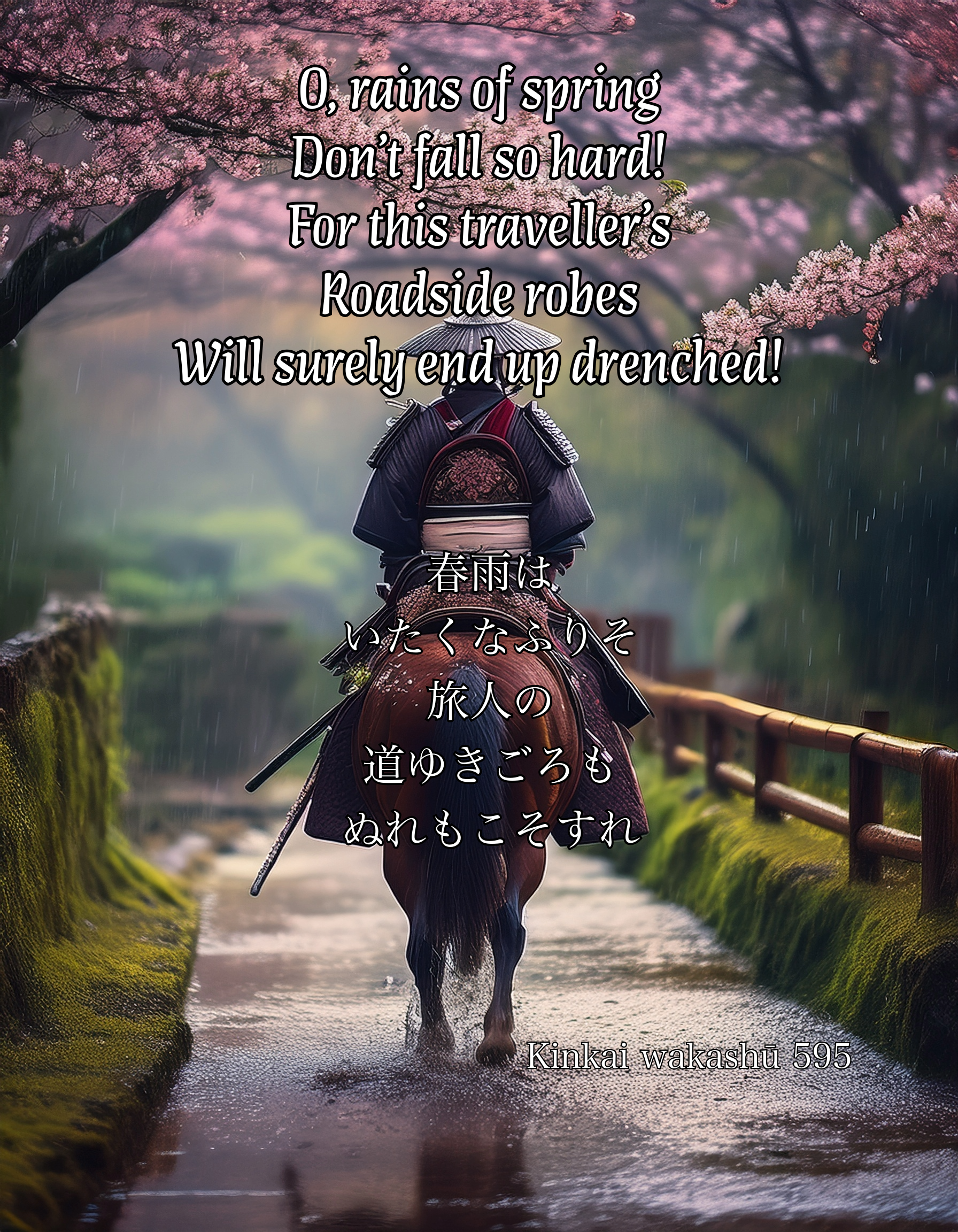
harusame wa itaku na furi so tabibito no michiyuki goromo nure mo koso sure
O, rains of spring Don’t fall so hard! For this traveller’s Roadside robes Will surely end up drenched![i]
595
[i] See: Topic unknown. 春雨はいたくなふりそ桜花まだみぬ人にちらまくもをし harusame wa / itaku na furi so / sakurabana / mada minu hito ni / chiramaku mo oshi ‘O, spring rains, / Fall not so hard! / The cherry blossom / Is yet unseen by folk who / Would regret its scattering’ Akahito (Shinkokinshū II: 110)
When there was a heavy spring shower falling, on the way back after I had made a pilgrimage to the two places.[i]
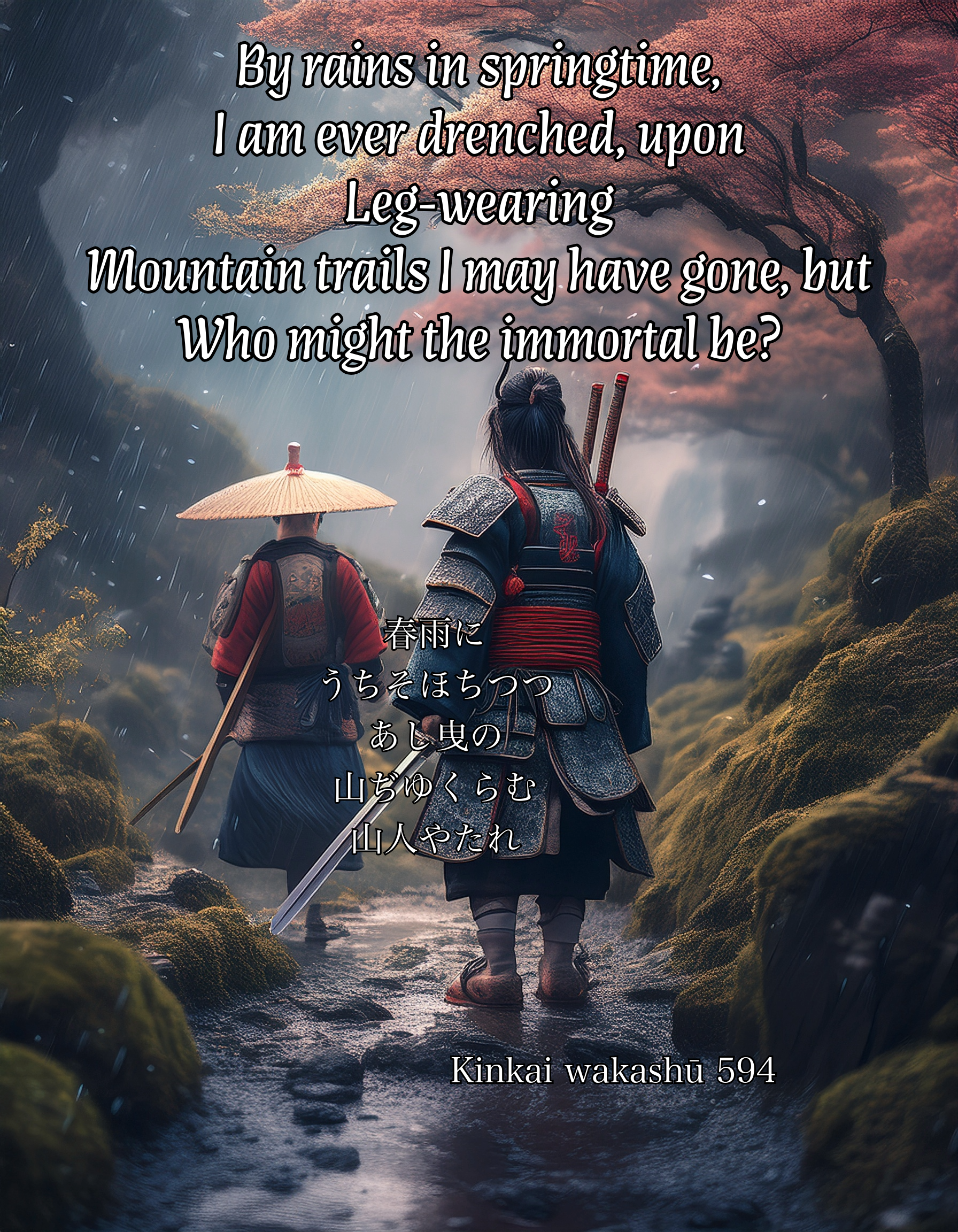
春雨にうちそほちつつあし曳の山ぢゆくらむ山人やたれ
harusame ni uchisōchitsutsu ashihiki no yamaji yukuramu yamabito ya tare
By rains in springtime, I am ever drenched, upon Leg-wearing Mountain trails I may have gone, but Who might the immortal be?[ii]
594
[i] ‘Two places’ (nisho 二所) was an abbreviation for ‘manifested deities of two shrines’ (nisho gongen 二所権現) which, in turn, was a reference to Hakone-gongen 箱根権現 and Izu-gongen 伊豆権現, the kami of Hakone shrine and Izuyama Shrine, manifesting as Buddhist deities. Both of these deities were venerated by Minamoto no Yoritomo 源頼朝 (1147-1199), the founder of the Kamakura shogunate, and his wife, Hōjō Masako 北条政子 (1157-1225) and after Yoritomo’s death, shogun’s continued to make an annual pilgrimage to both shrines.
[ii] See: A single poem presented in reply by Prince Toneri. 安之比奇能 山尓由伎家牟 夜麻妣等能 情母之良受 山人夜多礼 ashihiki no / yama ni yukikemu / yamabito no / kokoro mo shirazu / yamabito ya tare ‘To the leg-wearying / Mountains seeming to have gone / An immortal’s / Heart I cannot know, but / Who might that immortal be?’ (Man’yōshū XX: 4294)