Black.
うば玉ややみのくらきにあま雲のやへ雲がくれかりぞなくなる
| ubatama ya yami no kuraki ni amagumo no yaegumo gakure kari zo nakunaru | Lily seed Dark and gloomy The clouds within the heavens Eightfold layers conceal The geese, a’crying. |
706

Among my Shinto poems
いにしへの神代のかげぞ残りける天の岩戸の明がたのつき
| inishie no kamiyo no kage zo nokorikeru ama no iwato no akegata no tsuki | The bygone Age of Gods’ light Lingers in The Heavens’ stone door Opening, for the moon at dawn.[i] |
618
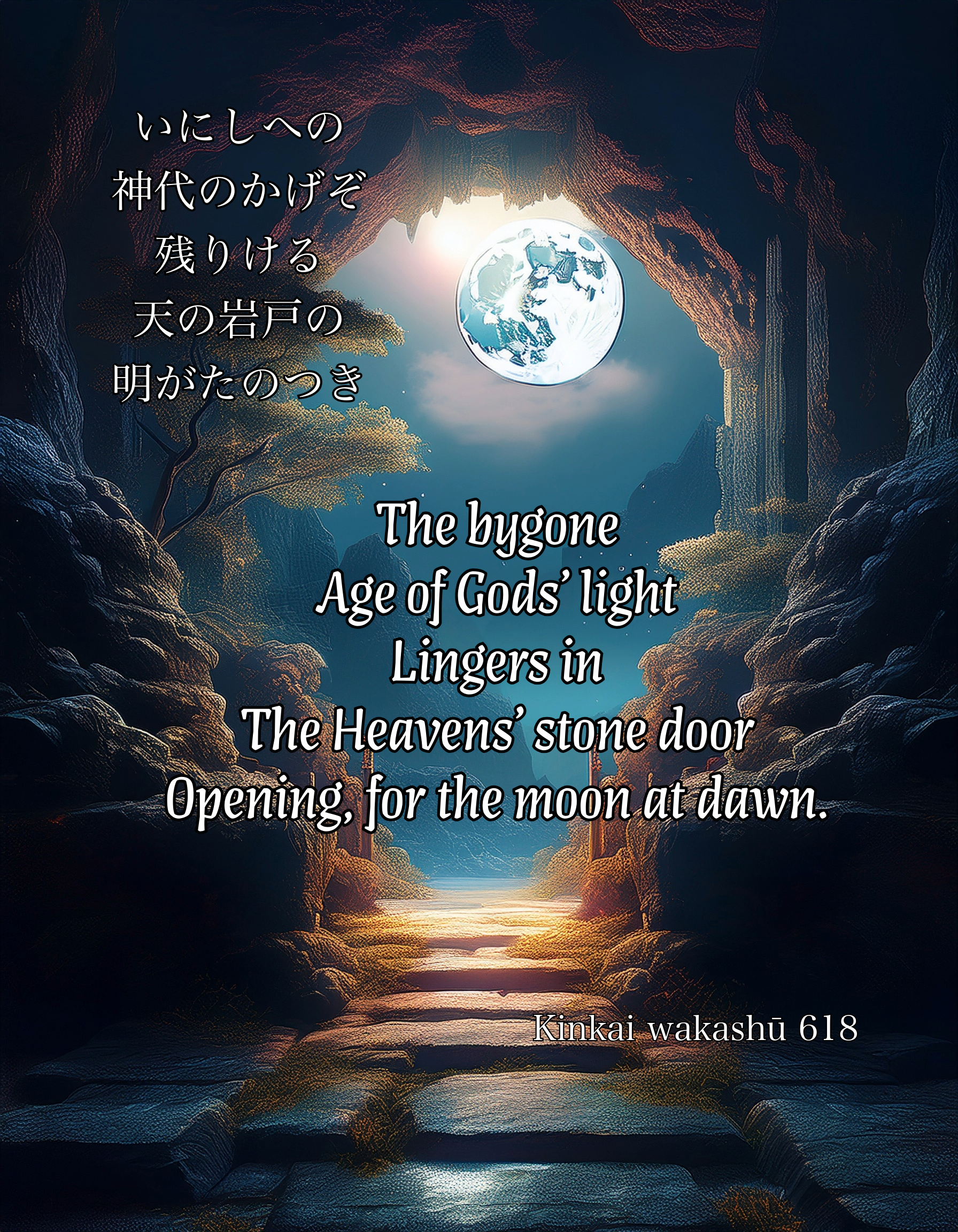
[i] See: On the conception of the moon at dawn, for the Kasuga Poetry Match. 天の戸をおしあけがたの雲間より神よの月の影ぞ残れる ama no to o / oshi akegata no / kumoma yori / kamiyo no tsuki no / kage zo nokoreru ‘Upon the gates of Heaven / Pushing brightening / Through the cloud-gaps / From the Age of Gods, the moon’s / Light lingers.’ The Regent and Chancellor (Shinkokinshū XVI: 1547)
When Dharma Master Sosen (he known as Taneyuki at the time) had gone to Shimōsa, I sent this to him in the Eleventh Month, Kenpō 6 [1218] to say he should return.
恋しともおもはでいはば久かたのあまてる神も空にしるらん
| koishi to mo omowade iwaba hisakata no ama teru kami mo sora ni shiruran | That I long for you, Should I not think, but say, The eternal Deity shining in the Heavens, Would know it in the skies.[i] |
617
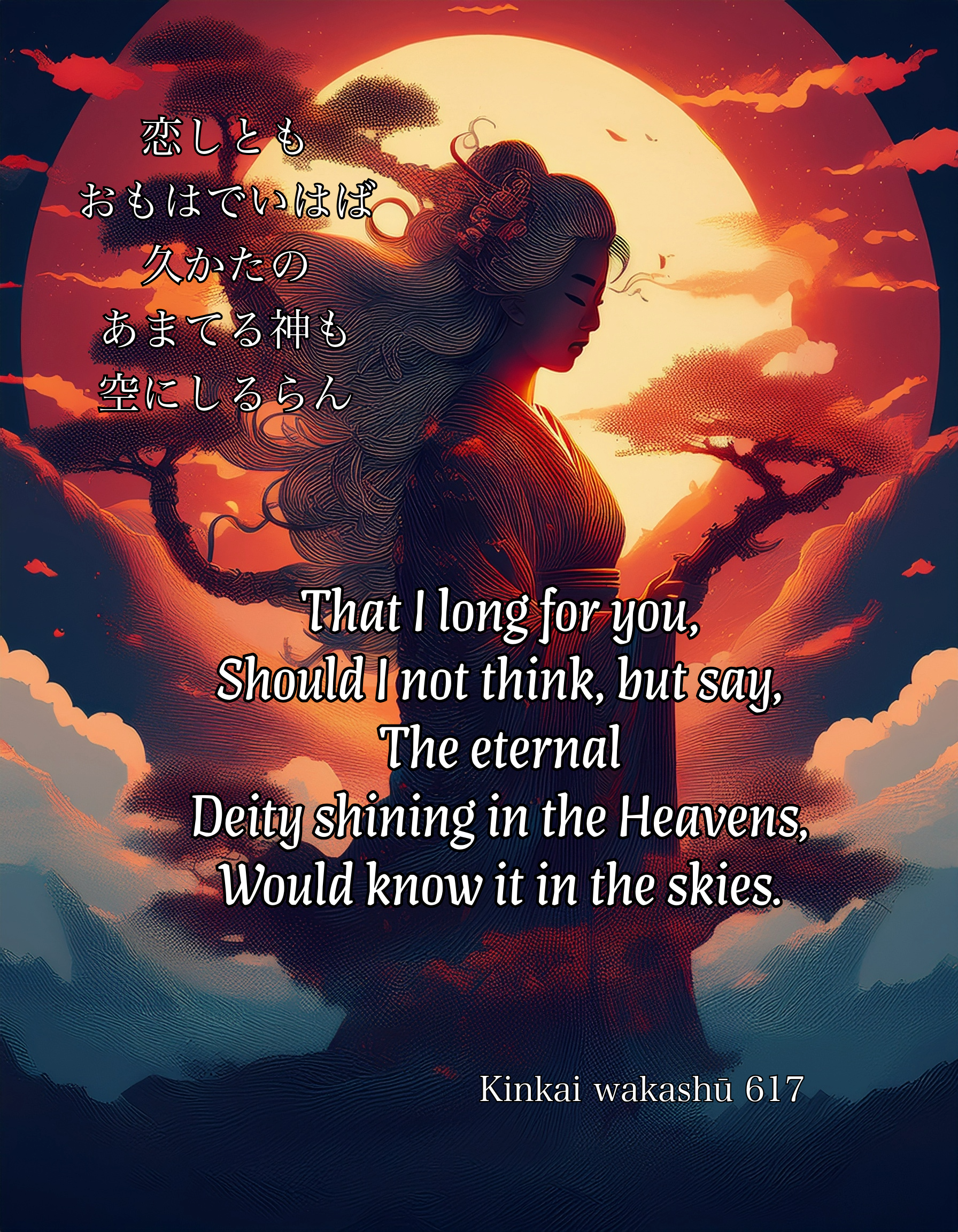
[i] See: Composed on the conception of felicitation for the poetry match held at the residence of His Excellency, Saneyuki. みづがきのひさしかるべき君が代をあまてる神やそらにしるらん mizugaki no / hisashikarubeki / kimi ga yo o / ama teru kami ya / sora ni shiruran ‘As sacred precincts, / Eternal shall be / My Lord’s reign, as / Shining in the Heavens the deity / In the skies must know!’ Fujiwara no Tametada (Kin’yōshū V: 328)
Composed on the conception of felicitation for the poetry match held at the residence of His Excellency, Saneyuki.
みづがきのひさしかるべき君が代をあまてる神やそらにしるらん
| midugaki no Fisasikarubeki kimi ga yo wo ama teru kami ya sora ni siruran | As sacred precincts, Eternal shall be My Lord’s reign, as Shining in the Heavens the deity In the skies must know! |
Fujiwara no Tametada

Around autumn, when someone with whom I had been accustomed to speaking had gone somewhere, I took the opportunity to send these by messenger.
うはの空にみし面影をおもひいでて月になれにし秋ぞ恋しき
| uwa no sora ni mishi omokage o omoi’idete tsuki ni narenishi aki zo koishiki | In the heavens’ heights The face that once I saw I do recall, and Accustomed to the moon In autumn do I yearn even more…[i] |
609
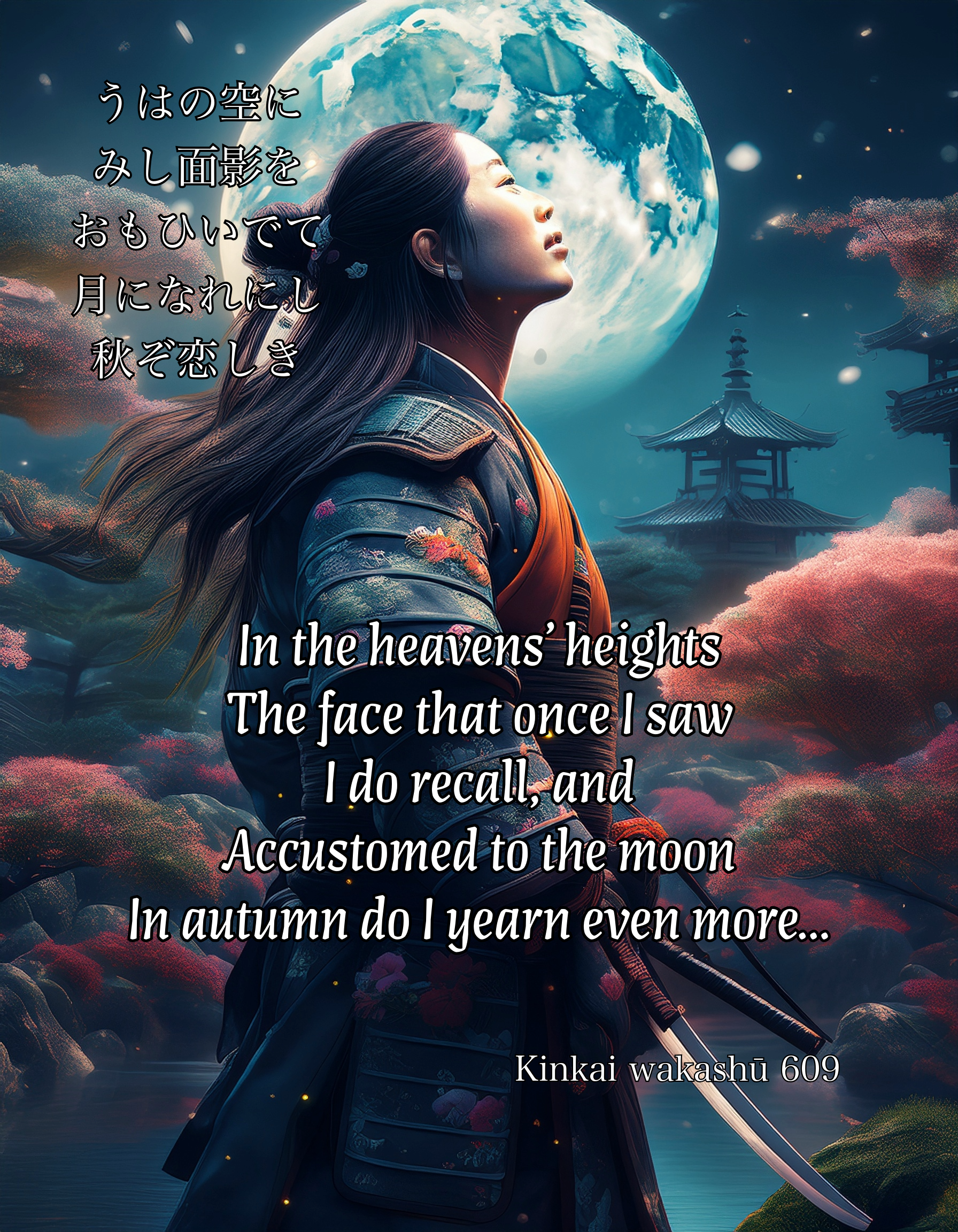
[i] See: On the conception of ‘love, having once met, but no longer’ for the Poetry Match held at the Poetry Office. ゆめかとよみし面影もちぎりしもわすれずながらうつつならねば yume ka to yo / mishi omokage mo / chigiri shi mo / wasurezu nagara / utsutsu naraneba ‘Was it a dream? Or not? / That face I saw, and / His promises, too, / I cannot forget, / Though real they were not…’ The Daughter of Toshinari, Assistant Master of the Dowager Empress Household Office (Shinkokinshū XV: 1391)
I sent this to the residence of someone, who had gone to a distant province, when they had said they’d return around the Eighth Month and there had been no sign of them by the Ninth.
| komu to shimo tanomenu uwa no sora ni dani akikaze fukeba kari wa kinikeri | That they would come, even I Do not expect of the heights of The heavens, but When the autumn wind has blown, The geese have arrived.[i] |
605
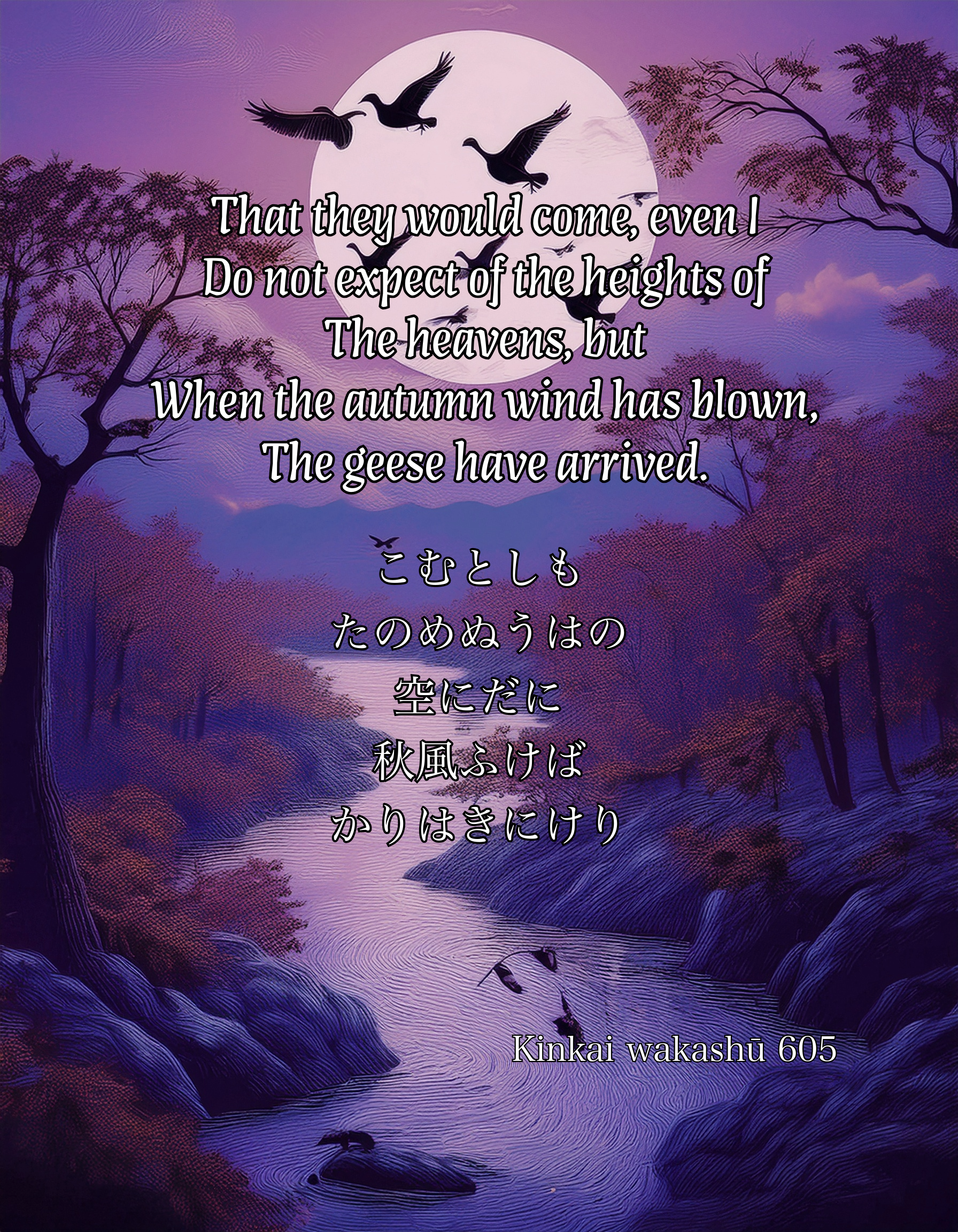
[i] See: Love carried on the wind. きくやいかにうはのそらなる風だにもまつにおとするならひありとは kiku ya ika ni / uwa no sora naru / kaze dani mo / matsu ni otosuru / narai ari to wa ‘Do you hear it? Well? / From the heavens’ heights / Even the wind, / To come whispering among the pines / Has grown accustomed.’ Kunaikyō (Shinkokinshū XIII: 1199); and: A poem from the poetry competition at Prince Koresada’s house. 秋風にはつかりがねぞきこゆなるたがたまづさをかけてきつらむ akikaze ni / hatsukari ga ne zo / kikoyunaru / ta ga tamazusa o / kaketekitsuran ‘On the autumn wind / Come the first goose cries. / I hear them; / Whose letters / Do they bring, I wonder?’ Ki no Tomonori (Kokinshū IV: 207)
Round Three
Left[i]
君が代は神にぞいのる住之江の松の千年をゆづれとおもへば
| kimi ga yo wa kami ni zo inoru suminoe no matsu no chitose o yuzure to omoeba | My Lord’s reign: To the gods I pray, that Suminoe’s Pines their thousand years Pass on—that is my hope… |
Retired from the World
61a
きみがへむやちよのかずはあめにますとよをかひめの神やしるらん
| kimi ga hemu yachiyo no kazu wa ame ni masu toyo’okahime no kami ya shiruran | That my Lord will endure The number of eight thousand ages— Residing in the heavens, The Goddess of the Eternal Hills, The deity, knows well, no doubt! |
Retired from the World
61b
Right (Win)
君がよはつきじとぞおもふ春の日の御笠の山にささむかぎりは
| kimi ga yo wa tsukiji to zo omou haru no hi no mikasa no yama ni sasamu kagiri wa | My Lord’s reign Will never fade, I feel! While in spring the sun Upon Mikasa Mountain Shines down… |
Senior Assistant Minister Past Lecturer
62
Both Left and Right have neither strengths nor weakness in their diction and sense, but I feel that ‘While in spring the sun / Upon Mikasa Mountain / Shines down’ is a bit more dependable at present than ‘Suminoe’s / Pines their thousand years’.
It is certainly not the case that there are no dubious elements about the Left’s poem. As ‘eight thousand ages’ is a definite number, what is it that the Goddess of the Eternal Hills is expected to know? If this is something in the deity’s hands, then it should be, ‘does not even know the number’. I’m sure the Goddess herself would ask what she’s expected to know. The Right seems stronger.


[i] There are different poems by Eien this round in different versions of the text of the contest. As can be inferred from the judgements, Mototoshi saw the first poem and Toshiyori the second. This strongly suggests that Mototoshi’s judgements were circulated before the text of the contest was submitted to Toshiyori, and Eien revised his poem this round as a result (Kubota et al. 2018, 308).
Round Two
Left (Win)
君がよはあまのいはとをいづるひのいくめぐりてふかずもしられず
| kimi ga yo wa ama no iwato o izuru hi no iku meguri chō kazu mo shirarezu | My Lord’s reign: Since from the stone door in the heavens Emerged the sun, ‘How many circuits has she made?’, they ask— A number quite unknown. |
Lord Saburō
59
Right
みかさやまふもとのさとはあめのしたふるにおもひもあらじとぞ思ふ
| mikasayama fumoto no sato wa ame no shita furu ni omoi mo araji to zo omou | At Mikasa Moutain’s Foot, in a hamlet ‘neath the heavens Passing time—painful thoughts There I’d have not a one, I feel! |
Ushigimi
60
The Left’s poem goes beyond the general flow of diction, containing mystery and depth. I have to say it is truly superior. While the Right’s poem has no faults to mention, it has yet to emerge from prosaic expression. Thus, the Left wins.
The ‘stone door in the heavens’ is that which the supreme sun-deity Amaterasu stood before and then entered. But when we’re talking about dawn breaking at the end of night, we say ‘gates of heaven’. Which of these two was did the poet have in mind, I wonder? If he was thinking of dawn breaking, then the usage is erroneous, but even if he did mean ‘stone door of the heavens’, then do we use this about the circuits of the sun? This is vague. In addition, the final ‘they ask’ is difficult to pronounce. As for the Right’s poem, ‘‘neath the heavens’ lacks emotion. The dual use of ‘thoughts’ and ‘feels’, as I have already remarked, is not an error, but does grate on the ears a bit.


Love
Left
あまぐもに鳴きわたるなる雁がねはおくれし秋や恋しかるらむ
| amagumo ni nakiwataru naru kari ga ne wa okureshi aki ya koishikaruramu | Through the heavens’ clouds Crying, crossing go The geese, their calls, Delayed, might autumn’s surfeit Make me yearn for you more? |
21
Right
わが心あやしかりけり秋果ててゆくとみるみるなほぞ恋しき
| wa ga kokoro ayashikarikeri aki hatete yuku to mirumiru nao zo koishiki | My heart Feels strange, indeed! Autumn’s done, and I ever watch it leave, yet Still I yearn so strongly… |
22


Round Two
Left
をちかたやくも井の山のほととぎすあまつよそにもなきわたるかな
| ochikata ya kumoi no yama no hototogisu ama tsu yoso ni mo nakiwataru kana | From the distant Mount within the clouds A cuckoo In yonder heavens Sings his song! |
Lord Saburō
17
Right
ほととぎすしのだのもりのしのびねをたづねざりせばいかできかまし
| hototogisu shinoda no mori no shinobine o tazunezariseba ikade kikamashi | A cuckoo In Shinoda’s sacred grove Lets out a hushed cry; Had I not come to visit here, How might I have heard it? |
Ushigimi
18
In regards the poem of the Left’s ‘from the distant’ and what follows, extremely recently and colloquially, at the Nakatomi purification ceremony it seems there was a composition, ‘in the distance, below the trees so lush’. This diction is contrary to the expected style of waka and something which occurs only extremely rarely. Truly, one does not compose using such diction in a poetry match. The poem of the Right has nothing of interest about it, yet it also lack faults to mention, so it wins.
This round, neither poem appears bad. The Left has a novel style, while the Right seems cliched, but its expression is smooth. I wonder if we could see these as a tie.


