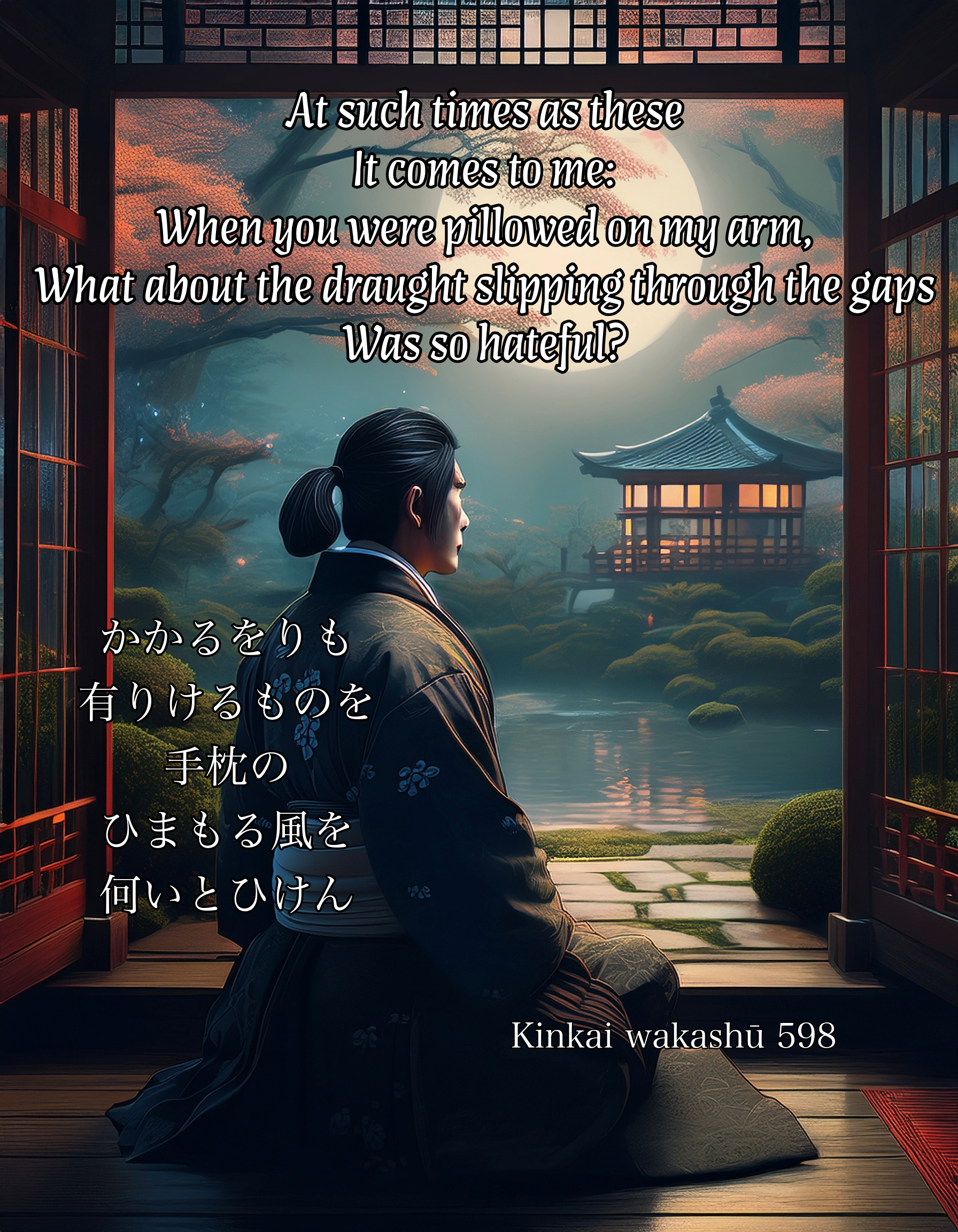
kakaru ori mo arikeru mono o tamakura no hima moru kaze o nani itoiken
At such times as these It comes to me: When you were pillowed on my arm, What about the draught slipping through the gaps Was so hateful?[i]
598
[i] See: Topic unknown. た枕のすきまの風もさむかりき身はならはしの物にぞ有りける tamakura no / sukima no kaze mo / samukariki / mi wa narawashi no / mono ni zo arikeru ‘When you were pillowed on my arm / The draught into the gaps between / Was cold, but / I did grow accustomed to it— / That’s how it was…’ Anonymous (Shūishū XIV: 901)
nami yosuru ama no tomaya no hima o arami moru nite zo shiru yowa no shigure wa
Waves break near A sedge-thatched hut’s Crude gaps The leaks reveal A midnight shower…
Lord Tadafusa 19
Right (M – Win)
ゆふ月よいるさの山の高根よりはるかにめぐる初しぐれかな
yūzukuyo irusa no yama no takane yori haruka ni meguru hatsushigure kana
On a moonlit night From Irusa Mountain’s High peak In the distance circles A first shower!
Lord Kanemasa 20
Toshiyori states: in the first poem, the shower sounds chilly! A shower is not something that one hears after getting up at dawn, yet this poem says that one first gets to know about it from the leaks, it seems that the poet has gone to bed, been leaked on, had his garments soaked and then got up and made a fuss. If he has not been leaked upon is this something he heard from someone else the following day? It really is very unclear. There’s a poem ‘Together with me / On my mountain pilgrimage’ which refers to showers falling on this mountain. The poem here refers to the same peak, so it sounds as if it’s referring to monks going around. Is that what it’s about? I am not just finding fault for the sake of it—these poems are unclear. As there’s only so much that can be understood from hearing them, they should tie.
Mototoshi states: one can compose about a shower falling anywhere and there’s no need to bring up a fisherman’s sedge-thatch hut, is there! Furthermore, one gets to know about a shower from the sound of it falling constantly on something like a roof of cedar boards, surely? Would one really be startled by rain of varying intensity falling soundlessly in spring? As for the poem of the Right, while it does not display a playfulness which would please the eye, ‘In the distance circles / A first shower’ is a bit better in the current context.
kishi chikami tabine no toko o utsu nami no kaeru hima ni zo shigure to wa shiru
Close by the coast My journey’s bed is Struck by waves; In the space as they withdraw, I know that showers are falling.
Dharma Master Yūsei 63
Right
しばのとをたたくあらしのおとにまたしぐれうちそふたびのよはかな
shiba no to o tataku arashi no oto ni mata shigure uchisou tabi no yowa kana
Upon my brushwood door The storm wind came a’knocking; The sound then Laced with showers, At midnight on my travels!
Norimori 64
In the Left’s poem, it sounds as if the shower is continuing to fall quietly, yet it then appears to have the conception that one knows the showers are falling in the gaps between the waves breaking. In the Right’s poem, ‘The storm wind came a’knocking; / The sound then’ sounds charming, but I do wonder about how it looks to have lines beginning beginning with both ‘brushwood door’ [shiba no to] and ‘showers’ [shigure]. Thus, again, these tie.
sumiyoshi no amakudarimasu matsu no ue ni sora yori kakuru tsuki no shirayū
At Sumiyoshi Did the Deity descend from Heaven To the pines—upon them From the skies are hung The moon’s sacred streamers.
Kamo no Agatanushi Masahira Kataoka Junior Assistant Priest[1] 25
Right (Win)
しめのうちにしらゆふかけぬひまぞなき月もたむけのこころありけり
shime no uchi ni shirayū kakenu hima zo naki tsuki mo tamuke no kokoro arikeri
Within the holy precints Sacred streamers fail to hang In not a single spot— The moon to make an offering Is of a mind.
Lord Fujiwara no Chikashige Junior Fifth Rank, Upper Grade, Without Office[2] 26
While the poem of the Left’s ‘From the skies are hung’ and so forth seems charming, I do wonder about the idea of the ‘Deity descending from Heaven / To the pines’—it’s vague. The poem of the Right’s conception and configuration of ‘The moon to make an offering’ appears pleasant, and thus it wins.
suminoboru tsuki no hikari ni migakurete kumori mo miezu tamatsu shimahime
Climbing clearly The moon’s light Polishes, so that No clouds appear above The divine Princess of Tamatsu Isle!
Lord Fujiwara no Suetsune Assistant Master of the Empress Household Office Exalted Senior Fourth Rank, Lower Grade[1] 23
Right
すみよしのまつのこずゑにいる月はしづえのひまぞなほまたれける
sumiyoshi no matsu no kozue ni iru tsuki wa shizue no hima zo nao matarekeru
At Sumiyoshi Into the treetops of the pines Has sunk the moon— The gaps ‘tween the lower boughs Will ever be awaited!
Lord Fujiwara no Takanobu Supernumerary Director of the Bureau of Horses, Right Division Exalted Junior Fifth Rank, Upper Grade[2] 24
The conception of the Left’s poem of the moon’s light polishing Tamatsu Isle appears charming, but it would have been preferable to stop with ‘No clouds appear above / Tamatsu Isle’. Even though the poem wishes to say that ‘no clouds appear above’ her, the final use of ‘princess’ is a bit critical [for a poem mentioning a deity], isn’t it? As for the Right’s poem, while it does seem to have been composed with some attempt at conception, saying ‘Into the treetops of the pines / Has sunk the moon’ makes it sound as if the light can sink there, but this is what happens at the mountains’ edge, I feel. Thus, here we do have a reference to the moon over this particular shrine, while the Left is based on a reference to the Deity of Tamatsu Isle, and as both of these places are splendid, I hesitate to award a win or a loss and thus, once more, the round ties.
[1]Shōyon’ige-gyō chūgū no suke Fujiwara ason Suetsune正四位下行中宮亮藤原朝臣季経
[2]Jūgoijō-gyō uma no gonkami Fujiwara ason Takanobu 従五位上行右馬権頭藤原朝臣隆信
sumiyoshi no matsu no yukiai no tsukikage wa kumoma ni izuru kokochi koso sure
At Sumiyoshi, Pine boughs entwine, and The moonlight Emerges from between the clouds— That’s how it feels!
Lord Fujiwara no Sanekuni Supernumerary Middle Counsellor Captain of the Palace Guards, Left Division Exalted Senior Third Rank[2] 6
Both Left and Right, having the same conception contemplating ‘pine boughs entwine’, appear charming. ‘Emerges from between the clouds’ truly does sound as if it captures the moment, but the Left’s use of ‘even’ in ‘even from the gaps between’ show a deep knowledge of the world of poetry,[3] and thus, again, the Left wins.
[2]Shōsan’i-gyō gonchūnagon ken saemon no kami Fujiwara ason Sanekuni 正三位行権中納言兼左衛門督藤原朝臣実国
[3] Shunzei is praising Shun’e for his knowledge of earlier poems. Shun’e’s work builds on: 夜やさむき衣やうすきかたそぎのゆきあひのまより霜やおくらむ yo ya samuki / koromo ya usuki / katasogi no / yukiai no ma yori / shimo ya okuramu ‘Is it the night’s chill, or / My scanty robe: / Where the ridge poles of My shrine / Entwine, from the gaps between / Frost does seem to fall.’ This poem is said to be by the deity of Sumiyoshi (SKKS XIX: 1855). By adding in ‘even’ (mo) to the phrase he has taken from the deity’s work, Shun’e adds to it, saying that frost falls not only from the gaps in the shrine roof, but also from between the pine boughs outside. Shunzei’s judgement acknowledges the deep knowledge of prior poetry needed for this type of usage.