Round Thirty-Three
Stags in the Night[1]
Left
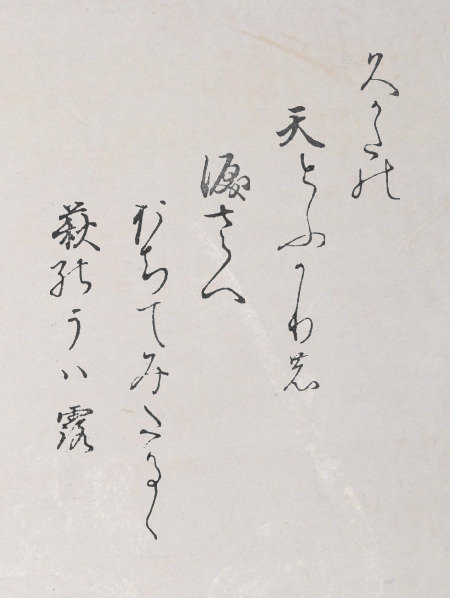
久方のかつらの陰に鳴く鹿は光をかけて声ぞさやけき
| hisakata no katsura no kage ni naku shika wa hikari o kakete koe zo sayakeki | In the eternal Silver trees’ glow The belling stag Is limned with light, and His voice sounds clear, indeed! |
A Court Lady
65
Right (Win)
天川秋の一夜のちぎりだにかた野に鹿の音をや鳴くらん
| ama no kawa aki no hitoyo no chigiri dani katano ni shika no ne o ya nakuran | By the River of Heaven For a single autumn night’s Brief bond— Is that why a stag at Katano Does cry out so? |
Ietaka
66
The Right’s poem, by beginning with ‘By the River of Heaven / For a single autumn night’s / Brief bond’ and then continuing with ‘a stag at Katano’ sounds particularly refined, evoking memories of bygone days when Prince Koretaka sought lodging from the Weaver Maid when hunting at Katano—how charming it is.[2] The Left’s poem overall is not particularly bad and seems to lack any obvious faults, but the Right’s poem surpasses it in every way: it is not one of the normal run of compositions and thus, it must win.


[1] 夜鹿 – there are early examples of poems on related topics in Kin’yōshū and Senzaishū.
[2] Gotoba is referring to a pair of poems in Kokinshū which are contextualized by an account of a hunting expedition by Prince Koretaka 惟喬 (844-897): Once, when he had gone hunting in the company of Prince Koretaka, they dismounted by the banks of a river called Ama no Gawa (River of Heaven), and while they were tippling, the Prince commanded that Narihira offer him a wine cup with a poem expressing the feelings of a hunter arriving at the river of Heaven, so he composed the following: かりくらしたなばたつめにやどからむあまのかはらに我はきにけり kari kurashi / tanabatatsume ni / yado karamu / ama no kawara ni / ware wa kinkeri ‘While hunting night is falling, / So from the Weaver Maid / Let us beg lodging / For to the Riverbank of Heaven / Have we come!’ Ariwara no Narihira (KKS IX: 418); The prince recited the above poem many times, but was unable to think of a reply so, being one of the party, Aritsune composed this: ひととせにひとたびきます君まてばやどかす人もあらじとぞ思ふ hito tose ni / hito tabi kimasu / kimi mateba / yado kasu hito mo / araji to zo omou ‘In a single year / But once comes / The Lord she awaits, so / One who provides lodging / She is not, I’d say!’ Ki no Aritsune (KKS IX: 419). These poems were famously incorporated into chapter 82 of Ise monogatari with four others to provide an expanded context. See Horiuchi and Akiyama (1997, 157-160) for the original text and Mostow and Tyler (2010, 175-179) for an English translation and commentary.