Tag Archives: katami

Nishinomiya uta’awase 17

Asters and the Same

Round Seventeen

Left

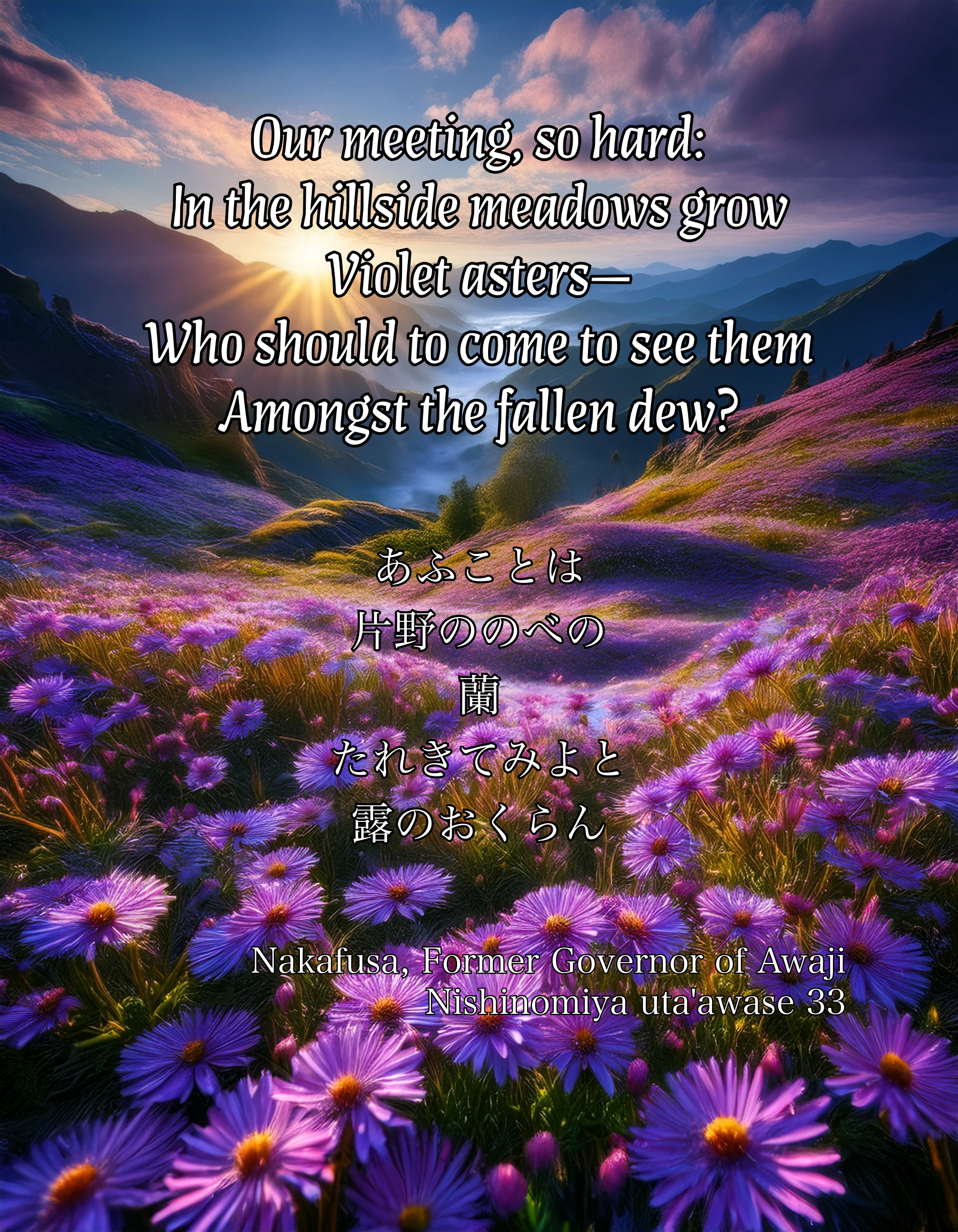
あふことは片野ののべの蘭たれきてみよと露のおくらん

au koto wa
katano no nobe no
fujibakama
tare kitemiyo to
tsuyu no okuran
Our meeting, so hard:
In the hillside meadows grow
Violet asters—
Who should to come to see them
Amongst the fallen dew?

Nakafusa, Former Governor of Awaji
33

Right

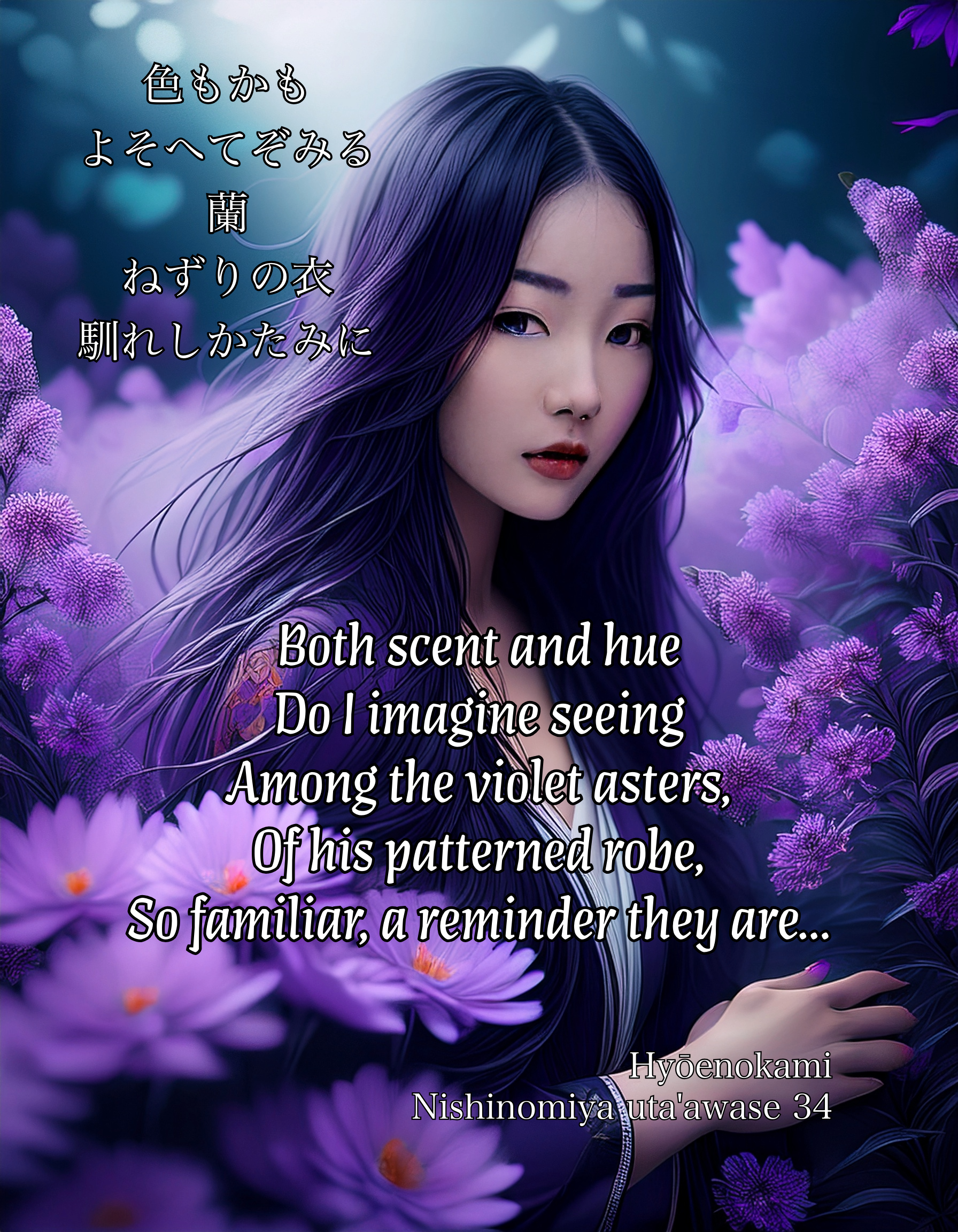
色もかもよそへてぞみる蘭ねずりの衣馴れしかたみに

iro mo ka mo
yosoete zo miru
fujibakama
nezuri no koromo
nareshi katami ni
Both scent and hue
Do I imagine seeing
Among the violet asters,
Of his patterned robe,
So familiar, a reminder they are…

Hyōenokami
34

These poems, both Left and Right, appear to be of about the same quality, but while I am familiar with robes patterned with purple gromwell, I do wonder what it is that is patterning the robes here. Is the poet composing on asters imagining them to be gromwell? Even if that’s the case, the conception is not particularly apparent, so I have to say that the Left is better.

Naidaijin-ke uta’awase 15

Round Three

Left

万代の秋のかたみになす物はきみがよはひをのぶるしらぎく

yorozuyo no
aki no katami ni
nasu mono wa
kimi ga yowai o
noburu shiragiku
Of ten thousand ages’
Autumns a keepsake
I will make:
My Lord’s age
Extended by a white chrysanthemum!

Lord Akinaka
29

Right

今朝みればさながら霜をいただきて翁さびゆくしら菊の花

kesa mireba
sanagara shimo o
itadakite
okina sabiyuku
shiragiku no hana
When this morn I look
That’s how it is: with frost
Bestowed
A lonesome ancient seems
This white chrysanthemum bloom!

Lord Mototoshi
30

Toshiyori states: this first poem is strongly characterized by felicitation, and that’s about all the fault I can mention. As for the second poem, ‘a lonesome ancient seems’ is certainly an expression I don’t know. Still, if I think of examples from prior poems, ‘lone ancient’ could be interpreted as deriving from ‘dotaged ancient’, but then the conception seems different here, so this is most likely wrong. I can only give a decision once I am certain.

Mototoshi states: ‘Of ten thousand ages’ / Autumns a keepsake / Will make’ resembles Kanemori’s famous work,[1] which has often been alluded to in composition, I think. This poem is charming. ‘Will make’ is an extremely abbreviated expression, and so the final ‘age / Extended by a white chrysanthemum’ appears to have little connection to it. There is Tomonori’ s ‘Dew-dappled / Let us pluck and wear’[2], and also responses sent on the 9th day of the Ninth Month to the residences of Tadamine and Tsurayuki like ‘Bearing droplets / Age is extended by / Chrysanthemums’, aren’t there. Given that’s the case there would be many such keepsakes of extended age. As for the Right’s ‘That’s how it is: with frost / Bestowed / A lonesome ancient seems, well, it seems that just how I composed a poem about lingering chrysanthemums—have I done something wrong?


[1] SIS III: 214

[2] KKS V: 270

SKKS VIII: 789

Composed on the wind bringing fond thoughts of the past, in the autumn after his father, Hidemune, had passed away.

露をだに今は形見の藤ごろもあだにも袖を吹く嵐かな

tsuyu o dani
ima wa katami no
fujigoromo
ada ni mo sode o
fuku arashi kana
Even the dewfall, which
Now is a keepsake upon
My mourning robes is
Transient, so from my sleeves
‘Tis blown by the storming wind!

Fujiwara no Hideyoshi

A kuzushiji version of the poem's text.
Created with Soan.

SCSS XIII: 830

When the Gokyōgoku Regent ordered her to produce a hundred poem sequence.

雲となり雨となりても身にそはばむなしき空をかたみとやみん

kumo to nari
ame to narite mo
mi ni sowaba
munashiki sora o
katami to ya min
Even should you become a cloud, and
Then become raindrops
Falling on my flesh, then
Would the vacant skies
I see as a keepsake, perhaps?

Kojijū

A kuzushiji version of the poem's text.
Created with Soan.