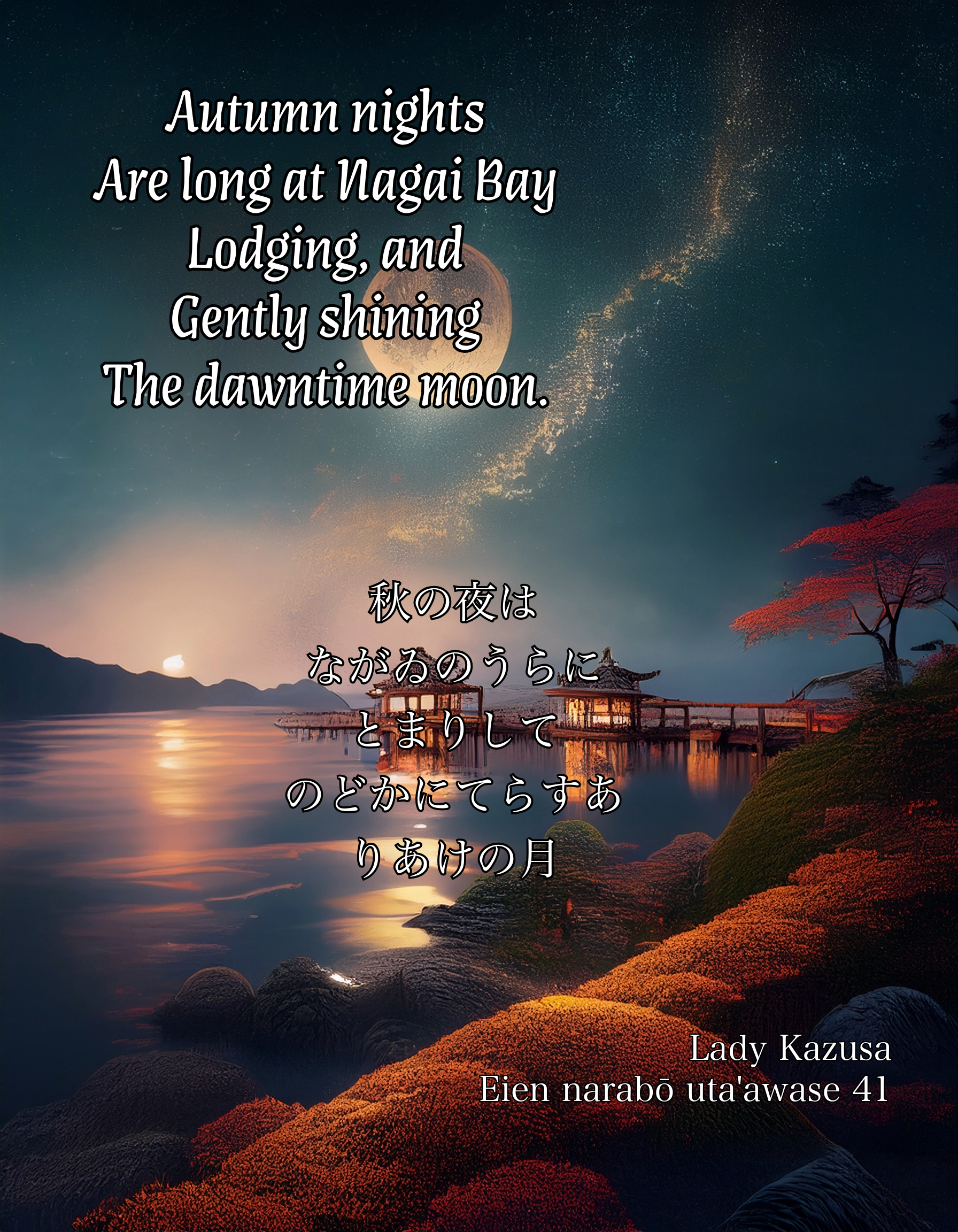
aki no yo wa nagai no ura ni tomarishite nodoka ni terasu ariake no tsuki
Autumn nights Are long at Nagai Bay Lodging, and Gently shining The dawntime moon.
Lady Kazusa 41
Right (Win)
秋の夜のくもふきはらふあらしこそ月みるひとのこころなりけれ
aki no yo no kumo fuki’harau arashi koso tsuki miru hito no kokoro narikere
On an autumn night The clouds a’blowing away, The storm wind, truly, As someone gazing upon the moon Has the selfsame heart!
Lady Shikibu 42
The poem of the Left certainly imagines the scene just as it is. With that being said, however, the dawntime moon is not present long enough. The Right’s poem simply sounds like one composed by Atsutaka for the ‘Poetry Match held at the Residence of the Former Captain of the Outer Palace Guards, Left Division’.[i] Thus, it’s impossible for me to determine a winner or loser.
It’s a poem which we see in the Poetry Match at Lord Moroyori’s Residence.
冬のよの雲ふきはらふ木枯や月見る人の心なるらむ
fuyu no yo no kumo fuki’harau kogarashi ya tsuki miru hito no kokoro naruramu
On a winter’s night The clouds a’blowing away, The bitter wind, indeed, As someone gazing upon the moon The same heart seems to have![ii]
In the poem of the Left, is it the moon or the poet who is lodging at Nagai Bay? If it’s the moon, then ‘lodging’ is erroneous; if it’s the poet, then ‘gently shining’ doesn’t work. In addition to this vagueness, I do also question whether ‘dawntime’ sounds appropriate. As for the Right’s poem, ‘as someone gazing at the moon / Has the selfsame heart!’ is an elegant conception, and the diction is also smooth. It reminds me of an earlier work by someone else. Thus, it wins.
[i] This match has a several different titles, Mototoshi refers to here as both: Zen sa-hyōe no kami no ie no uta’awase 前左兵衛督家歌合 and also Moriyori-kyō no ie uta’awase 師頼卿家歌合, but it is also known as the ‘Poetry Match held by the Late Master of the of the Crown Prince’s Household’ (Ko-tōgū daibu ie uta’awase 故東宮大夫家歌合) and the ‘Poetry held by Moroyori, Captain of the Outer Palace Guards, Right Division’ (U-hyōe no kami moroyori uta’awase 右兵衛督師頼歌合): the text of this match is no longer extant, but it is known to have taken place in the winter Tennin 天仁 2 (1109). Fujiwara no Kiyosuke notes that it was judged by Toshiyori, but Mototoshi disagreed with his assessments and submitted at set of judgements of his own in appeal (Fujioka 1995, 212).
[ii] This poem is included in Shoku shikashū (VI: 293), attributed to Moroyori, with the headnote, ‘Composed on the moon in winter’.