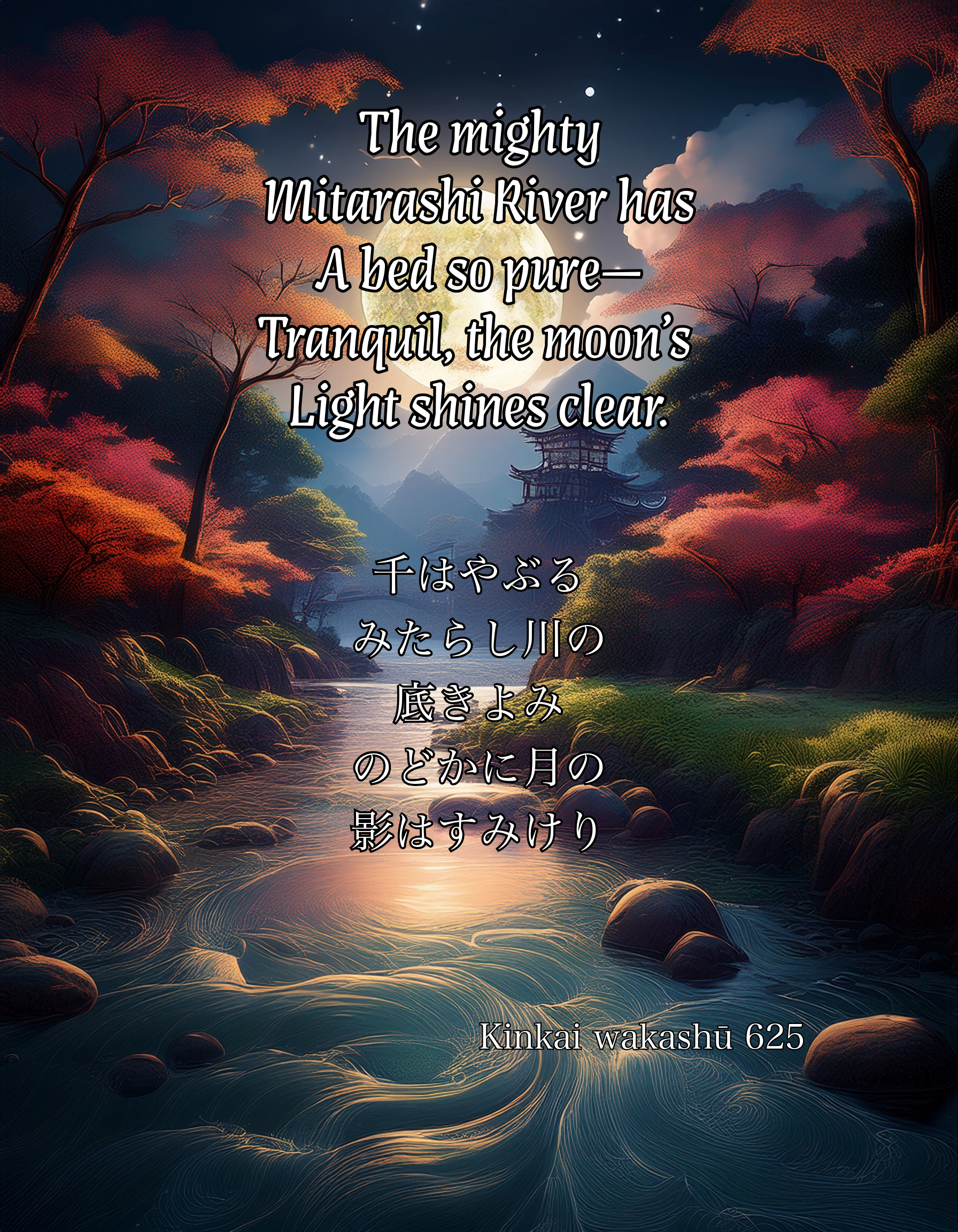
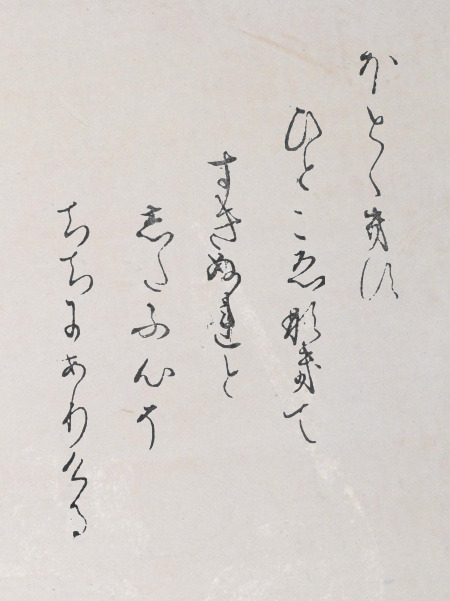
chihayaburu mitarashigawa no soko kiyomi nodoka ni tsuki no kage wa sumikeri
The mighty Mitarashi River has A bed so pure— Tranquil, the moon’s Light shines clear.[ii]
625
[i] Even though it is not specified in the headnote, the poem makes it clear that Sanetomo is referring to a specific river, the Mitarashi here.
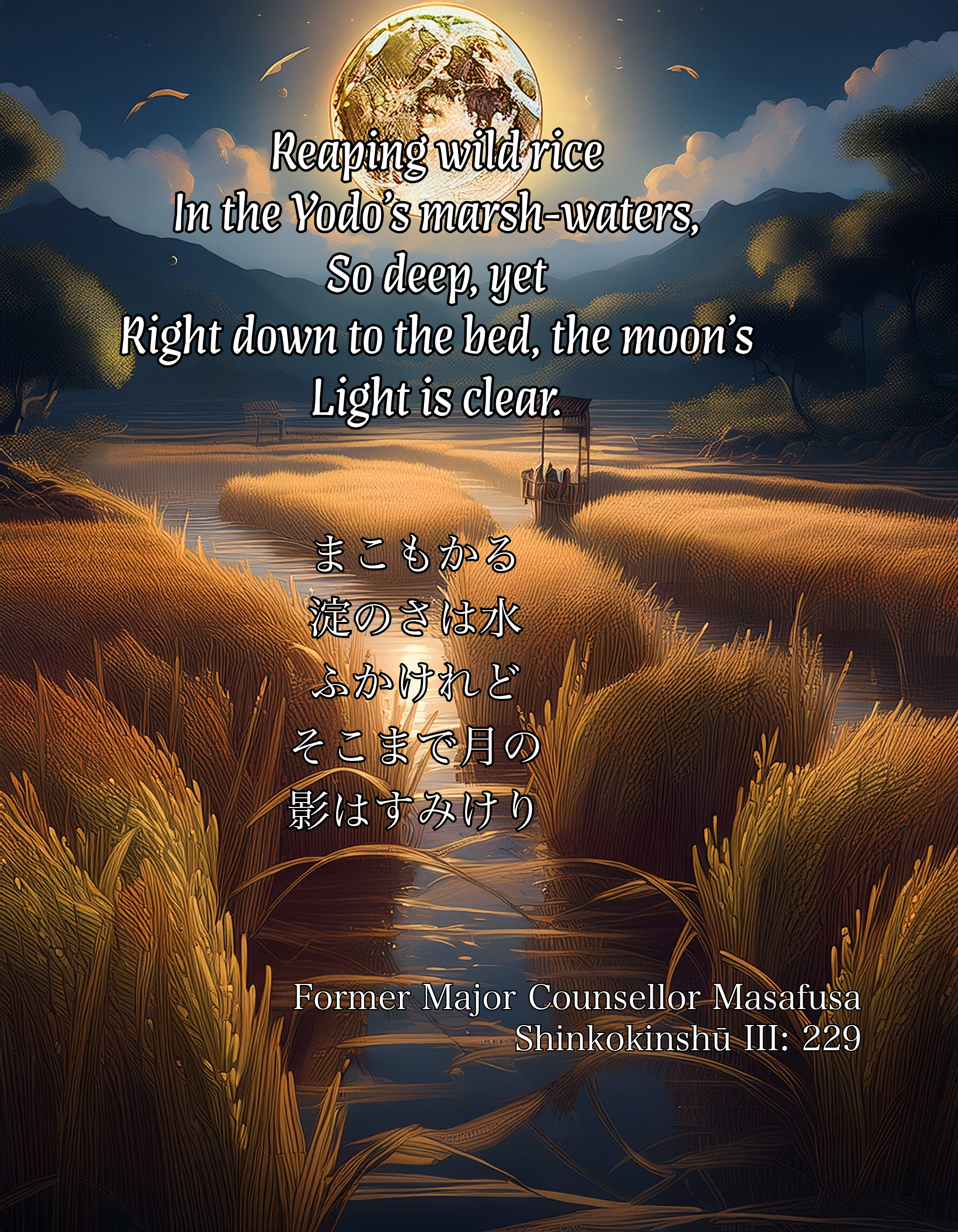
[ii] This poem shows influence from Shinkokinshū XIX: 1889, and also: Topic unknown. まこもかる淀のさは水ふかけれどそこまで月の影はすみけり makomo karu / yodo no sawamizu / fukakeredo / soko made tsuki no / kage wa sumikeri ‘Reaping wild rice / In the Yodo’s marsh-waters, / So deep, yet / Right down to the bed, the moon’s / Light is clear.’ Former Major Counsellor Masafusa (Shinkokinshū III: 229)
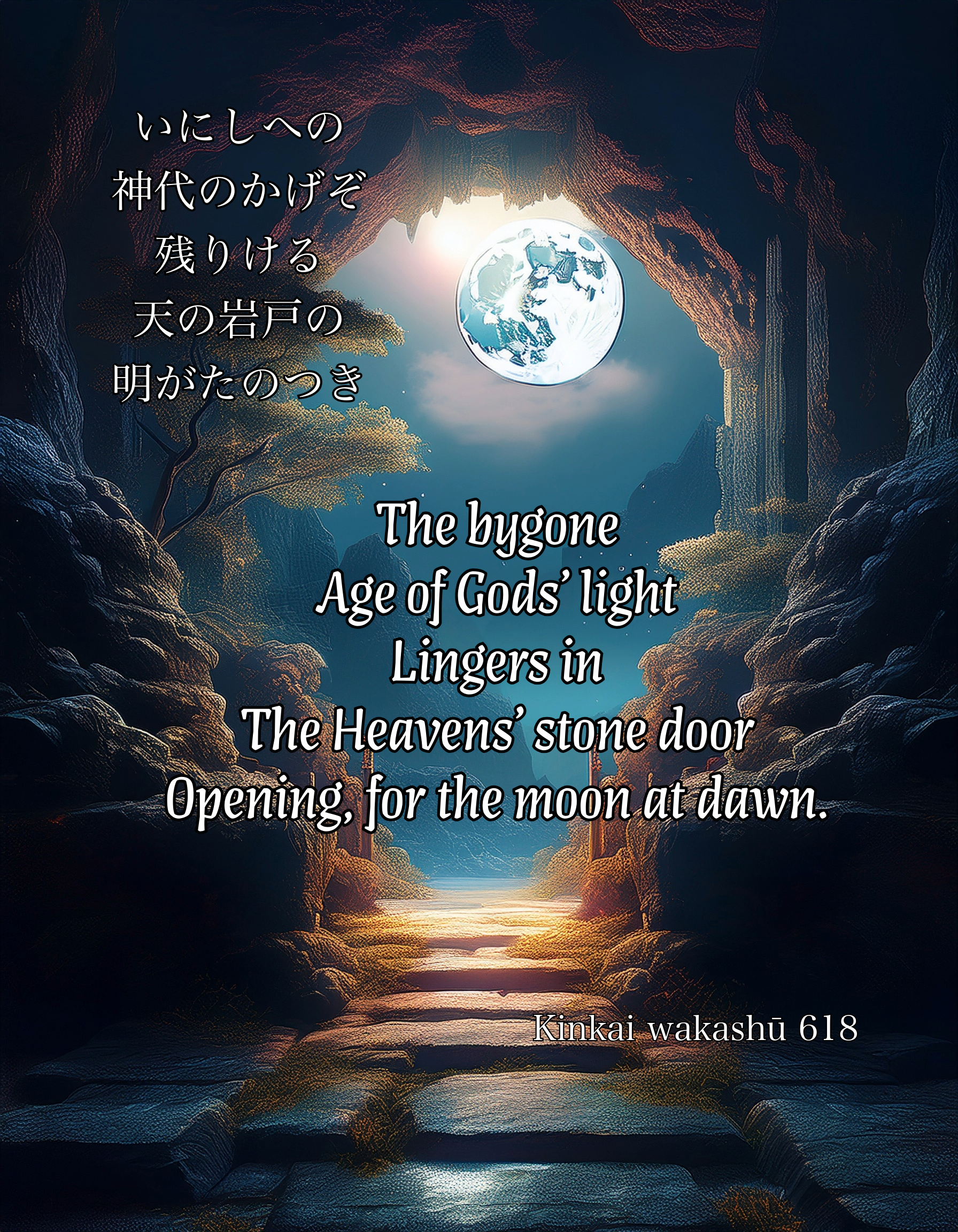
inishie no kamiyo no kage zo nokorikeru ama no iwato no akegata no tsuki
The bygone Age of Gods’ light Lingers in The Heavens’ stone door Opening, for the moon at dawn.[i]
618
[i] See: On the conception of the moon at dawn, for the Kasuga Poetry Match. 天の戸をおしあけがたの雲間より神よの月の影ぞ残れる ama no to o / oshi akegata no / kumoma yori / kamiyo no tsuki no / kage zo nokoreru ‘Upon the gates of Heaven / Pushing brightening / Through the cloud-gaps / From the Age of Gods, the moon’s / Light lingers.’ The Regent and Chancellor (Shinkokinshū XVI: 1547)
A poem composed during the year when the Ise Shrine was renewed.[i]
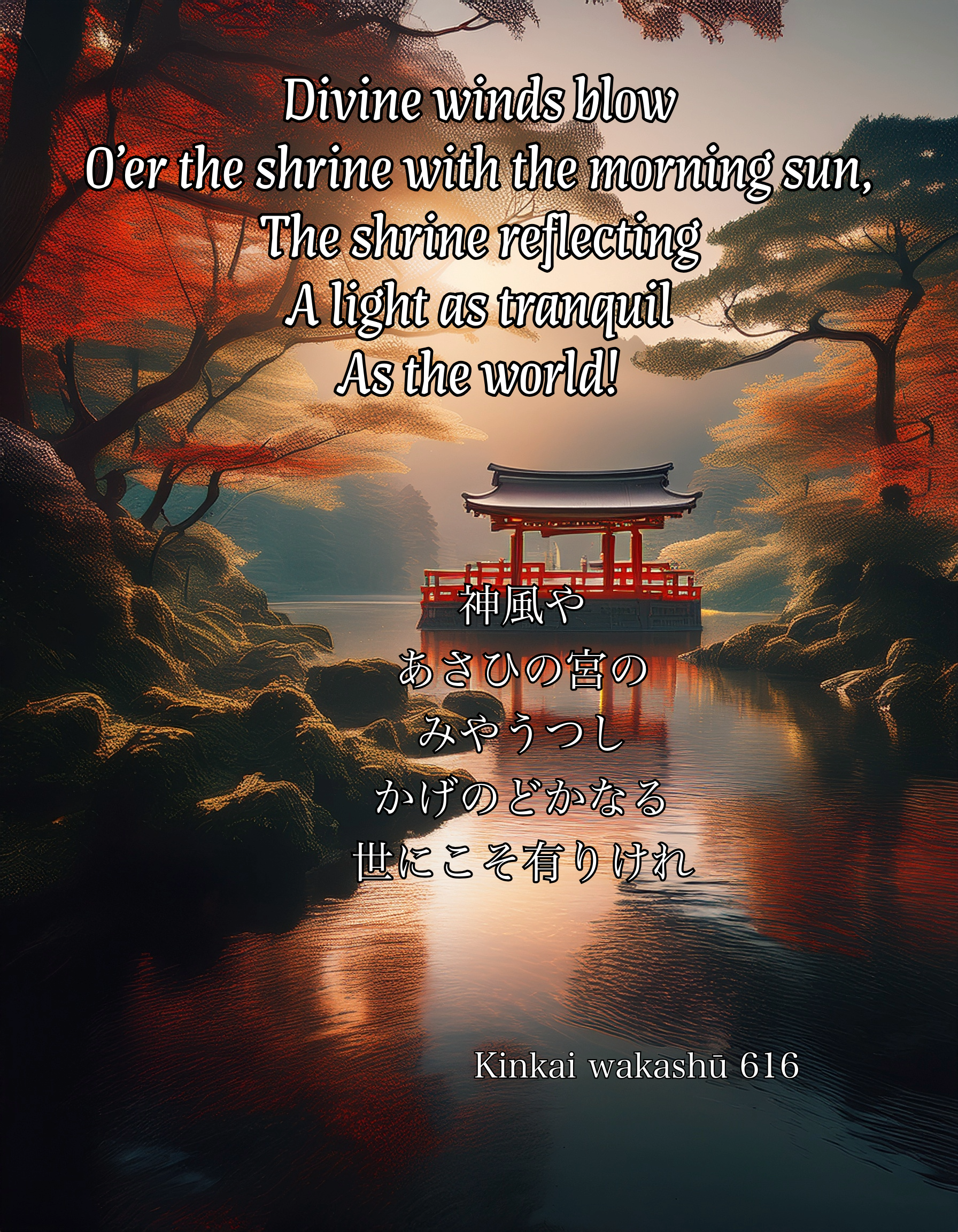
神風やあさひの宮のみやうつしかげのどかなる世にこそ有りけれ
kamikaze ya asahi no miya no miya utsushi kage nodokanaru yo ni koso arikere
Divine winds blow O’er the shrine with the morning sun, The shrine reflecting A light as tranquil As the world![ii]
616
[i] The Grand Shrine at Ise was demolished and rebuilt approximately every twenty years. The occasion Sanetomo is referring to here took place in the Ninth Month, Jōgen 3 [1209] (Higuchi 2016, 188).
[ii] See: In reply. 神風やいすずかは浪かずしらずすむべきみよに又かへりこん kamikaze ya / isuzukawanami / kazu shirazu / sumubeki miyo ni / mata kaerikon ‘Divine winds blow / Waves upon the Isuzu River / In numbers unknown, / So bright this age that / Ever will I return.’ Supernumerary Master of the Crown Prince’s Household Kintsugu (Shinkokinshū XIX: 1874)
Former Emperor Yōzei, on the 15th day of the Ninth Month, when it fell upon the day of Elder Brother-Metal Monkey, held a poetry match of the Left and Right with his eldest son’s daughters, the First Princess and the Second Princess, as the leaders of the two teams, composing poems in response to prior poems on the conception of the end of autumn.
Original
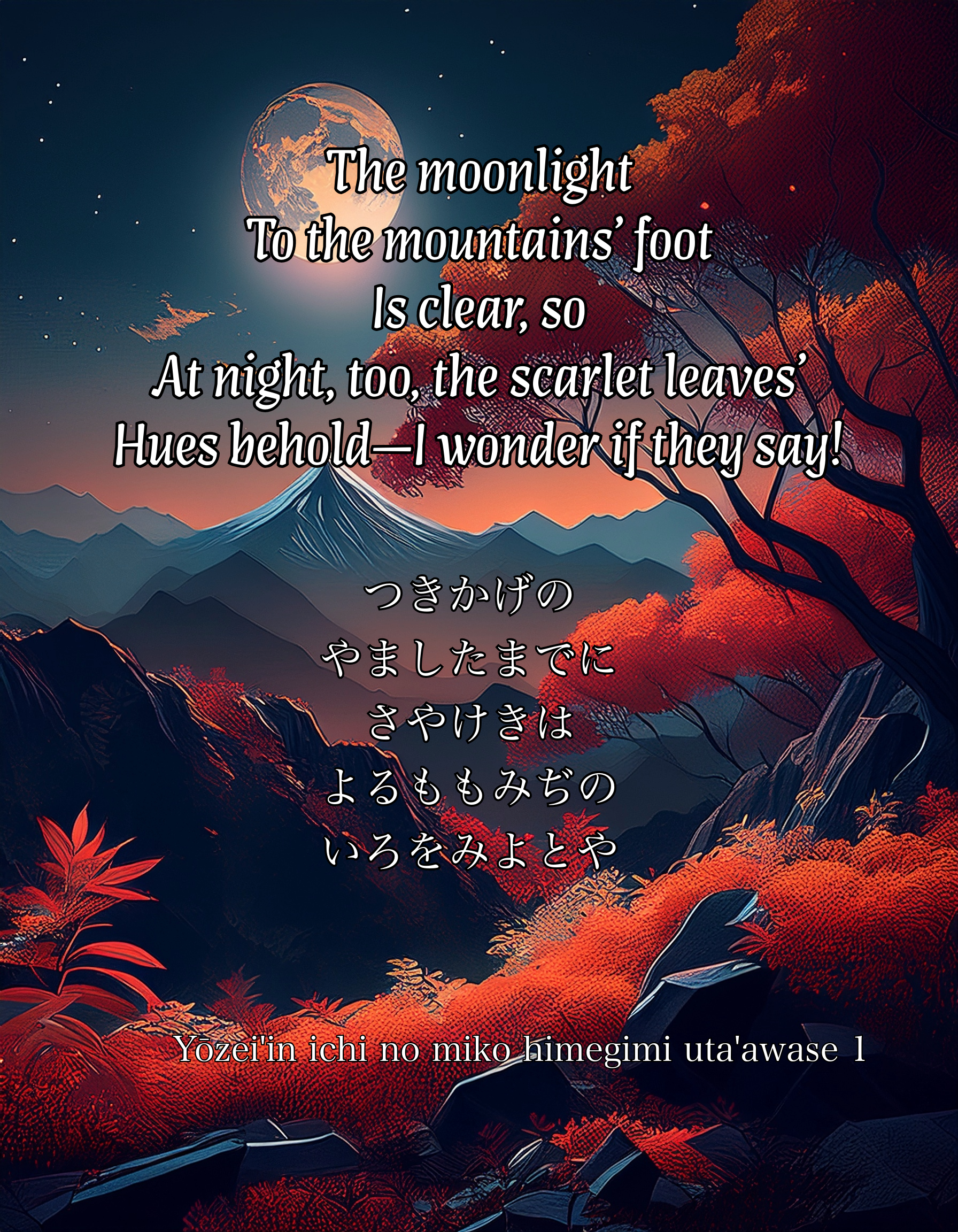
つきかげのやましたまでにさやけきはよるももみぢのいろをみよとや
tsukikage no yamashita made ni sayakeki wa yoru mo momiji no iro o miyo to ya
The moonlight To the mountains’ foot Is clear, so At night, too, the scarlet leaves’ Hues behold—I wonder if they say!
1
Left
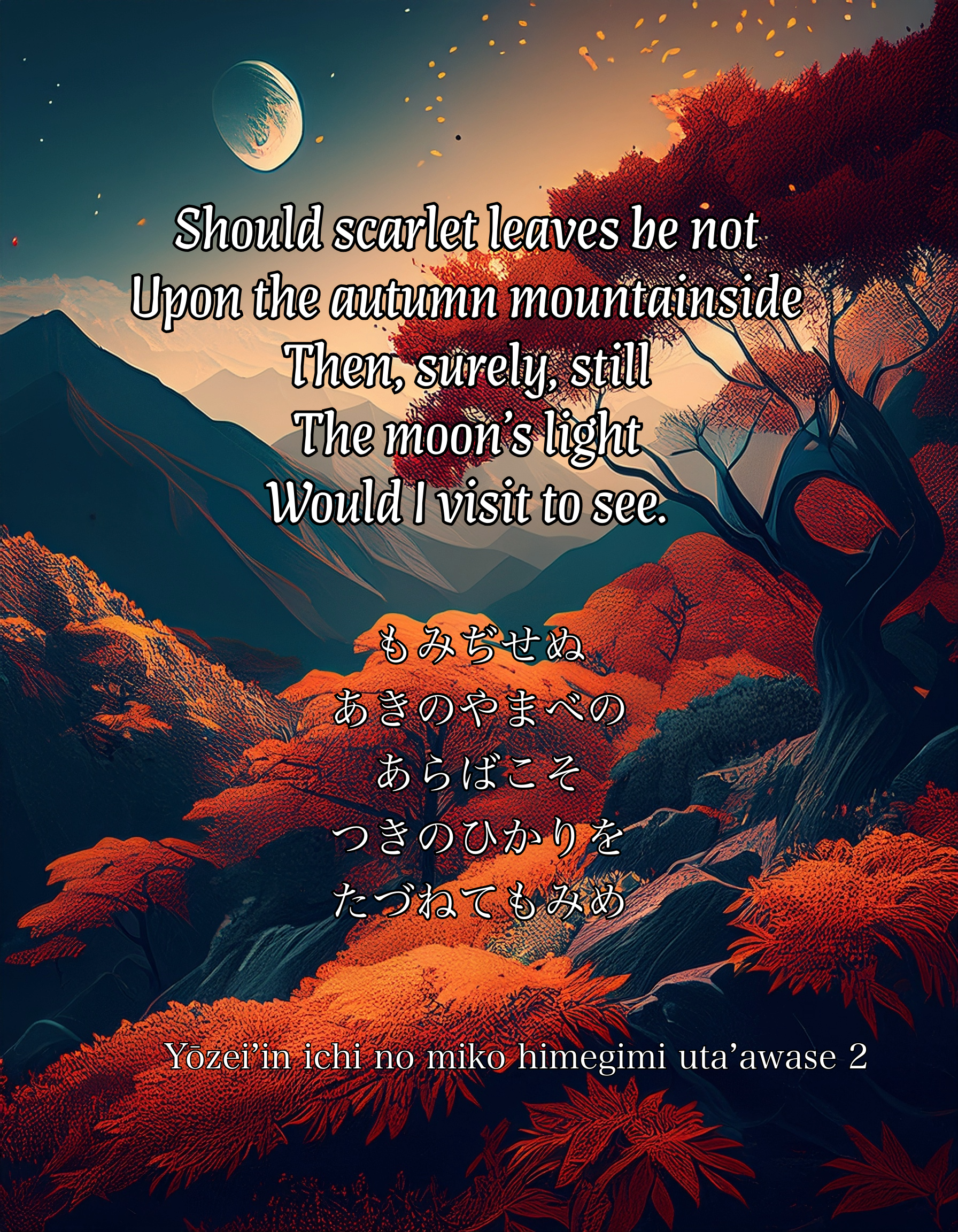
もみぢせぬあきのやまべのあらばこそつきのひかりをたづねてもみめ
momiji senu aki no yamabe no araba koso tsuki no hikari o tazunete mo miyu
Should scarlet leaves be not Upon the autumn mountainside Then, surely, still The moon’s light Would I visit to see.
makuzu hau yamaji mo harete aki no yo wa koyuru tabibito yasuki tsuki kana
Kudzu vines crawl Along the mountain paths, so clear On an autumn night for A traveller a’crossing Lit by a clement moon!
Cell of the Fragrant Elephant 35
Right
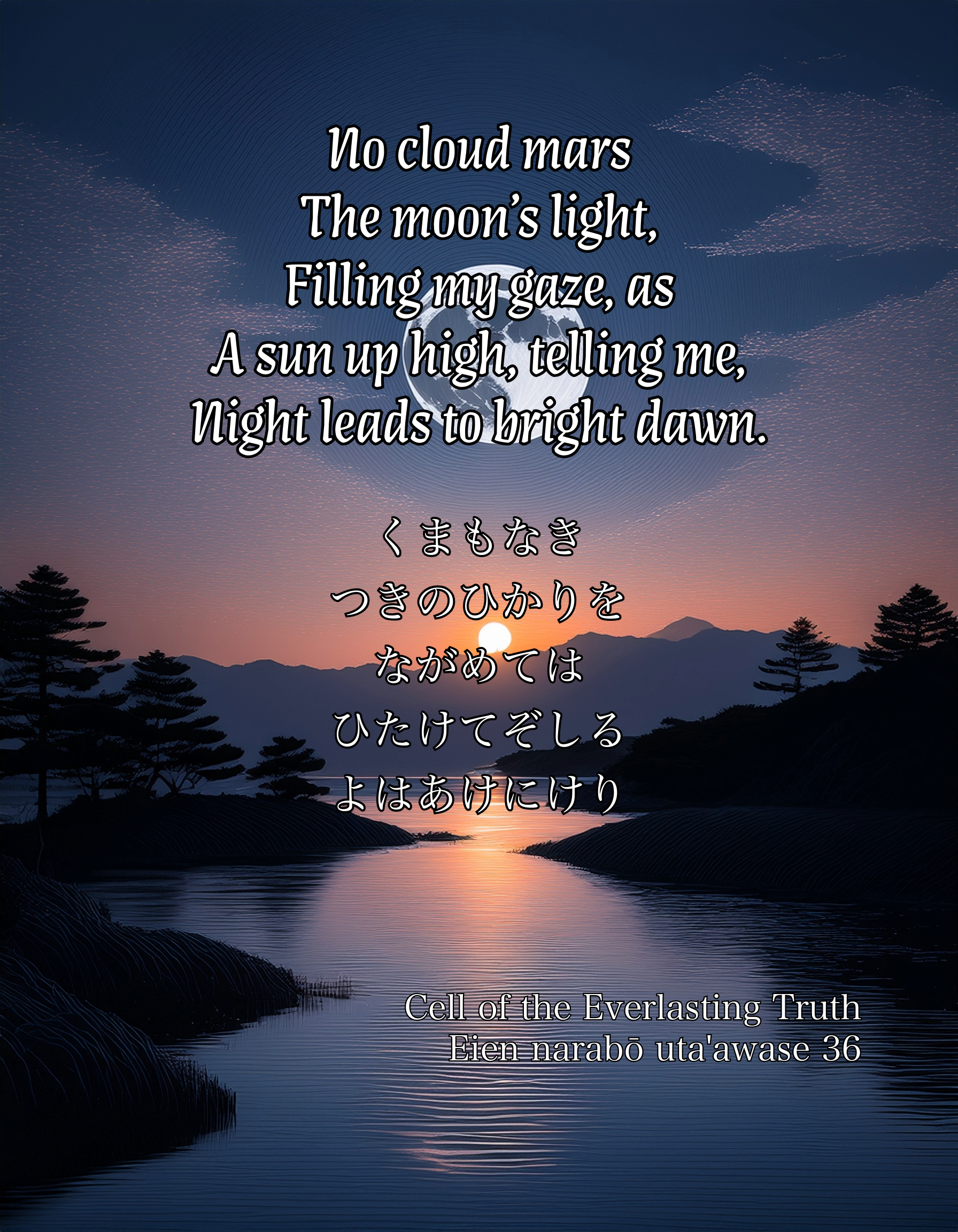
くまもなきつきのひかりをながめてはひたけてぞしるよはあけにけり
kuma mo naki tsuki no hikari o nagamete wa hi takete zo shiru yo wa akenikeri
No cloud mars The moon’s light, Filling my gaze, as A sun up high, telling me, Night leads to bright dawn.
Cell of the Everlasting Truth 36
The poem of the Left has nothing to present in all of its syllables. The poem of the Right resembles a composition by someone drunk out of his mind. As a result, it’s impossible to decide between them.
In the poem of the Left, does ‘clement moonlight’ mean that the moon’s light enables one to traverse a mountain path, which normally one would be unable to make one’s way along because one would expect it to be dark? The diction here is insufficient. As it says in the preface to the Ancient and Modern Collection of Narihira’s poems, ‘excessive conception but lacking in diction, like withered flowers lacking colours, but with a lingering fragrance’. This is a poem in that style, isn’t it. As for the poem of the Right, this, too, has ‘night leads to bright dawn’—the diction here is stilted and the conception lacks elegance. I have to say these poems are of about the same standard.
aki no yo no tsuki no hikari wa kawaranedo tabi no sora koso aware narikeri
On an autumn night The moon’s light Is unchanged, yet The sky above me on my travels Is so very sad, indeed.
Lord Saburō 31
Right
あきの夜はたのむる人もなきやどもありあけの月はなほぞまちいづる
aki no yo wa tanomuru hito mo naki yado mo ariake no tsuki wa nao zo machi’izuru
On an autumn night With no man even expected At my house, It is the dawntime moon’s Appearance that, indeed, I have awaited.
Ushigimi
32
The poem of the Left seems extremely well-trodden. It resembles a something sung as a popular song. As for the poem of the Right, ‘not…at my house’ is extraordinarily stilted, yet the poems are of the same quality, so I would say these tie.
The poem of the Left’s final ‘Is so very sad, indeed’ sounds pitiful and truly unskilled. The poem of the Right overemphasises ‘even’, and also appears to say that the dawntime moon is an element conveying a moving desolation. I wonder if this is appropriate for the topic of the ‘the moon’ in a poetry match? There needs to be a prior poem as precedent. It does say that the moon’s emergence after having waited for it is something precious, but the poem refers to the moon in the latter part of the month, after the twentieth day, doesn’t it? This would seem to be moving, for sure, but it’s something which doesn’t shed much light, so I would say that the Left wins.
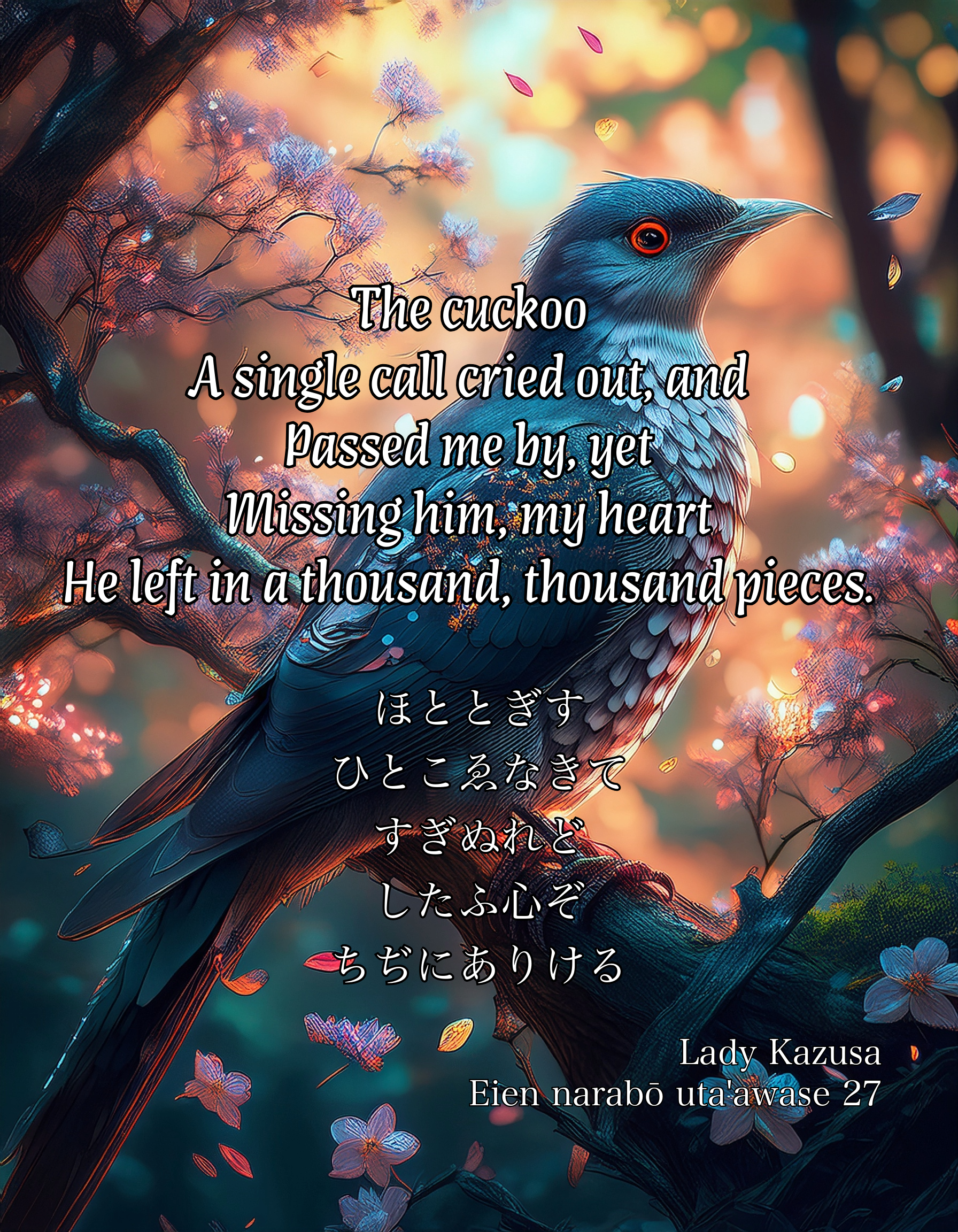
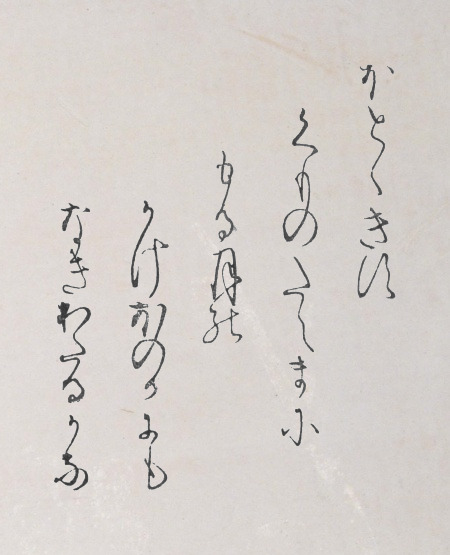
hototogisu hitokoe nakite suginuredo shitau kokoro zo chiji ni arikeru
The cuckoo A single call cried out, and Passed me by, yet Missing him, my heart He left in a thousand, thousand pieces.
Lady Kazusa 27
Right (Win)
ほととぎすくものたえまにもる月のかげほのかにもなきわたるかな
hototogisu kumo no taema ni moru tsuki no kage honoka ni mo nakiwataru kana
The cuckoo, as From a gap between the clouds Drips the moon’s Light, faintly Calls on!
Lady Shikibu 28
Both poems are of the same quality.
The Left’s poem really makes me wonder why that should be the case, with the final ‘he left’ putting me in mind of someone in court dress who has forgotten to put on his shoes! The Right’s poem appears rather more bright than it needs to be. Furthermore, if one says that the ‘light is faint’ then shouldn’t the moon be hidden by the clouds? It’s vague over that, but if there were a prior poem as precedent, then it would be a good composition. For the present, I will make it the winner.