A summer poem, when she presented a hundred poem sequence.
かへりこぬむかしをいまとおもひねの夢の枕ににほふ橘
kaerikonu mukashi o ima to omoine no yume no makura ni niou tachibana
Never to return is The past, but in the present It fills my sleepy thoughts A’dreaming on my pillow With the scent of orange blossom.[1]
Princess Shokushi
[1] An allusive variation on: Sent to a lady with whom he had once been intimate, after some years had passed. いにしへのしづのをだまき繰りかへし昔を今になすよしもがな inishie no / shizu no odamaki / kurikaeshi / mukashi o ima ni / nasu yoshi mogana ‘In times long gone / Thread upon a bobbin was / Wound back— / Just so, the present into the past / I wish we could make!’ It seems, though, that the lady thought nothing of it. (Ise monogatari 65)
shinagadori inano no hara no sasamakura makura no shimo ya yadoru tsukikage
Upon waterbird-filled Inano Plain, with A pillow of bamboo— And the frost upon my pillow is The moonlight’s lodging…[i]
583
[i] See: Topic unknown. しながどりゐなのをゆけばありまやま夕ぎり立ちぬやどはなくして shinagadori / inano o yukeba / arimayama / yūgiri tachinu / yado wa nakushite ‘Through waterbird-filled / Inano I go, as / Upon Arima Mountain / Evening mist has risen, and / Me without a lodging…’ Anonymous (Shinkokinshū X: 910)
sode makura shimo oku toko no koke no ue ni akasu bakari no sayo no nakayama
With my sleeve for my pillow, and Frost falling on my bed Atop the moss, Swiftly breaks the dawn At Sayo-no-Nakayama.[i]
582
[i] See: On a storm at one’s lodgings on a journey, for the Iwashimizu Poetry Match. 岩がねのとこに嵐をかたしきてひとりやねなんさよの中山 iwa ga ne no / toko ni arashi o / katashikite / hitori ya nenan / sayo no Nakayama ‘At the crags’ foot / Lies my bed with the storm wind / Alone, spread upon me— / Lonely, must I sleep? / At Sayo-no-Nakayama…’ Lord Ari’ie (Shinkokinshū X: 962)
iwa ga ne no koke no makura ni tsuyu okite iku yo miyama no tsuki ni nenuran
At the crags’ foot With moss for my pillow, and Awake until the dewfall, How many nights in the mountain deeps Have I slept beneath the moon.[i]
580
[i] See: On the conception of seeing the moon while travelling, while at a place called the Barrier Gate Hall. 草枕ほどぞへにける都いでていくよかたびの月にねぬらむ kusamakura / hodo zo henikeru / miyako idete / ikuyo ka tabi no / tsuki ni nenuramu ‘Grassy pillows / For a while have been my lot! / Since departing the capital / For some days on my travels / Will I sleep beneath the moon.’ Ōe no Yoshitoki (Shinkokinshū X: 931)
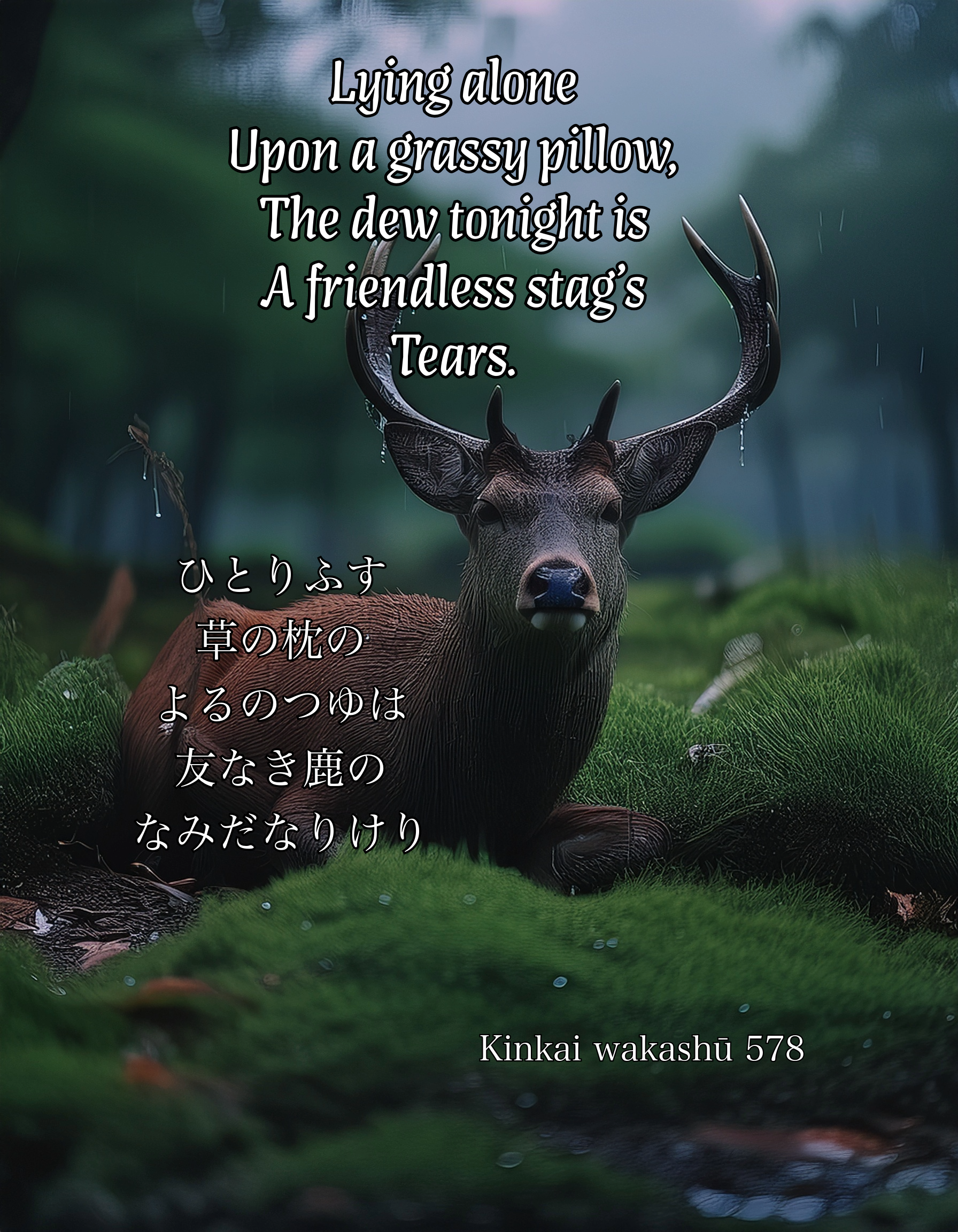
hitori fusu kusa no makura no tsuyu no ue ni shiranu nobara no tsuki o miru kana
Lying alone Upon a grassy pillow Within the dew on This unknown plain I glimpse the moon.[i]
579
[i] See: Composed on the moon above the mountains. あしびきの山ぢのこけの露のうへにねざめ夜ぶかき月を見るかな ashibiki no / yamaji no koke no / tsuyu no ue ni / nezame yobukaki / tsuki o miru kana ‘Resting upon leg-wearying / Mountain trails’ moss / Atop the dew / I awoke late at night / And glimpsed the moon.’ Fujiwara no Hideyoshi (Shinkokinshū IV: 398): and: Composed as a travel poem. けふは又しらぬ野ばらに行きくれぬいづれの山か月はいづらん kyō wa mata / shiranu nobara ni / yukikurenu / izure no yama ka / tsuki wa izuran ‘Today, once more / Across an unknown plain /I go at sundown; / Which will be the mountain / Where the moon does rise?’ Minamoto no Ienaga (Shinkokinshū X: 956)
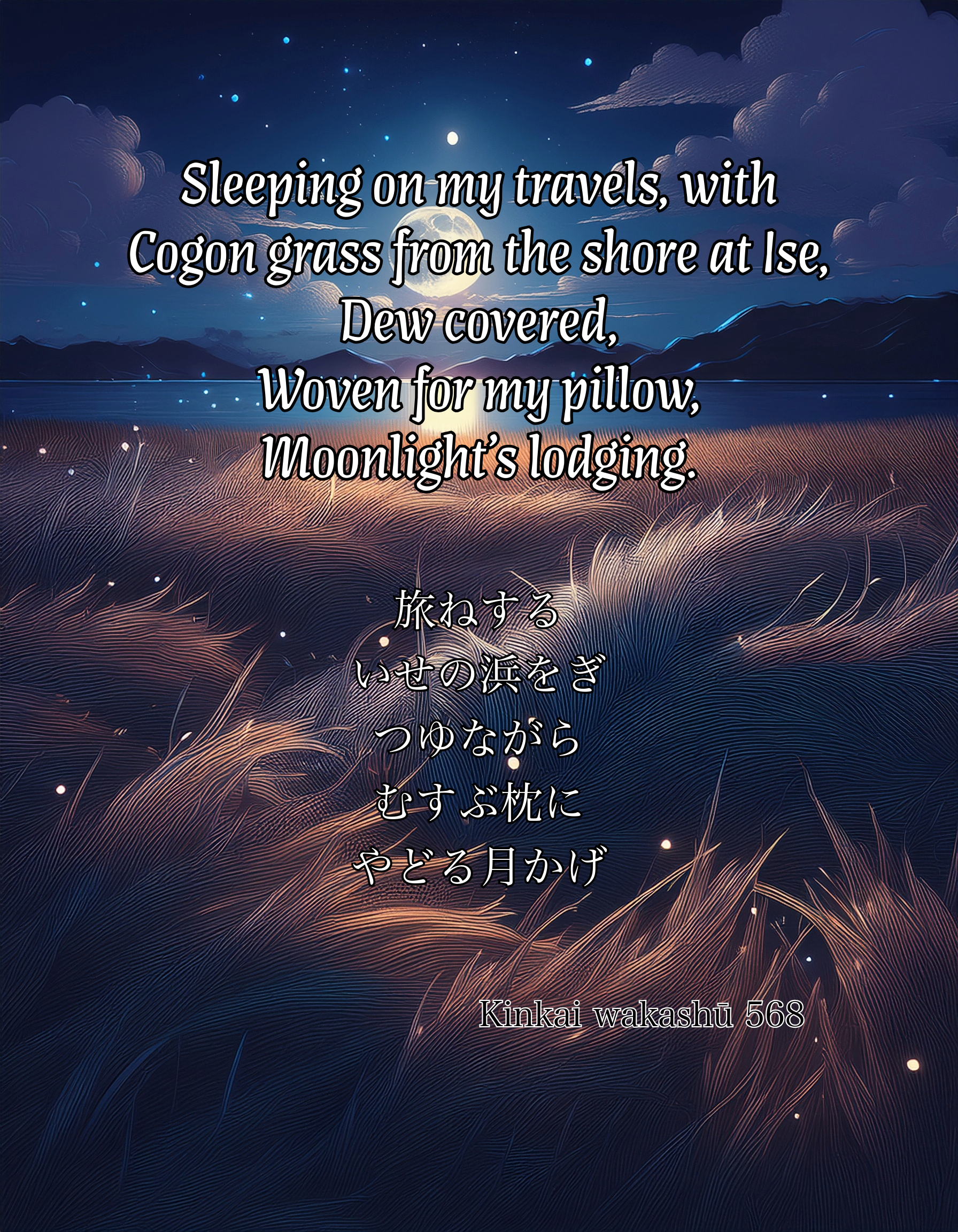
tabinesuru ise no hamaogi tsuyu nagara musubu makura ni yadoru tsukikage
Sleeping on my travels, with Cogon grass from the shore at Ise, Dew covered, Woven for my pillow, Moonlight’s lodging.[i]
568
[i] See: 神風之 伊勢乃浜荻 折伏 客宿也将為 荒浜辺尓 kamukaze no/ ise no hamaogi / orifusete / tabine ya suramu / araki hamabe ni ‘Divine winds blow / Cogon grass on the shore at Ise / I weave and lay me down— / Should I doze upon my travels? / On this wild beachside…’ (Man’yōshū IV: 500).