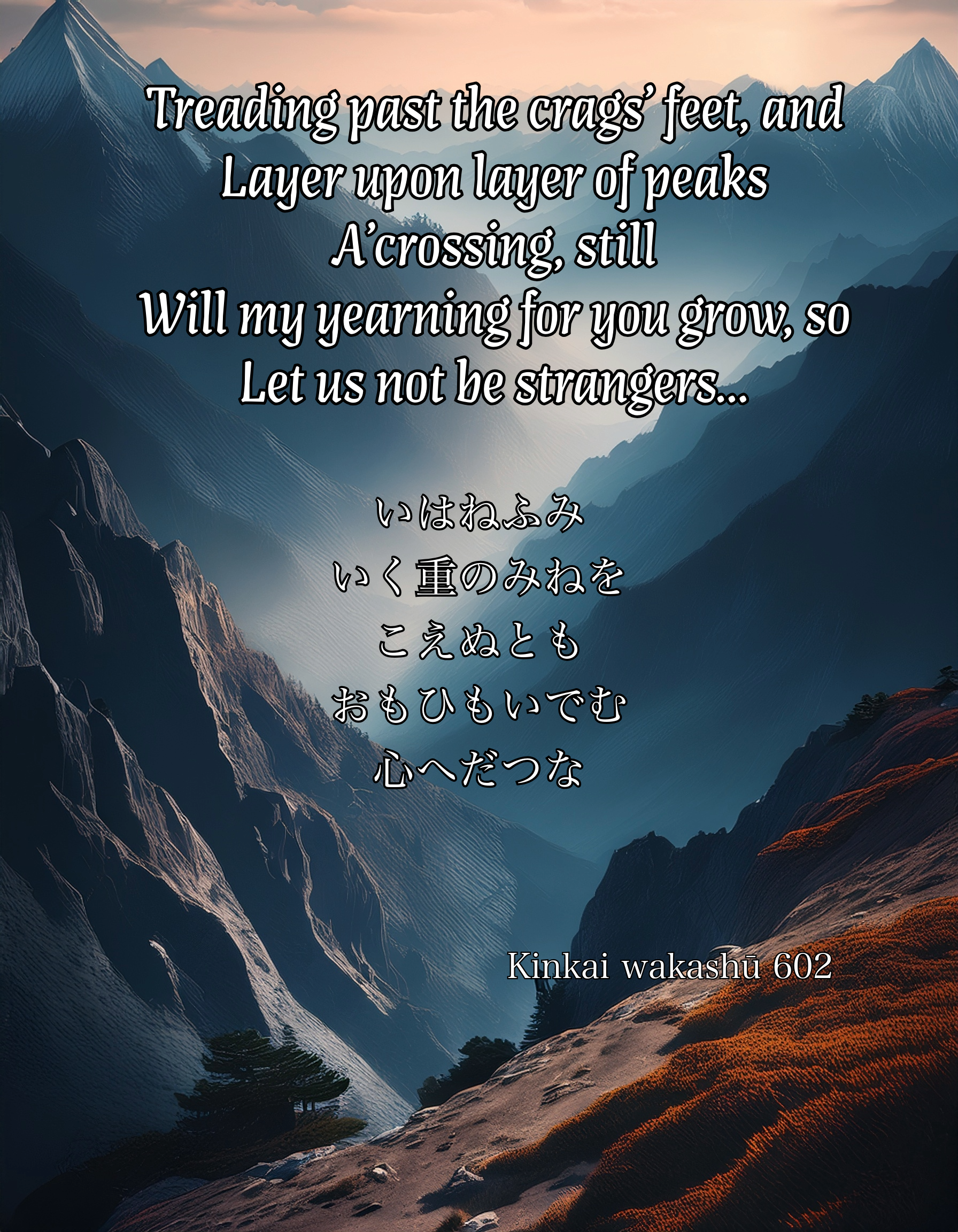
iwane fumi ikue no mine o koenu tomo omoi mo idemu kokoro hedatsu na
Treading past the crags’ feet, and Layer upon layer of peaks A’crossing, still Will my yearning for you grow, so Let us not be strangers…[i]
602
[i] See: Composed in the conception of parting when he took part in a hundred-poem sequence. 別れても心へだつな旅ごろも幾重かさなる山路なりとも wakarete mo / kokoro hedatsu na / tabigoromo / ikue kasanaru / yamaji naritomo ‘We may part, yet / Let us not be strangers; / Travellers’ robes / Place layer on layer, / Though mountain paths lie in-between.’ Fujiwara no Sada’ie (Senzaishū VII: 497)
kasugayama chie ni sakayuru sakakiba wa yorozuyo made no kimi ga tame ka
Upon Kasuga Mountain A thousand branches grow, Leafy, on the sacred tree— Until ten thousand ages pass Will they ward my Lord!
Lady Kazusa 69
Right
君がよはいふかぎりなしみよしののこがねがみねにみよをまつまで
kimi ga yo wa iu kagiri nashi miyoshino no kogane ga mine ni miyo o matsu made
My Lord’s reign— Words cannot describe: ‘til fair Yoshino’s Golden peak’s Age one must await!
Lady Shikibu 70
The poem of the Left seems poetic to an extraordinarily outlandish degree! The poem of the Right’s ‘‘til fair Yoshino’s / Golden peak’s / Age one must await!’ has a sufficient conception of felicitation. Thus, these tie.
That the Left is addressed to Mount Kasuga is highly admirable. Is the Right’s ‘golden peak’ a reference to Mount Mitake? It’s very difficult to say anything profound here. Arbitrarily, I would make this a tie—the quality of the poems makes that seem right.
ureshisa wa ōtsu no hama ni tatsu nami no kazu mo shirarenu kimi ga miyo kana
My joy is Great, as upon Ōtsu Beach Break waves In numbers quite unknown, Such is my Lord’s reign most fair!
Cell of Fragrant Cloud 67
Right
かすがやまみねのしらがしよろづよをきみにといへばかみもいさめず
kasugayama mine no shiragashi yorozuyo o kimi ni to ieba kami mo isamezu
Kasuga Mountain has White-barked evergreen oaks upon its peak: ‘Ten thousand generations For my Lord!’—should I say that, The God will surely not refuse!
Cell of Compassionate Light 68
The poem of the Left’s ‘Great, as upon Ōtsu Beach’ and what follows is something that sounds grievously prosaic. With that said, there are many parts of the poem which are not. What is the poem of the Right’s ‘White-barked evergreen oaks on its peak / Ten thousand generations’ linked with in the remainder of the poem? I wonder what it’s composed about… The Left doesn’t contain any errors, so I still say it wins.
The Left’s poem, as I have said in an earlier round, appears to lack smoothness. Is the poem of the Right’s ‘white-barked evergreen oaks’ a long-standing expression? I can’t seem to recall a prior precedent. ‘The God will surely not refuse’ is vague, too. Is it asking the deity’s favour for the speaker? While I am somewhat hesitant, given my appallingly constricted knowledge, I will, fearfully, say that this is inferior.
ono ga sumu mine no kogarashi samuki yo wa shika mo momiji no koromo kirurashi
Where he dwells upon The peak, the bitter wind On a night so chill, for The stag, of scarlet leaves Does seem to make a robe.
The Supernumerary Major Counsellor 69
Right
すみのぼる月にうらむる声すなりねられぬ鹿や夜寒なるらん
suminoboru tsuki ni uramuru koesunari nerarenu shika ya yozamu naruran
Climbing clearly At the moon, in despair Does he cry— Sleepless, does the stag Feel night’s chill, perhaps?
Nobunari 70
The Left’s poem has ‘the stag, of scarlet leaves does seem to make a robe’ which sounds charming, and the Right’s poem has ‘sleepless, does the stag feel night’s chill, perhaps’, which appears refined. Thus, they tie.
takasago no susono no ma’hagi tsuyu fukashi mine no akikaze fukazu mo aranamu
On Takasago’s Slopes the fair bush clover is Deep in dew— O, that the autumn winds from the peak Would fail to blow…
The Supernumerary Major Counsellor 53
Right
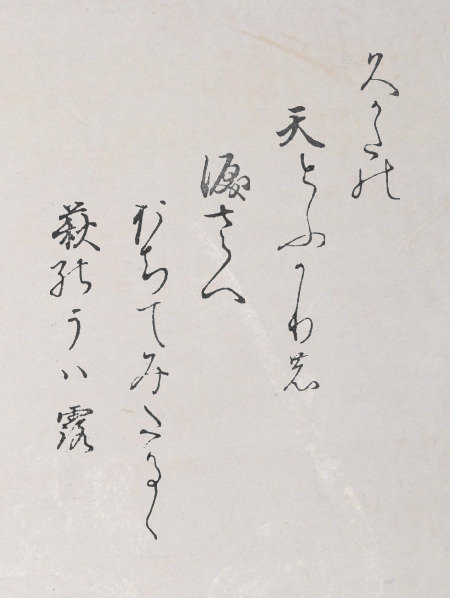
久かたの天とぶかりの涙さへおちてみだるる萩のうは露
hisakata no ama tobu kari no namida sae ochite midaruru hagi no uwazuyu
From the eternal Heavens flying, even the goose Tears Drop in confusion Overlaying the dew upon the bush clover.[1]
Nobunari 54
Both Left and Right seem particularly pleasant. Thus, they tie.
[1] An allusive variation on: Topic unknown. なきわたるかりの涙やおちつらむ物思ふやどの萩のうへのつゆ nakiwataru / kari no namida ya / ochitsuran / mono’omou yado no / hagi no ue no tsuyu ‘Calling across / Did the geese let tears / Fall? / My dwelling, lost in thought, / Has dew upon the bush clover.’ Anonymous (KKS IV: 221)