Tag Archives: moon

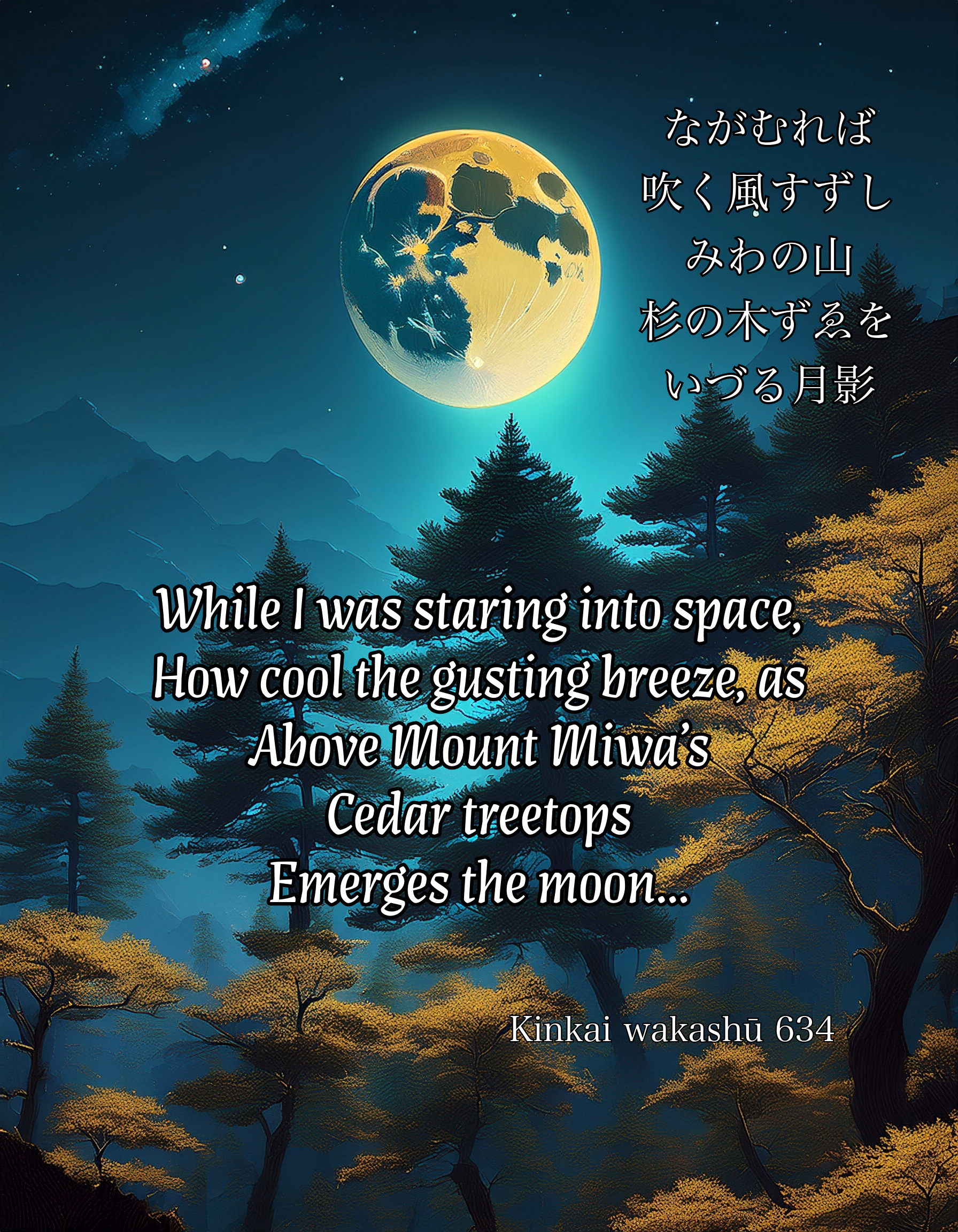
Kinkai wakashū 634

The summer moon above a shrine.[i]

ながむれば吹く風すずしみわの山杉の木ずゑをいづる月影

nagamureba
fuku kaze suzushi
miwa no yama
sugi no kozue o
izuru tsukikage
While I was staring into space,
How cool the gusting breeze, as
Above Mount Miwa’s
Cedar treetops
Emerges the moon…[ii]

634


[i] As with poem 631, the topic here, ‘The summer moon above the shrine’ (shatō kagetsu 社頭夏月) was generally used when the poet had a specific shrine in mind—in this case, Ōmiwa Shrine (Ōmiwa jinja 大神神社).

[ii] See: As part of a hundred-poem sequence. ながむれば衣手すゞしひさかたのあまのかはらの秋のゆふぐれ nagamureba / koromode suzushi / hisakata no / ama no kawara no / aki no yūgure ‘While I was staring into space, / How chill my sleeves became; / Upon eternal / Heaven’s riverbed / Comes an autumn evening.’ Princess Shokushi (Shinkokinshū IV: 321)
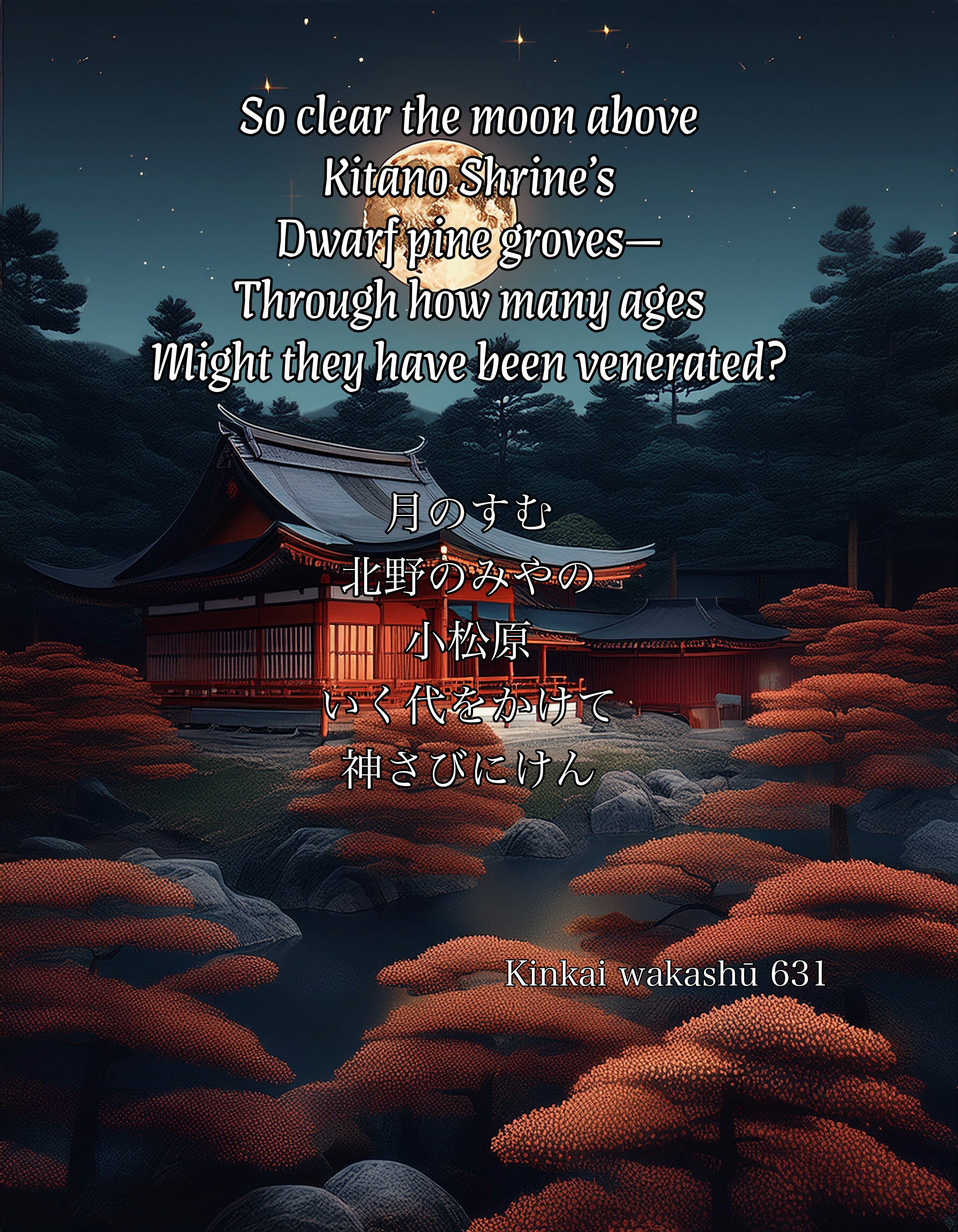
Kinkai wakashū 631

The moon above the shrine.[i]

月のすむ北野のみやの小松原いく代をかけて神さびにけん

tsuki no sumu
kitano no miya no
komatsubara
ikuyo o kakete
kamisabiniken
So clear the moon above
Kitano Shrine’s[ii]
Dwarf pine groves—
Through how many ages
Might they have been venerated?[iii]

631


[i] The topic here, ‘the moon over the shrine’ (shatō no tsuki 社頭月) was a standard one which could be applied to any poem on this theme, but poets usually had a specific shrine in mind when using it—that is, their poems were intended to describe a specific scene rather than a generic one. Sometimes the context would be supplied by the time and place in which the poem was composed: for example, this is one of the topics used in the Sumiyoshi-sha uta’awase kaō ni-nen (‘Sumiyoshi Shrine Poetry Match – Kaō 2’) held in 1170, so all the poems on it can be understood as describing the moon over Sumiyoshi Grand Shrine. Alternatively, the poet could refer to the shrine in the poem itself, as Sanetomo does here.

[ii] This is Kitano Tenmangū 北野天満宮 in the north of Kyoto, dedicated to Sugawara no Michizane 菅原道真 (845-903), as the deity of learning, Tenman Tenjin 天満天神.

[iii] See: 和我伊能知乎 奈我刀能之麻能 小松原 伊久与乎倍弖加 可武佐備和多流 wa ga inochi / nagato no shima no / komatsubara / ikuyo o hete ka / kamusabiwataru ‘My life! / Upon the isle of Nagato / The dwarf pine groves / Have through how many ages passed? / Ever venerable…’ (Man’yōshū XV: 3621)

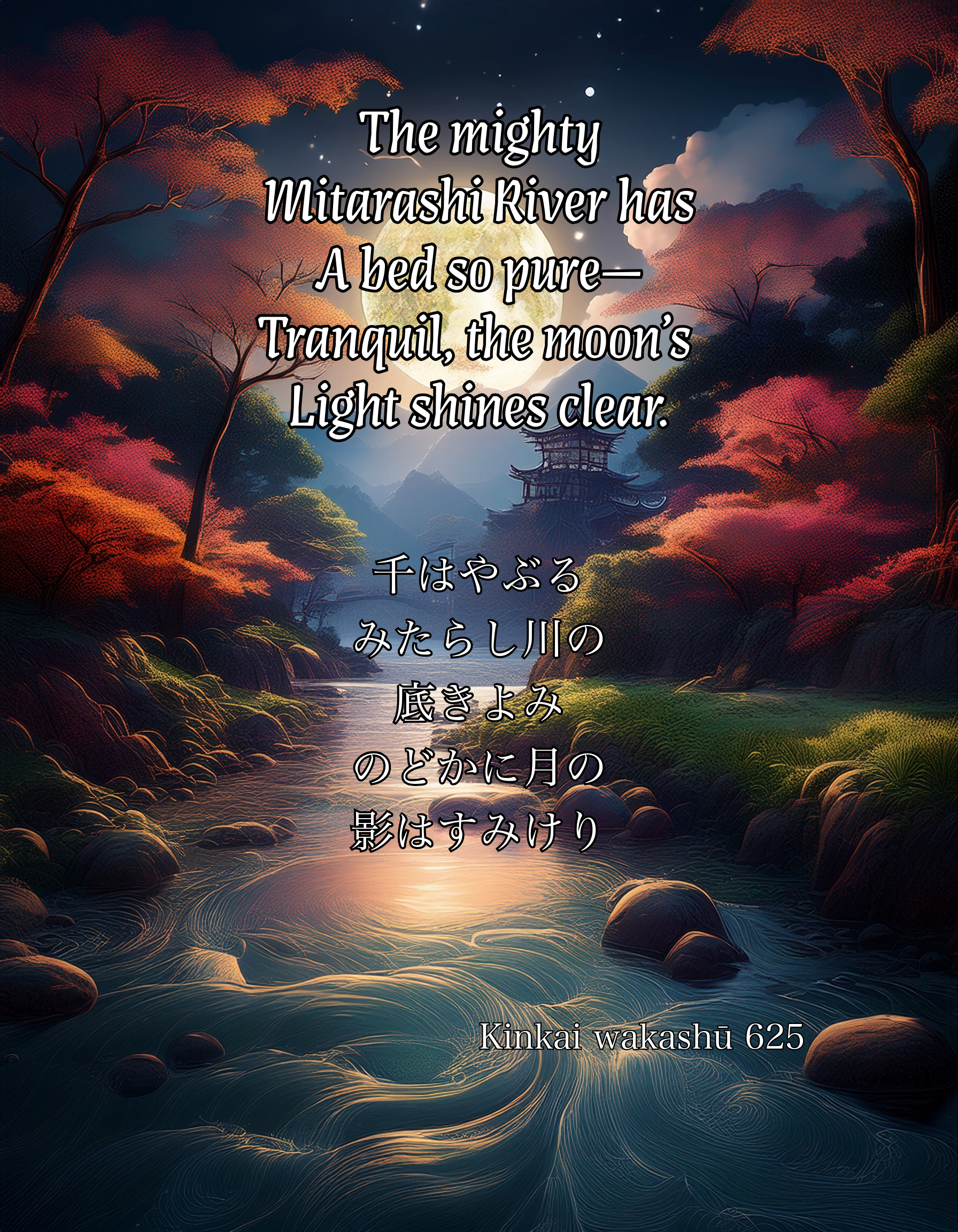
Kinkai wakashū 625

The moon above the riverside.[i]

千はやぶるみたらし川の底きよみのどかに月の影はすみけり

chihayaburu
mitarashigawa no
soko kiyomi
nodoka ni tsuki no
kage wa sumikeri
The mighty
Mitarashi River has
A bed so pure—
Tranquil, the moon’s
Light shines clear.[ii]

625


[i] Even though it is not specified in the headnote, the poem makes it clear that Sanetomo is referring to a specific river, the Mitarashi here.

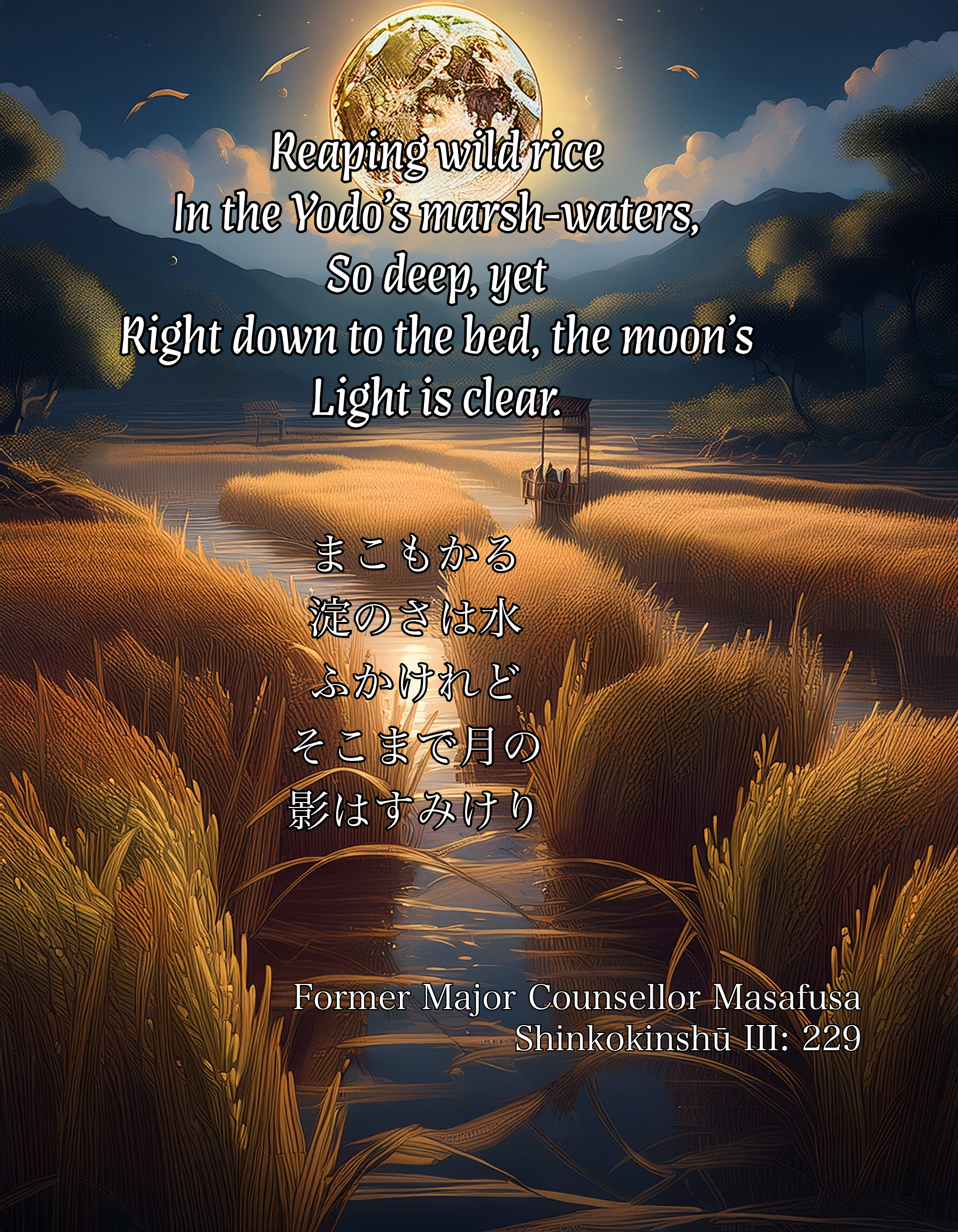
[ii] This poem shows influence from Shinkokinshū XIX: 1889, and also: Topic unknown. まこもかる淀のさは水ふかけれどそこまで月の影はすみけり makomo karu / yodo no sawamizu / fukakeredo / soko made tsuki no / kage wa sumikeri ‘Reaping wild rice / In the Yodo’s marsh-waters, / So deep, yet / Right down to the bed, the moon’s / Light is clear.’ Former Major Counsellor Masafusa (Shinkokinshū III: 229)

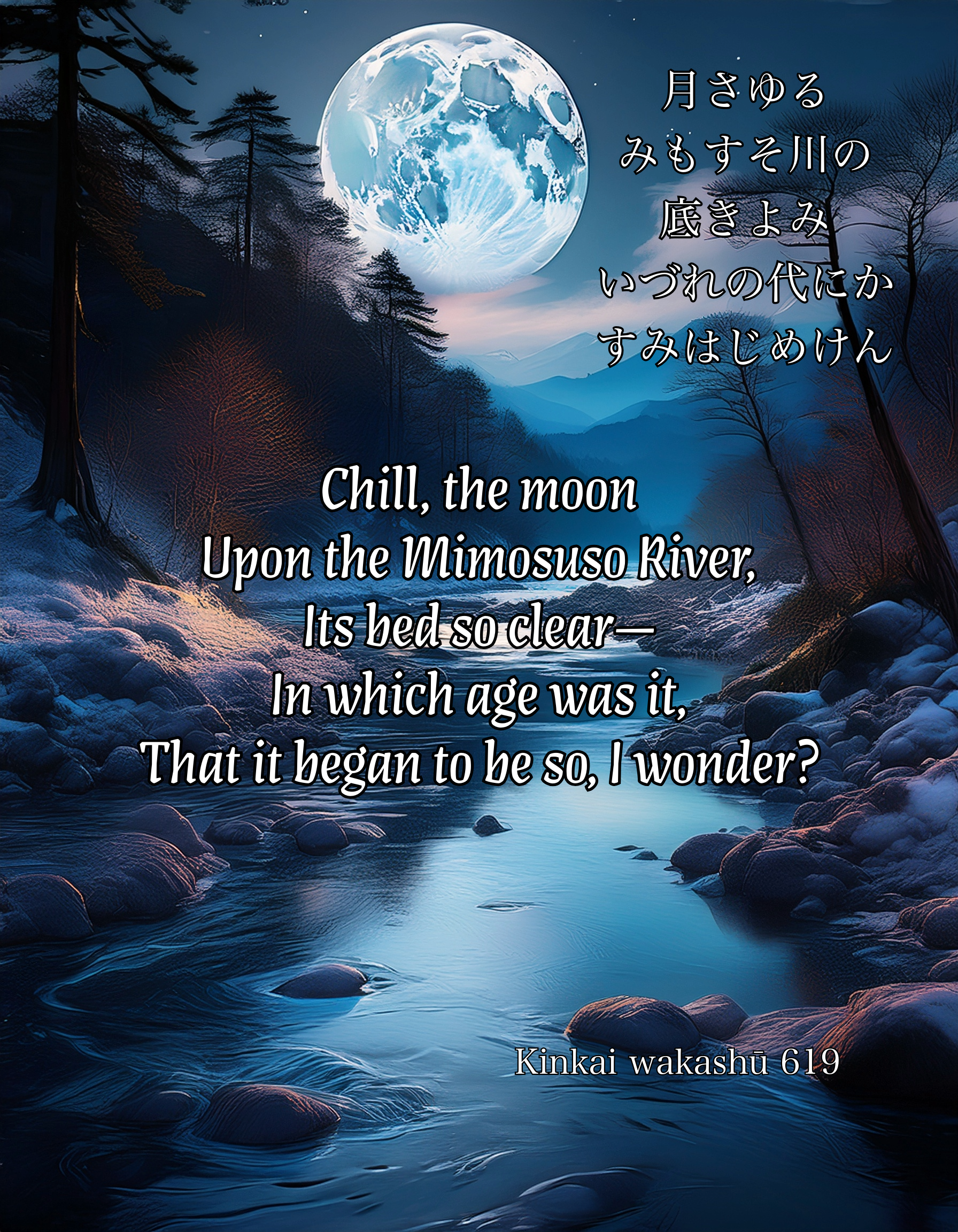
Kinkai wakashū 619

月さゆるみもすそ川の底きよみいづれの代にかすみはじめけん

tsuki sayuru
mimosusogawa no
soko kiyomi
izure no yo ni ka
sumihajimeken
Chill, the moon
Upon the Mimosuso River,
Its bed so clear—
In which age was it,
That it began to be so, I wonder?[i]

619


[i] See: Composed for a picture of the Rinji Festival at the Kamo Shrine on a folding screen prepared for the entrance of a Junior Consort to the palace in the 6th year of Bunji (1190). 月さゆるみたらし河にかげみえてこほりにすれる山あゐの袖 tsuki sayuru / mitarashigawa ni / kage miete / kōri ni sureru / yama’ai no sode ‘Chill, the moon, / Upon the Mitarashi River / Shines, seeming as / A design of ice upon / Indigo sleeves.’ Master of the Dowager Empress’ Household Office Toshinari (Shinkokinshū XIX: 1889)

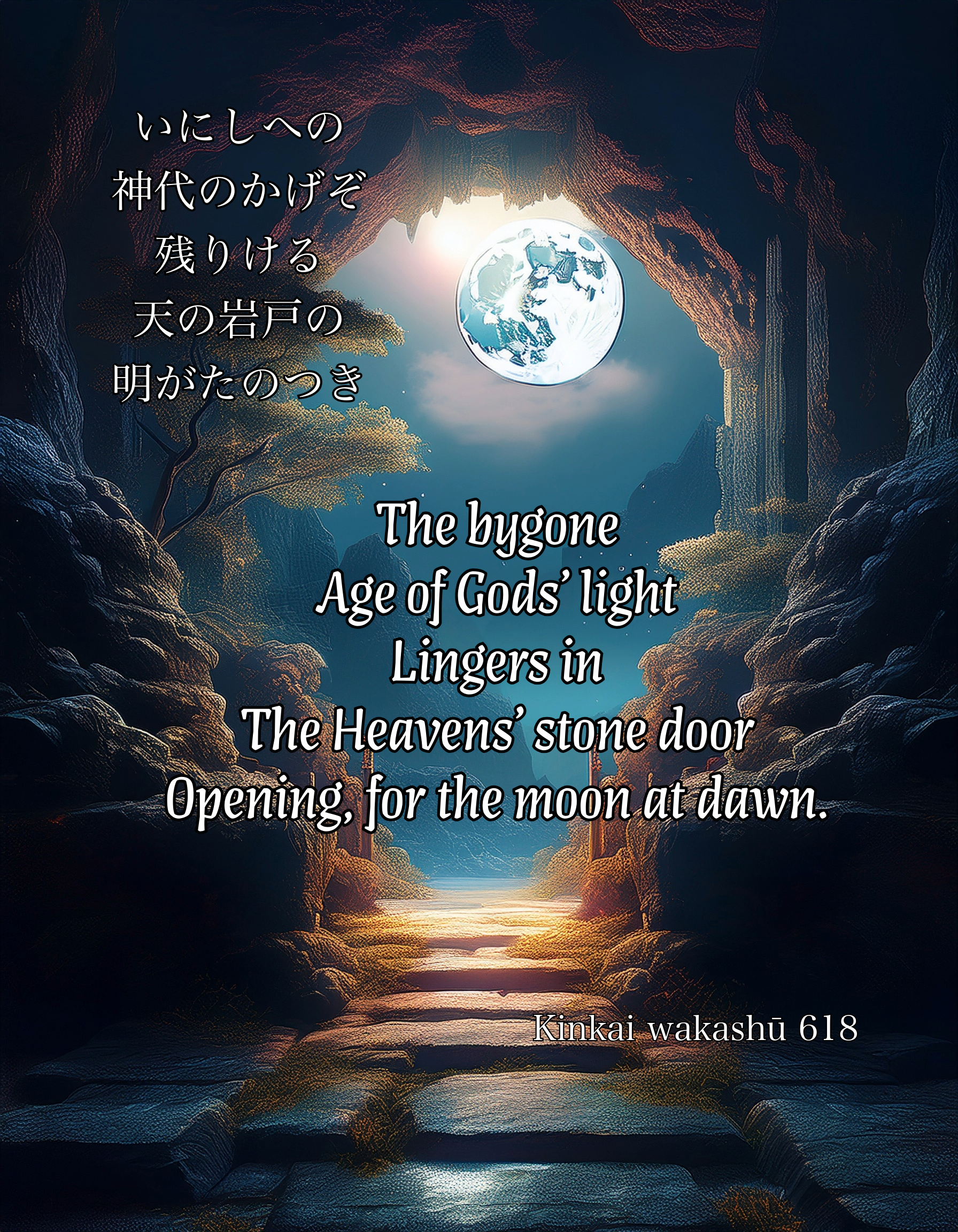
Kinkai wakashū 618

Among my Shinto poems

いにしへの神代のかげぞ残りける天の岩戸の明がたのつき

inishie no
kamiyo no kage zo
nokorikeru
ama no iwato no
akegata no tsuki
The bygone
Age of Gods’ light
Lingers in
The Heavens’ stone door
Opening, for the moon at dawn.[i]

618


[i] See: On the conception of the moon at dawn, for the Kasuga Poetry Match. 天の戸をおしあけがたの雲間より神よの月の影ぞ残れる ama no to o / oshi akegata no / kumoma yori / kamiyo no tsuki no / kage zo nokoreru ‘Upon the gates of Heaven / Pushing brightening / Through the cloud-gaps / From the Age of Gods, the moon’s / Light lingers.’ The Regent and Chancellor (Shinkokinshū XVI: 1547)

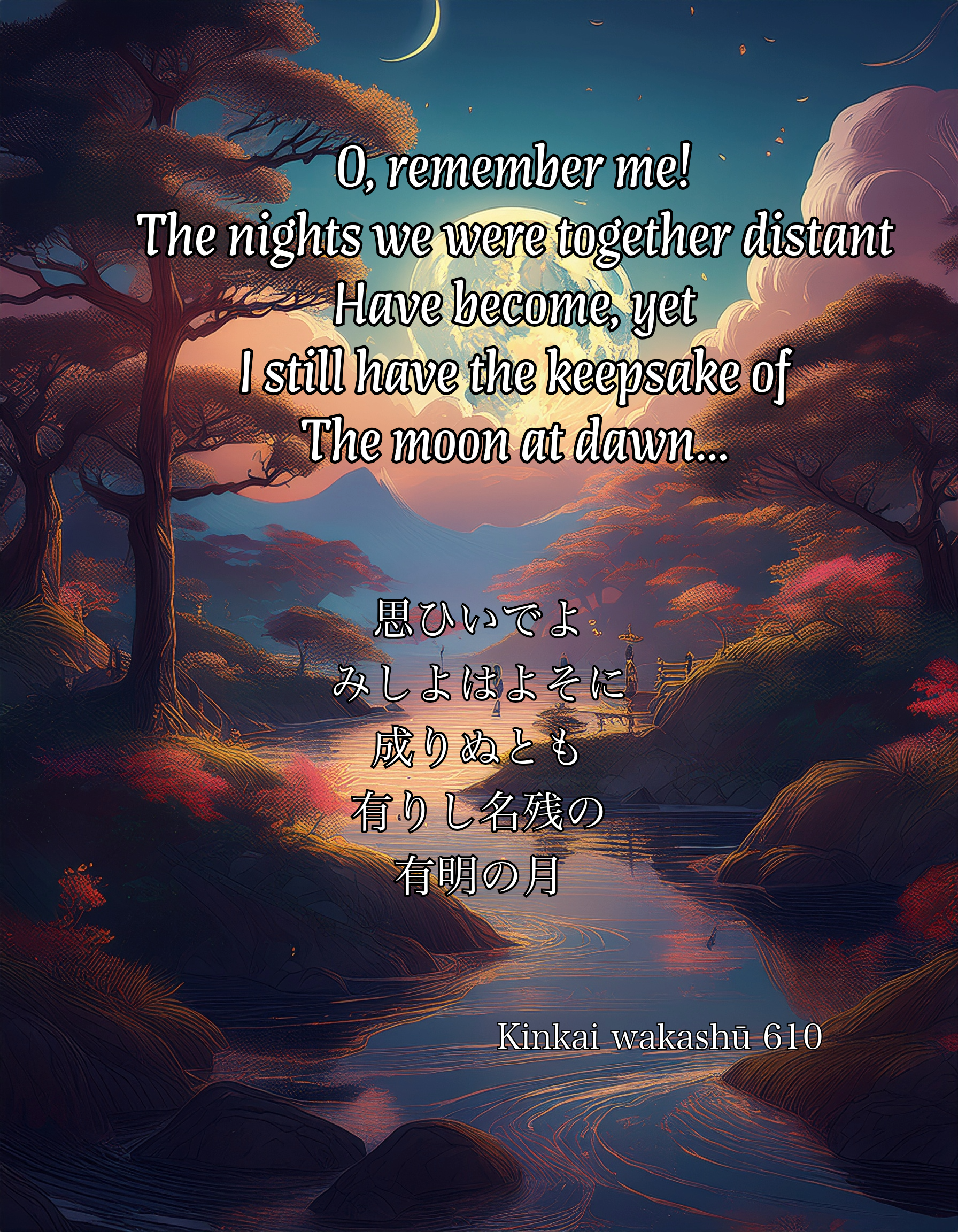
Kinkai wakashū 610

思ひいでよみしよはよそに成りぬとも有りし名残の有明の月

omoi’ideyo
mishi yowa yoso ni
narinu tomo
arishi nagori no
ariake no tsuki
O, remember me!
The nights we were together distant
Have become, yet
I still have the keepsake of
The moon at dawn…[i]

610


[i] See: For the Poetry Match held at the Residence of the Regent and Chancellor. 風ふかばみねにわかれむ雲をだにありしなごりのかたみともみよ kaze fukaba / mine ni wakaremu / kumo o dani / arishi nagori no / katami to mo miyo ‘If the wind should blow, / Parting from the peak, / Even the clouds / My memories / Seem to represent!’ Lord Ietaka (Shinkokinshū XIV: 1292/Roppyakuban uta’awase 720)