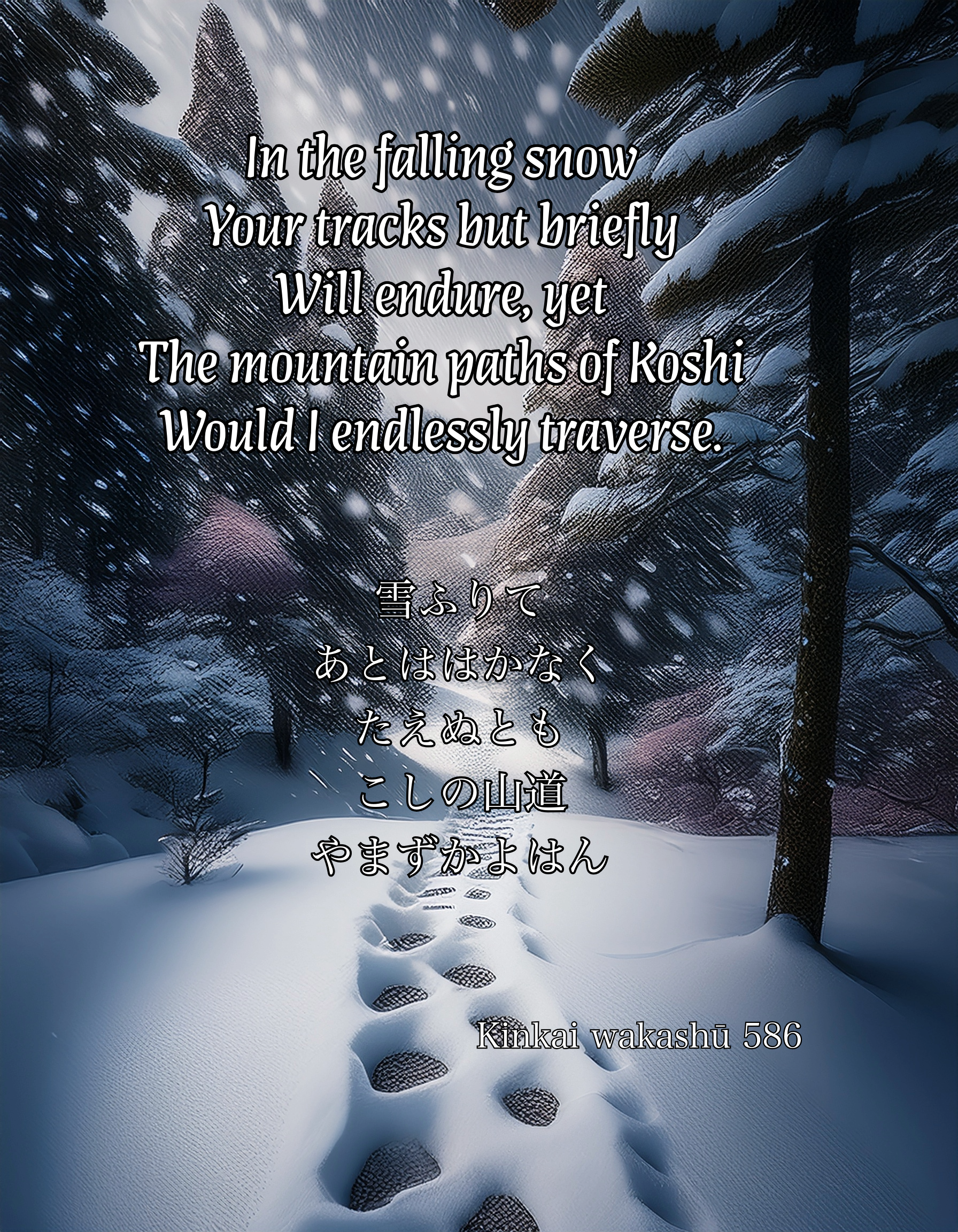
yuki furite ato wa hakanaku taenu tomo koshi no yamamichi yamazu kayowan
In the falling snow Your tracks but briefly Will endure, yet The mountain paths of Koshi Would I endlessly traverse.[i]
586
[i] See: Composed to send off Ōe no Chifuru when he went to Koshi. 君がゆくこしのしら山しらねども雪のまにまにあとはたづねむ kimi ga yuku / koshi no shirayama / shiranedomo / yuki no manimani / ato wa tazunemu ‘My Lord, you go / To the mountains, so white, of Koshi— / I know them not, yet / While the snow endures / Would I seek your trail.’ Lord Fujiwara no Kanesuke (Kokinshū VIII: 391)
Hidden in the grass on the path o’er the plains[i]
Left
なつくればのべのくさばもしげりあひていづれかみちとみえぞわかれぬ
natsu kureba nobe no kusaba mo shigeriaite izure ka michi to mie zo wakarenu
When the summer comes, The blades of grass upon the plains Grow lushly together, so Which is the path to take I cannot tell by looking!
9
Right
をちこちのみちみえぬまでなつののはくさばしげくもなりにけるかな
ochikochi no michi mienu made natsuno no wa kusaba shigeku mo narinikeru kana
Until both distant and nearby Paths I cannot see Across the summer plains Have the blades of grass so lushly Grown, indeed!
10
Do they not know the features of the summer plains conveyed by ‘Hidden in the grass on the path o’er the plains’? While both Left and Right use ‘blades of grass’, this puts one in mind of fresh grass sprouting in spring showers; and then of the two of them, the Right uses ‘distant and nearby’, which is nothing more than an archaic expression from the Age of Gods used for leg-wearying mountain paths, while at least the Left does not have a tangled argument.
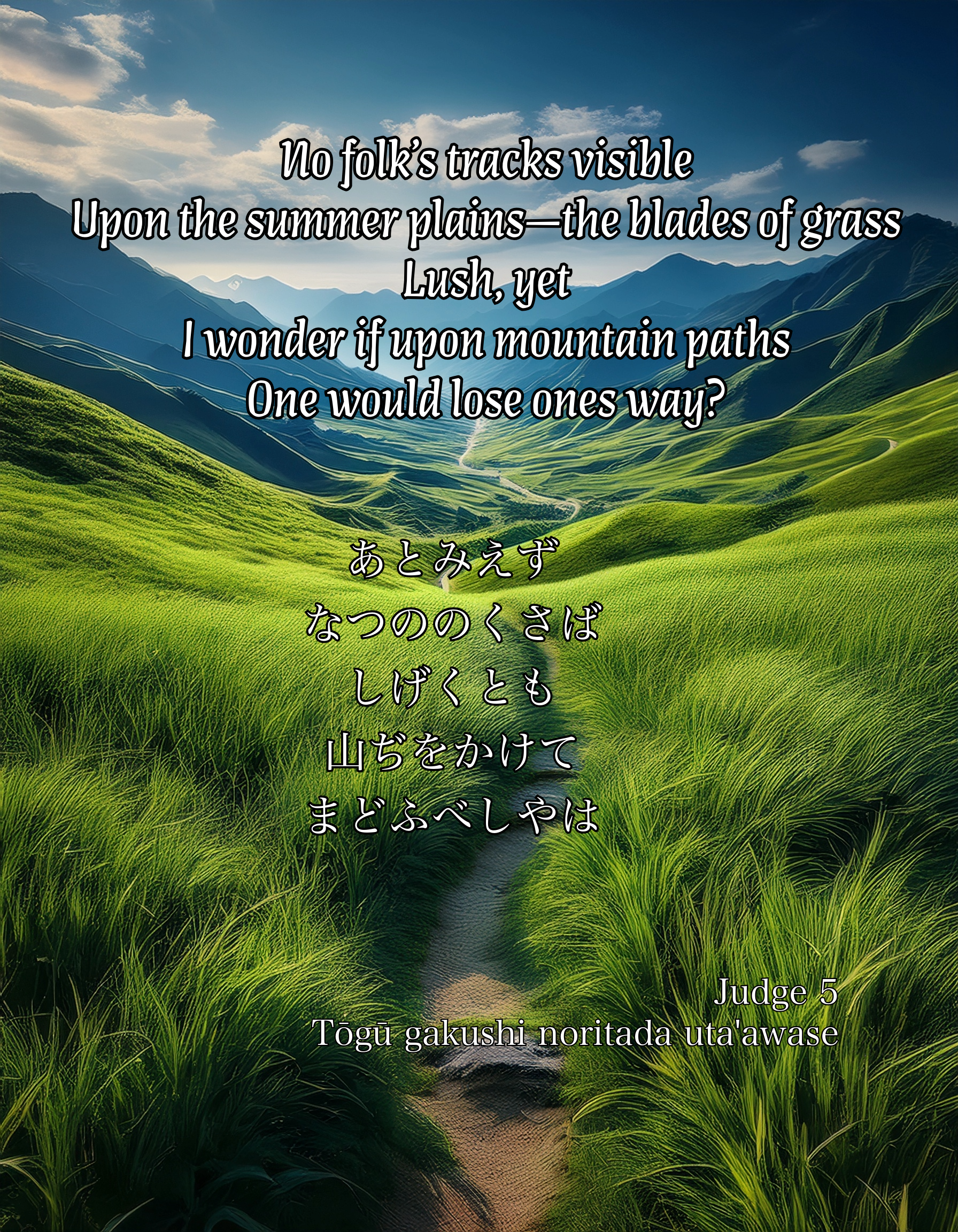
ato miezu natsuno no kusaba shigeku tomo yamaji o kakete madoubeshi ya wa
No folk’s tracks visible Upon the summer plains—the blades of grass Lush, yet I wonder if upon mountain paths One would lose ones way?
yuki fureba shirushi no sugi mo hana sakite miwa no yamabe mo ikaga tazunemu
When the snow has fallen, The symbolic cedars, too, Bloom with blossom— To Miwa’s mountainside How might I make my way?
Lord Saburō 45
Right (Win)
しらゆきにふるの山みちうづもれてたどるばかりになりもゆくかな
shirayuki ni furu no yamamichi uzumorete tadoru bakari ni nari mo yuku kana
In snow, so white, Furu’s ancient mountain paths Are buried, so Simply I must feel my way As I go along!
Ushigimi 46
The Left’s poem is an entirely transparent adaptation of an earlier work. This poem is:
ふる雪に印の杉もうづもれていづこなるらむ三輪の山本
furu yuki ni shirushi no sugi mo uzumorete izuko naruruamu miwa no yamamoto
In the falling snow, Even the symbolic cedars Are buried Where might be Miwa mountain’s foot?[i]
The Right’s poem has nothing of interest about it, nor does it have any faults to indicate. Thus, there are insufficient grounds for judgement.
The Left’s poem follows the conception of a poem which appeared in the Kaya Palace Poetry Match.[ii] Although this is an earlier work, truly, it’s not that good, and so this poem doesn’t seem that superlative. Why couldn’t one visit if blossom has simply bloomed? The former poem says it would be difficult to get there because it’s buried in snow. The Right’s poem isn’t that good, but it seems better than the Left, so it should win.
[ii] Snow. ふるゆきにすぎのあをばもうづもれてしるしも見えずみわのやまもと furu yuki ni / sugi no aoba mo / uzumorete / shirushi mo miezu / miwa no yamamoto ‘In the falling snow / The green cedar needles / Are buried, so / The symbol goes unseen, / Of Miwa mountain’s foot.’ Lady Settsu (Kaya no in shichiban uta’awase 55). This poetry match, Kaya no in shichiban uta’awase 高陽院七番歌合 (‘Seven Round Poetry Match held at the Kaya Palace’), was sponsored by Fujiwara no Morozane 藤原師実 (1042-1101) and held on the 19th day of the Eighth Month, Kahō 1 [1.10.1094]. The judge, Minamoto no Tsunenobu 源経信 (1016-1097), approved of this poem, saying it was ‘extremely charming’. It was later included in Kin’yōshū (IV: 285), with the headnote, ‘Composed on the conception of snow at the Poetry Match held at the Residence of the Former Uji Chancellor’.
makuzu hau yamaji mo harete aki no yo wa koyuru tabibito yasuki tsuki kana
Kudzu vines crawl Along the mountain paths, so clear On an autumn night for A traveller a’crossing Lit by a clement moon!
Cell of the Fragrant Elephant 35
Right
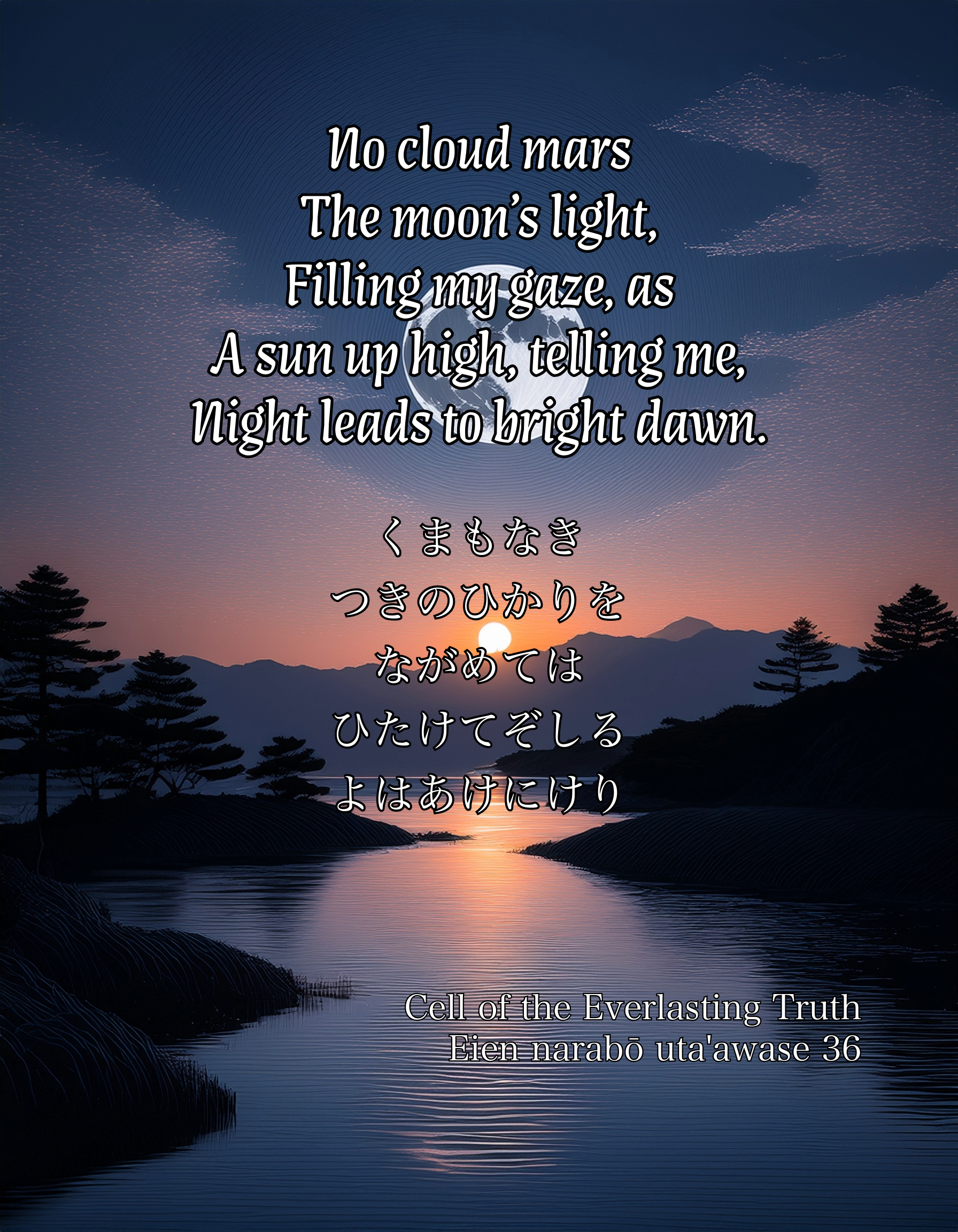
くまもなきつきのひかりをながめてはひたけてぞしるよはあけにけり
kuma mo naki tsuki no hikari o nagamete wa hi takete zo shiru yo wa akenikeri
No cloud mars The moon’s light, Filling my gaze, as A sun up high, telling me, Night leads to bright dawn.
Cell of the Everlasting Truth 36
The poem of the Left has nothing to present in all of its syllables. The poem of the Right resembles a composition by someone drunk out of his mind. As a result, it’s impossible to decide between them.
In the poem of the Left, does ‘clement moonlight’ mean that the moon’s light enables one to traverse a mountain path, which normally one would be unable to make one’s way along because one would expect it to be dark? The diction here is insufficient. As it says in the preface to the Ancient and Modern Collection of Narihira’s poems, ‘excessive conception but lacking in diction, like withered flowers lacking colours, but with a lingering fragrance’. This is a poem in that style, isn’t it. As for the poem of the Right, this, too, has ‘night leads to bright dawn’—the diction here is stilted and the conception lacks elegance. I have to say these poems are of about the same standard.