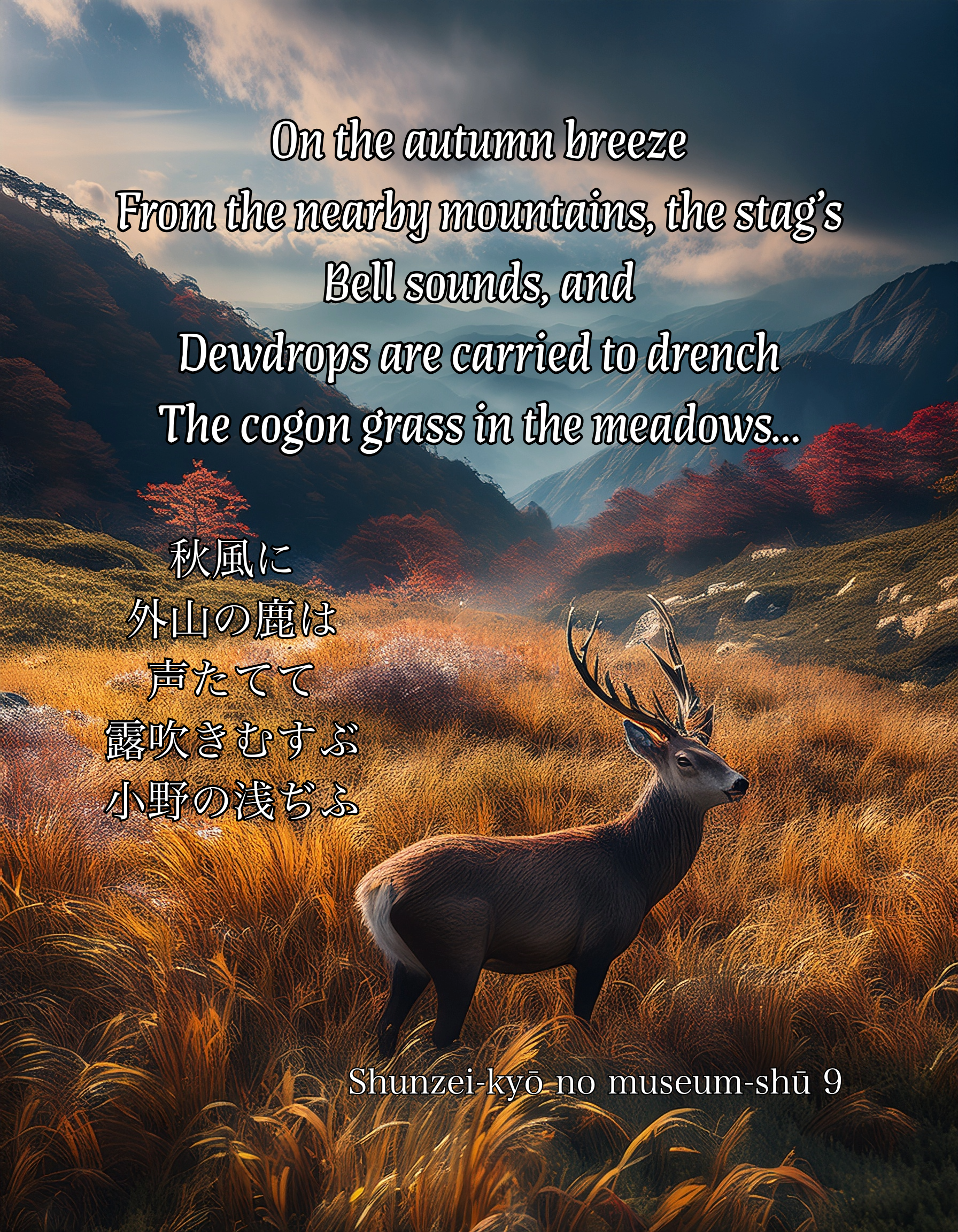
秋風に外山の鹿は声たてて露吹きむすぶ小野の浅ぢふ
| akikaze ni toyama no shika wa koe tatete tsuyu fukimusubu ono no asajū | On the autumn breeze From the nearby mountains, the stag’s Bell sounds, and Dewdrops are carried to drench The cogon grass in the meadows… |
9
Round Thirty-Seven
Left (Tie)
むば玉のよやふけぬらんさをしかの声すみのぼるをのの草ぶし
| mubatama no yo ya fukenuran saoshika no koe suminoboru ono no kusabushi | Might lily-seed dark Night have fallen? The stag’s Cry clearly climbs From where he lies among the meadow grasses. |
Takasuke
73
Right
秋のよはつまどふ鹿の深山出でていまだ旅なるをのの草ぶし
| aki no yo wa tsumadou shika no miyama idete imada tabi naru ono no kusabushi | On an autumn night, Seeking his bride, the stag Emerges from the mountains’ depths, And now on his travels Lies among the meadow grasses. |
Shimotsuke
74
Left and Right’s ‘lies among the meadow grasses’ have no merits or faults between them. A pleasant tie.


Round Five
Left (T – Tie)
時雨には菅の小笠も水もりて遠の旅人ぬれやしぬらん
| shigure ni wa suga no ogasa mo mizu morite ochi no tabibito nure ya shinuran | In such a shower A little hat of woven sedge, too, Drips with water; A distant traveller Is drenched, no doubt… |
Lady Kazusa
9
Right (M – Win)
霜さえて枯行くをのの岡べなるならの朽葉にしぐれ降るなり
| shimo saete kareyuku ono no okabe naru nara no kuchiba ni shigure furu nari | Chill the frost upon The sere meadows on The hillside where Upon the withered oak leaves A shower is falling. |
Lord Mototoshi
10
Toshiyori states: In the first poem, ‘drips with water’ is vague. In the second poem, ‘hillside where’ lacks smoothness. What are we to make of ‘withered oak leaves’? If leaves have withered away, then they wouldn’t make any sound, would they. Is this even possible?
Mototoshi states: the diction of ‘In such a shower / A little umbrella of woven sedge, too, / Drips with water’ is something which lacks any prior precedent. ‘Dripping with water’ give the impression of a painted pot with a crack in it, so what kind of shower can this be? It would be more normal to refer to having to shelter beneath one’s sleeves. While it is lacking in any superlative features, I feel that the sound of a shower on withered oak leaves is somewhat more commonplace.


Bush clover at the roadside.
みちのべのをのの夕霧たちかへりみてこそゆかめ秋はぎの花
| michi no be no ono no yūgiri tachikaeri mite koso yukame akihagi no hana | By the roadside Across the meadows evening mists Rise and fall endlessly; Thus would I go and see The autumn bush clover blooms.[1] |

[1] An allusive variation on: For a poetry competition held in the Tenryaku era. 春ふかみゐてのかは浪たちかへり見てこそゆかめ山吹の花 haru fukami / ide no kawanami / tachikaeri / mite koso yukame / yamabuki no hana ‘In the depths of spring / Waves on the river at Idé / Rise and fall endlessly; / Thus would I go and see / The kerria blooms…’ Minamoto no Shitagō (SIS I: 68).
Round Eight
Left (Tie)
うづら鳴く遠里小野の小萩はら心なき身も過ぎうかりけり
| uzura naku tōsato ono no kohagiwara kokoronaki mi mo sugi’ukarikeri | Quails cry from Tōsato plain’s Bush-clover groves— Even one as insensitive as I Finds it hard to pass them by. |
Kenshō Sukenokimi
15
Right
あきの野の花に心をそめしよりくさかやひめもあはれとぞ思ふ
| aki no no no hana ni kokoro o someshi yori kusakayahime mo aware to zo omou | Since the autumn meadows’ Blooms my heart Did fill, for Kusakayahime Fondness, I feel! |
Tōren
16
As for the Left, if one is composing about bush-clover groves, then I would want the poem to mention Miyagi Plain. As for the Right’s Kusakayahime, I wondered if she appeared in the Chronicles of Japan, but in that work you have Izanagi-no-miko and Izanami-no-miko, who wed and create the first land, Akitsushima, and then many provinces, mountains, rivers and seas and thus trees and plants, too. It further states that the primordial tree was Kukunochi and the primordial plant was Kayanohime. The conception of the Right’s poem does not differ from this, yet it continues to mention Kusakayahime, which is unclear. I get the feeling that this poem was composed with the works composed for the banquet held for the completion of the Chronicles of Japan in mind, which refer to each and every spring and the ancient Kayanohime, but even these poems did not differ in conception from that of the main work. It’s impossible to pick a loser or winner.


Round Two
Left
鶯は春をしりてもなきぬなる我が身は春をしらでこそなけ
| uguisu wa haru o shiritemo nakinunaru wa ga mi wa haru o shirade koso nake | The warbler Knowing of the springtime Cries out, but My sorry self, of spring All unknowing, cries. |
Masashige
3
Right (Win)
杣人よをののおとしばしとどめなん谷の鶯はつねなくなり
| somabito yo ono no oto shibashi todomenan tani no uguisu hatsune nakunari | O, woodcutter, Your axe’s sound, briefly Won’t you stop? For the warbler in the valley Has let out his first call… |
Kenshō
4
The Left’s poem, too, is smooth; the Right poem’s diction is halting, but its conception does not sound bad. It should win, I’d say.


Composed as an autumn poem.
ゆふさればをののあさぢふ玉ちりてこころくだくる風の音かな
| yuFu sareba wono no asadiFu tama tirite kokoro kudakuru kaze no oto kana | When the evening comes All across the cogon-grass plain Scatter gemstones— Heart-tangling is The sound of wind! |
The Regent and Former Minister of the Right


