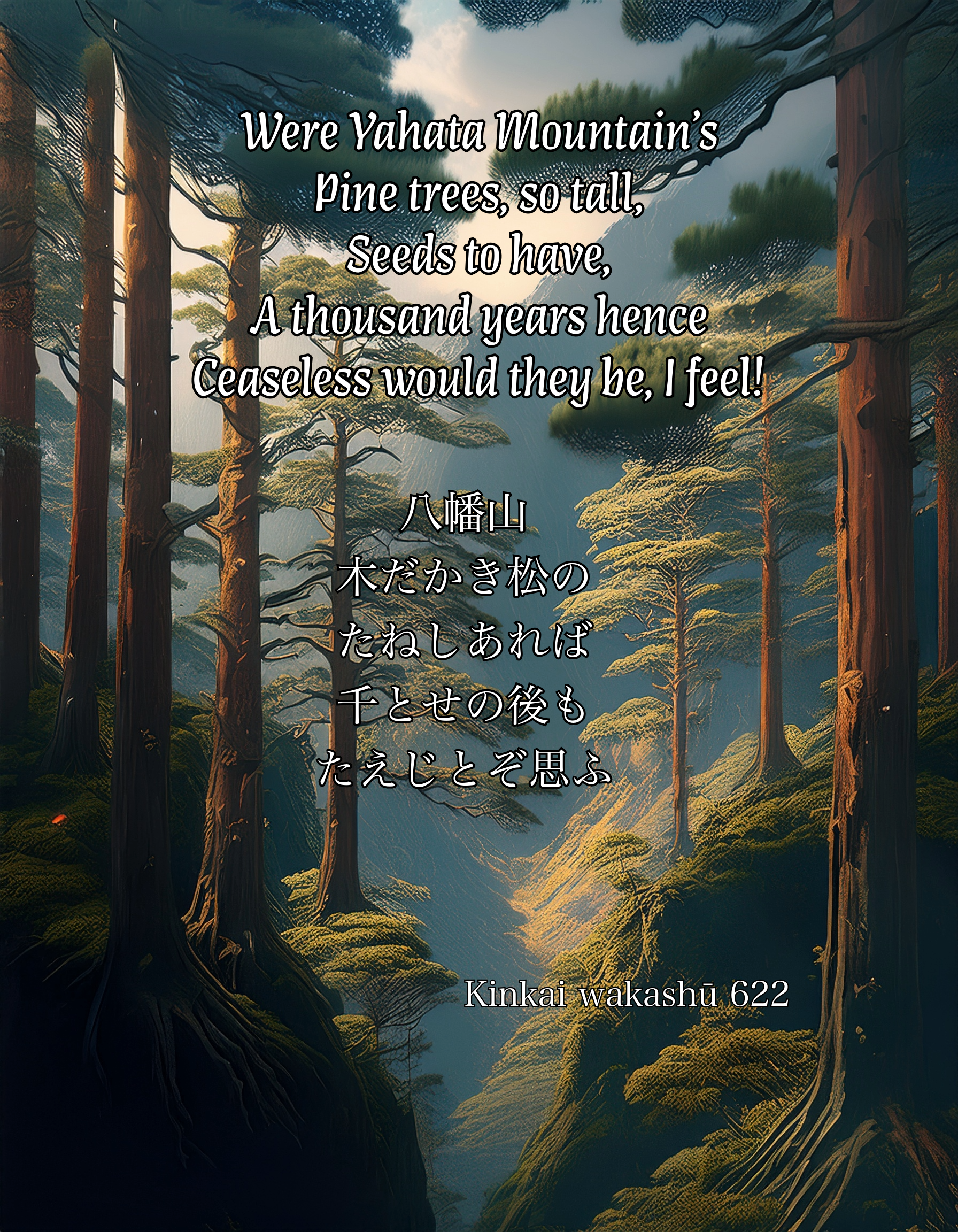
kuraiyama kodakaku naran matsu ni nomi yaoyorozuyo to harukaze zo fuku
On Mount Kurai[i] Tall will become the pines trees ‘Simply wait Eight million ages,’ whispers The gusting breeze of spring!
662
[i] Mount Kurai (kuraiyama 位山), lies in what is now northern Gifu prefecture, and is one of the peaks in the Hida Mountains (hida sanmyaku 飛騨山脈), also known as the Northern Alps, stretching through north central Honshu. Its use here, however, is purely because kurai 位, was homophonous with the word for ‘court rank’. As matsu 松 (‘pine tree’) was also homophonous with matsu 待つ (‘wait’), the poem is a dual play on words
midori naru matsukage hitasu ikemizu ni chiyo no sumika to miyuru yado kana
Evergreen The pine tree’s shapes sink Into the pond waters— A residence for a thousand ages Does that dwelling seem!
Lord Dainagon 57
Right (Win)
ちとせともいろにはいでていはし水ながれむほどは君がよなれば
chitose to mo iro ni wa idete iwashimizu nagaremu hodo wa kimi ga yo nareba
For a thousand years or more Does its hue emerge— Spring waters from the rocks Might flow as long as My Lord’s reign will be, so…
Lord Chūnagon 58
What on earth might be the colour of the Left poem’s ‘pine tree’s shapes sink’ and the Right poem’s ‘thousand years’ hue’? When one talks about ‘hue’ that means ‘scarlet’ and, in addition, it’s used of blossoms or autumn leaves. I have yet to see wisteria colouring the water in numerous private collections. The two poems are about the same, but the Right is marred by a series of faults.
The Left’s ‘shapes sink’ is extremely vague. ‘Sink’ means to submerge an object in water. One could certainly compose about a pine tree’s branches sinking, but how can we accept ‘shapes sink’ to mean an object’s reflection from beneath the water in the absence of a poem as precedent? The end is extremely, charming, though.
The poem of the Right doesn’t have anything special about it. It’s a pedestrian affair which doesn’t seem to show much evidence of thought. How are we to distinguish between a poem which is hackneyed but lacking any faults and one which is vague?
matsu mo mina shirayū kakete sumiyoshi no tsuki no hikari mo kamisabinikeri
The pine trees, every one, Are hung with sacred streamers— At Sumiyoshi Even the moon’s light Inspires awe.
Hyōenosuke, in service to the Junior Consort (formerly Handmaid Mikawa, in service at the Nijō Palace)[1] 19
Right
かたそぎのゆきあはぬまよりもる月をさえぬしもとやかみは見るらむ
katasogi no yuki awanu ma yori moru tsuki o saenu shimo to ya kami wa miruramu
The ridge poles Fail to entwine, and from the gaps Drips moonlight— As chill-less frost, I wonder, Does the Deity regard it?
Lord Fujiwara no Naganori Supernumerary Minor Captain in the Inner Palace Guards, Left Division Exalted Senior Fourth Rank, Lower Grade[2] 20
The Left’s poem appears to have a pleasant configuration with ‘Even the moon’s light / Inspires awe’. The poem of the Right, furthermore, has a charming-sounding sequence with ‘As chill-less frost, I wonder, / Does the Deity regard it?’ but in composition one usually states that the moon is fair precisely because of its chill. Thus, when one compares it to true frost, can one say that it lacks it? While I do feel that this is somewhat vague, both the poems appear to pleasant configurations, so I make this a tie.
[1]Nȳogo no ie Hyōenosuke moto nijōin Mikawa no maishi女御家兵衛佐元二条院参河内侍
The Right state: the Left’s poem lacks any faults. The Left state: the Right’s poem is pedestrian.
In judgement: the configuration of the Left’s ‘Blow across the bay!’ (ura ni fuke) and its links with the preceding and subsequent lines, sounds charming. The Right’s poem is stylistically elegant, but the poem more closely resembles a poem on the topic of ‘Love and Pine Trees’. Thus, the Left wins.