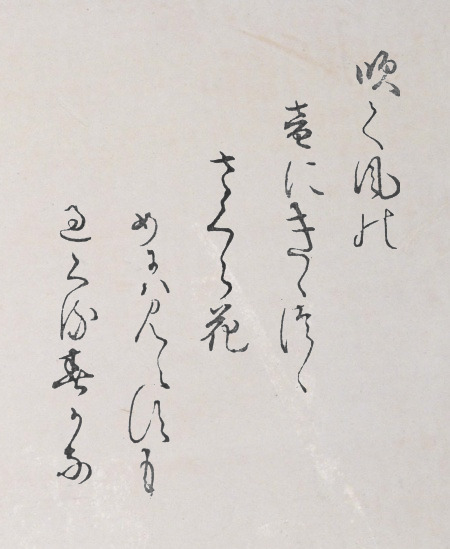
sakurabana yukitourumeri mikasayama iza tachiyoramu nani kakuru ya to
The cherry blossom Seems to pass as falling snow On Mikasa Mountain— Say, let’s shelter ‘neath umbrellas there, Whether they’ll conceal us or not…[1]
Mitsune 28
Left (Tie)
やまのなにたちしもよらじさくらばなゆきとふるともいろにぬれめや
yama no na ni tachishi mo yoraji sakurabana yukitouru to mo iro ni nureme ya
Based on the mountain’s name, I would take no shelter from The cherry blossoms, for Even should they pass as falling snow Would their hues wet my sleeves?
29
Right
かくるれどやまずゆきこそふりかかれみかさのやまははなやもるらん
kakururedo yamazu yuki koso furikakare mikasa no yama wa hana ya moruran
I have concealed myself, yet Incessantly those snows Do fall; From Mikasa Mountain, will The blossom drip, I wonder?
30
[1] This poem occurs in Mitsune-shū (328) with the same headnote as that for poem 22 (above). This is a somewhat facetious poem in that Mitsune is punning on the name of the mountain, Mikasa, which could be read to mean ‘honoured umbrella’. Both of the ladies composing this round pick up on his wordplay, with the author of (29) saying that there’s no need to take shelter as blossom will not leave a stain, as snow would, and the author of (30) wondering rhetorically if the blossom would drip from an umbrella as melting snow would.
furusato ni saku to wabitsuru sakurabana kotoshi zo kimi ni mienuberanaru
In the ancient capital In lonely sadness bloom The cherry blossoms, that This year, my Lady Has been able to behold. [1]
13
Left
ふるさととおもひなわびそさくらばなほかのいろにもおとらざりけり
furusato to omoi na wabi so sakurabana hoka no iro ni mo otorazarikeri
That ‘tis an ancient place Think not so sadly! For the cherry blossoms To any other hues Are not inferior at all!
14
Right (Win)
見そめずもあらましものをふるさとのはなにこころのうつりぬるかな
misomezu mo aramashi mono o furusato no hana ni kokoro no utsurinuru kana
They would not first catch they eye One would have thought, but The ancient capital’s Blossoms in the heart Do linger! [2]
15
[1] SIS XVI: 1045 Headnote ‘Among the many poems presented by provincial officials, when the Kyōgoku Lady of the Bedchamber visited Kasuga.’
[2] Variants of this poem attributed to Ise, appear in both Ise-shū みそめずもあらましものをからころもたつなのみしてきるよなきかな misomezu mo / aramashi mono o / karakoromo / tatsu na nomi shite / kiru yo naki kana ‘It would not first catch the eye / One would have thought, but / A Cathay robe / Is singly remarkable in name / Though it is worn on nights not a one!’(230) and Shokugoshūishū みそめずはあらましものを山ふかみ花に心のとまりぬるかな misomezu wa / aramashi mono o / yama fukami / hana ni kokoro no / tomarinuru kana ‘They would not first catch the eye / One would have thought, but / Deep within the mountains / The blossoms in the heart / Have halted!’(II: 99)
sakurabana mikasa no yama no kage shi areba yuki to furutomo nureji to zo omou
When cherry blossom Upon Mikasa mountain Shows its shape, Even should snow fall, I’ll not get damp, I feel![1]
4
Left
このまよりはなのゆきのみちりくるはみかさのやまのもるにざるべき
ko no ma yori hana no yuki nomi chirikuru wa mikasa no yama no morunizarubeki
Between the trees Simply a snow of blossom Comes a’falling— Mikasa mountain Will certainly be covered![2]
5
Right (Win)
かすがのにゆきとふるてふはなみにぞみかさの山をさしてきにける
kasugano ni yuki to furu chō hanami ni zo mikasa no yama o sashite kinikeri
Upon Kasuga Plain, Snow falls, they say— Indeed, when viewing blossom On Mikasa mountain, an umbrella Raise up as you come!
6
[1] This is included in Shūishū (XVI: 1056) as an anonymous poem under the heading ‘Topic unknown’.
[2] This poem is included in Shinsenzaishū (II: 152), as an anonymous poem with the headnote: ‘Composed in reply to “When cherry blossom / Upon Mikasa mountain / Shows its shape, / Even should snow fall, / I’ll not get damp, I feel!”, which was among twenty-one poems by provincial officials, when the Kyōgoku Lady of the Bedchamber went to Kasuga.’
sakurabana sora ni amagiru shirakumo no tanabikiwataru kazuragi no yama
The cherry blossoms, As sky-sweeping Clouds of white Drape all across Kazuragi Mountain.
Takasuke 25
Right
さくらさくながらの山のながき日も昔をこひぬ時のまぞなき
sakura saku nagara no yama no nagaki hi mo mukashi o koinu toki no ma zo naki
The cherries bloom Changeless on Nagara Mountain; The lengthy days to Those beloved bygone Moments do not compare.
Shimotsuke 26
Neither Left nor Right has any faults worth mentioning. The Right’s poem appears tranquil, with an artless quality. It has a moving sensibility of longing for the past, but the Left’s poem should just about win, I think.