Tag Archives: shade

Tōgū gakushi noritada uta’awase 06

Dark shade beneath the mountain trees[i]

Left

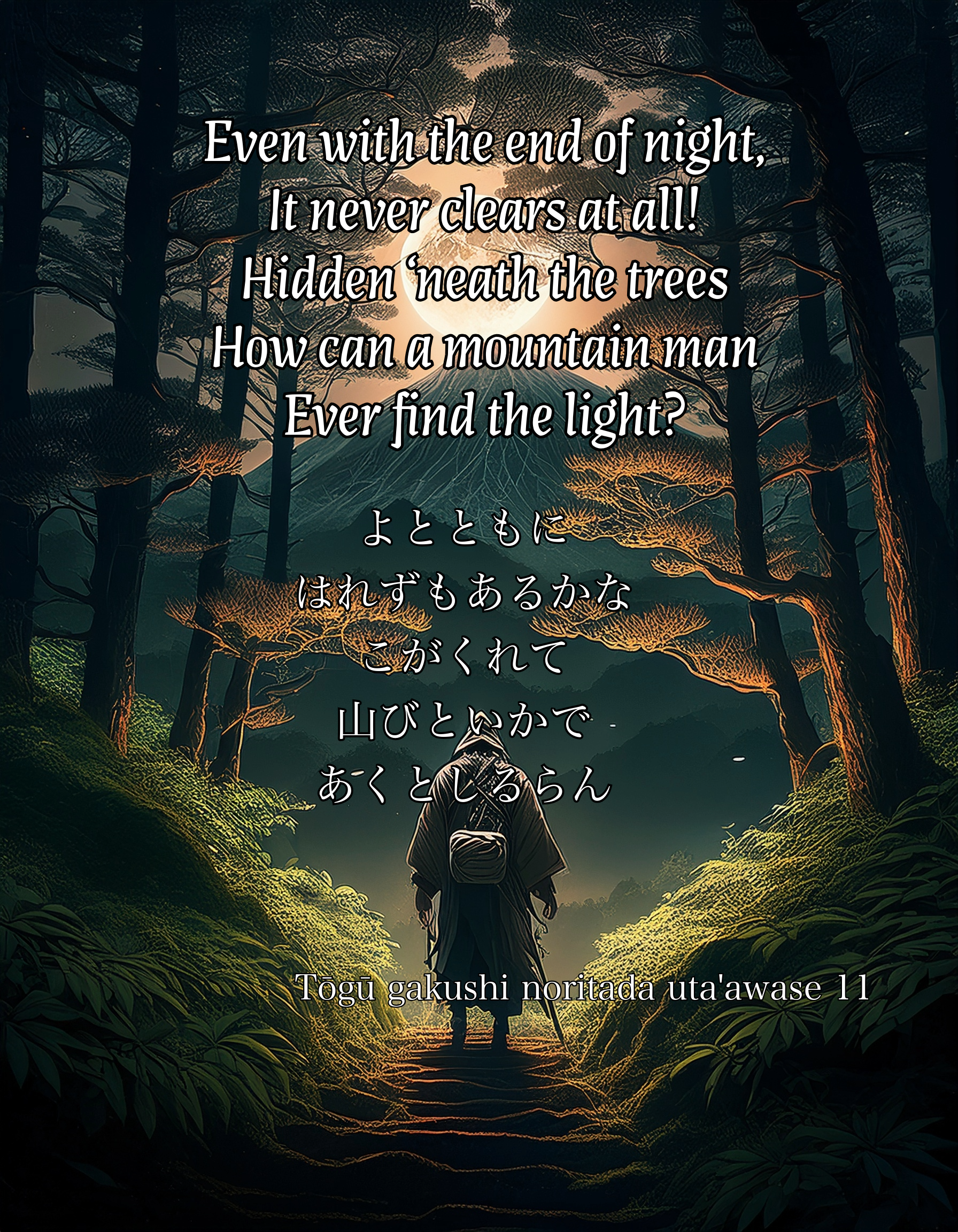
よとともにはれずもあるかなこがくれて山びといかであくとしるらん

yo to tomo ni
harezu mo aru kana
kogakurete
yamabito ikade
aku to shiruran
Even with the end of night,
It never clears at all!
Hidden ‘neath the trees
How can a mountain man
Ever find the light?

11

Right

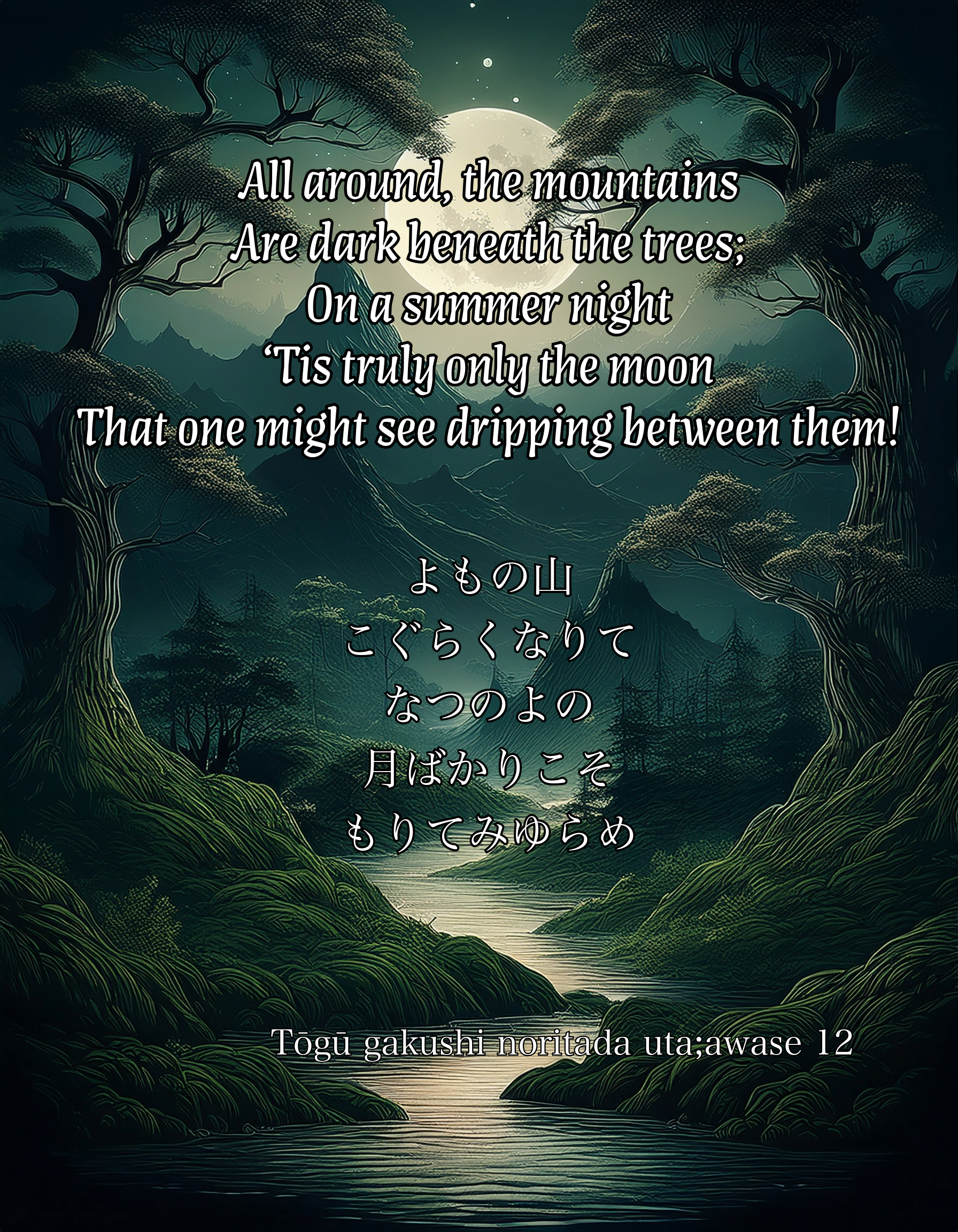
よもの山こぐらくなりてなつのよの月ばかりこそもりてみゆらめ

yomo no yama
koguraku narite
natsu no yo no
tsuki bakari koso
morite miyurame
All around, the mountains
Are dark beneath the trees;
On a summer night
‘Tis truly only the moon
That one might see dripping between them!

12

This topic refers to a hunted stag concealed among the trees in the summer mountains. There is not a particular strong feeling of either evergreen or other types of mountain forests,[ii] but the Left’s poem has ‘Even with the end of night’, forgetting that this implies a season of biting wind and showers striking the leaves on the trees—thus the darkness here is excessively conceived. While the Right takes ‘dark shade’ as an opportunity to compose with the elevated conception of the moon dripping between the trees—and surpasses the peaks in doing this—I wonder if the conceptions of both poems don’t contain brightness? Thus, both Left and Right are examples of the ‘Reizei Palace’,[iii] so I would decide on a tie for these.

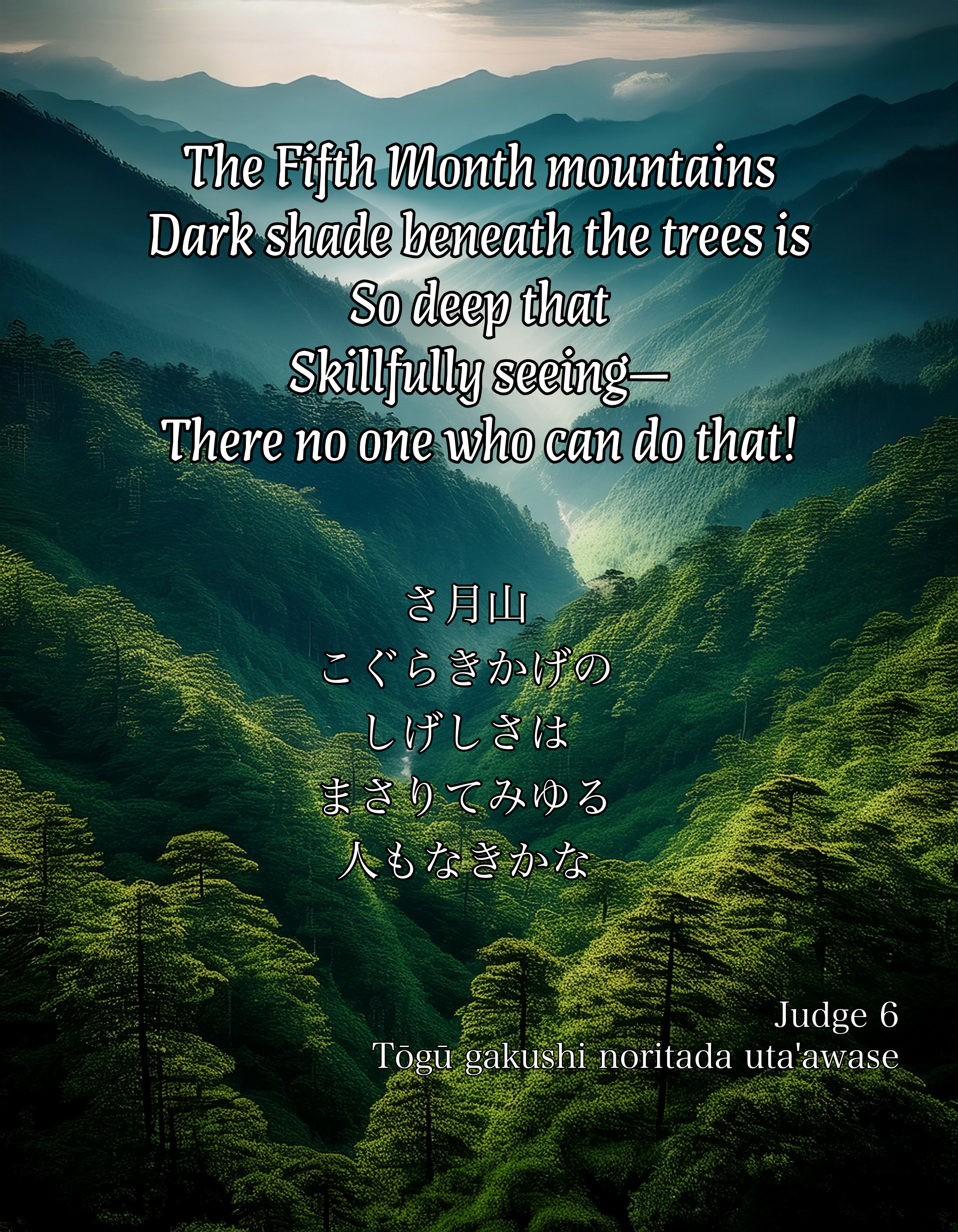
さ月山こぐらきかげのしげしさはまさりてみゆる人もなきかな

satsuki yama
koguraki kage no
shigeshisa wa
masarite miyuru
hito mo naki kana
The Fifth Month mountains
Dark shade beneath the trees is
So deep that
Skillfully seeing—
There no one who can do that!

Judge 6


[i] Yamagi no kagegurashi山樹蔭暗

[ii] The expression Noritada uses here Tokiwayama makeyama is obscure, so this interpretation is speculative.

[iii] Another unclear expression, but from the context apparently an idiom that means ‘poems not matching the topic’.

SKKS III: 274

Composed on ‘enjoying cool’ for the Poetry Match held by Yorisuke, the Minister of Justice.

ひさぎ生ふるかた山かげにしのびつつふきけるものを秋の夕風

hisagi ouru
katayama kage ni
shinobitsutsu
fukikeru mono o
aki no yūkaze
Where red-oaks grow and
Cast their shade upon the mountain slopes
Ever secretly
Does it blow—
The autumn evening breeze.

Shun’e

A kuzushiji version of the poem's text.
Created with Soan.

Kinkai wakashū 4

うちなびき春さりくればひさぎおふるかた山かげに鶯ぞなく

uchinabiki
haru sarikureba
hisagi ouru
katayama kage ni
uguisu zo naku
Trailing in
Comes spring, then
Where red-oaks grow and
Cast their shade upon the mountain slopes
A warbler sings![i]

4

A kuzushiji version of the poem's text.
Created with Soan.

[i] An allusive variation on: Composed on ‘enjoying cool’ for the Poetry Match held by Yorisuke, the Minister of Justice. ひさぎ生ふるかた山かげにしのびつつふきけるものを秋の夕風 hisagi ouru / katayama kage ni / shinobitsutsu / fukikeru mono o / aki no yūkaze ‘Where red-oaks grow and  / Cast their shade upon the mountain slopes / Ever secretly does it blow— / The autumn evening breeze.’ Shune (SKKS IV: 274).

Teiji-in uta’awase 20

Left (Tie)

はなみつつをしむかひなくけふくれてほかのはるとやあすはなりなむ

hana mitsutsu
oshimu kainaku
kyō kurete
hoka no haru to ya
asu wa narinamu
Ever do I gaze upon the blossom, in
Vain regret, for
Today will end and
A different spring will
Greet me on the morrow!

Mitsune
39

Right

けふのみとはるをおもはぬときだにもたつことやすきはなのかげかは

kyō nomi to
haru o omowanu
toki dani mo
tatsu koto ya suki
hana no kage ka wa
“Only today is left
Of spring”—I’ll not think that for
Even at such a time,
Is it easy to part from
The blossoms’ shade?

Mitsune
40[i]

‘Both of these are charming,’—they tied.


[i] This poem is included as the final spring poem in Kokinshū (II: 134), attributed to Mitsune, and with the headnote, ‘A poem on the end of spring from the Poetry Contest held by Former Emperor Uda’.

Koresada shinnō-ke uta’awase 27

あきのよにかりとなくねをきくときは我がみのうへと思ひこそすれ

aki no yo ni
kari to naku ne o
kiku toki wa
wa ga mi no ue to
omoi koso sure
On an autumn night,
When the geese a’crying
I do hear,
Upon me
My sad thoughts weigh all the more…

53

いまよりはいざまつかげにたちよらむ秋のもみぢはかぜさそひけり

ima yori wa
iza matsu kage ni
tachiyoramu
aki no momiji wa
kaze sasoikeri
From now it is, that
Long-awaited shade
Does seem to rise;
The autumn’s scarlet leaves,
Beckon in the breeze.

54