Tag Archives: shape

Nishinomiya uta’awase 01

On the 29th day of the Eighth Month, Taiji 3,[i] Head of the Department of Shinto, His Excellency Akinaka gave a lecture before the Hirota Shrine, and various people from among his friends and relative met together in the same place.

Judge   Mototoshi, Former Assistant Captain in the Palace Guards, Left Division.

Personal Grievances and the Moon

Round One

Left     

難波江のあしまにやどる月みれば我が身ひとつも沈まざりけり

naniwae no
ashima ni yadoru
tsuki mireba
wa ga mi hitotsu mo
shizumazarikeri
When, at the inlet at Naniwa
Between the reeds a’lodging
The moon I see,
My sorry self, alone,
Is sunk in sadness, am I not?

Lord Akisuke, Former Governor of Mimasaka
1

Right

かがみ川影見る月にそこ澄みて沈むみくづのはづかしきかな

kagamigawa
kage miru tsuki ni
soko sumite
shizumu mikuzu no
hazukashiki kana
In the mirror of Kagami River,
The shape, I see, of the moon
Clear down to the bed of
Sunken flotsam—
How terrible that I am so!

His Excellency Akinaka, Head of the Department of Shintō
2

While both Left and Right show awareness of the conventions, I find it difficult to be beguiled more by coming to the realisation that ‘My sorry self, alone, / Is sunk in sadness, am I not’ on seeing the moon lodging between the reeds, than I am by the conception of the one who seems to have seen the moon over Mount Obasute[1], so I could say that it has a bit of conception about it at present.


[1] Topic unknown. わが心なぐさめかねつさらしなやをばすて山にてる月を見て wa ga kokoro / nagusamekanetsu / sarashina ya / obasuteyama ni / teru tsuki o mite ‘My heart / Cannot be consoled— / In Sarashina / Above Mount Obasute / On seeing the shining moon…’ Anonymous (KKS XVII: 878)


[i] 25 September 1128
Yōzei’in miko futari uta’awase 07

Left

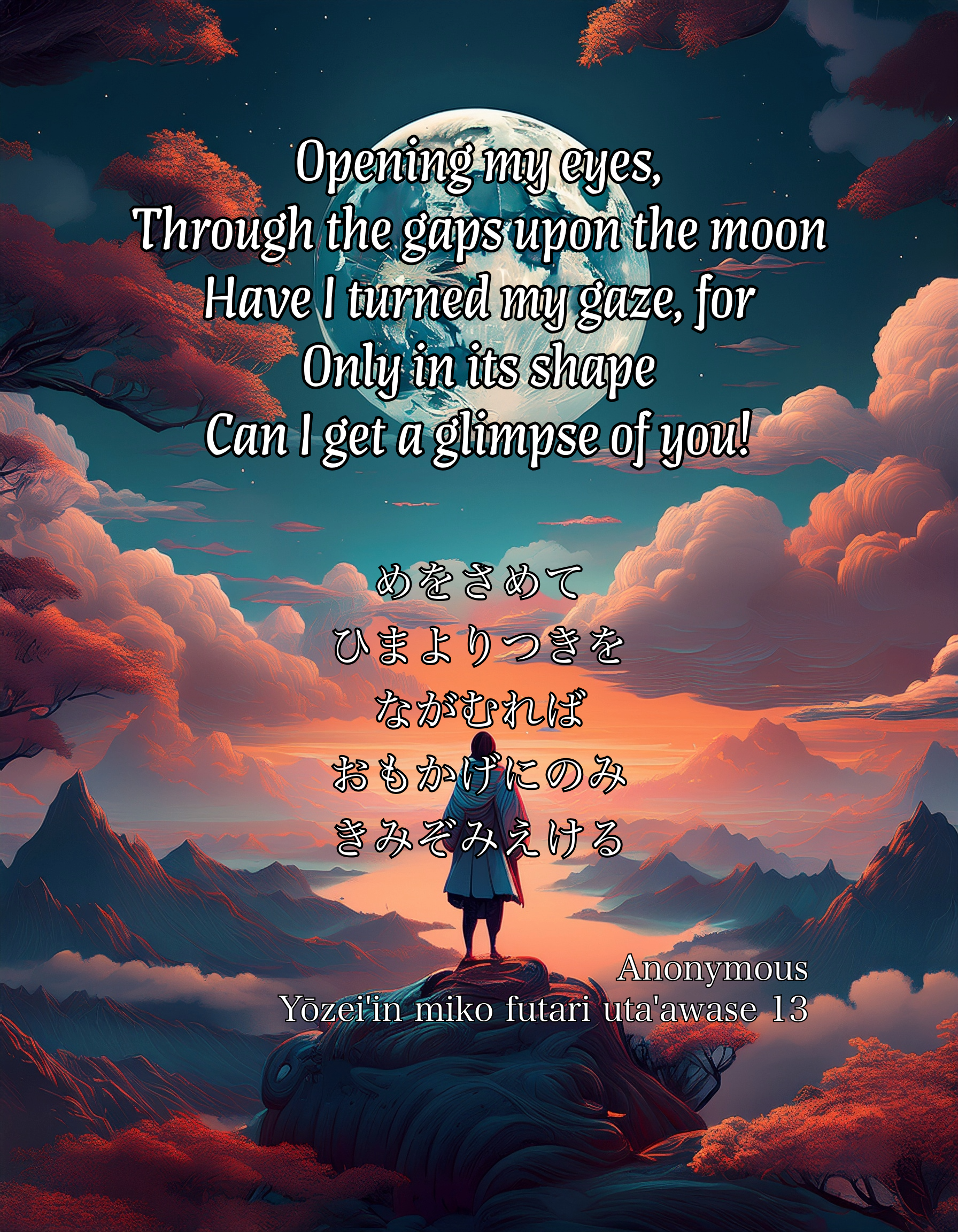
めをさめてひまよりつきをながむればおもかげにのみきみぞみえける

me o samete
hima yori tsuki o
nagamureba
omokage ni nomi
kimi zo miekeru
Opening my eyes,
Through the gaps upon the moon
Have I turned my gaze, for
Only in its shape
Can I get a glimpse of you!

13

Right

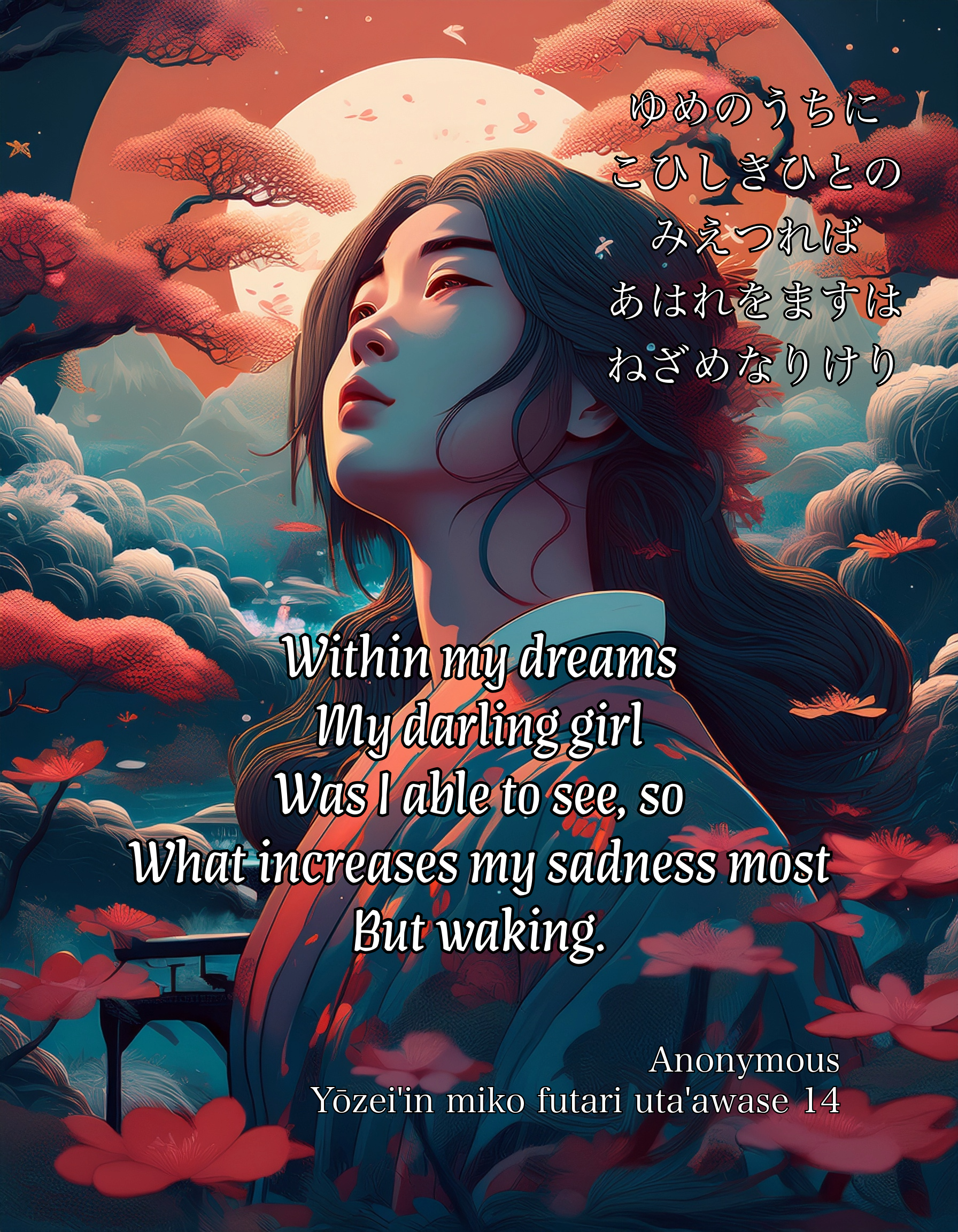
ゆめのうちにこひしきひとのみえつればあはれをますはねざめなりけり

yume no uchi ni
koishiki hito no
mietsureba
aware o masu wa
nezame narikeri
Within my dreams
My darling girl
Was I able to see, so
What increases my sadness most
But waking.

14

Kyōgoku no miyasudokoro uta’awase 02

Original

さくらばなみかさのやまのかげしあればゆきとふるともぬれじとぞおもふ

sakurabana
mikasa no yama no
kage shi areba
yuki to furutomo
nureji to zo omou
When cherry blossom
Upon Mikasa mountain
Shows its shape,
Even should snow fall,
I’ll not get damp, I feel![1]

4

Left

このまよりはなのゆきのみちりくるはみかさのやまのもるにざるべき

ko no ma yori
hana no yuki nomi
chirikuru wa
mikasa no yama no
morunizarubeki
Between the trees
Simply a snow of blossom
Comes a’falling—
Mikasa mountain
Will certainly be covered![2]

5

Right (Win)

かすがのにゆきとふるてふはなみにぞみかさの山をさしてきにける

kasugano ni
yuki to furu chō
hanami ni zo
mikasa no yama o
sashite kinikeri
Upon Kasuga Plain,
Snow falls, they say—
Indeed, when viewing blossom
On Mikasa mountain, an umbrella
Raise up as you come!

6


[1] This is included in Shūishū (XVI: 1056) as an anonymous poem under the heading ‘Topic unknown’.

[2] This poem is included in Shinsenzaishū (II: 152), as an anonymous poem with the headnote: ‘Composed in reply to “When cherry blossom / Upon Mikasa mountain / Shows its shape, / Even should snow fall, / I’ll not get damp, I feel!”, which was among twenty-one poems by provincial officials, when the Kyōgoku Lady of the Bedchamber went to Kasuga.’

Dairi kiku awase 03

わぎもこがひもゆふぐれのきくなればあかずぞはなのいろはみえける

wagimoko ga
hi mo yūgure no
kiku nareba
akazu zo hana no
iro wa miekeru
My darling girl
Both day and eve is
As a chrysanthemum, so
Never sated am I with this flower’s
Hues I see.

Korenori
5

きくのはなふゆののかぜにちりもせでけふまでとてやしもはおくらん

kiku no hana
fuyu no kaze ni
chiri mo sede
kyō made tote ya
shimo wa okuran
Chrysanthemum blooms
In the winter wind
Scatter not;
Is it that up to today is when
Frost is said to fall?

Korenori
6

かげさへやこよひはにほふきくのはなあまてるつきにかのそはるらん

kage sae ya
koyoi wa niou
kiku no hana
ama teru tsuki ni
ka no sowaruran
Even their shape
Fills tonight with a scented glow; Chrysanthemum blooms
To the heaven-shining moon
Seem to add their fragrance.

Korenori
7

Teiji-in uta’awase 02

Left

さかざらむものならなくにさくらばなおもかげにのみまだきみゆらむ

sakazaramu
mono naranaku ni
sakurabana
nao mo kage ni nomi
madaki miyuramu
Wishing not to bloom
Will not remain
The cherry blossom, but
Even so their shape alone
Swiftly, I would wish to see!

Mitsune
3

Right

やまざくらさきぬるときはつねよりもみねのしらくもたちまさりけり

yamazakura
sakinuru toki wa
tsune yori mo
mine no shirakumo
tachimasarikeri
When the mountain cherry
Has bloomed,
Earlier than usual
Clouds of white around the peak
Do rise spectacularly!

Tsurayuki
4[i]

The Left uses ‘wish’[ii] twice; the Right places the mountain cherries at a distance—that make the round a tie.


[i] This poem is included in Gosenshū (I: 118), with the headnote, ‘A poem from Former Emperor Uda’s Poetry Contest’.

[ii] Uda is objecting to Mitsune’s double usage of the auxiliary verb -ramu in his judgement here.

Sahyōe no suke sadafumi uta’awase 11

Love without meeting

Left (Win)

あふことのかたきしなればしらなみのたちよるかずはわれのみぞしる

au koto no
katakishi nareba
shiranami no
tachiyoru kazu wa
ware nomi zo shiru
Meeting you is
A distant cliff, so
The whitecaps’
Numbers breaking there
I alone do know.

21

Right

あはむとはおもひわたれどふじかはのすまずはつひにかげもみえじを

awamu to wa
omoi wataredo
fujikawa no
sumazu wa tsui ni
kage mo mieji o
To meet her
Passionately did I cross, yet
The Fuji River
Was so clouded that at the last
Her shape I could not see at all…

Mitsune
22

SSIS X: 725

Composed at the Kameyama Palace in the Eighth Month, Kenji 2 [1276], when the first topic announced was ‘the shape of a pine tree floating in a pond’.

万代とかめのを山の松かげをうつしてすめるやどの池水

yorozuyo to
kame no oyama no
matsukage o
utsushite sumeru
yado no ikemizu
For ten thousand generations
On the mount of Kame
Is the pine tree’s shape,
Reflected, so clear in
This dwelling’s pond waters.

The Retired Emperor [Kameyama]

Kanpyō no ōntoki kisai no miya uta’awase 34

Left

いつの間に花かれにけむながくだにありせば夏のかげとみましを

itsu no ma ni
hana karenikemu
nagaku dani
ariseba natsu no
kage to mimashi o
In an instant
The blossoms seems to wither!
If but longer
They were here, summer’s
Shape I would see in them…

66

Right

幾千たび鳴きかへるらむ足引の山ほととぎす声はわすれて

ikuchi tabi
nakikaeruramu
ashihiki no
yamahototogisu
koe wa wasurete
How many thousand times,
Does he return to sing?
The leg-wearying
Mountain cuckoo,
Forgetting his song…

67

Shiki koi sanshu uta’awase – Autumn

Autumn

Left

秋の夜の有明にみれど久堅の月のかつらはうつろはぬかな

aki no yo no
ariake ni miredo
hisakata no
tsuki no katsura wa
utsurouwanu kana
An autumn night’s
Dawn I see, yet
The eternal
Moon’s silver trees
Show no sign of fading!

13

秋萩の花咲く比の白露は下ばのためとわきて置くべし

aki hagi no
hana saku koro no
shiratsuyu wa
shitaba no tame to
wakite okubeshi
In autumn, the bush clover
Flowers bloom—just then
Silver dewdrops
For the under-leaves
Do fall, marking every one.

14

秋風はいなばもそよとふきつめりかりみる程と成りやしぬらん

akikaze wa
inaba mo soyo to
fukitsumeri
kari miru hodo to
nari ya shinuran
The autumn breeze
Seems to rustle the rice stalks
As it blows;
Seeing if ‘tis time to reap them—
Is that what it is, I wonder?

15

Right

銀河とわたる舟は花薄ほにいづるほどぞかげもみゆべき

ama no kawa
towataru fune wa
hanasusuki
ho ni izuru hodo zo
kage mo miyubeki
Across the River of Heaven
A boat goes ferrying:
When the silver grass
Ears burst into bloom,
Can its shape be seen.

16

女郎花さがの花をば色ながら秋をさかりといはれずもがな

ominaeshi
saga no hana oba
iro nagara
aki o sakari to
iwarezu mogana
Maidenflowers:
Blossoms from Saga
Reveal their hues, and
In autumn are most fine—that
Goes without saying!

17

小男鹿の朝たつ霧にうりふ山嶺の梢は色こかりけり

saoshika no
asa tatsu kiri ni
urifuyama
mine no kozue wa
iro kokarikeri
Stags
Within the rising morning mist on
Urifu Moutain, where
The treetops on the peak
Have taken darker hues.

18