ai’oi no sode no furenishi yado no take yoyo wa henikeri wa ga tomo toshite
Growing together, Brushing my sleeves, The bamboo at my house Has passed through the ages— My friend, it is.[i]
667
[i] See: 晋騎兵参軍王子猷 栽称此君 唐太子賓客白楽天 愛為吾友 shin no kihei sangun ōshi iu / uete kono kimi to shōsu / tō no Taishi hinkaku hakurakuten / aishite wa ga tomo to su ‘In Chin times, Administrator for Cavalry Wang Tzu-yu / Planted it and called it “This Gentleman.” / In T’ang times, Adviser to the Heir Apparent Po Lo-t’ien / loved it as being “my friend.”’ (Rimer and Chaves 1997, 132) Fujiwara no Atsumochi (Wakan rōeishū II: 432); and: When His Majesty was yet a prince and had paid a visit to the Toba Palace to converse the Hachijō’in Princess, Her Highness recited, ‘The bamboo has been my friend these many years,’ so His Majesty composed a poem [along with others present]. わが友と君がみかきのくれ竹は千代にいく世のかげをそふらん wa ga tomo to / kimi ga migaki no / kuretake wa / chiyo ni ikuyo no / kage o souran ‘As “my friend” does / My Lady see, by her fence / Black bamboo— / Its thousand knots o’er how many ages / To her will show their shape?’ Master of the Dowager Empress Household Office, Toshinari (Senzaishū X: 608).
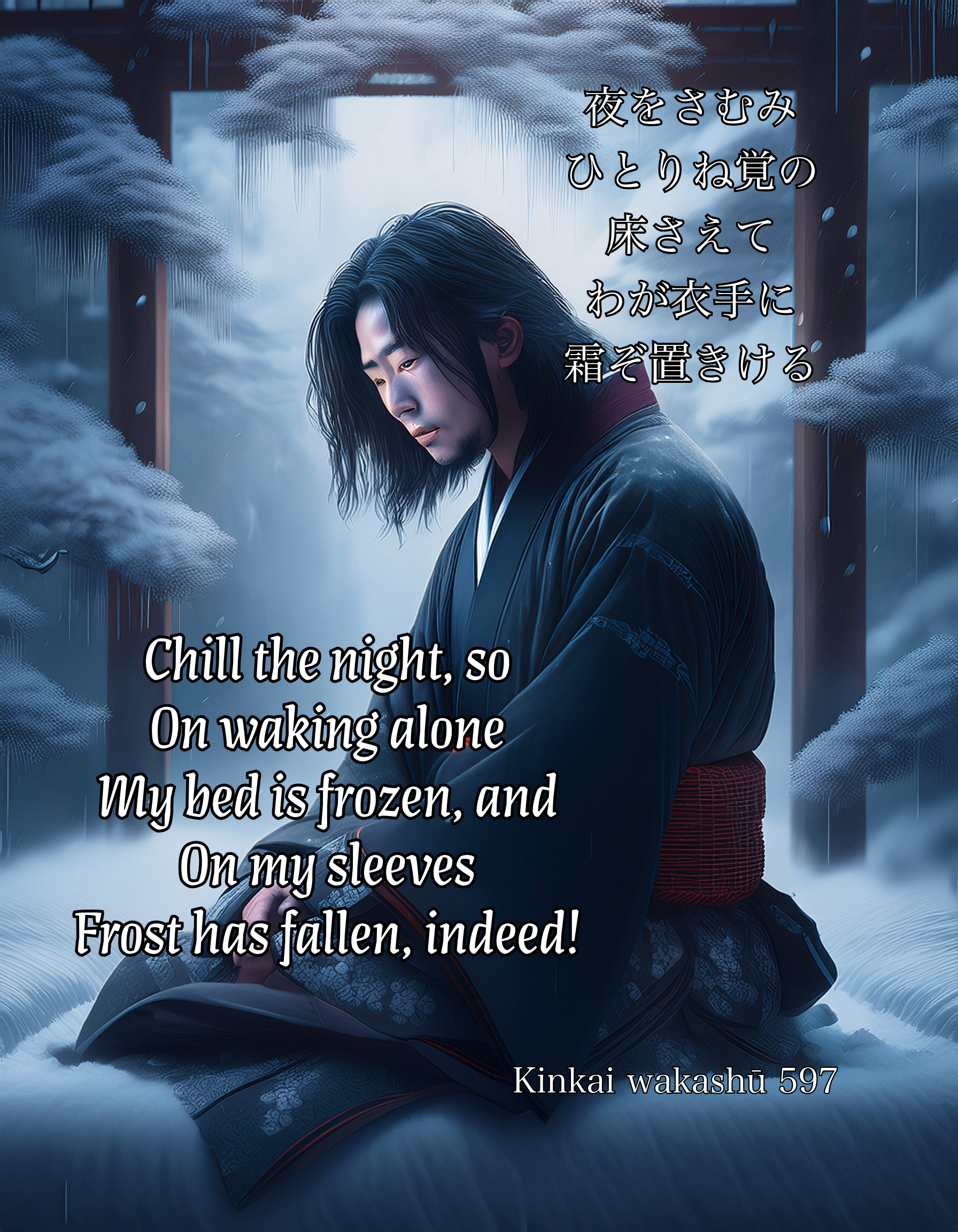
After a certain lady had set off up to the capital, I composed these and, attaching them to a letter, had it sent to her.
夜をさむみひとりね覚の床さえてわが衣手に霜ぞ置きける
yo o samumi hitori nezame no toko saete wa ga koromode ni shimo zo okikeru
Chill the night, so On waking alone My bed is frozen, and On my sleeves Frost has fallen, indeed![i]
597
[i] See: Topic unknown. 夜をさむみねざめてきけばをしぞなく払ひもあへず霜やおくらん yo o samumi / nezamete kikeba / oshi zo naku / harai mo aezu / shimo ya okuran ‘Chill the night and / On waking, I hear / A mandarin drake a’crying / For he cannot brush away / The fallen frost, it seems.’ Anonymous (Gosenshū VIII: 478)