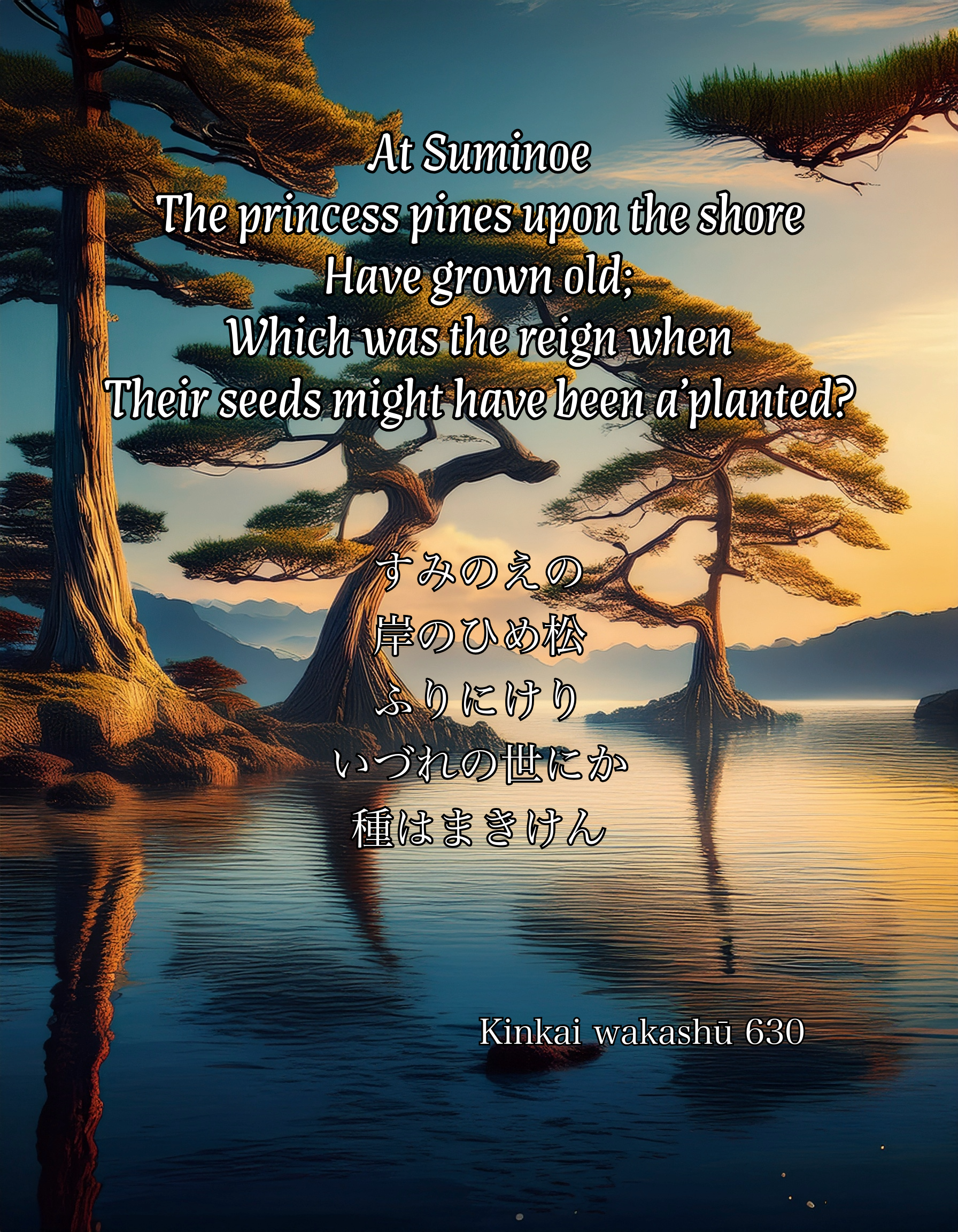
suminoe no kishi no himematsu furinikeri izure no yo ni ka tane wa makiken
At Suminoe The princess pines upon the shore Have grown old; Which was the reign when Their seeds might have been a’planted?[i]
630
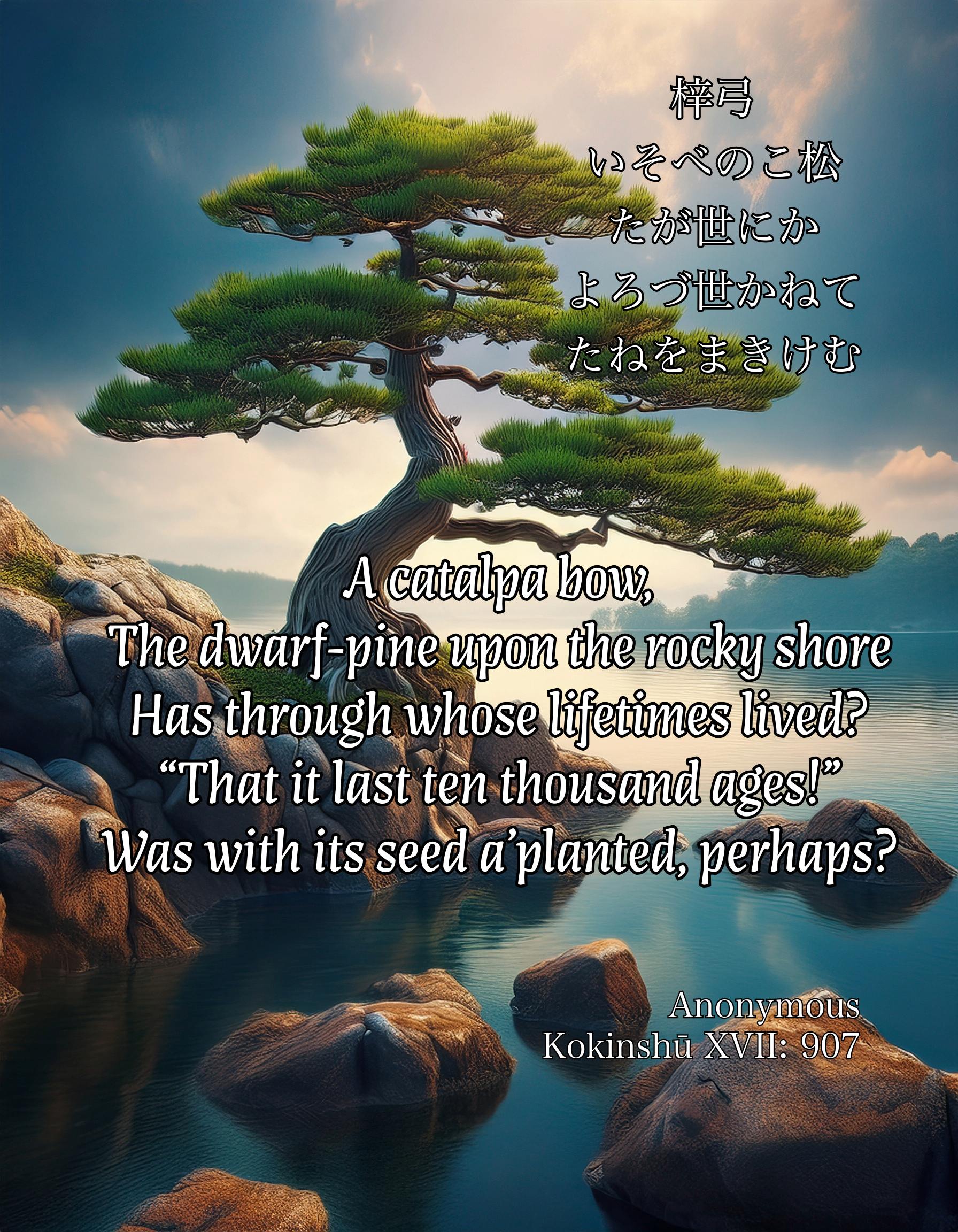
[i] See: Topic unknown. 梓弓いそべのこ松たが世にかよろづ世かねてたねをまきけむ azusayumi / isobe no komatsu / ta ga yo ni ka / yorozuyo kanete / tane o makikemu ‘A catalpa bow, / The dwarf-pine upon the rocky shore / Has through whose lifetimes lived? / “That it last ten thousand ages!” / Was with its seed a’planted, perhaps?’ Anonymous (Kokinshū XVII: 907); and: Topic unknown. 我見てもひさしく成りぬ住の江の岸の姫松いくよへぬらむ ware mite mo / hisashiku narinu / suminoe no / kishi no himematsu / iku yo henuramu ‘Even to my sight / Eternal are / Suminoe’s / Princess pines upon the shore: / How many ages have they passed through?’ Anonymous (Kokinshū XVII: 905)
adusayumi isobe no komatu ta ga yo ni ka yoroduyo kanete tane wo makikemu
A catalpa bow, The dwarf pine upon the rocky shore Has through whose lifetimes lived? “That it last ten thousand ages!” Was with its seed a’planted, perhaps?
In the spring of the year following that in which the Sanjō Minister of the Right had passed away, on hearing that the Minister had summoned her, she sent this to the Prince who was father to the Ise Virgin.
いかでかの年ぎりもせぬたねもがなあれたるやどにうゑて見るべく
ikade ka no tosigiri mo senu tane mogana aretaru yado ni uwete mirubeku
Why is it that Absent this year are not These seeds! At a ruined dwelling Planted, could they be seen…
Left and Right together state: we find no faults to mention.
In judgement: While there are such things in the heart of the mountains as ‘crags where seeds grow into pines’ (tane aru iwa ni ouru matsu), it is normally by the sea or on rocky coastlines that one finds firmly rooted pine trees. Surely, mountain pines are but lightly rooted? Cedars on River Hatsuse recollects ‘Nor will I ever; a solid brick-kiln’ (wasurezu yo kawaraya), but ‘You vowed it, did you not’ (chigirikina) also reminds me of the old phrase ‘Both our sleeves wringing out’ (katami ni sode o shiboritsutsu), which is most fine. Thus, the Right wins.
The Gentlemen of the Right state: we wonder about the appropriateness of sowing seeds beneath eaves? The Left, in appeal: why not compose a poem in this manner, given ‘even the grass seeds, forgotten’? The Left state: this seems little different from Toshiyori’s poem, ‘Beneath the eaves, my thoughts run wild / As the growing plants…’ (omoinoki yori ouru narikeri).
In judgement: both poems refer to ferns, and the conception of ‘my aged home’ (wa ga mi furuya no) and ‘my heart’s depths’ (kokoro no ne yori) both sound suitable. I make this a tie.