haru no no no wakana wa kimi ga tame ni koso ōku no toshi o tsumamu to wa omoe
In the springtime meadows Fresh herbs, for my Lord’s Sake, indeed, In many a year Will I pick, I feel!
12
The Right’s poem was inferior, but tied as it contained an element of Felicitation.
[i] This poem is included in Shoku gosenshū (I: 34), attributed to Kanemori, with the headnote ‘A poem from the Poetry Match held by the Reikeiden Junior Consort’.
[ii] Kanemori’s poem here can be viewed as a response to the emotions expressed by Ono no Komachi in her famous composition: Topic unknown. 花の色はうつりにけりないたづらにわが身世にふるながめせしまに hana no iro wa / utsurinikeri na / itazura ni / wa ga mi yo ni furu / nagameseshi ma ni ‘The colour of this flower / Has already faded away, / While in idle thoughts / My life goes by, / As I watch the long rains fall.’ (Kokinshū II: 113) (Hagitani and Taniyama 1965, 81)
saohime no ito somekakuru aoyagi o fuki na midari so haru no yamakaze
Princess Sao Has dyed the dangling threads of Green willow— O, don’t blow them into tangles, Spring breeze from the mountains!
Kanemori 9
While the Right’s poem was being recited, the gentlemen of the Left stated, ‘The current willow poem was already recited out of sequence, and yet they desire to recite it again. It seems they have forgotten basic procedure!’ This minor official replied, ‘His Majesty’s ruling has already been granted on this matter following the Left’s request when the poems on bush warblers were recited, so this objection cannot be raised again.’
In the Left’s poem ‘New jewels, / The years seem to spin out / Green willow’ lacks sense. While the Right’s poem has nothing worth mentioning about it, it does not appear to have any faults, and thus it wins.
[i] A variant on this poem is included in Goshūishū (I: 74), as well as in some texts of this match: Composed on willows for the Palace Poetry Match held in Tentoku 4. あらたまのとしをへつつもあをやぎのいとはいづれのはるかたゆべき aratama no / toshi o hetsutsu mo / aoyagi no / ito wa izure no / haru ka tayubeki ‘New jewels, / The years pass ever by with / Green willow / Threads: when might / The spring be that they snap?’ Given Saneyori’s judgement, however, I am following Hagitani and Taniyama (1965, 80) in prioritising this version.
When both Left and Right had recited their poems, His Majesty spoke to this minor official, saying, ‘You should determine their merits and failings.’ I demurred, saying, ‘My understanding of the thirty-one syllables of waka is not such as to enable me to do this. I humbly request that Your Majesty decides.’ His Majesty, responded, ‘Should you not do this, it will spoil today’s events, and store up resentment. Make your determinations swiftly.’ In the face of His Majesty’s displeasure, I presented my own clumsy opinions.
In the Left’s poem, it is pleasant to describe Mount Kurahashi [Storehouse-bridge] as storing up the new year. In addition, it is certainly the case that crossing a bridge is what one does. The poem’s overall manner is also appropriate. As for the Right’s poem, the reference to being covered with haze seems a bit late, leaving one to wonder why the capital is springlike.
This round, my decision reflected His Majesty’s views. Observing the expressions of the imperial mien, I swiftly declared the Left the winner.
[ii] This poem was included in the third edition of Kin’yōshū (I: 3), although not in either of the earlier two versions. It is also in Shinsen rōeishū (I: 69).
toshi goto ni kitsutsu wa ga miru sakurabana kasumi mo ima wa tachi na kakushi so
Every single year I hear of and gaze upon Cherry blossom: The haze, too, now Arising, don’t hide them!
Nakatsukasa
15
The Left’s poem is extremely charming – that really is how things are.
The Right’s poem: where is it that you always hear of and then see them? This is a bit rough. There’s also no reason to include the expression ‘now’ here. Thus, the Left wins.
[1] A variant of this poem was later included in Shūishū (I: 66).
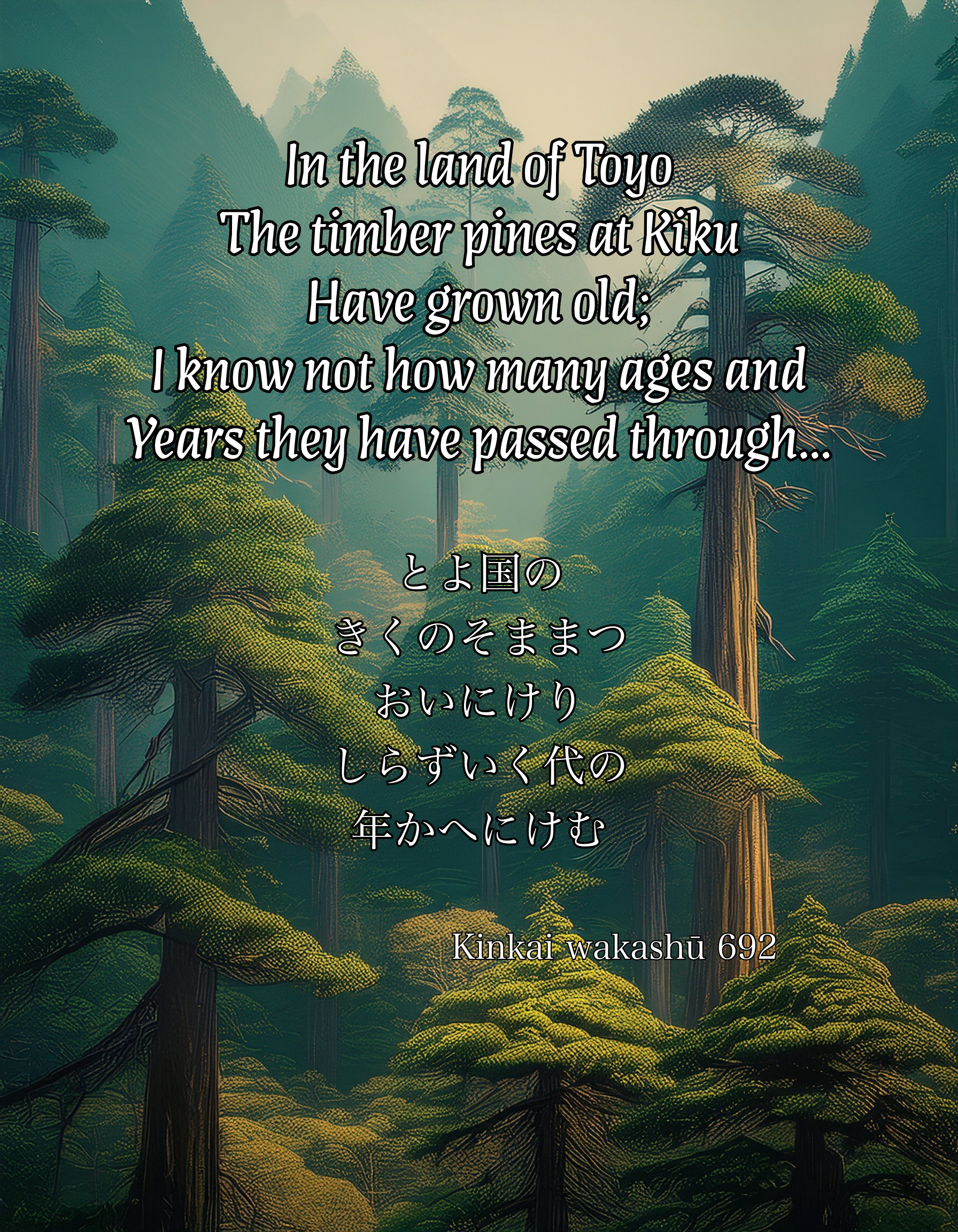
toyokuni no kiku no somamatsu oinikeri shirazu ikuyo no toshi ka henikemu
In the land of Toyo The timber pines at Kiku Have grown old; I know not how many ages and Years they have passed through…[i]
692
[i] See: 豊洲 聞浜松 心裳 何妹 相云始 toyokuni no / kiku no hamamatsu / nemokoro ni / nani shika imo ni / ai’iisomekemu ‘As in the land of Toyo / At Kiku the beach-pines, / Sweetly, / Why has my darling / Begun to meet and talk with me?’ Kakinomoto no Hitomaro Collection (Man’yōshū XII: 3130)