Composed on a large number of travellers being at mountain retreat surrounded by pine trees.
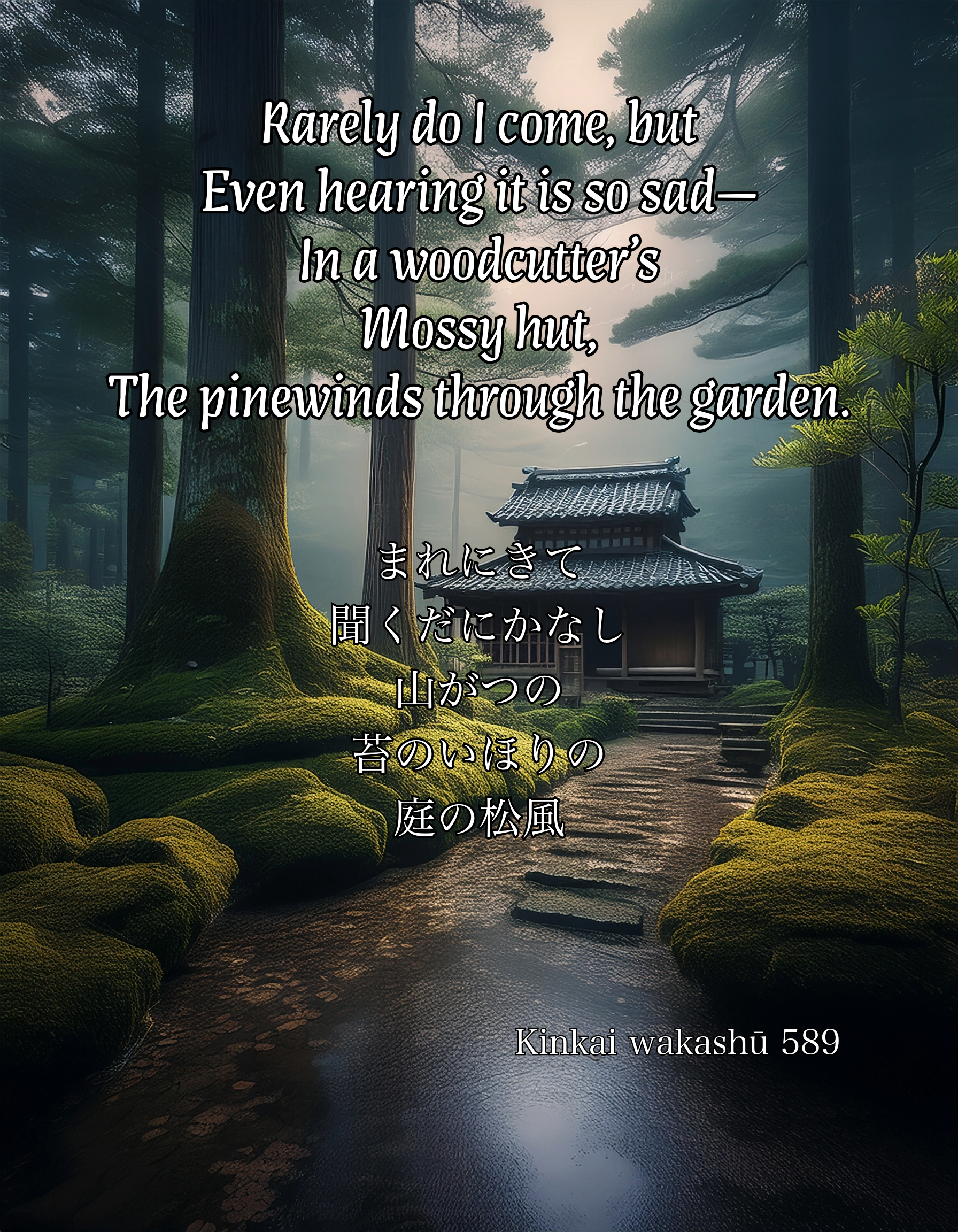
まれにきて聞くだにかなし山がつの苔のいほりの庭の松風
mare ni kite kiku dani kanashi yamagatsu no koke no iori no niwa no matsukaze
Rarely do I come, but Even hearing it is so sad— In a woodcutter’s Mossy hut, The pinewinds through the garden.[i]
589
[i] See: After the death of Sada’ie’s mother, around autumn time he was staying at a temple near her grave and composed this. まれにくる夜はもかなしき松風をたえずやこけのしたにきくらん mare ni kuru / yo wa mo kanashiki / matsu kaze o / taezu ya koke no / shita ni kikuran ‘Rarely did I come / At nights now I sorrowfully / Pine trees in the wind / Unceasingly beneath the moss / I wonder will you hear it?’ Master of the Dowager Empress’ Household Office Toshinari (Shinkokinshū VIII: 796)
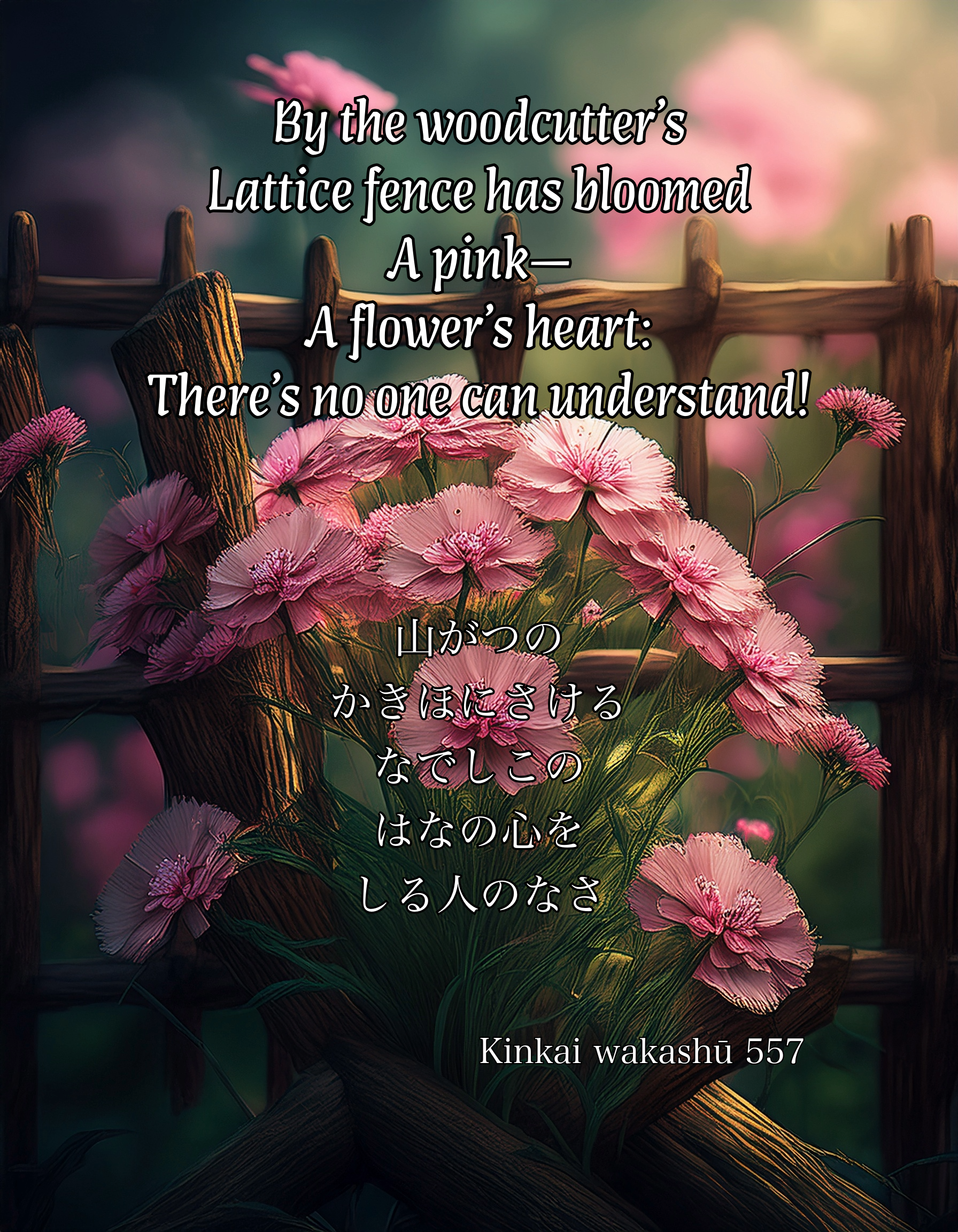
yamagatsu no kakio ni sakeru nadeshiko no hana no kokoro o shiru hito no nasa
By the woodcutter’s Lattice fence has bloomed A pink— A flower’s heart: There’s no one can understand!
557
[i] Topic unknown. あなこひし今も見てしか山がつのかきほにさける山となでしこ ana koishi / ima mo miteshika / yamagatsu no / kakio ni sakeru / yamato nadeshiko ‘O, how sweet! / And how I long to see / The woodcutter’s / Lattice fence, where blooms / My darling Yamato pink!’ Anonymous (KKS XIV: 695)
kumo kakaru takashi no yama no akegure ni tsuma madowaseru oshika naku nari
All hung about with cloud On Takashi Mountain In the gloaming Having lost his mate A stag bells out.
Nakamasa 11
Right
山がつの先あかつきをしりがほに裾野に出でて鹿ぞ鳴くなる
yamagatsu no mazu akatsuki o shirigao ni susono ni idete shika zo naku naru
A mountain man First of all, that ‘tis dawn Knows plain upon his face, As he sets out upon the slopes As a stag bells out!
Head 12
The Left poem’s conclusion, ‘Having lost his mate / A stag bells out’ seems no different from that of a poem by Gō no Jijū in poetry match held by the First Princess.[1] As for the poem of the Right’s ‘A mountain man / Awaits the dawn / Knowing plain upon his face’—what on earth might a mountain man look like while waiting for dawn? There is the tale of Hangu Pass in Cathay, where the barrier guard was waiting for dawn and opened the gate after hearing a cock’s crow, but the expression ‘a mountain man awaits the dawn’ has never appeared before in a poem—either one of Cathay or in the words of Yamato, so I feel that both Left and Right lack any superlative qualities.
[1] Stags. をぐら山たちどもみえぬゆふぎりにつままどはせるしかぞなくなる ogurayama / tachidomo mienu / yūgiri ni / tsuma madowaseru / shika zo nakunaru ‘On gloomy Ogura Mountain / Stands unseen / Among the evening mists / Having lost his mate / A belling stag.’ (Yūshi naishinnō-ke uta’awase eishō go-nen 27). This event was held at the residence of Imperial Princess Sukeko (Yūshi) on the 5th day of the Sixth Month, Eishō 5 [26.10.1050]. The poem won its round, and was later included in Goshūishū (IV: 292).
The Right state, ‘it is normal diction to say ‘roughly’ (arate) ‘hang’ (kaku). Is it possible to also use ‘twine’ (kumu)?’ In response from the Left, ‘Yes, one can.’ The Left have no criticisms to make of the Right’s poem.
Shunzei states, ‘Both poems are equally lacking in faults or merits. Whether one uses “roughly” twining or hanging, neither is particularly superlative, I think. “Her time is pledged” (chigiri no hodo ya) seems somehow lacking , too. This round must tie.’
The Right grumble that ‘alone, she turns’ (sashi nomi mukau) is ‘grating on the ear’, while the Left wonder if ‘gardlands’ (motenasu) is appropriate (it’s not standard in the lexicon of poetry).
Shunzei simply says, ‘Both poems are equally lacking in faults or merits, but yet I feel the Right should win.’