Tag Archives: yamazato

Eien narabō uta’awase 06

Round Six

Left (Win)

やへざくらふるきみやこににほへどもふりずもはなのめづらしきかな

yaezakura
furuki miyako ni
nioedomo
furizu mo hana no
mezurashiki kana
Eightfold cherry
Around the ancient capital
Does glow, yet
Unfallen and anew, the blossoms
Are remarkable!

Cell of Fragrant Cloud
11

Right

みやこいでてかりそめにこし山ざとの花に心のからめられぬる

miyako idete
karisome ni koshi
yamazato no
hana ni kokoro no
karamerarenuru
Departing the capital
On occasion I make my way
To a mountain retreat where
The blossoms my heart
Have entangled.

Cell of Compassionate Light
12

The Left’s poem is a clear example of the overlayed diction fault. As for the Right’s poem, saying ‘have entangled’ is extremely overblown diction. Whatever sort of poem it might be, this expression would be unacceptable, wouldn’t it! Was this, perhaps, composed with an imperfect understanding of the Kawara Minister’s poem? That goes ‘For the scented / Breeze has yet to blow…’[1] Perhaps this is a misreading of a character in the poem’s text?[i] The Left has the fault of overlayed diction, and the Right…[ii]

The Left’s poem is extremely charming. I do have to say that having both ‘ancient’ (furuki) and ‘unfallen’ (furizu) is a fault and yet, this should not be criticized excessively. The poem of the Right’s ‘On occasion I make my way’, too, does not seem as if the poet is visiting the blossom, and so is lacking in sentiment. The concluding ‘have entangled’ is a piece of overblown diction, although it is not the case that it does not appear in prior poetry,[2] but I still feel that it grates on the ear a bit.


[1] When he participated in an archery display, during the reign of the Jōgan emperor [Seiwa]. けふ桜しづくにわが身いざぬれむかごめにさそふ風のこぬまに kyō sakura / shizuku ni wa ga mi / iza nuremu / kagome ni sasou / kaze no konu ma ni ‘Today let cherry blossom / Droplets my body / Drench! / For the scented / Breeze has yet to blow…’ The Kawara Minister of the Left (GSS II: 56)

[2] 美知乃倍乃 宇万良能宇礼尓 波保麻米乃 可良麻流伎美乎 波可礼加由加牟 michi no e no / umara no ure ni / haomame no / karamaru kimi o / hagareka yukamu ‘At the roadside / The briar rose tips / By bean vines / Are entangled, but from you / My love, I must depart…’ Hasetsukabe no Tori (MYS XX: 4352)


[i] Mototoshi is suggesting that Sōen has misread kagome かこめ in Minamoto no Tōru’s famous earlier poem as karame からめ, which would have been possible if reading a handwritten text.

[ii] There is a lacuna in Mototoshi’s judgement here, but it is clear from what he has said that he disapproved of both poems this round and so it would have been a tie.

Naidaijin-ke uta’awase 12

Round Twelve

Left (T – Win)

柞原紅ふかく染めてけり時雨の雨はいろなけれども

hahasowara
kurenai fukaku
sometekeri
shigure no ame wa
iro nakeredomo
The oak groves
Deeply scarlet
Have been dyed,
Though the rain shower
Lacks any hue at all…

Lord Shigemoto
23

Right (M – Win)

山里はならのから葉の散敷きてしぐれの音もはげしかりけり

yamazato wa
nara no karaba no
chirishikite
shigure no oto mo
hageshikarikeri
My mountain retreat has
The oaks’ withered leaves
Scattered and spread around, so
The sound of showers is all
The more severe.

Lord Tamezane
24

Toshiyori states: the ‘oak grove’ poem, saying that plants fade and autumn leaves are dyed by things like dew and frost is as unremarkable as saying that one’s sweetheart’s skirt trails down. The ‘mountain retreat’ poem has ‘the oaks’ withered leaves’ and this is problematic. It would certainly have been better to avoid using ‘withered leaves’. In addition, I wonder about saying ‘the sound of showers is severe’? I feel it would be better to use this when looking down on the stony valley gate from the high peak of Mount Arachi. The first poem is slightly superior.

Mototoshi states; the poems of Left and Right are about the same quality, but the Left’s poem lacks a conception of showers and is entirely a poem on scarlet leaves, so in the current context ‘oaks’ withered leaves’ is slightly superior.

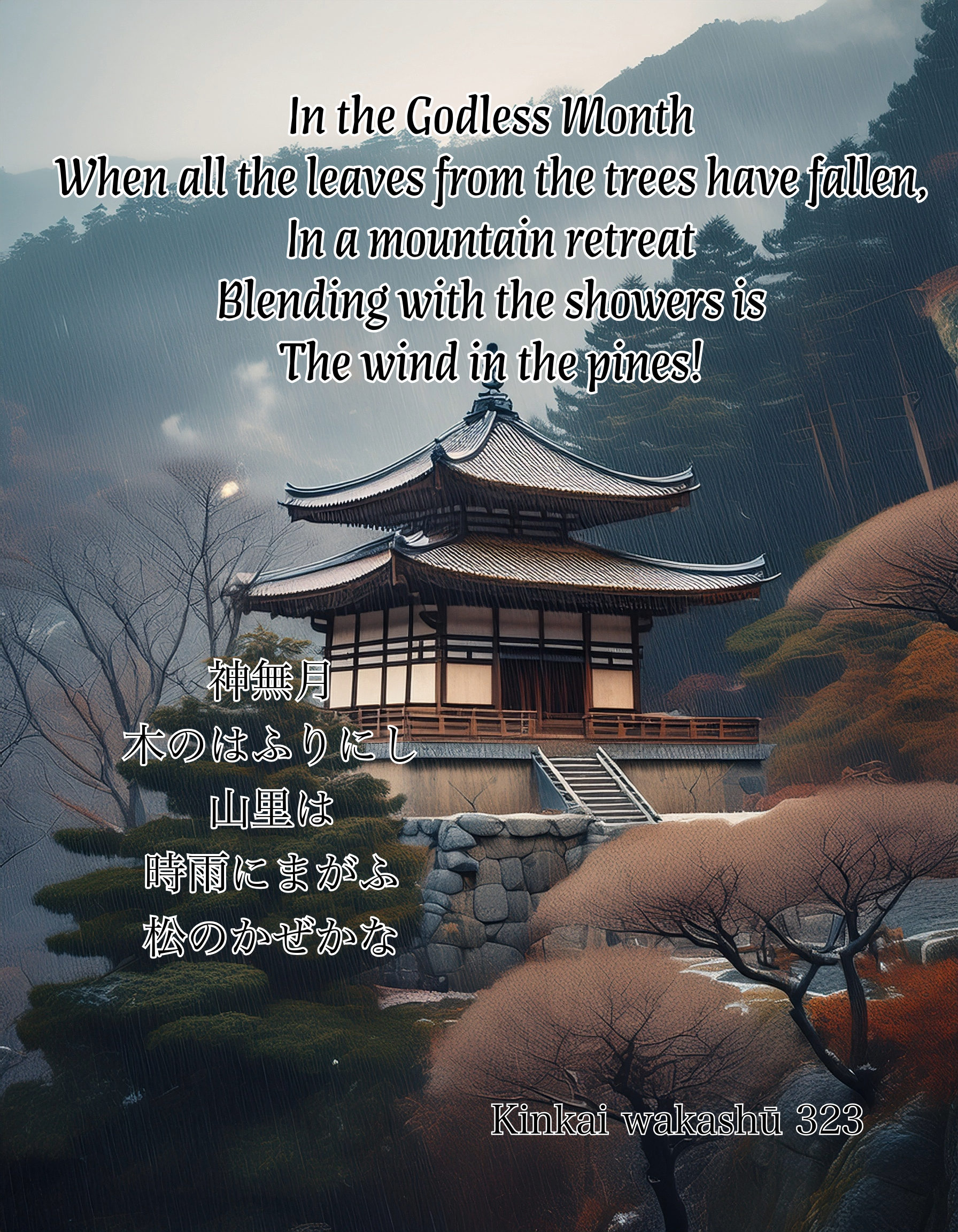
Kinkai wakashū 323

The wind through the pines sounding like a shower

神無月木のはふりにし山里は時雨にまがふ松のかぜかな

kamidazuki
ko no ha furinishi
yamazato wa
shigure ni magau
matsu no kaze kana
In the Godless Month
When all the leaves from the trees have fallen,
In a mountain retreat
Blending with the showers is
The wind in the pines!

Daikōtaigōgū no suke taira no tsunemori-ason ke uta’awase 24

Round Twelve

Left (Tie)

あらし吹くまくずが原に鳴く鹿は恨みてのみや妻をこふらん

arashi fuku
makuzu ga hara ni
naku shika wa
uramite nomi ya
tsuma o kouran
Storm winds blow
Across the arrowroot upon the plain
Where bells a stag—
Might it be with bitterness, alone, that
He yearns for a mate?

Shun’e
47

Right

山里は妻こひかぬる鹿の音にさもあらぬ我もねられざりけり

yamazato wa
tsuma koikanuru
shika no ne ni
sa mo aranu ware mo
nerarezarikeri
In a mountain retreat,
Filled with too much yearning for his mate
A stag bells out—
‘Tis not true of me, yet
Still I cannot sleep.

Lay Priest Master
48

The Left’s stag’s bell seeming to despise the arrowroot field and the Right’s inability to sleep on hearing a stag belling at a mountain retreat are both evocative of lonely sadness and neither sounds at all inferior to the other in the depths of the emotion they convey, so I find myself quite unable to distinguish between them.

Daikōtaigōgū no suke taira no tsunemori-ason ke uta’awase 23

Round Eleven

Left

さをしかの空にあはれときこゆるは山のたかねになけばなりけり

saoshika no
sora ni aware to
kikoyuru wa
yama no takane ni
nakeba narikeri
A stag belling
To the skies, sadly
I hear—
Perhaps, because ‘tis on the mountain’s peak
He cries so…

Lord Masahira

45

Right (Win)

ゆふまぐれ霧のまがきのさびしさにをしか鳴くなり秋の山里

yūmagure
kiri no magaki no
sabishisa ni
oshika nakunari
aki no yamazato
Tangled in twilight
With mist around my brushwood fence,
Loneliness fills me, as
A stag bells, by
A mountain retreat in autumn

Shinkaku
46

What on earth is the conception of ‘sadly hearing something in the skies’? While no one can truly know why a stag bells, what is the point of saying that ‘sadness is in the skies’? And if one does hear it, it isn’t the case that anyone really knows that the stag is belling out of longing for his mate, is it. The stag seeming to bell by a brushwood fence in the mist, seems to sound a bit more moving at the moment.

GSIS IV: 258

Composed gazing at the moon over Hirosawa.

すむ人もなき山ざとのあきの夜は月のひかりもさびしかりけり

sumu Fito mo
naki yamazato no
aki no yo Fa
tuki no Fikari mo
sabisikarikeri
No folk dwell around
This mountain retreat, where
On an autumn night
The moon’s very light is
Filled with lonliness.

Lord Fujiwara no Norinaga

A kuzushiji version of the poem's text.
Created with Soan.

Kinkai wakashū 57

On an occasion when I had many people compose on the same conception.

さくらばなさきちるみれば山里に我ぞおほくの春はへにける

sakurabana
saki chiru mireba
yamazato ni
ware zo ōku no
haru wa henikeru
When the cherry blossoms’
Early scattering I see,
That in this mountain retreat
I have many a
Springtime spent, I know.
A kuzushiji version of the poem's text.
Created with Soan.