Tag Archives: mountain trails

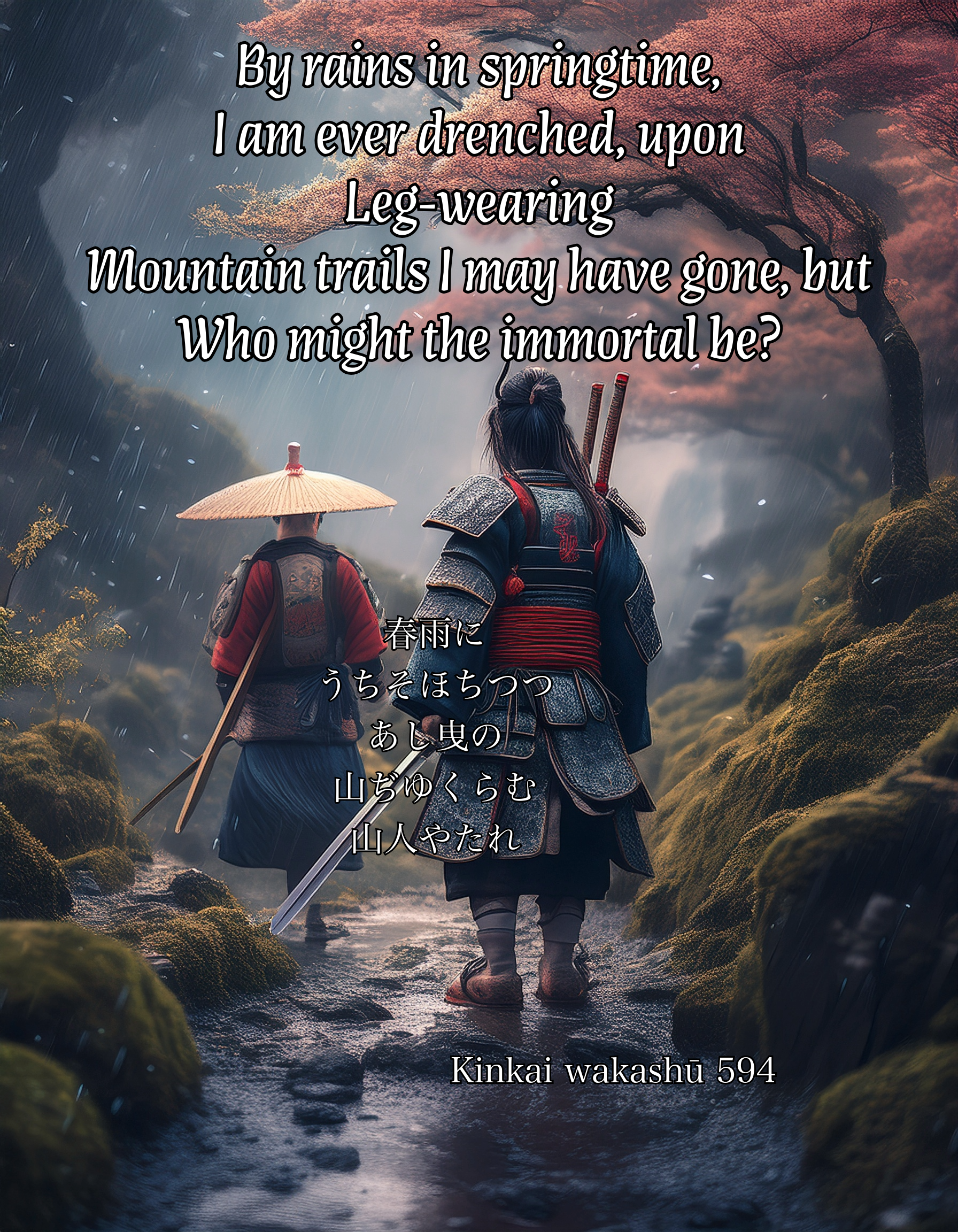
Kinkai wakashū 594

When there was a heavy spring shower falling, on the way back after I had made a pilgrimage to the two places.[i]

春雨にうちそほちつつあし曳の山ぢゆくらむ山人やたれ

harusame ni
uchisōchitsutsu
ashihiki no
yamaji yukuramu
yamabito ya tare
By rains in springtime,
I am ever drenched, upon
Leg-wearing
Mountain trails I may have gone, but
Who might the immortal be?[ii]

594


[i] ‘Two places’ (nisho 二所)  was an abbreviation for ‘manifested deities of two shrines’ (nisho gongen 二所権現) which, in turn, was a reference to Hakone-gongen 箱根権現 and Izu-gongen 伊豆権現, the kami of Hakone shrine and Izuyama Shrine, manifesting as Buddhist deities. Both of these deities were venerated by Minamoto no Yoritomo 源頼朝 (1147-1199), the founder of the Kamakura shogunate, and his wife, Hōjō Masako 北条政子 (1157-1225) and after Yoritomo’s death, shogun’s continued to make an annual pilgrimage to both shrines.

[ii] See: A single poem presented in reply by Prince Toneri. 安之比奇能 山尓由伎家牟 夜麻妣等能 情母之良受 山人夜多礼 ashihiki no / yama ni yukikemu / yamabito no / kokoro mo shirazu / yamabito ya tare ‘To the leg-wearying / Mountains seeming to have gone / An immortal’s / Heart I cannot know, but / Who might that immortal be?’ (Man’yōshū XX: 4294)
Love VII: 6

Left (Tie).
足引の山路の秋になる袖はうつろふ人のあらしなりけり

ashihiki no
yamaji no aki ni
naru sode wa
utsurou hito no
arashi narikeri
Leg wearying
Mountain trails in autumn
Have my sleeves become,
For she fades from my life, as
A departing storm…

Lord Sada’ie.
971

Right.
この世には吉野の山の奧にだにありとはつらき人に知られじ

kono yo ni wa
yoshino no yama no
oku ni dani
ari to wa tsuraki
hito ni shirareji
Within this world, were I
In the Yoshino mountains’
Heart, even so
That cruel
One would know it not!

Jakuren.
972

The Right state: the Left’s poem does not refer to a specific mountain – we wonder whether this is acceptable? In addition, ‘in autumn have my sleeves’ (aki ni naru sode) and ‘she…as a storm’ (hito no arashi) is difficult to understand. The Left state: the Right’s poem has no faults to indicate.

In judgement: in connection with the criticism made of the Left’s poem, I do not feel that it is always essential to refer to a specific mountain. The other matters are, indeed, difficult to understand. The underlying sense of the Right’s poem seems overly pretentious. It is reminiscent of the tales of Boyi and Shuqi, or of Jie Zhitui, and Mount Shouyang and Mount Mian. Really, it does put me in mind of the Four White-Headed Recluses of Mount Shang, where it says, ‘They emerged due to the plans of Zhang Liang, made for Huidi, who said, “Though I may lie down with the greybeards, enjoying Mount Shang myself, all, in the end, are people under Zhang Liang.”’ It is extremely difficult, in the end, to make these sentiments relevant to our own land. Thus, I find it inappropriate to accept the content of the Right’s poem. The Left’s poem has its faults, too, so cursorily, I make this round a tie.