toshi goto ni kitsutsu wa ga miru sakurabana kasumi mo ima wa tachi na kakushi so
Every single year I hear of and gaze upon Cherry blossom: The haze, too, now Arising, don’t hide them!
Nakatsukasa
15
The Left’s poem is extremely charming – that really is how things are.
The Right’s poem: where is it that you always hear of and then see them? This is a bit rough. There’s also no reason to include the expression ‘now’ here. Thus, the Left wins.
[1] A variant of this poem was later included in Shūishū (I: 66).
From a poetry match held during the reign of the Tenryraku Emperor.[i]
あしひきの山がくれなるさくら花ちりのこれりと風にしらるな
asiFiki no yamagakure naru sakurabana tirinokoreri to kaze ni siraru na
Within the leg-wearing Mountains concealed, O, cherry blossom, That you linger and not scatter, I would not have the wind discover!
Shōni no myōbu 少弐命婦
[i] The poetry match in question is Dairi uta’awase – Tentoku yo-nen (‘Palace Poetry Match – Tentoku 4’; 960), held by Emperor Murakami 村上 (924-967; r. 946-967). The poem in the match is slightly different.
When there was a heavy spring shower falling, on the way back after I had made a pilgrimage to the two places.[i]
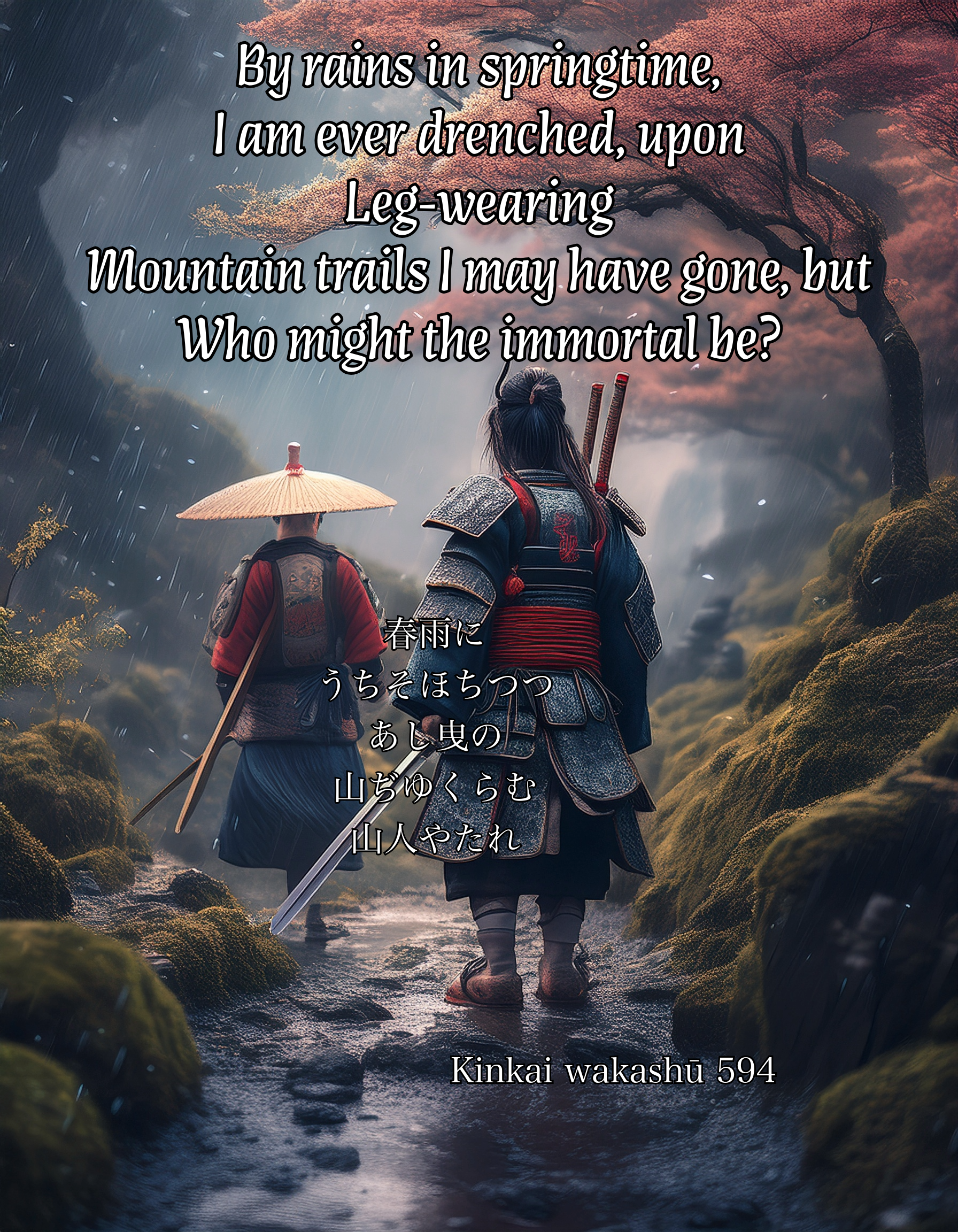
春雨にうちそほちつつあし曳の山ぢゆくらむ山人やたれ
harusame ni uchisōchitsutsu ashihiki no yamaji yukuramu yamabito ya tare
By rains in springtime, I am ever drenched, upon Leg-wearing Mountain trails I may have gone, but Who might the immortal be?[ii]
594
[i] ‘Two places’ (nisho 二所) was an abbreviation for ‘manifested deities of two shrines’ (nisho gongen 二所権現) which, in turn, was a reference to Hakone-gongen 箱根権現 and Izu-gongen 伊豆権現, the kami of Hakone shrine and Izuyama Shrine, manifesting as Buddhist deities. Both of these deities were venerated by Minamoto no Yoritomo 源頼朝 (1147-1199), the founder of the Kamakura shogunate, and his wife, Hōjō Masako 北条政子 (1157-1225) and after Yoritomo’s death, shogun’s continued to make an annual pilgrimage to both shrines.
[ii] See: A single poem presented in reply by Prince Toneri. 安之比奇能 山尓由伎家牟 夜麻妣等能 情母之良受 山人夜多礼 ashihiki no / yama ni yukikemu / yamabito no / kokoro mo shirazu / yamabito ya tare ‘To the leg-wearying / Mountains seeming to have gone / An immortal’s / Heart I cannot know, but / Who might that immortal be?’ (Man’yōshū XX: 4294)