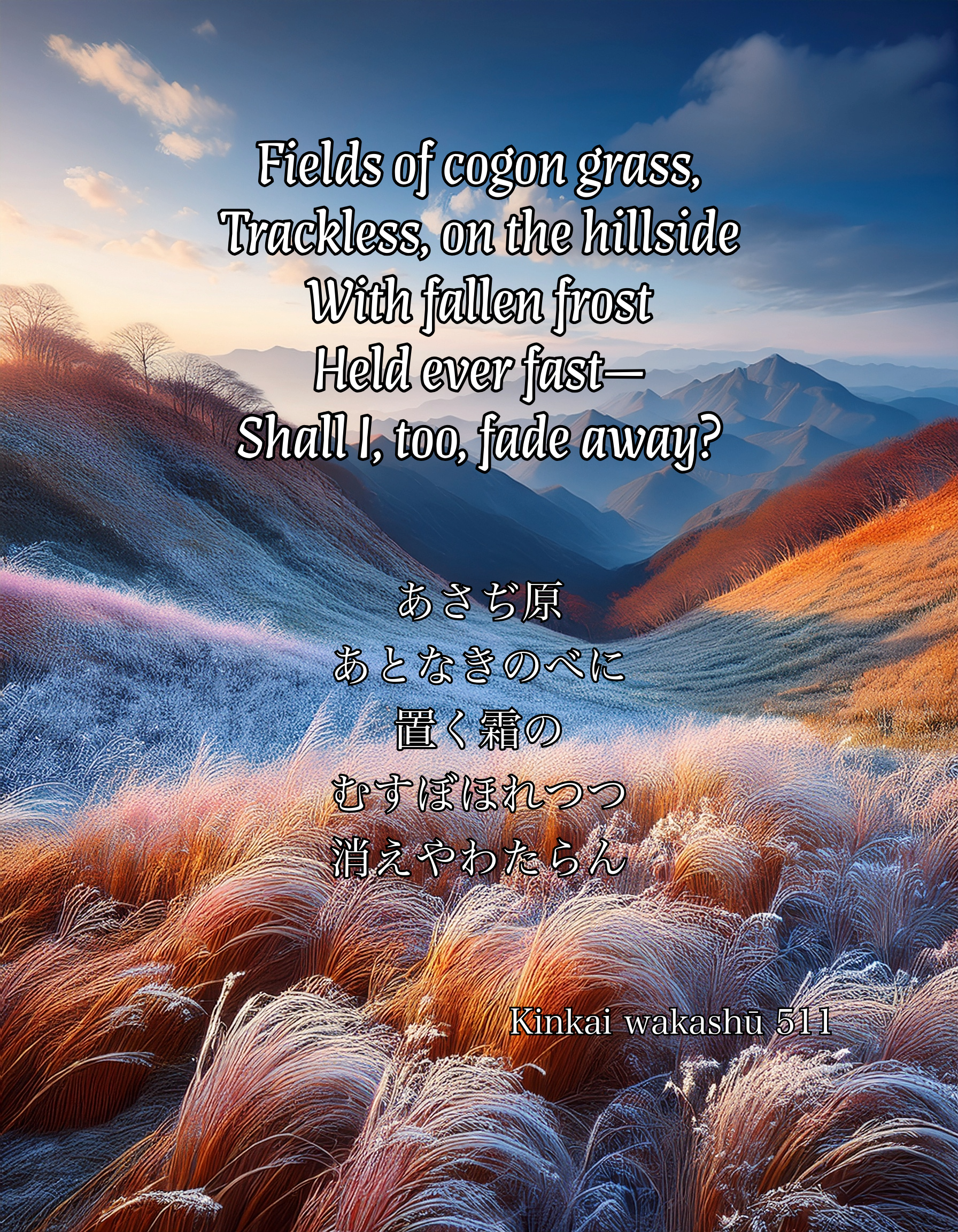
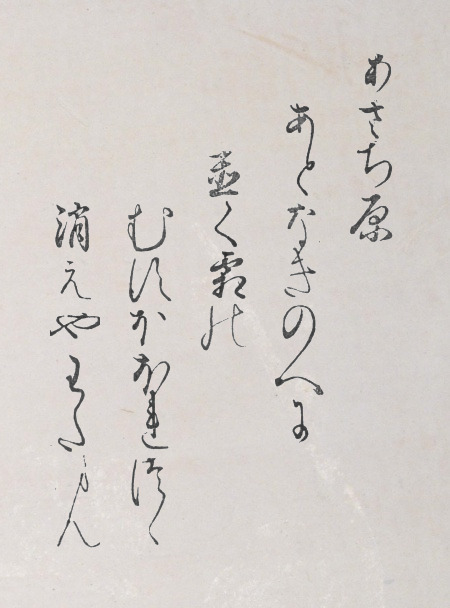
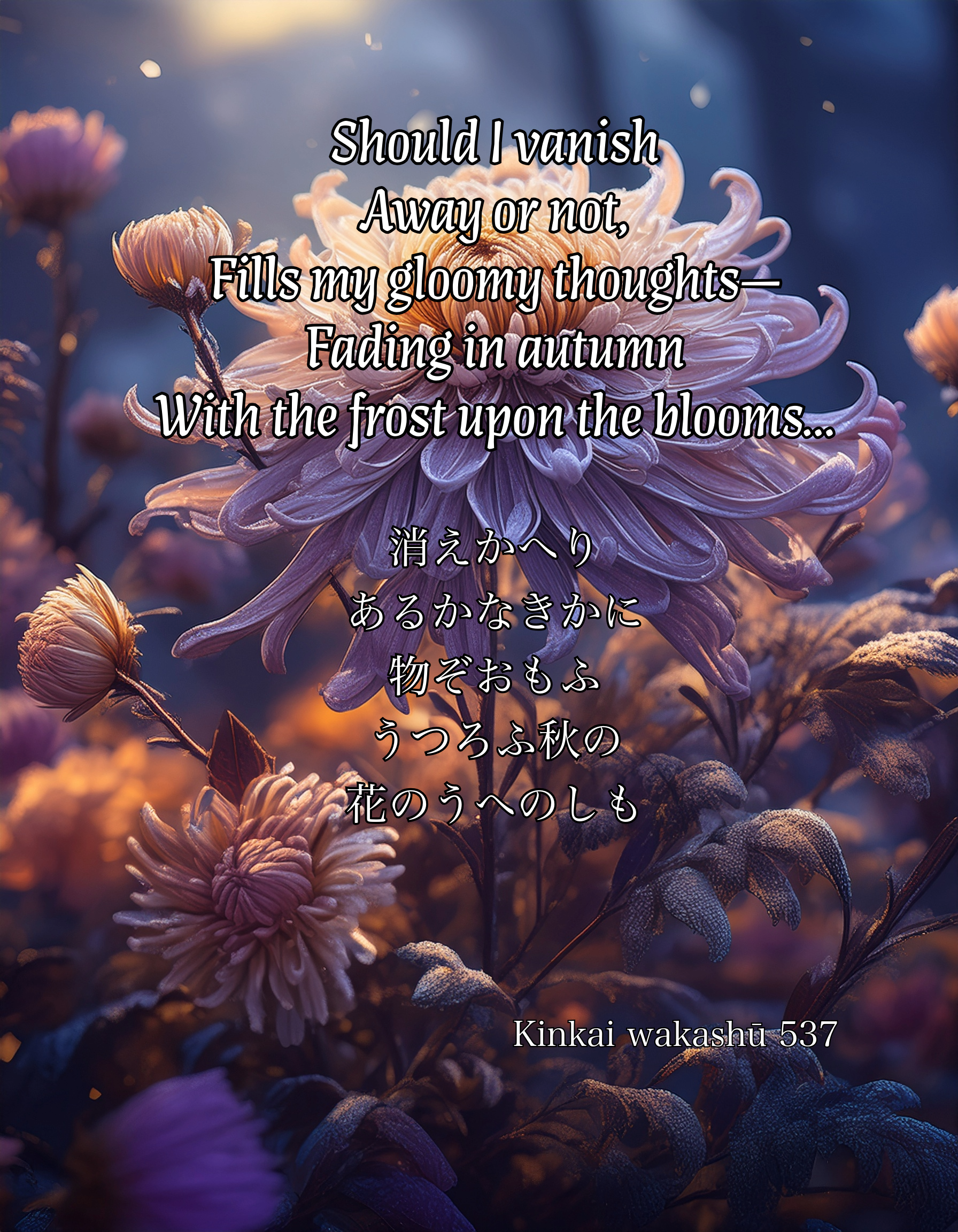
消えかへりあるかなきかに物ぞおもふうつろふ秋の花のうへのしも
| kiekaeri aru ka naki ka ni mono zo omou utsurou aki no hana no ue no shimo | Should I vanish Away or not, Fills my gloomy thoughts— Fading in autumn With the frost upon the blooms… |
537
The Beginning of Winter
Left
ほどもなく冬は来にけり神無月秋はまだきもみえなかくを
| hodo mo naku fuyu wa kinikeri kaminazuki aki wa madaki mo mienakaku o | Before I knew it Winter has arrived! In the Godless Month Autumn has only just Vanished from view… |
23
Right
神無月たてるをみれば白露のむすぼほれたる霜おきにけり
| kaminazuki tateru o mireba shiratsuyu no musubōretaru shimo okinikeri | When, the Godless Month’s Arrival I see, Silver dewdrops Have drenched The fallen frost. |
24


Round Twelve
Left
霜枯に移ひ残る村菊はみる朝ごとにめづらしきかな
| shimogare ni utsuroinokoru muragiku wa miru asa goto ni mezurashiki kana | Burned by frost, Faded and lingering A cluster of chrysanthemums When I see them every morn Strikes me afresh! |
Lord Toshitaka
47
Right (Both Judges – Win)
置くしものなからましかば菊のはな移ふ色をけふみましやは
| oku shimo no nakaramashikaba kiku no hana utsurou iro o kyō mimashi ya wa | Fallen frost Were there none, then Chrysanthemum blooms Faded hues I would not see today… |
Lord Tamezane
48
Toshiyori states: the first poem has nothing remarkable about it, apart from the undesirable use of ‘clustered chrysanthemums’. The second poem’s sense could be that when the frost has fallen, the chrysanthemum won’t display faded hues, but it is a mistake to link frost fall and being able to see them. However, if we interpret is as meaning it has fallen, so we can then view them for a long time, well, I can understand that, and will make it the winner.
Mototoshi states: this poem has no faults, but it does not appear to be a poem suited to a poetry match—it’s just rather dull. The poem of the Right, too, lacks anything worth pointing out and just says that the poet wants to gaze upon faded hues today—this seems a bit cliched, but I’d say it’s superior.


Round Eleven
Left (Both Judges – Tie)
こけのむす岩ねに残る八重ぎくはや千代さくとも君ぞみるべき
| koke no musu iwane ni nokoru yaegiku wa yachiyo saku tomo kimi zo mirubeki | Choked with moss are The crags where linger Eightfold chrysanthemums: E’en were they eight thousand ages a’bloom My Lord would have beheld them, no doubt! |
Lady Shinano
45
Right
霜がれに我ひとりとや白菊の色をかへても人にみすらん
| shimogare ni ware hitori to ya shiragiku no iro o kaetemo hito ni misuran | ‘Burned by frost ‘Tis me alone!’ thinks A white chrysanthemum, Changing hue To show to folk, for sure. |
Lord Tokimasa
46
Toshiyori states: I wonder if there is a poem as precedent for chrysanthemums lingering beneath moss-covered crags? If not, it’s a very crude expression. The ending of the poem is antiquated, too. As for the second poem ‘“Tis me alone!” thinks’ does not sound satisfactory. The assembled company settled the matter of the final ‘folk’, so I must make this a tie.
Mototoshi states: whether they are placed by a brushwood fence, or at the base of a crag, chrysanthemums feel like pines. As for the Right, having a chrysanthemum seem to think ‘‘tis me alone’ is speculative—had it been something like ‘this bloom opens’ then it would have been the poet’s thoughts. Neither of these is of quality to win or lose, so I make them a tie.


Round Ten
Left
植ゑしその心も置かぬ白菊はあだなる霜に移ひにけり
| ueshi sono kokoro mo okanu shiragiku wa adanaru shimo ni utsuroinikeri | I planted them, yet Unconcerned are The white chrysanthemums, For with the faithless frost Have they faded. |
Lord Munekuni
43
Right (Both Judges – Win)
菊のはな夜のまに色やかはれると霜を払ひて今朝みつるかな
| kiku no hana yo no ma ni iro ya kawareru to shimo o haraite kesa mitsuru kana | The chrysanthemum blooms Within the space of but one night their hue Will change, I thought, so Brushing away the frost Will I gaze on them this morn! |
Lord Kanemasa
44
Toshiyori states: the first poem uses ‘unconcerned’, doesn’t it. The second poem’s sequencing is undesirable, yet ‘brushing away the frost’ sounds like that really is the case. It seems superior.
Mototoshi states: one has to ask what on earth a chrysanthemum might be concerned about! As for the Right, ‘Within the space of but one night their hue’ is vague, I think, but ‘brushing away the frost and gazing’ is certainly charming—it is still lodged within my aged heart.


Round Eight
Left (T – Win; M – Tie)
冬枯にうつろひ残る白菊はうは葉に置ける霜かとぞみる
| fuyugare ni utsuroi nokoru shiragiku wa uwaba ni okeru shimo ka to zo miru | Sere in winter, Faded and lingering A white chrysanthemum as, Fallen upon its upper leaves, Frost does appear, perhaps? |
Lord Morikata
39
Right
露じもの暁置きのあさごとに移ひまさるしらぎくの花
| tsuyujimo no akatsuki oki no asa goto ni utsuroi masaru shiragiku no hana | Frosty dewdrops With the dawn fall—arising Every morning Fading fairer become The white chrysanthemum blooms. |
Lord Michitsune
40
Toshiyori states: I have the feeling that I have never heard the expression ‘sere in winter’, and I certainly have no recollection of it being in the Collection of a Myriad Leaves. The poem of the Right is smooth and extremely charming; I’m very familiar with the expression ‘dew fallen in the morning when I arise’, and here there seems to be some reason for it, doesn’t there! Still, the first poem is better.
Mototoshi states: the expression ‘faded and lingering’ is difficult to distinguish. In addition, saying ‘Fallen upon [the flower’s] upper leaves, / Frost’ is a severe misjudgment. The poem of the Right has the tautology ‘with the dawn fall’ and then ‘every morning’. Clearly neither of these appears to win or lose, so I make this a tie.