Tag Archives: frost

Naidaijin-ke uta’awase 17

Round Five

Left (T – Tie; M – Win)

秋はてて霜枯れぬれどきくの花残れる色は深くみえけり

aki hatete
shimogarenuredo
kiku no hana
nokoreru iro wa
fukaku miekeri
With the end of autumn
Burned by frost they are, yet
The chrysanthemum blooms’
Lingering hues
Appear all the deeper.

Lady Shinano
33

Right

白ぎくも移ひにけりうき人のこころばかりとなにおもひけむ

shiragiku mo
utsuroinikeri
ukibito no
kokoro bakari to
nani omoikemu
This white chrysanthemum, too
Has faded; ‘tis simply as
My cruel lady’s
Heart—
I wonder why would I think so?

A Court Lady
34

Toshiyori states: the first poem has ‘With the end of autumn / Burned by frost they are’ and this gives the impression that there is nothing remaining. But saying that autumn has ended, yet one can still see the chrysanthemums, so, in the end, ‘hues appear all the deeper’ means there is a mismatch between the beginning and end of the poem. As for the second poem, it’s a commonplace style of composition to say that you despise someone who has forgotten you, but this is certainly a love poem, and it does not resemble a chrysanthemum one. Nevertheless, there’s nothing particular to point out in this poem and it has some vague parts, so I say this is a tie.

Mototoshi states: the phrase ‘Lingering hues / Appears all the deeper’ doesn’t say what these look like or how they appear. In addition, the poem’s style is not that superlative, and its diction seems halting. With that being said, however, the poem of the Right does not resemble one regretting the chrysanthemums in the slightest. It expresses the feelings of despite between a man and woman who have parted and become distant from each other using the metaphor of the chrysanthemum, and thus the conception of the topic lacks depth, so again the Left has to win.

Naidaijin-ke uta’awase 16

Round Four

Left (M – Tie)

白砂の霜よに置きてみつれども移ふ菊はまがはざりけり

shirotae no
shimo yo ni okite
mitsuredomo
utsurou kiku wa
magawazarikeri
White as mulberry cloth.
Frost has fallen tonight
I see, and yet
The faded chrysanthemums
I can clearly tell apart.

Lord Masakane
31

Right (T – Win)

八重菊の花の袂をあかずとや霜のうはぎを猶かさぬらん

yaegiku no
hana no tamoto o
akazu to ya
shimo no uwagi o
nao kasanuran
Of eightfold chrysanthemum
Bloomed sleeves
I cannot get my fill, but
Is a frosty jacket
Yet laid upon them?

Lord Tadafusa
32

Toshiyori states: the assemble company have stated about the first poem that in the absence of the moon or the stars it would difficult to distinguish chrysanthemums from the frost, and it certainly sounds like this would be the case. In the latter poem, we need to think of who it is that is feeling that they cannot get their fill of bloomed sleeves—the person wearing them should be included, or if the chrysanthemums are, perhaps, the subject, then ‘eightfold chrysanthemum’ is an error. Even so, the style of the poem seems elevated.

Mototoshi states: the poem stating ‘White as mulberry cloth. / Frost has fallen tonight’ is a bit hackneyed, and it then continues ‘The faded chrysanthemums / I can clearly tell apart’—I question whether one would really mistake faded chrysanthemums and frost. As for the Right’s poem, which says ‘Bloomed sleeves / I cannot get my fill’, well, this really is difficult to grasp. I spent quite a bit of time going back and forth agonizing over whether these were a person’s sleeves or those of the chrysanthemum! I feel that the diction in both poems is skillful, but there’s a lack of necessary information, so it’s impossible to decide a winner or loser here.

Naidaijin-ke uta’awase 15

Round Three

Left

万代の秋のかたみになす物はきみがよはひをのぶるしらぎく

yorozuyo no
aki no katami ni
nasu mono wa
kimi ga yowai o
noburu shiragiku
Of ten thousand ages’
Autumns a keepsake
I will make:
My Lord’s age
Extended by a white chrysanthemum!

Lord Akinaka
29

Right

今朝みればさながら霜をいただきて翁さびゆくしら菊の花

kesa mireba
sanagara shimo o
itadakite
okina sabiyuku
shiragiku no hana
When this morn I look
That’s how it is: with frost
Bestowed
A lonesome ancient seems
This white chrysanthemum bloom!

Lord Mototoshi
30

Toshiyori states: this first poem is strongly characterized by felicitation, and that’s about all the fault I can mention. As for the second poem, ‘a lonesome ancient seems’ is certainly an expression I don’t know. Still, if I think of examples from prior poems, ‘lone ancient’ could be interpreted as deriving from ‘dotaged ancient’, but then the conception seems different here, so this is most likely wrong. I can only give a decision once I am certain.

Mototoshi states: ‘Of ten thousand ages’ / Autumns a keepsake / Will make’ resembles Kanemori’s famous work,[1] which has often been alluded to in composition, I think. This poem is charming. ‘Will make’ is an extremely abbreviated expression, and so the final ‘age / Extended by a white chrysanthemum’ appears to have little connection to it. There is Tomonori’ s ‘Dew-dappled / Let us pluck and wear’[2], and also responses sent on the 9th day of the Ninth Month to the residences of Tadamine and Tsurayuki like ‘Bearing droplets / Age is extended by / Chrysanthemums’, aren’t there. Given that’s the case there would be many such keepsakes of extended age. As for the Right’s ‘That’s how it is: with frost / Bestowed / A lonesome ancient seems, well, it seems that just how I composed a poem about lingering chrysanthemums—have I done something wrong?


[1] SIS III: 214

[2] KKS V: 270

Naidaijin-ke uta’awase 14

Round Two

Left

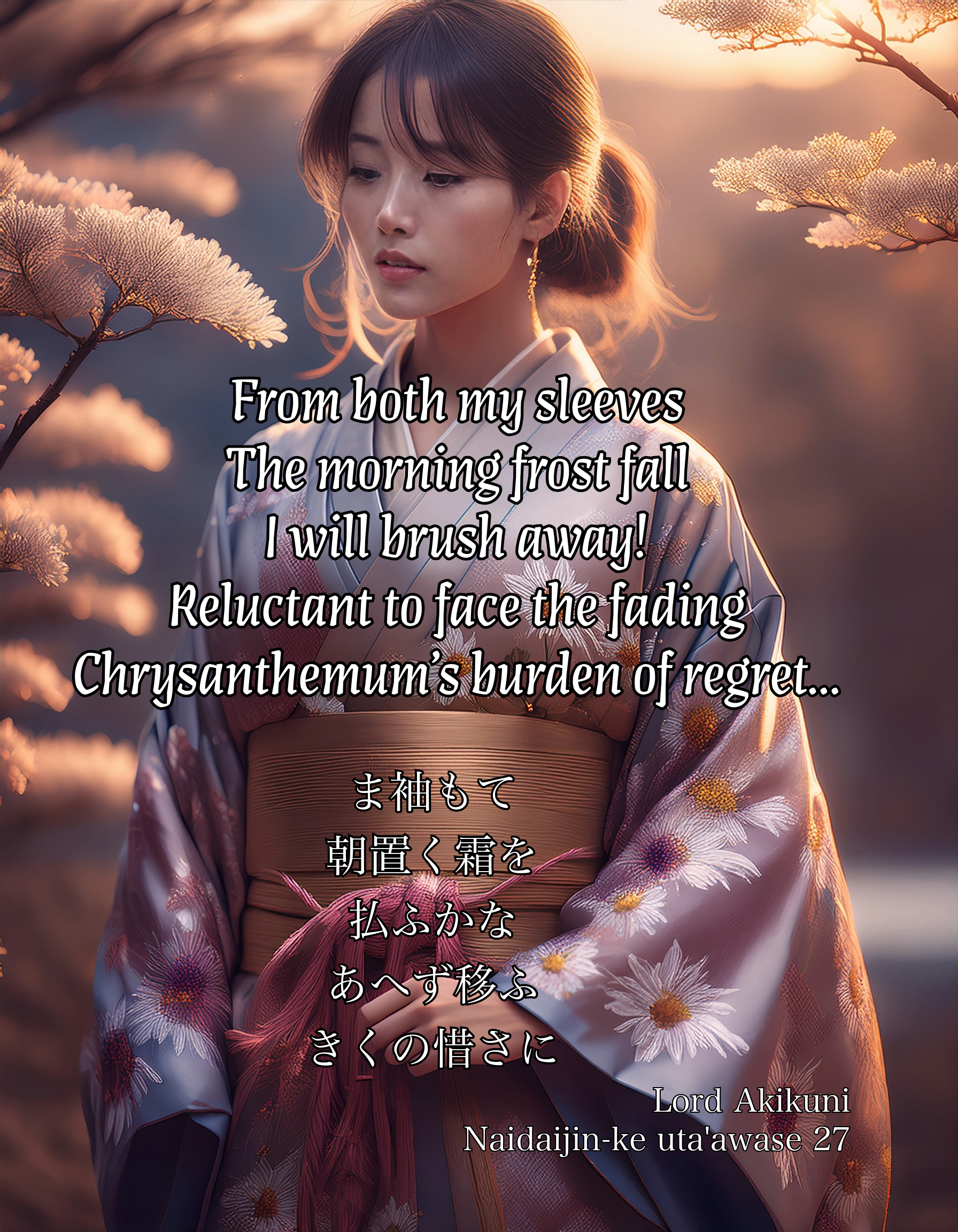
ま袖もて朝置く霜を払ふかなあへず移ふきくの惜さに

masodemote
asa oku shimo o
harau kana
aezu utsurou
kiku no oshisa ni
From both my sleeves
The morning frost fall
I will brush away!
Reluctant to face the fading
Chrysanthemum’s burden of regret…

Lord Akikuni
27

Right (Both Judges – Win)

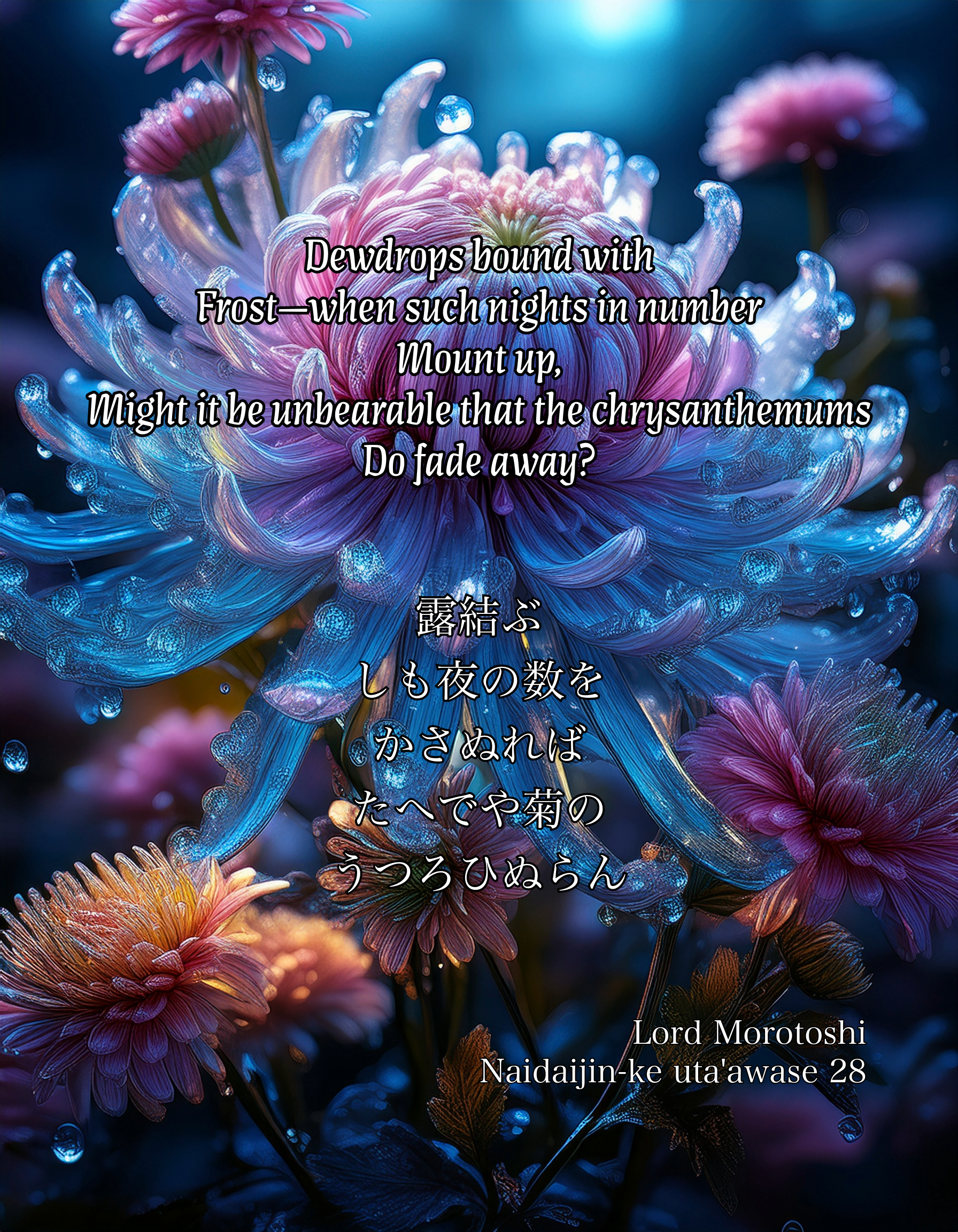
露結ぶしも夜の数をかさぬればたへでや菊のうつろひぬらん

tsuyu musubu
shimo yo no kazu o
kasanureba
taede ya kiku no
utsuroinuran
Dewdrops bound with
Frost—when such nights in number
Mount up,
Might it be unbearable that the chrysanthemums
Do fade away?

Lord Morotoshi
28

Toshiyori states: the first poem is extremely charming. Nevertheless, I must question the use of ‘reluctant to face the fading’ as I feel this is something I have not heard before. I can grasp the sense of diction such as ‘unable to do anything about’ or ‘without taking on autumn hues’, but did the poet mean to use the diction ‘unbearable’, perhaps? Even though this is somewhat archaic phrasing, it is used in composition. This poem’s expressions, though, I feel are somewhat unfamiliar. The conception and diction of the second poem are both extremely charming. However, this poem, too, is vague. What is going on with the initial ‘dewdrops bound’? Does it mean that the dewdrops get turned into frost? If so, then, from what is known of the calendar, this is something which only occurs on a single night, and from the following night there is only frost. It sounds as if the conception of this poem, though, is that night after night dew turns to frost, and this would be a fault. Despite this vagueness, however, its tone is elegant, so it seems superior.

Mototoshi states: the poem of the Left has a poetic configuration, but I strongly feel that it would have been preferable not to use the diction ‘both my sleeves’. It does seem as if this was used in the ancient Collection of a Myriad Leaves, but even given that was the case, in the preface to the Ancient and Modern, I recall it saying, ‘On examining the poems of ancient times, we find they use many archaic expressions. These were there not just to please the ear, but simply for moral instruction’. It appears that there are no instances of this piece of diction being used in poetry matches from the period of the Ancient and Modern, Later Selection and Gleanings, and these were all conducted for entertainment. Even in a poetry match conducted in Engi 12 [912], when the term ‘sleeve’ was used, I get the feeling that it was such a source of amusement that the poem was not recited. While the quality of the Right’s poem is not superb, the tone of ‘Dewdrops bound with  / Frost—when such nights in number’ is not bad, so I feel the dew can still remain bound!

Naidaijin-ke uta’awase 13

Lingering Chrysanthemums

Round One

Left (Both Judges – Win)

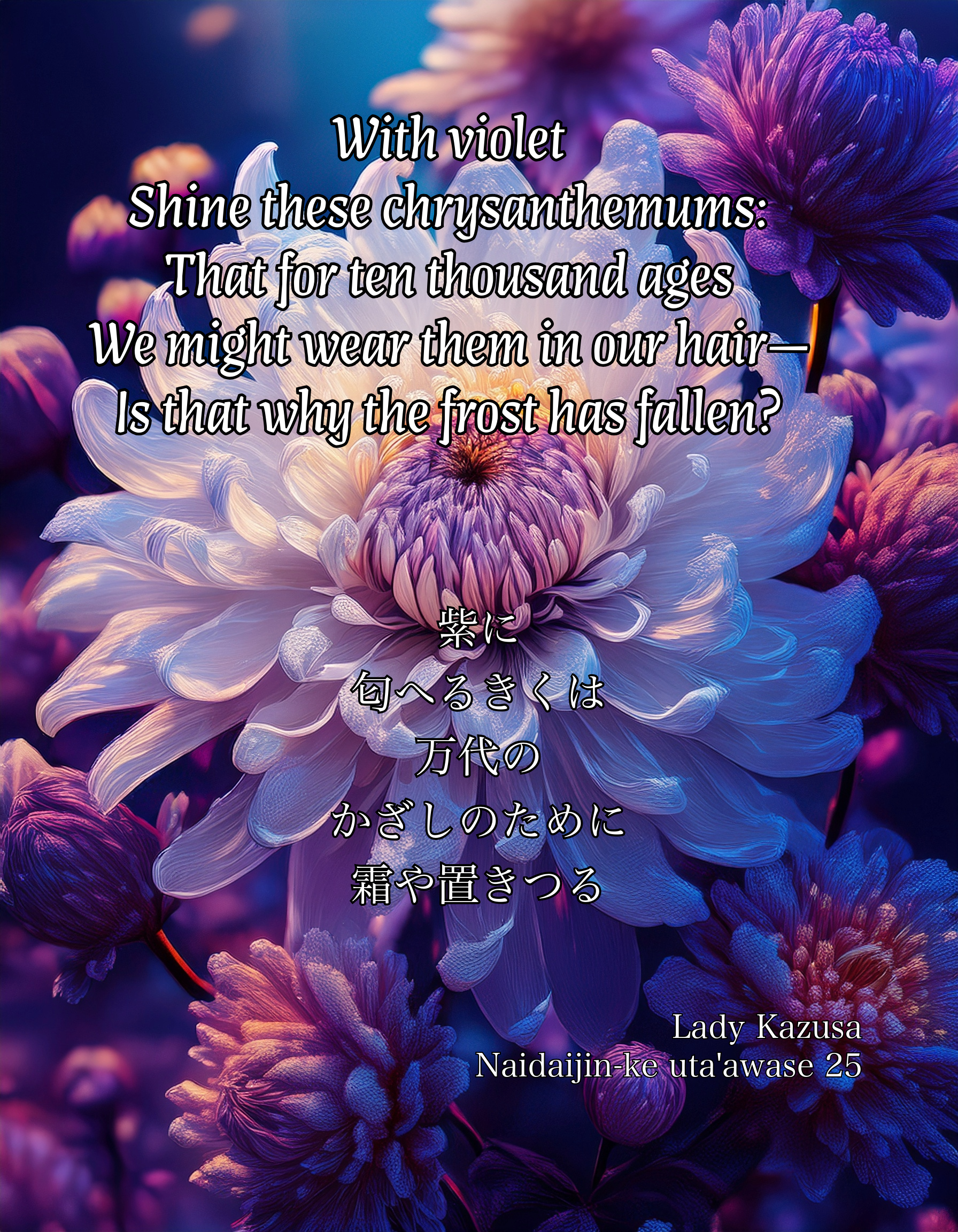
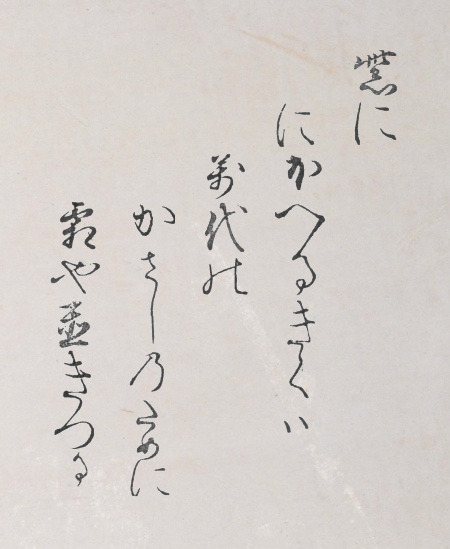
紫に匂へるきくは万代のかざしのために霜や置きつる

murasaki ni
nioeru kiku wa
yorozuyo no
kazashi no tame ni
shimo ya okitsuru
With violet
Shine these chrysanthemums:
That for ten thousand ages
We might wear them in our hair—
Is that why the frost has fallen?

Lady Kazusa
25

Right

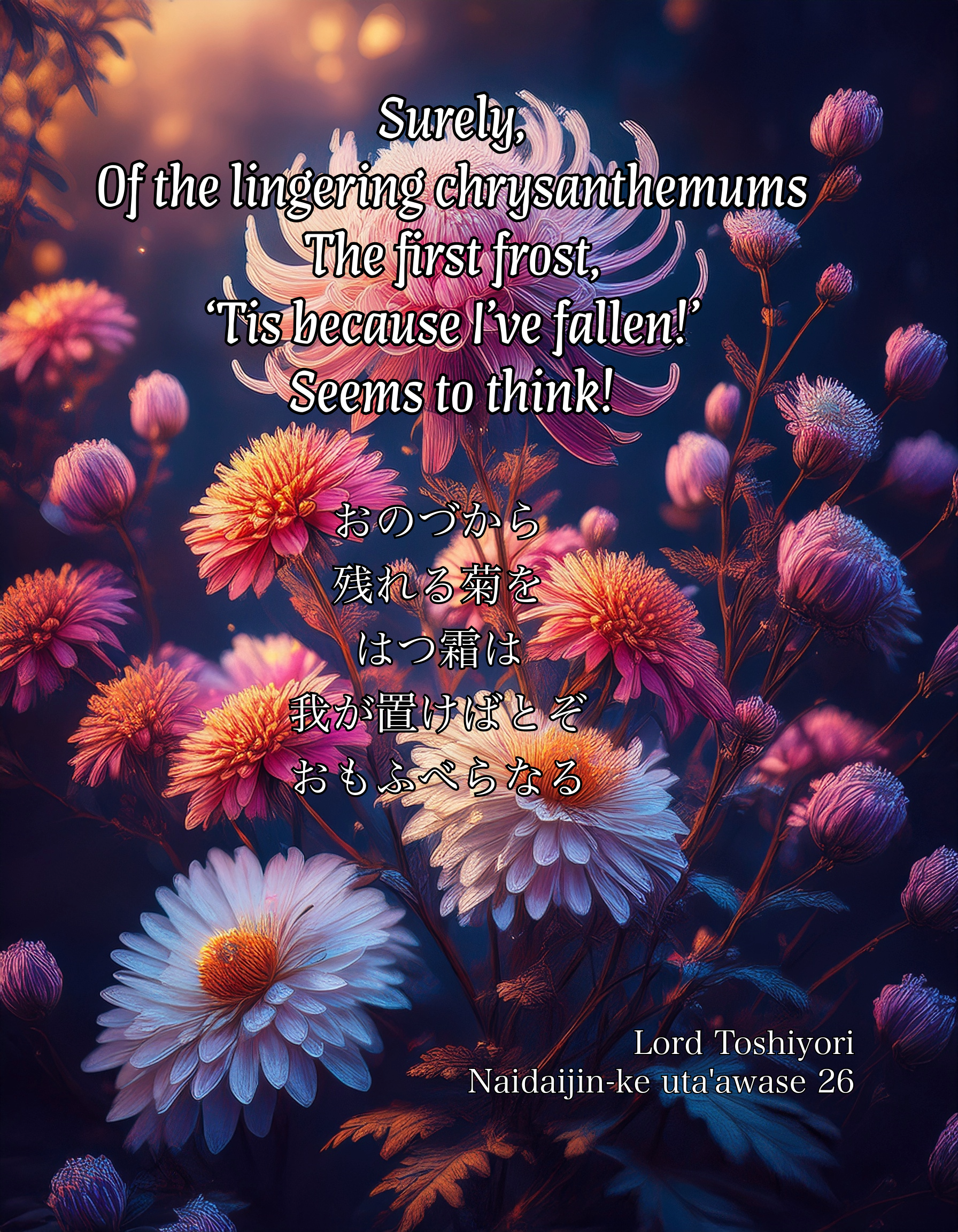
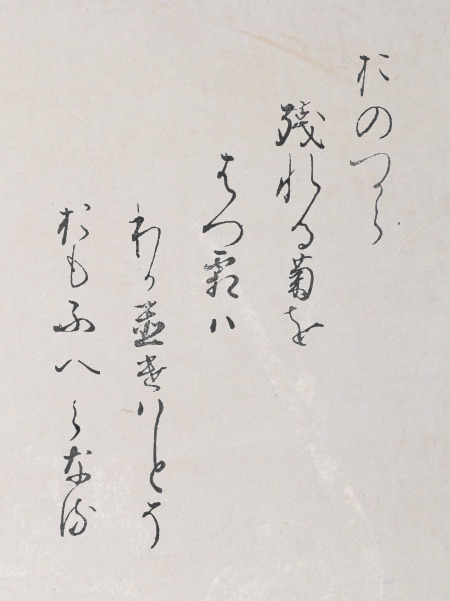
おのづから残れる菊をはつ霜は我が置けばとぞおもふべらなる

onozukara
nokoreru kiku o
hatsushimo wa
wa ga okeba to zo
omouberanaru
Surely,
Of the lingering chrysanthemums
The first frost,
‘Tis because I’ve fallen!’
Seems to think!

Lord Toshiyori
26

Toshiyori states: while the first poem is not remarkable, it does sound smooth. The concluding ‘has fallen’, though—would it be excessive to say that I feel it’s a bit grating? In the second poem, the assembled company have stated that ‘seems to’ is something that they have never heard before in their lives and given that they have said that this is what it sounds like, I make the Left the winner.

Mototoshi states: ‘With violet / Shine these chrysanthemums’ sounds appropriately poetic, but saying ‘that…we might wear them in our hair’ followed by the final ‘has fallen’ is a sequencing that is, in great part, inharmonious and lacking in gentle beauty. Nevertheless, I feel that the second poem’s ‘Surely, / Of the lingering chrysanthemums’ and the final ‘seems to’ is so unfamiliar that it makes me wonder what is going on with the sequencing there, so a single dipping in violet dye is superior and, I feel, all the sweeter!