Tag Archives: kazu

Eien narabō uta’awase 34

Round Six

Left (Win)

うれしさはおほつのはまにたつなみのかずもしられぬきみがみよかな

ureshisa wa
ōtsu no hama ni
tatsu nami no
kazu mo shirarenu
kimi ga miyo kana
My joy is
Great, as upon Ōtsu Beach
Break waves
In numbers quite unknown,
Such is my Lord’s reign most fair!

Cell of Fragrant Cloud
67

Right

かすがやまみねのしらがしよろづよをきみにといへばかみもいさめず

kasugayama
mine no shiragashi
yorozuyo o
kimi ni to ieba
kami mo isamezu
Kasuga Mountain has
White-barked evergreen oaks upon its peak:
‘Ten thousand generations
For my Lord!’—should I say that,
The God will surely not refuse!

Cell of Compassionate Light
68

The poem of the Left’s ‘Great, as upon Ōtsu Beach’ and what follows is something that sounds grievously prosaic. With that said, there are many parts of the poem which are not. What is the poem of the Right’s ‘White-barked evergreen oaks on its peak / Ten thousand generations’ linked with in the remainder of the poem? I wonder what it’s composed about… The Left doesn’t contain any errors, so I still say it wins.

The Left’s poem, as I have said in an earlier round, appears to lack smoothness. Is the poem of the Right’s ‘white-barked evergreen oaks’ a long-standing expression? I can’t seem to recall a prior precedent. ‘The God will surely not refuse’ is vague, too. Is it asking the deity’s favour for the speaker? While I am somewhat hesitant, given my appallingly constricted knowledge, I will, fearfully, say that this is inferior.

Eien narabō uta’awase 33

Round Five

Left

君がよはながゐのうらのはまかぜにたつしらなみのかずもしられず

kimi ga yo wa
nagai no ura no
hamakaze ni
tatsu shiranami no
kazu mo shirarezu
My Lord’s reign:
At Nagai Bay
The beach breezes
Rouse the whitecaps
In number entirely unknown.

Controller’s Graduate
65

Right

きみがよをまつちのやまのこまつばらちよのけしきを見るぞうれしき

kimi ga yo o
matsuchi no yama no
komatsubara
chiyo no keshiki o
miru zo ureshiki
My Lord’s reign
Awaiting upon Matsuchi Mountain
The pine seedling groves
The sight for a thousand ages
Joyfully will see!

Kerin’in Graduate
66

It’s impossible to decide on a winner or loser between the Left and the Right here in terms of conception, diction and overall style. To put it in general terms, I must make this round a further tie.

Neither Left nor Right is remarkable, but nor do they have any faults to mention. I’d make this round a tie.

Eien narabō uta’awase 32

Round Four

Left

うちむれていはねにねざすこまつばのきぎのちとせはきみぞかぞへむ

uchimurete
iwane ni nezasu
komatsuba no
kigi no chitose wa
kimi zo kazoemu
Crowding
At the crags’ foot, roots stretching,
The dwarf pines’ needles with
The trees’ thousand years—
My Lord may count them all!

Cell of the Fragrant Elephant
63

Right (Win)

たとふべきものこそなけれ君がよははまのまさごもかずなからめや

tatoubeki
mono koso nakere
kimi ga yo wa
hama no masago mo
kazu nakarame ya
A suitable metaphor
Is there none, at all!
My Lord’s reign:
Even the fair sands on the shore
Would not exceed its number…

Cell of Everlasting Truth
64

Both of the Left poem’s expressions, ‘crowding’ and ‘dwarf pines’ needles’, seem to sound awkward. ‘Crowding’ is used of cranes, while it would have been preferable to say ‘the needles of the dwarf pines’. The poem of the Right is not especially charming, but it is in a familiar style, so I feel that ‘the fair sands’ number’ is superior.

I feel that ‘crowding’ is better applied to human beings. Perhaps there’s a conception here of looking down on each and every one? This is a mistake, isn’t it? In addition, what is ‘dwarf pines’ needles’? Maybe the poet is trying to say ‘the needles of the dwarf pines’? Is there a prior poem as precedent? It’s a piece of awkward-sounding diction! The Right’s poem appears straightforward, but without errors.

Eien narabō uta’awase 30

Round Two

Left (Win)

君がよはあまのいはとをいづるひのいくめぐりてふかずもしられず

kimi ga yo wa
ama no iwato o
izuru hi no
iku meguri chō
kazu mo shirarezu
My Lord’s reign:
Since from the stone door in the heavens
Emerged the sun,
‘How many circuits has she made?’, they ask—
A number quite unknown.

Lord Saburō
59

Right

みかさやまふもとのさとはあめのしたふるにおもひもあらじとぞ思ふ

mikasayama
fumoto no sato wa
ame no shita
furu ni omoi mo
araji to zo omou
At Mikasa Moutain’s
Foot, in a hamlet
‘neath the heavens
Passing time—painful thoughts
There I’d have not a one, I feel!

Ushigimi
60

The Left’s poem goes beyond the general flow of diction, containing mystery and depth. I have to say it is truly superior. While the Right’s poem has no faults to mention, it has yet to emerge from prosaic expression. Thus, the Left wins.

The ‘stone door in the heavens’ is that which the supreme sun-deity Amaterasu stood before and then entered. But when we’re talking about dawn breaking at the end of night, we say ‘gates of heaven’. Which of these two was did the poet have in mind, I wonder? If he was thinking of dawn breaking, then the usage is erroneous, but even if he did mean ‘stone door of the heavens’, then do we use this about the circuits of the sun? This is vague. In addition, the final ‘they ask’ is difficult to pronounce. As for the Right’s poem, ‘‘neath the heavens’ lacks emotion. The dual use of ‘thoughts’ and ‘feels’, as I have already remarked, is not an error, but does grate on the ears a bit.

Eien narabō uta’awase 20

Round Six

Left

あきの夜のありあけのつきはくまもなしあさくらやまもなのみこそあらめ

aki no yo no
ariake no tsuki wa
kuma mo nashi
asakurayama mo
na nomi koso arame
At an autumn night’s
Dawn, the moon
Has not a cloud before it;
The Mount of Morning Dark
May be so in name alone!

Cell of Fragrant Cloud
39

Right (Win)

秋の月あかしのうらはなびきもにすむわれからのかずも見つべし

aki no tsuki
akashi no ura wa
nabikimo ni
sumu warekara no
kazu mo mitsubeshi
The autumn moon is
Bright above Akashi Bay;
Among the trailing seaweed
Dwell tiny shrimp,
Their number now clear to my eyes.

Cell of Compassionate Light
40

The poem of the Left is an entirely tedious composition. It simply states that a cloudless autumn moon does not fit with the place name, Mount Asakura. The moon at ‘dawn’ is the same as the moon at ‘dawntime’, while Mount Asakura is used when dawn has completely finished. As for the poem of the Right, while the moon is described as bright, it doesn’t seem right to then make it a poem about trailing seaweed—this does not seem charming at all. This round, too, there’s not much more I can say than that.

As I have already mentioned, ‘moon at dawn’ in the poem of the Left is an expression which it is impossible to say is praiseworthy. Even more so, really, the concluding ‘may be so in name alone’ just says ‘is so in name alone’, doesn’t it? It’s contrary to reason to say that it’s fluent and thus, and I say this reluctantly, it’s difficult to understand. As for the Right’s poem, I don’t understand this either: it ought to be ‘their numbers, too, I have been able to see’—saying ‘their number now clear to my eyes’ implies that you haven’t previously been able to see them up to that point, and it’s vague about when you have. Even so, it’s getting light, so the light of the moon at dawn seems superior.

Entō ōn’uta’awase 38

Round Thirty-Eight

Left

今更にふしもさだめぬ鹿の音よ木葉の数のつもるよごとに

ima sara ni
fushi mo sadamenu
shika no ne yo
ko no ha no kazu no
tsumoru goto ni
At around this time,
With his bedding undecided,
The stag bells out!
Just as the leaves’ from on the trees numbers
Do mount up…

Shō
75

Right (Win)

木葉ちる夜半の嵐の月影に心すみてや鹿も鳴くらん

ko no ha chiru
yowa no arashi no
tsukikage ni
kokoro sumite ya
shika mo nakuran
Leaves scatter from the trees
In the midnight storm
In the moonlight
From his wild and earthy thoughts
Does the stag, too, cry out?

Nagatsuna
76

The Left’s ‘just as the leaves from on the trees numbers do mount up’ at night and so forth, appears to be a novel style, yet the Right poem sounds more gorgeous, so it wins.

Kinkai wakashū 466

三熊野のうらのはまゆふいはずとも思ふ心の数をしらなん

mikumano no
ura no hamayū
iwazu tomo
omou kokoro no
kazu o shiranan
At fair Kumano,
Lilies on the beach
Say nothing, yet
The yearnings in my heart for you
In number I would have you know![1]

466


[1] An allusive variation on: [One of] Four poems by Hitomaro, Lord Kakinomoto. み熊野の浦の濱木綿百重なす心は思へど直に逢はぬかも mikumano no / ura no hamayū / momoe nasu / kokoro wa omoedo / tada ni awanu kamo ‘At fair Kumano / Lilies on the beach / A hundred deep / My heart’s yearning, but / Never will we meet.’ (MYS IV: 496)

Naidaijin-ke uta’awase 14

Round Two

Left

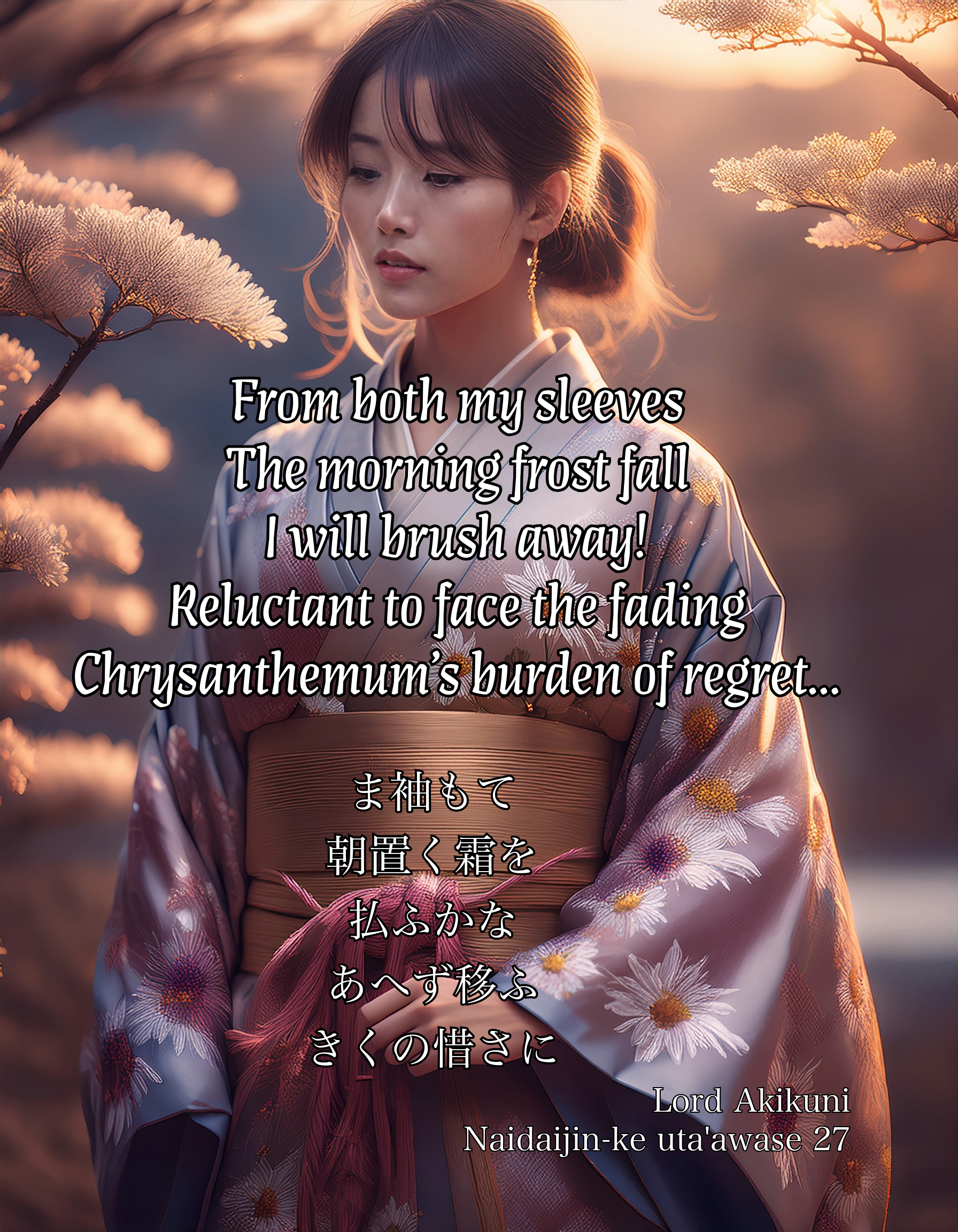
ま袖もて朝置く霜を払ふかなあへず移ふきくの惜さに

masodemote
asa oku shimo o
harau kana
aezu utsurou
kiku no oshisa ni
From both my sleeves
The morning frost fall
I will brush away!
Reluctant to face the fading
Chrysanthemum’s burden of regret…

Lord Akikuni
27

Right (Both Judges – Win)

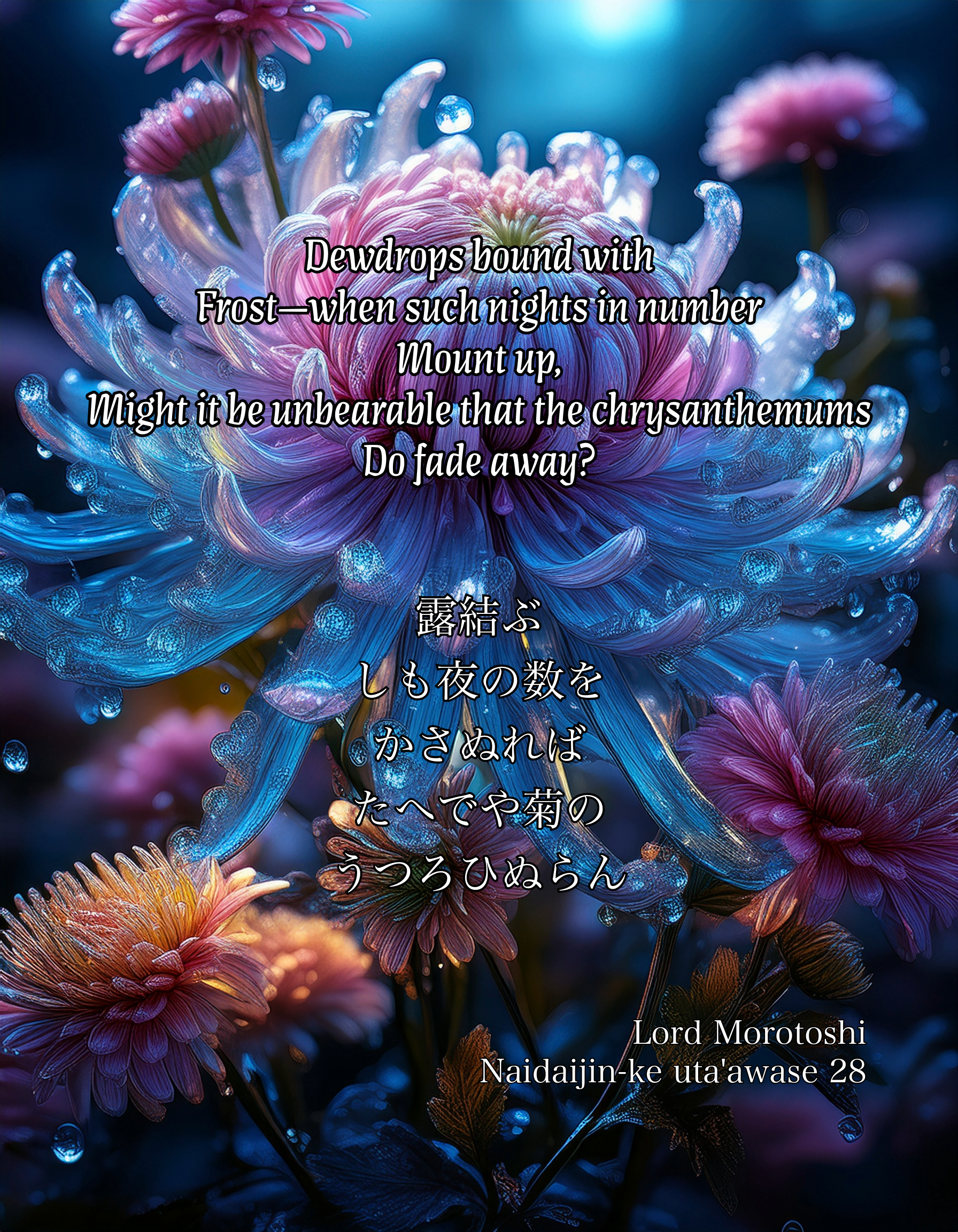
露結ぶしも夜の数をかさぬればたへでや菊のうつろひぬらん

tsuyu musubu
shimo yo no kazu o
kasanureba
taede ya kiku no
utsuroinuran
Dewdrops bound with
Frost—when such nights in number
Mount up,
Might it be unbearable that the chrysanthemums
Do fade away?

Lord Morotoshi
28

Toshiyori states: the first poem is extremely charming. Nevertheless, I must question the use of ‘reluctant to face the fading’ as I feel this is something I have not heard before. I can grasp the sense of diction such as ‘unable to do anything about’ or ‘without taking on autumn hues’, but did the poet mean to use the diction ‘unbearable’, perhaps? Even though this is somewhat archaic phrasing, it is used in composition. This poem’s expressions, though, I feel are somewhat unfamiliar. The conception and diction of the second poem are both extremely charming. However, this poem, too, is vague. What is going on with the initial ‘dewdrops bound’? Does it mean that the dewdrops get turned into frost? If so, then, from what is known of the calendar, this is something which only occurs on a single night, and from the following night there is only frost. It sounds as if the conception of this poem, though, is that night after night dew turns to frost, and this would be a fault. Despite this vagueness, however, its tone is elegant, so it seems superior.

Mototoshi states: the poem of the Left has a poetic configuration, but I strongly feel that it would have been preferable not to use the diction ‘both my sleeves’. It does seem as if this was used in the ancient Collection of a Myriad Leaves, but even given that was the case, in the preface to the Ancient and Modern, I recall it saying, ‘On examining the poems of ancient times, we find they use many archaic expressions. These were there not just to please the ear, but simply for moral instruction’. It appears that there are no instances of this piece of diction being used in poetry matches from the period of the Ancient and Modern, Later Selection and Gleanings, and these were all conducted for entertainment. Even in a poetry match conducted in Engi 12 [912], when the term ‘sleeve’ was used, I get the feeling that it was such a source of amusement that the poem was not recited. While the quality of the Right’s poem is not superb, the tone of ‘Dewdrops bound with  / Frost—when such nights in number’ is not bad, so I feel the dew can still remain bound!

Sumiyoshi-sha uta’awase kaō ni-nen 71

Round Twenty-One

Left (Tie)

かずならぬみこそおもへばうれしけれうきにつけてぞよをもいとはむ

kazu naranu
mi koso omoeba
ureshikere
uki ni tsukete zo
yo o mo itowamu
Not even numbered among folk
Am I, thinking that
Fills me with joy, but
All the cruelties of this world
Make me wish to leave it.

Asamune
141

Right

ながらへばかくてのみやははてむとてすぎにしかたはなぐさみもしき

nagaraeba
kakute nomi ya wa
hatemu tote
suginishi kata wa
nagusami mo shiki
Should I live on, then
Being simply as I am
Would I reach my end, I wonder?
In days gone by
I had some hope of consolation…

Kanetsuna
142

The sequencing of the Left’s ‘Am I, thinking that’ appears elegant. The Right, starting with ‘Would I reach my end, I wonder?’ sounds overly forceful, yet the conception of saying ‘in days gone by’ is still pleasant. Thus, once again, I make this a tie.