kumo kakaru takashi no yama no akegure ni tsuma madowaseru oshika naku nari
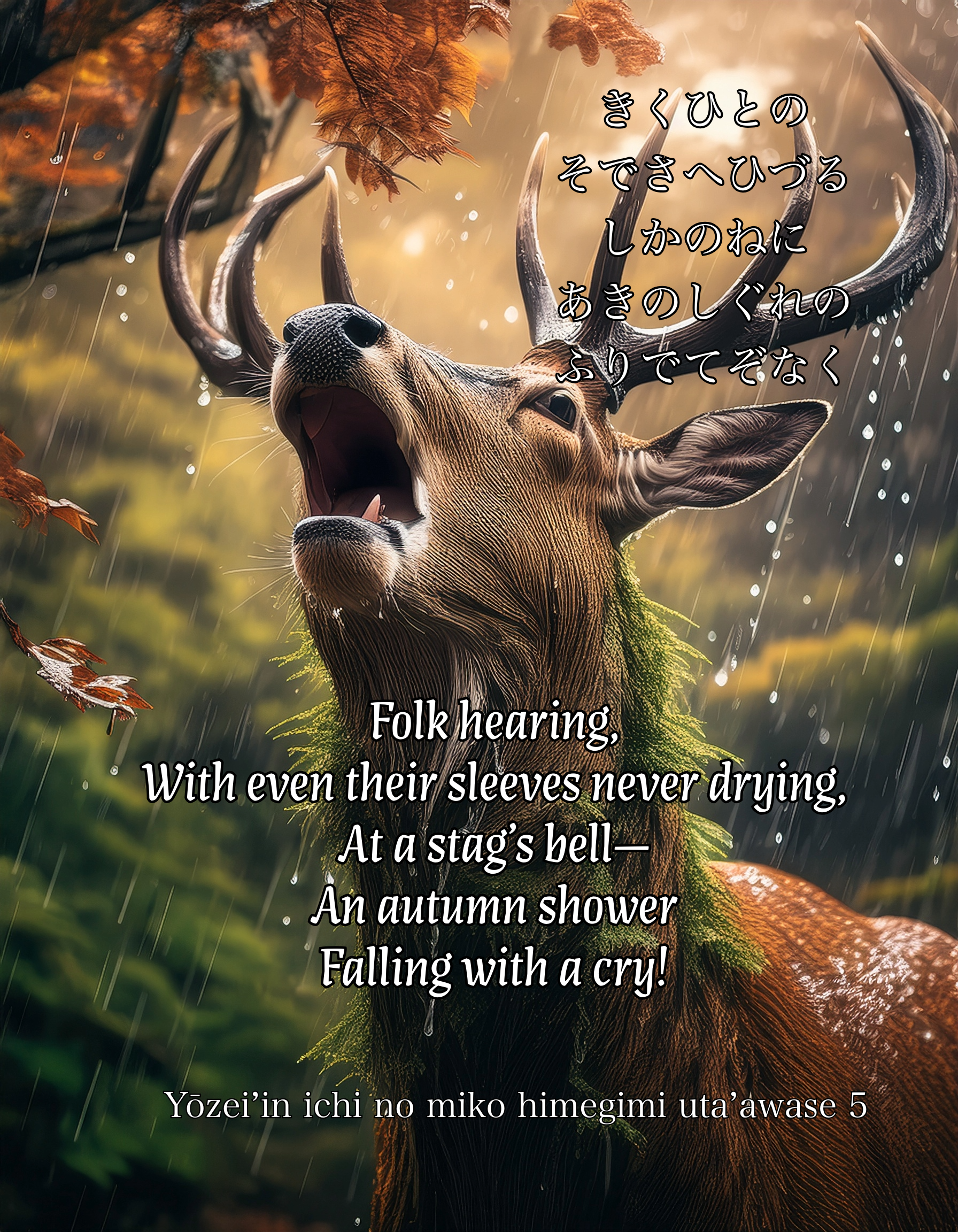
All hung about with cloud On Takashi Mountain In the gloaming Having lost his mate A stag bells out.
Nakamasa 11
Right
山がつの先あかつきをしりがほに裾野に出でて鹿ぞ鳴くなる
yamagatsu no mazu akatsuki o shirigao ni susono ni idete shika zo naku naru
A mountain man First of all, that ‘tis dawn Knows plain upon his face, As he sets out upon the slopes As a stag bells out!
Head 12
The Left poem’s conclusion, ‘Having lost his mate / A stag bells out’ seems no different from that of a poem by Gō no Jijū in poetry match held by the First Princess.[1] As for the poem of the Right’s ‘A mountain man / Awaits the dawn / Knowing plain upon his face’—what on earth might a mountain man look like while waiting for dawn? There is the tale of Hangu Pass in Cathay, where the barrier guard was waiting for dawn and opened the gate after hearing a cock’s crow, but the expression ‘a mountain man awaits the dawn’ has never appeared before in a poem—either one of Cathay or in the words of Yamato, so I feel that both Left and Right lack any superlative qualities.
[1] Stags. をぐら山たちどもみえぬゆふぎりにつままどはせるしかぞなくなる ogurayama / tachidomo mienu / yūgiri ni / tsuma madowaseru / shika zo nakunaru ‘On gloomy Ogura Mountain / Stands unseen / Among the evening mists / Having lost his mate / A belling stag.’ (Yūshi naishinnō-ke uta’awase eishō go-nen 27). This event was held at the residence of Imperial Princess Sukeko (Yūshi) on the 5th day of the Sixth Month, Eishō 5 [26.10.1050]. The poem won its round, and was later included in Goshūishū (IV: 292).
yamamoto no mori no shimenawa nagaki yo o aki no oshika no nakiakasuran
At the mountains’ foot lies A sacred grove with garlands Long as the nights In autumn when the stag Bells in the dawn.
Tomoshige 79
Right
なよ竹のよながき秋の山風に幾たび鹿のね覚しつらん
nayotake no yo nagaki aki no yamakaze ni ikutabi shika no nezameshitsuran
Green bamboo with Knots as apart as the autumn night is long, While with the mountain wind How many times might the stag Have awakened?[1]
Dharma Master Zenshin 80
The Left’s poem has ‘at the mountains’ foot lies a sacred grove with garlands long as the nights’ which sounds pleasant. The Right has ‘knots as apart as the autumn night is long, while with the mountain wind’—these, too, seem to have no clear winner or loser, yet still, the Left should be superior and should win.[2]
[1] An allusive variation on: Composed when the gentlemen in the Crown Prince’s service were presented with wine, on the occasion of Tadafusa being appointed Secretary of an embassy to China, during the reign of the Kanpyō emperor. なよ竹のよながきうへにはつしものおきゐて物を思ふころかな nayotake no / yo nagaki ue ni / hatsushimo no / oki’ite mono o / omou koro kana ‘Green bamboo with / Knots as far apart as the night is long / While the first frost settles on my active / Thoughts these days!’ Fujiwara no Tadafusa (KKS XVIII: 993)
saoshika no fushido o asami fuku kaze ni yowa ni naku ne zo fukaku nariyuku
The stag’s Resting place disturbed by The gusting wind At midnight his belling cry Comes from deeper in the mountains.
Chikanari 77
Right
さらでだにね覚かなしき秋風に夜しもなどか鹿の鳴くらん
sarade dani nezame kanashiki akikaze ni yoru shimo nado ka shika no nakuran
Even were it not so, To waken is so sad With the cruel autumn wind; Why is it that above all at night The stag should cry so?
Ie’kiyo 78
The Left poem’s ‘at midnight his belling cry comes from deeper’ does not sound especially elegant. The Right poem composes ‘why is it that above all at night the stag should cry so’, sounding like it is only at night that stags bell, but stags do this all the time in autumn. The Ancient and Modern also has the composition, ‘Mud-daubers buzzing / In the autumn bush clover; / Leaving with morning’.[1] The poems of Left and Right have no merits or faults between them—they should tie.
[1] This is a quotation from: Topic unknown. すがるなく秋のはぎはらあさたちて旅行く人をいつとかまたむ sugaru naku / aki no hagiwara / asa tachite / tabi yuku hito o / itsu to ka matan ‘Mud-daubers buzzing / In the autumn bush clover; / Leaving with morning, / Away on a journey: for him, / How long must I wait?’ Anonymous (KKS VIII: 366)
ima sara ni fushi mo sadamenu shika no ne yo ko no ha no kazu no tsumoru goto ni
At around this time, With his bedding undecided, The stag bells out! Just as the leaves’ from on the trees numbers Do mount up…
Shō 75
Right (Win)
木葉ちる夜半の嵐の月影に心すみてや鹿も鳴くらん
ko no ha chiru yowa no arashi no tsukikage ni kokoro sumite ya shika mo nakuran
Leaves scatter from the trees In the midnight storm In the moonlight From his wild and earthy thoughts Does the stag, too, cry out?
Nagatsuna 76
The Left’s ‘just as the leaves from on the trees numbers do mount up’ at night and so forth, appears to be a novel style, yet the Right poem sounds more gorgeous, so it wins.
ono ga sumu mine no kogarashi samuki yo wa shika mo momiji no koromo kirurashi
Where he dwells upon The peak, the bitter wind On a night so chill, for The stag, of scarlet leaves Does seem to make a robe.
The Supernumerary Major Counsellor 69
Right
すみのぼる月にうらむる声すなりねられぬ鹿や夜寒なるらん
suminoboru tsuki ni uramuru koesunari nerarenu shika ya yozamu naruran
Climbing clearly At the moon, in despair Does he cry— Sleepless, does the stag Feel night’s chill, perhaps?
Nobunari 70
The Left’s poem has ‘the stag, of scarlet leaves does seem to make a robe’ which sounds charming, and the Right’s poem has ‘sleepless, does the stag feel night’s chill, perhaps’, which appears refined. Thus, they tie.