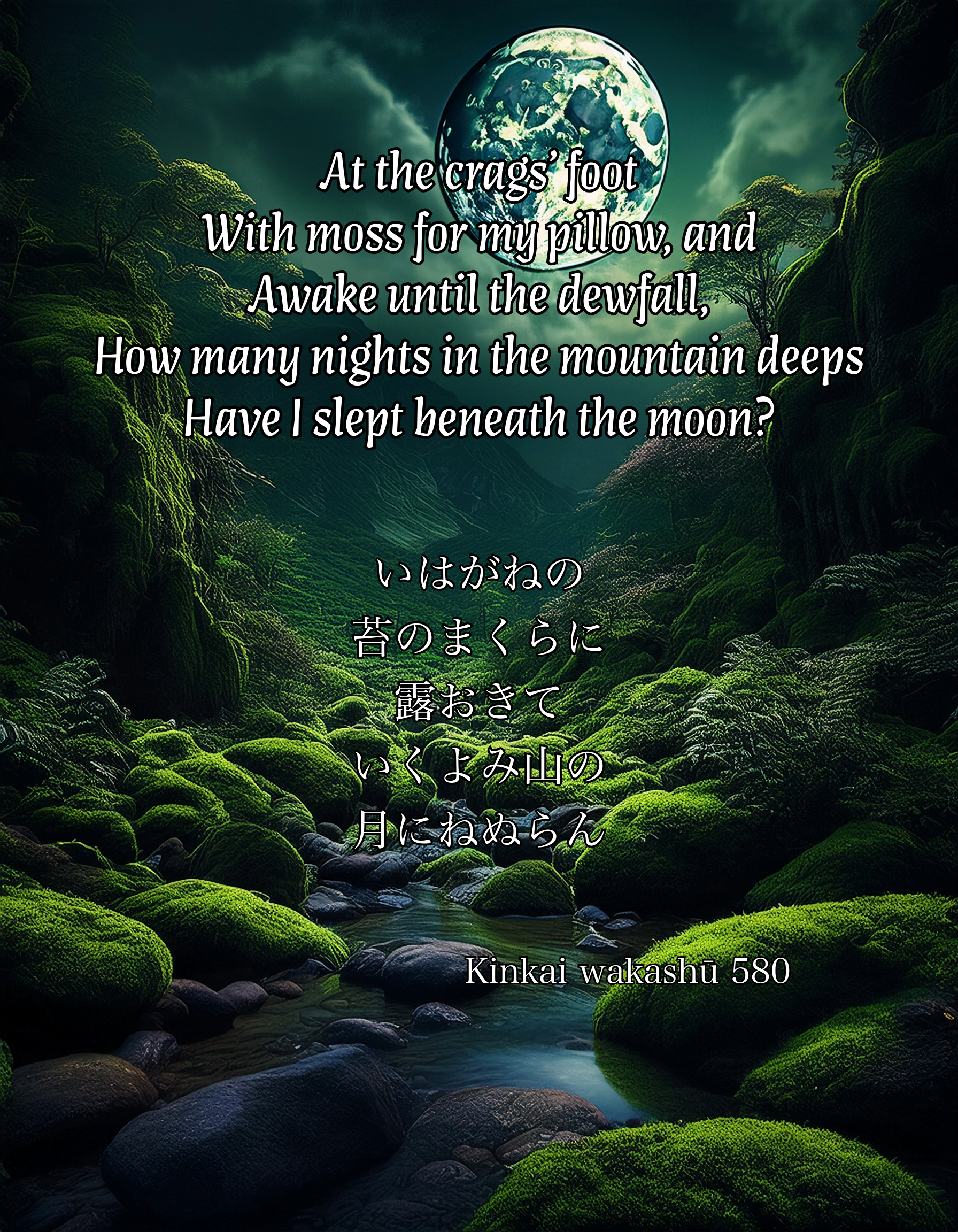
iwa ga ne no koke no makura ni tsuyu okite iku yo miyama no tsuki ni nenuran
At the crags’ foot With moss for my pillow, and Awake until the dewfall, How many nights in the mountain deeps Have I slept beneath the moon.[i]
580
[i] See: On the conception of seeing the moon while travelling, while at a place called the Barrier Gate Hall. 草枕ほどぞへにける都いでていくよかたびの月にねぬらむ kusamakura / hodo zo henikeru / miyako idete / ikuyo ka tabi no / tsuki ni nenuramu ‘Grassy pillows / For a while have been my lot! / Since departing the capital / For some days on my travels / Will I sleep beneath the moon.’ Ōe no Yoshitoki (Shinkokinshū X: 931)
Former Emperor Yōzei, on the 15th day of the Ninth Month, when it fell upon the day of Elder Brother-Metal Monkey, held a poetry match of the Left and Right with his eldest son’s daughters, the First Princess and the Second Princess, as the leaders of the two teams, composing poems in response to prior poems on the conception of the end of autumn.
Original
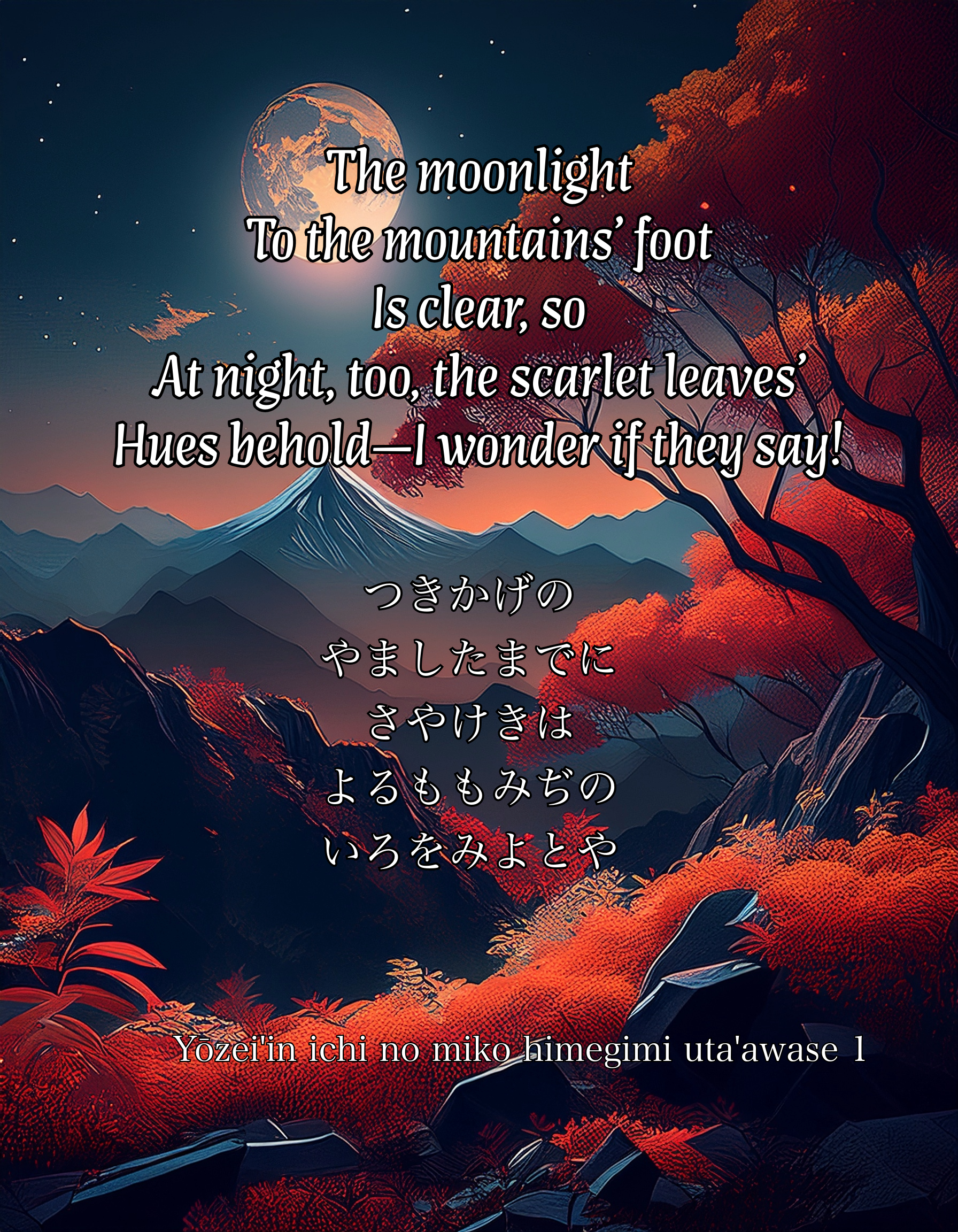
つきかげのやましたまでにさやけきはよるももみぢのいろをみよとや
tsukikage no yamashita made ni sayakeki wa yoru mo momiji no iro o miyo to ya
The moonlight To the mountains’ foot Is clear, so At night, too, the scarlet leaves’ Hues behold—I wonder if they say!
1
Left
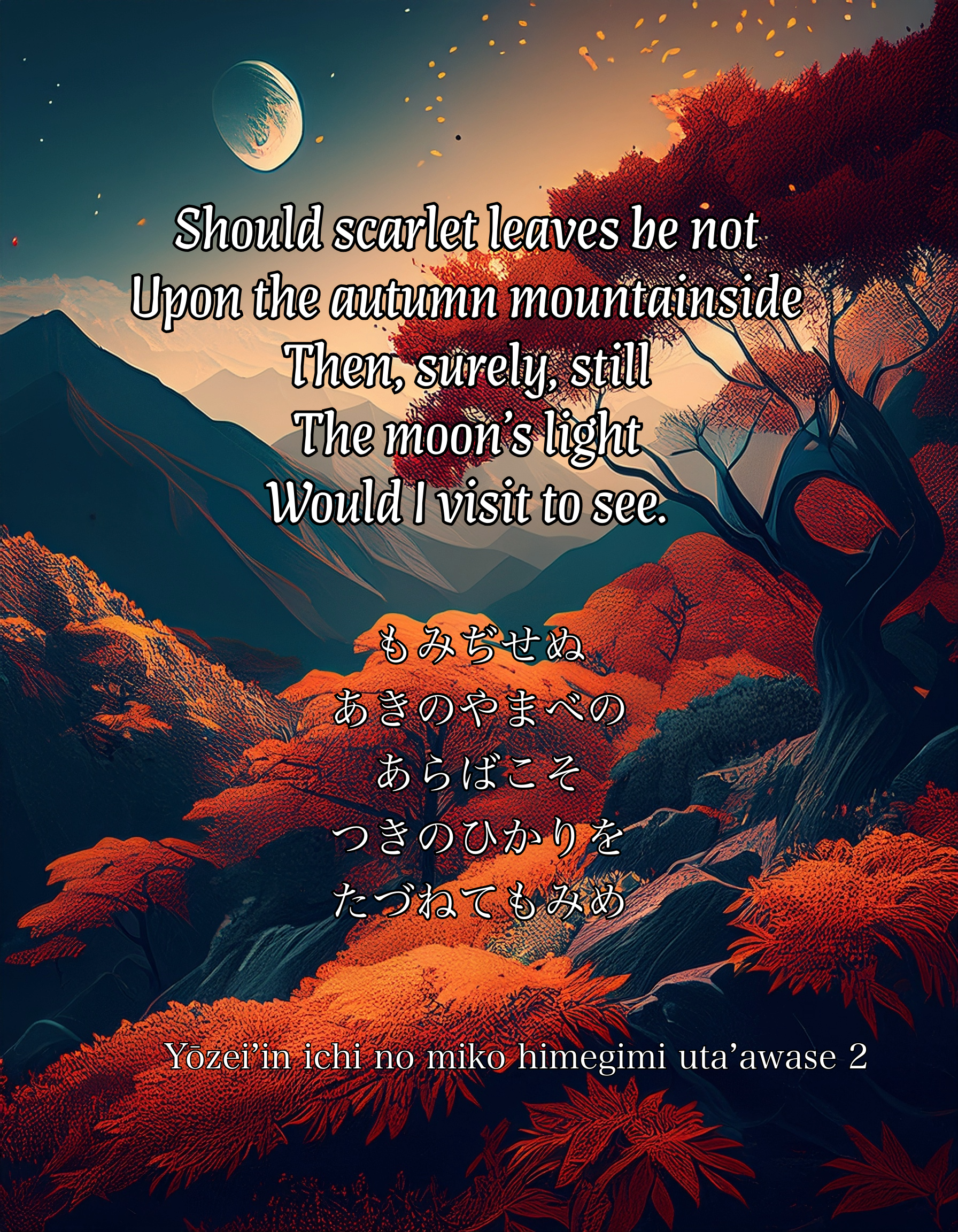
もみぢせぬあきのやまべのあらばこそつきのひかりをたづねてもみめ
momiji senu aki no yamabe no araba koso tsuki no hikari o tazunete mo miyu
Should scarlet leaves be not Upon the autumn mountainside Then, surely, still The moon’s light Would I visit to see.
hōriko ga shimeyū nobe no suzumushi wa yū tsukete koso furitatete nake
The priests have Garlanded the meadows where The bell crickets With the fall of evening Sing out so loud.
Major Archbishop 13
Right
神がきのいはねにさせる榊葉にゆふかけてなく鈴虫のこゑ
kamigaki no iwane ni saseru sakakiba ni yū kakete naku suzumushi no koe
Within the sacred precincts At the crags’ foot thrust Are leaves from the sacred tree To the garlands clinging, as crying Come the bell crickets’ songs.
Tadasue, Senior Assistant Minister of the Sovereign’s Household 14
I would say that both of these, Left and Right, are of the same quality in terms of diction and configuration.
uchimurete iwane ni nezasu komatsuba no kigi no chitose wa kimi zo kazoemu
Crowding At the crags’ foot, roots stretching, The dwarf pines’ needles with The trees’ thousand years— My Lord may count them all!
Cell of the Fragrant Elephant 63
Right (Win)
たとふべきものこそなけれ君がよははまのまさごもかずなからめや
tatoubeki mono koso nakere kimi ga yo wa hama no masago mo kazu nakarame ya
A suitable metaphor Is there none, at all! My Lord’s reign: Even the fair sands on the shore Would not exceed its number…
Cell of Everlasting Truth 64
Both of the Left poem’s expressions, ‘crowding’ and ‘dwarf pines’ needles’, seem to sound awkward. ‘Crowding’ is used of cranes, while it would have been preferable to say ‘the needles of the dwarf pines’. The poem of the Right is not especially charming, but it is in a familiar style, so I feel that ‘the fair sands’ number’ is superior.
I feel that ‘crowding’ is better applied to human beings. Perhaps there’s a conception here of looking down on each and every one? This is a mistake, isn’t it? In addition, what is ‘dwarf pines’ needles’? Maybe the poet is trying to say ‘the needles of the dwarf pines’? Is there a prior poem as precedent? It’s a piece of awkward-sounding diction! The Right’s poem appears straightforward, but without errors.
kimi ga yo wa ama no iwato o izuru hi no iku meguri chō kazu mo shirarezu
My Lord’s reign: Since from the stone door in the heavens Emerged the sun, ‘How many circuits has she made?’, they ask— A number quite unknown.
Lord Saburō 59
Right
みかさやまふもとのさとはあめのしたふるにおもひもあらじとぞ思ふ
mikasayama fumoto no sato wa ame no shita furu ni omoi mo araji to zo omou
At Mikasa Moutain’s Foot, in a hamlet ‘neath the heavens Passing time—painful thoughts There I’d have not a one, I feel!
Ushigimi 60
The Left’s poem goes beyond the general flow of diction, containing mystery and depth. I have to say it is truly superior. While the Right’s poem has no faults to mention, it has yet to emerge from prosaic expression. Thus, the Left wins.
The ‘stone door in the heavens’ is that which the supreme sun-deity Amaterasu stood before and then entered. But when we’re talking about dawn breaking at the end of night, we say ‘gates of heaven’. Which of these two was did the poet have in mind, I wonder? If he was thinking of dawn breaking, then the usage is erroneous, but even if he did mean ‘stone door of the heavens’, then do we use this about the circuits of the sun? This is vague. In addition, the final ‘they ask’ is difficult to pronounce. As for the Right’s poem, ‘‘neath the heavens’ lacks emotion. The dual use of ‘thoughts’ and ‘feels’, as I have already remarked, is not an error, but does grate on the ears a bit.
yamamoto no mori no shimenawa nagaki yo o aki no oshika no nakiakasuran
At the mountains’ foot lies A sacred grove with garlands Long as the nights In autumn when the stag Bells in the dawn.
Tomoshige 79
Right
なよ竹のよながき秋の山風に幾たび鹿のね覚しつらん
nayotake no yo nagaki aki no yamakaze ni ikutabi shika no nezameshitsuran
Green bamboo with Knots as apart as the autumn night is long, While with the mountain wind How many times might the stag Have awakened?[1]
Dharma Master Zenshin 80
The Left’s poem has ‘at the mountains’ foot lies a sacred grove with garlands long as the nights’ which sounds pleasant. The Right has ‘knots as apart as the autumn night is long, while with the mountain wind’—these, too, seem to have no clear winner or loser, yet still, the Left should be superior and should win.[2]
[1] An allusive variation on: Composed when the gentlemen in the Crown Prince’s service were presented with wine, on the occasion of Tadafusa being appointed Secretary of an embassy to China, during the reign of the Kanpyō emperor. なよ竹のよながきうへにはつしものおきゐて物を思ふころかな nayotake no / yo nagaki ue ni / hatsushimo no / oki’ite mono o / omou koro kana ‘Green bamboo with / Knots as far apart as the night is long / While the first frost settles on my active / Thoughts these days!’ Fujiwara no Tadafusa (KKS XVIII: 993)