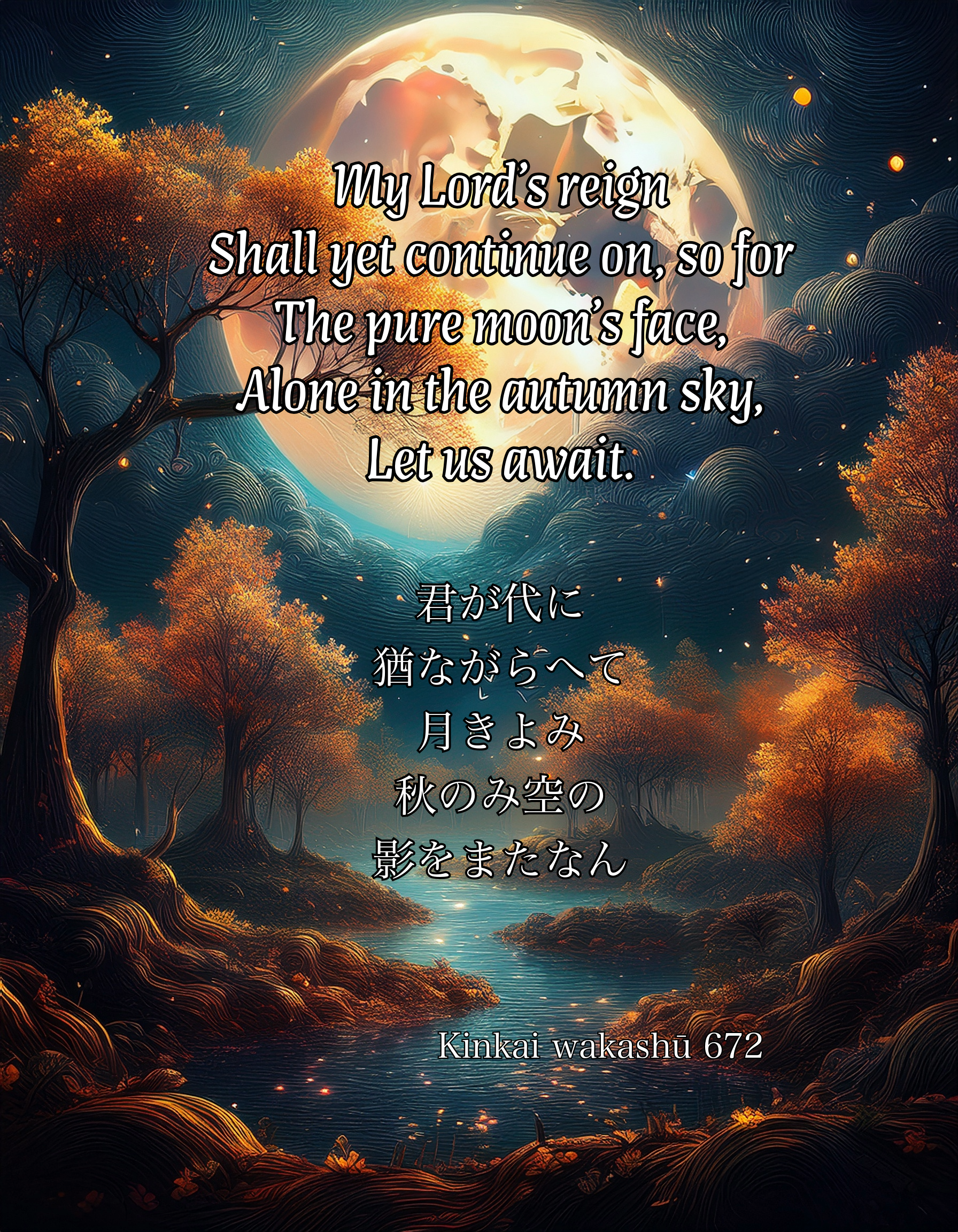
朝にありてわが代はつきじ天の戸や出づる月日のてらむかぎりは
| asa ni arite wa ga yo wa tsukji ama no to ya izuru tsukihi no teramu kagiri wa | In the mornings My reign will never end, I feel, While from the gates of Heaven The sun and moon emerge To shine! |
674

Written on a folding screen.
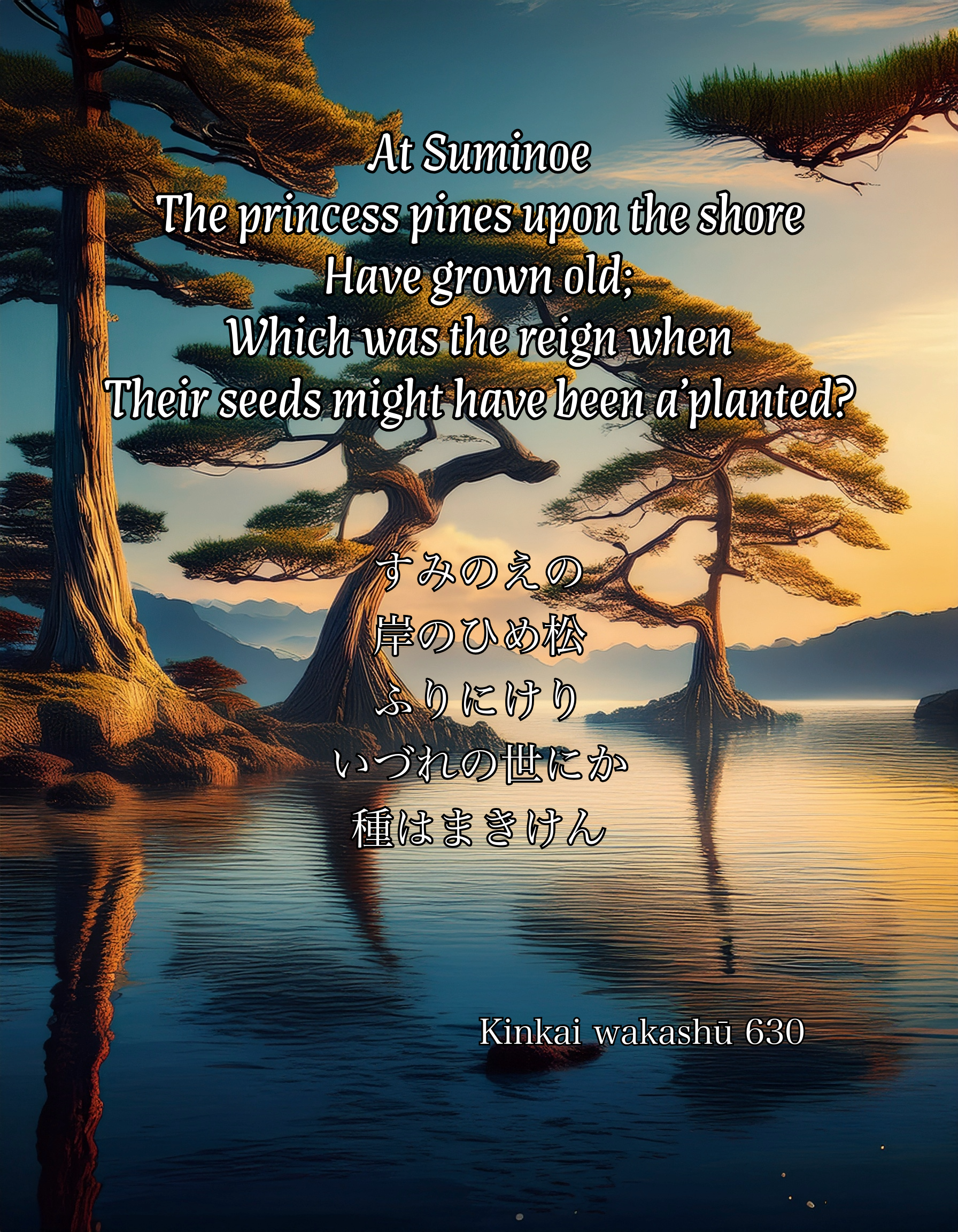
すみのえの岸のひめ松ふりにけりいづれの世にか種はまきけん
| suminoe no kishi no himematsu furinikeri izure no yo ni ka tane wa makiken | At Suminoe The princess pines upon the shore Have grown old; Which was the reign when Their seeds might have been a’planted?[i] |
630
[i] See: Topic unknown. 梓弓いそべのこ松たが世にかよろづ世かねてたねをまきけむ azusayumi / isobe no komatsu / ta ga yo ni ka / yorozuyo kanete / tane o makikemu ‘A catalpa bow, / The dwarf-pine upon the rocky shore / Has through whose lifetimes lived? / “That it last ten thousand ages!” / Was with its seed a’planted, perhaps?’ Anonymous (Kokinshū XVII: 907); and: Topic unknown. 我見てもひさしく成りぬ住の江の岸の姫松いくよへぬらむ ware mite mo / hisashiku narinu / suminoe no / kishi no himematsu / iku yo henuramu ‘Even to my sight / Eternal are / Suminoe’s / Princess pines upon the shore: / How many ages have they passed through?’ Anonymous (Kokinshū XVII: 905)
Composed on the conception of felicitation for the poetry match held at the residence of His Excellency, Saneyuki.
みづがきのひさしかるべき君が代をあまてる神やそらにしるらん
| midugaki no Fisasikarubeki kimi ga yo wo ama teru kami ya sora ni siruran | As sacred precincts, Eternal shall be My Lord’s reign, as Shining in the Heavens the deity In the skies must know! |
Fujiwara no Tametada

Maidens spinning thread
Left
てにかけてくるなつごとにわぎもこがおほくのいとをひきてけるかな
| te ni kakete kuru natsu goto ni wagimoko ga ōku no ito o hikitekeru kana | Through her hands a’running Again, with every summer’s coming, My darling girl So much thread Has spun! |
7
Right
てもたゆくひきおくいとのたえまなくきみがみちよのさかゆべきかな
| te mo tayuku hiki’oku ito no taemanaku kimi ga michiyo no sakayubeki kana | Her weary hands A’spinning thread, Never ending My Lord’s reign through three thousand years Of prosperity! |
8
‘Maidens spinning’ is about their expertise at it, and is not something that you need to need to ponder over and over like a peasant’s hempen thread or struggle to pull apart like a hardened silk cocoon, but both Left and Right really seem to have spun things out, and I feel that, although there’s an air of elegance to start with, the diction at the end of both poems is confused, so I would make these a tie.
| hidari migi hiku te mo tayuku tatsu ito wa izukata e ka wa yorubekaruran | Left and Right, The hands spinning wearily, Produce thread that Heads off but, I wonder where to? |
Judge 4


Round Seven
Left
かすがやまちえにさかゆるさかきばはよろづよまでのきみがためか
| kasugayama chie ni sakayuru sakakiba wa yorozuyo made no kimi ga tame ka | Upon Kasuga Mountain A thousand branches grow, Leafy, on the sacred tree— Until ten thousand ages pass Will they ward my Lord! |
Lady Kazusa
69
Right
君がよはいふかぎりなしみよしののこがねがみねにみよをまつまで
| kimi ga yo wa iu kagiri nashi miyoshino no kogane ga mine ni miyo o matsu made | My Lord’s reign— Words cannot describe: ‘til fair Yoshino’s Golden peak’s Age one must await! |
Lady Shikibu
70
The poem of the Left seems poetic to an extraordinarily outlandish degree! The poem of the Right’s ‘‘til fair Yoshino’s / Golden peak’s / Age one must await!’ has a sufficient conception of felicitation. Thus, these tie.
That the Left is addressed to Mount Kasuga is highly admirable. Is the Right’s ‘golden peak’ a reference to Mount Mitake? It’s very difficult to say anything profound here. Arbitrarily, I would make this a tie—the quality of the poems makes that seem right.


Round Six
Left (Win)
うれしさはおほつのはまにたつなみのかずもしられぬきみがみよかな
| ureshisa wa ōtsu no hama ni tatsu nami no kazu mo shirarenu kimi ga miyo kana | My joy is Great, as upon Ōtsu Beach Break waves In numbers quite unknown, Such is my Lord’s reign most fair! |
Cell of Fragrant Cloud
67
Right
かすがやまみねのしらがしよろづよをきみにといへばかみもいさめず
| kasugayama mine no shiragashi yorozuyo o kimi ni to ieba kami mo isamezu | Kasuga Mountain has White-barked evergreen oaks upon its peak: ‘Ten thousand generations For my Lord!’—should I say that, The God will surely not refuse! |
Cell of Compassionate Light
68
The poem of the Left’s ‘Great, as upon Ōtsu Beach’ and what follows is something that sounds grievously prosaic. With that said, there are many parts of the poem which are not. What is the poem of the Right’s ‘White-barked evergreen oaks on its peak / Ten thousand generations’ linked with in the remainder of the poem? I wonder what it’s composed about… The Left doesn’t contain any errors, so I still say it wins.
The Left’s poem, as I have said in an earlier round, appears to lack smoothness. Is the poem of the Right’s ‘white-barked evergreen oaks’ a long-standing expression? I can’t seem to recall a prior precedent. ‘The God will surely not refuse’ is vague, too. Is it asking the deity’s favour for the speaker? While I am somewhat hesitant, given my appallingly constricted knowledge, I will, fearfully, say that this is inferior.


Round Five
Left
君がよはながゐのうらのはまかぜにたつしらなみのかずもしられず
| kimi ga yo wa nagai no ura no hamakaze ni tatsu shiranami no kazu mo shirarezu | My Lord’s reign: At Nagai Bay The beach breezes Rouse the whitecaps In number entirely unknown. |
Controller’s Graduate
65
Right
きみがよをまつちのやまのこまつばらちよのけしきを見るぞうれしき
| kimi ga yo o matsuchi no yama no komatsubara chiyo no keshiki o miru zo ureshiki | My Lord’s reign Awaiting upon Matsuchi Mountain The pine seedling groves The sight for a thousand ages Joyfully will see! |
Kerin’in Graduate
66
It’s impossible to decide on a winner or loser between the Left and the Right here in terms of conception, diction and overall style. To put it in general terms, I must make this round a further tie.
Neither Left nor Right is remarkable, but nor do they have any faults to mention. I’d make this round a tie.


Round Four
Left
うちむれていはねにねざすこまつばのきぎのちとせはきみぞかぞへむ
| uchimurete iwane ni nezasu komatsuba no kigi no chitose wa kimi zo kazoemu | Crowding At the crags’ foot, roots stretching, The dwarf pines’ needles with The trees’ thousand years— My Lord may count them all! |
Cell of the Fragrant Elephant
63
Right (Win)
たとふべきものこそなけれ君がよははまのまさごもかずなからめや
| tatoubeki mono koso nakere kimi ga yo wa hama no masago mo kazu nakarame ya | A suitable metaphor Is there none, at all! My Lord’s reign: Even the fair sands on the shore Would not exceed its number… |
Cell of Everlasting Truth
64
Both of the Left poem’s expressions, ‘crowding’ and ‘dwarf pines’ needles’, seem to sound awkward. ‘Crowding’ is used of cranes, while it would have been preferable to say ‘the needles of the dwarf pines’. The poem of the Right is not especially charming, but it is in a familiar style, so I feel that ‘the fair sands’ number’ is superior.
I feel that ‘crowding’ is better applied to human beings. Perhaps there’s a conception here of looking down on each and every one? This is a mistake, isn’t it? In addition, what is ‘dwarf pines’ needles’? Maybe the poet is trying to say ‘the needles of the dwarf pines’? Is there a prior poem as precedent? It’s a piece of awkward-sounding diction! The Right’s poem appears straightforward, but without errors.


Round Three
Left[i]
君が代は神にぞいのる住之江の松の千年をゆづれとおもへば
| kimi ga yo wa kami ni zo inoru suminoe no matsu no chitose o yuzure to omoeba | My Lord’s reign: To the gods I pray, that Suminoe’s Pines their thousand years Pass on—that is my hope… |
Retired from the World
61a
きみがへむやちよのかずはあめにますとよをかひめの神やしるらん
| kimi ga hemu yachiyo no kazu wa ame ni masu toyo’okahime no kami ya shiruran | That my Lord will endure The number of eight thousand ages— Residing in the heavens, The Goddess of the Eternal Hills, The deity, knows well, no doubt! |
Retired from the World
61b
Right (Win)
君がよはつきじとぞおもふ春の日の御笠の山にささむかぎりは
| kimi ga yo wa tsukiji to zo omou haru no hi no mikasa no yama ni sasamu kagiri wa | My Lord’s reign Will never fade, I feel! While in spring the sun Upon Mikasa Mountain Shines down… |
Senior Assistant Minister Past Lecturer
62
Both Left and Right have neither strengths nor weakness in their diction and sense, but I feel that ‘While in spring the sun / Upon Mikasa Mountain / Shines down’ is a bit more dependable at present than ‘Suminoe’s / Pines their thousand years’.
It is certainly not the case that there are no dubious elements about the Left’s poem. As ‘eight thousand ages’ is a definite number, what is it that the Goddess of the Eternal Hills is expected to know? If this is something in the deity’s hands, then it should be, ‘does not even know the number’. I’m sure the Goddess herself would ask what she’s expected to know. The Right seems stronger.


[i] There are different poems by Eien this round in different versions of the text of the contest. As can be inferred from the judgements, Mototoshi saw the first poem and Toshiyori the second. This strongly suggests that Mototoshi’s judgements were circulated before the text of the contest was submitted to Toshiyori, and Eien revised his poem this round as a result (Kubota et al. 2018, 308).