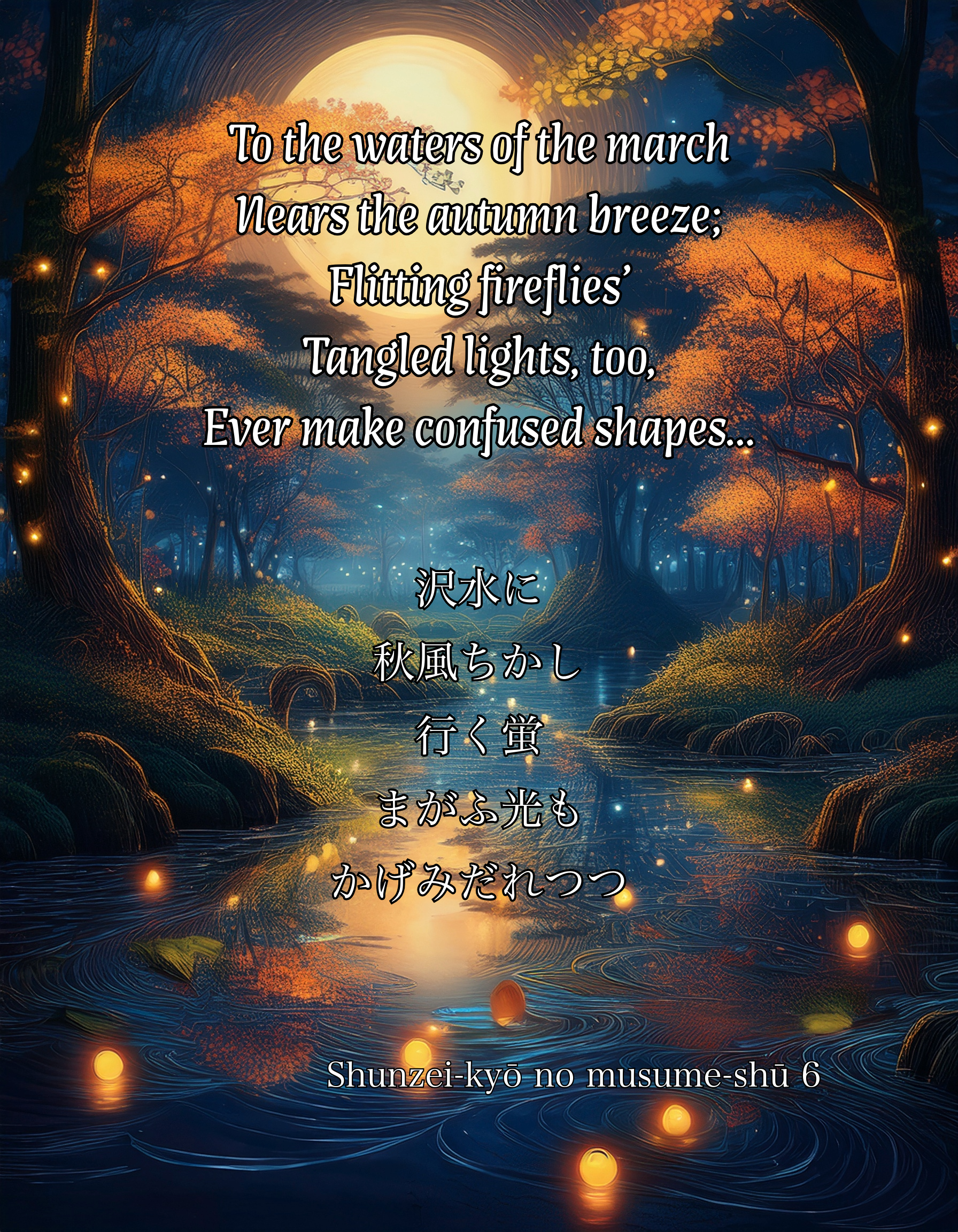
sawamizu ni akikaze chikashi yuku hotaru magau hikari mo kage midaretsutsu
To the waters of the marsh Nears the autumn breeze; Flitting fireflies’ Tangled lights, too, Ever make confused shapes…[i]
6
[i] An allusive variation on: Topic unknown. ゆく螢雲の上までいぬべくは秋風吹くと雁に告げこせ yuku hotaru / kumo no ue made / inubeku wa / aki kaze fuku to / kari ni tsugekose ‘O, flitting fireflies, / Beyond the clouds / Should you ascend, then say, / ‘ The Autumn wind is blowing!’ / To the geese.’ Narihira (Gosenshū V: 252)
yamagatsu no kakio nagara ni utsushi uete itsu to naku mimu tokonatsu no hana
Even by a woodcutter’s Brushwood fence Should they be transplanted Always would I gaze upon Bedded pinks in bloom…
6
[i] This poem is included in Fubokushō (IX: 3460), attributed to Nakatsukasa, with the headnote ‘Poetry Match held by Junior Consort Yoshiko (Hōshi) in the Fifth Month, Tenryaku 10’. In some texts of the match, there is a minor variation in the wording of the final line, having iro (‘hues’), instead of kage (‘shapes’) as here.
[i] A similar poem to this is included in Nakatsukasa’s personal collection, Nakatsukasa-shū (118): かきほなるやまとなでしこいろふかきけふやこふこふ人をまたまし kakio naru / yamato nadeshiko / iro fukaki / kyō ya kou / hito o matamashi ‘By the lattice fence / The Yamato pinks’ / Hues are so deep, that / I wonder for today and one to love them / Have they awaited?’
[ii] Some texts of this match have an alternate wording for this poem: みなそこにかげさへみゆるなでしこのなみのはなをやいろにそむらむ minasoko ni / kage sae miyuru / nadeshiko no / nami no hana o ya / iro ni somuramu ‘Upon the very riverbed / Their shapes do appear— / Do the pinks / Even the spray from off the waves / Dye with their hues, I wonder?’
midori naru matsukage hitasu ikemizu ni chiyo no sumika to miyuru yado kana
Evergreen The pine tree’s shapes sink Into the pond waters— A residence for a thousand ages Does that dwelling seem!
Lord Dainagon 57
Right (Win)
ちとせともいろにはいでていはし水ながれむほどは君がよなれば
chitose to mo iro ni wa idete iwashimizu nagaremu hodo wa kimi ga yo nareba
For a thousand years or more Does its hue emerge— Spring waters from the rocks Might flow as long as My Lord’s reign will be, so…
Lord Chūnagon 58
What on earth might be the colour of the Left poem’s ‘pine tree’s shapes sink’ and the Right poem’s ‘thousand years’ hue’? When one talks about ‘hue’ that means ‘scarlet’ and, in addition, it’s used of blossoms or autumn leaves. I have yet to see wisteria colouring the water in numerous private collections. The two poems are about the same, but the Right is marred by a series of faults.
The Left’s ‘shapes sink’ is extremely vague. ‘Sink’ means to submerge an object in water. One could certainly compose about a pine tree’s branches sinking, but how can we accept ‘shapes sink’ to mean an object’s reflection from beneath the water in the absence of a poem as precedent? The end is extremely, charming, though.
The poem of the Right doesn’t have anything special about it. It’s a pedestrian affair which doesn’t seem to show much evidence of thought. How are we to distinguish between a poem which is hackneyed but lacking any faults and one which is vague?