Tōgū gakushi noritada uta’awase – Preface

Lord Fujiwara no Noritada, Governor of Awa and Confucian Tutor to the Heir Apparent, was in high good humour and, thinking that he did not wish to idle away his hours at such a time of celebration,[i] gathered sundry folk of a poetic disposition, who thought only of the dew upon blades of grass, of the poems of ages past, each proceeding as knots on a bamboo stalk,[ii] as many and as indistinct as ears of rice in the autumn paddies. He hoped that his own innumerable words would be as strung gems passing into the world to come, yet it is also the case that they say ‘Traces will a thousand years’,[1] so praying that they would be transmitted into the future,[iii] he produced ten poetic topics, dividing his guests into Left and Right and, so that their words, which he had them compose with the strains of flute and zither in their ears, would be passed down to the future and not vanish like tracks of birds on the beach—for he worried that folk seeing them might feel that the poems of today’s folk seemed many as blades of grass in summer—he decided on winners and losers and, desiring to reveal the conception of the matter, he was able decide upon and compose himself ten poems as judgements: it appears he produced ten judgements in all—how wonderful that is!


[1] Letters. かひなしと思ひなけちそ水ぐきのあとぞ千とせのかたみともなる kai nashi to / omoi na kechi so / mizuguki no / ato zo chitose no / katami to mo naru ‘As pointless / O, don’t belittle me! / For these waterweed / Traces will a thousand years’ / Memento become!’ Anonymous (Kokin rokujō V: 3379)


[i] Wife of Heir Apparent give birth

[ii] A reference to the Kokinshu kana preface suguretaru hito mo, kureteke no, yoyo ni kikoete 優れたる人も、呉竹の、世世に聞こえて ‘…other superlative poets were heard each proceeding as knots on a bamboo stalk…’ (Kojima and Arai 1989, 12).

[iii] Kokinshū kana preface. 後の世にも伝はれとて nochi no yo ni mo tsutaware tote ‘…desiring that they be transmitted to the future…’ (Kojima and Arai 1989, 16).
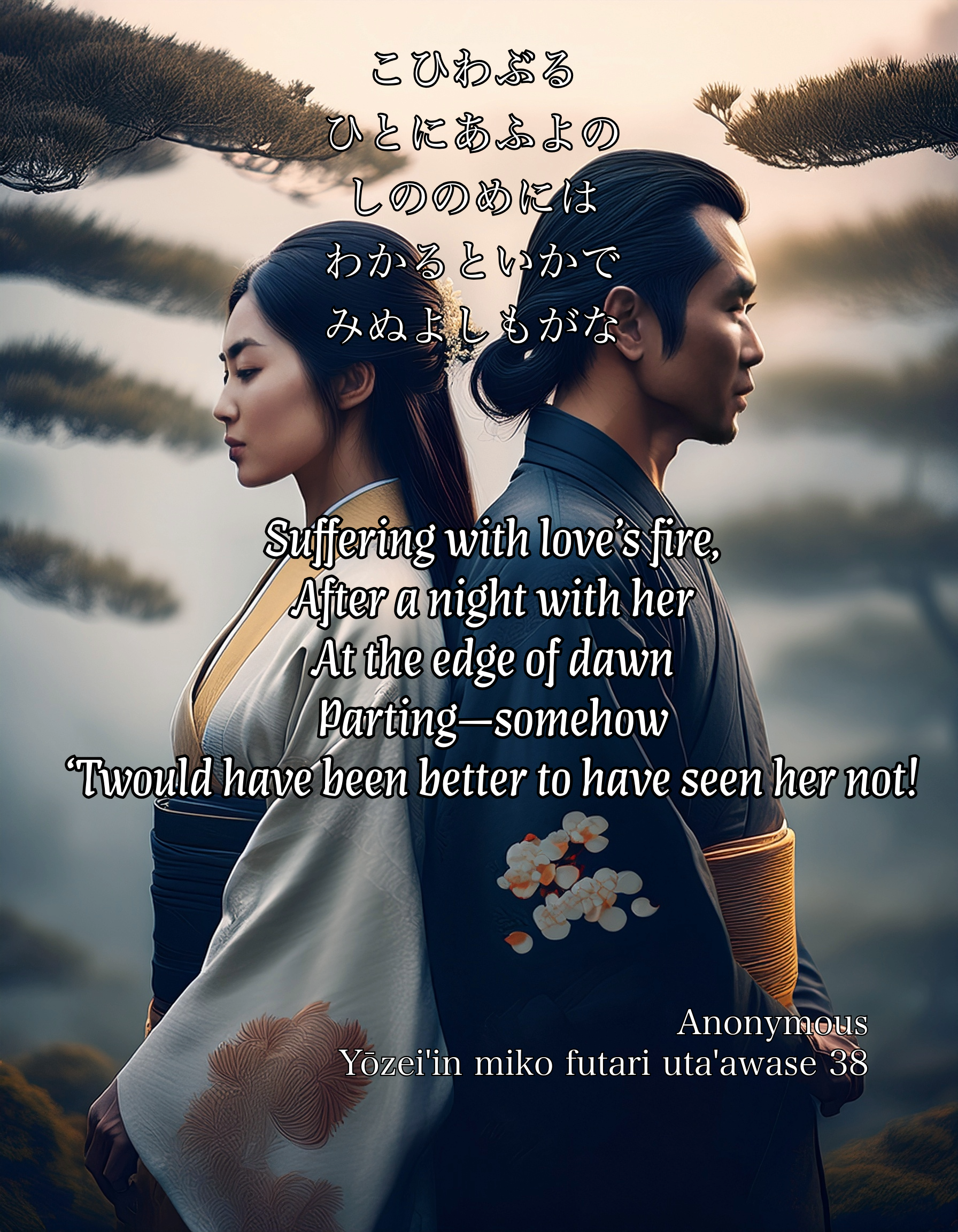
Yōzei’in miko futari uta’awase 20

Left

こひわぶるひとにあふよのしののめにはわかるといかでみぬよしもがな

koi waburu
hito ni au yo no
shinonome ni wa
wakaru to ikade
minu yoshi mogana
Suffering with love’s fire,
After a night with her
At the edge of dawn
Parting—somehow
‘Twould have been better to have seen her not!

38

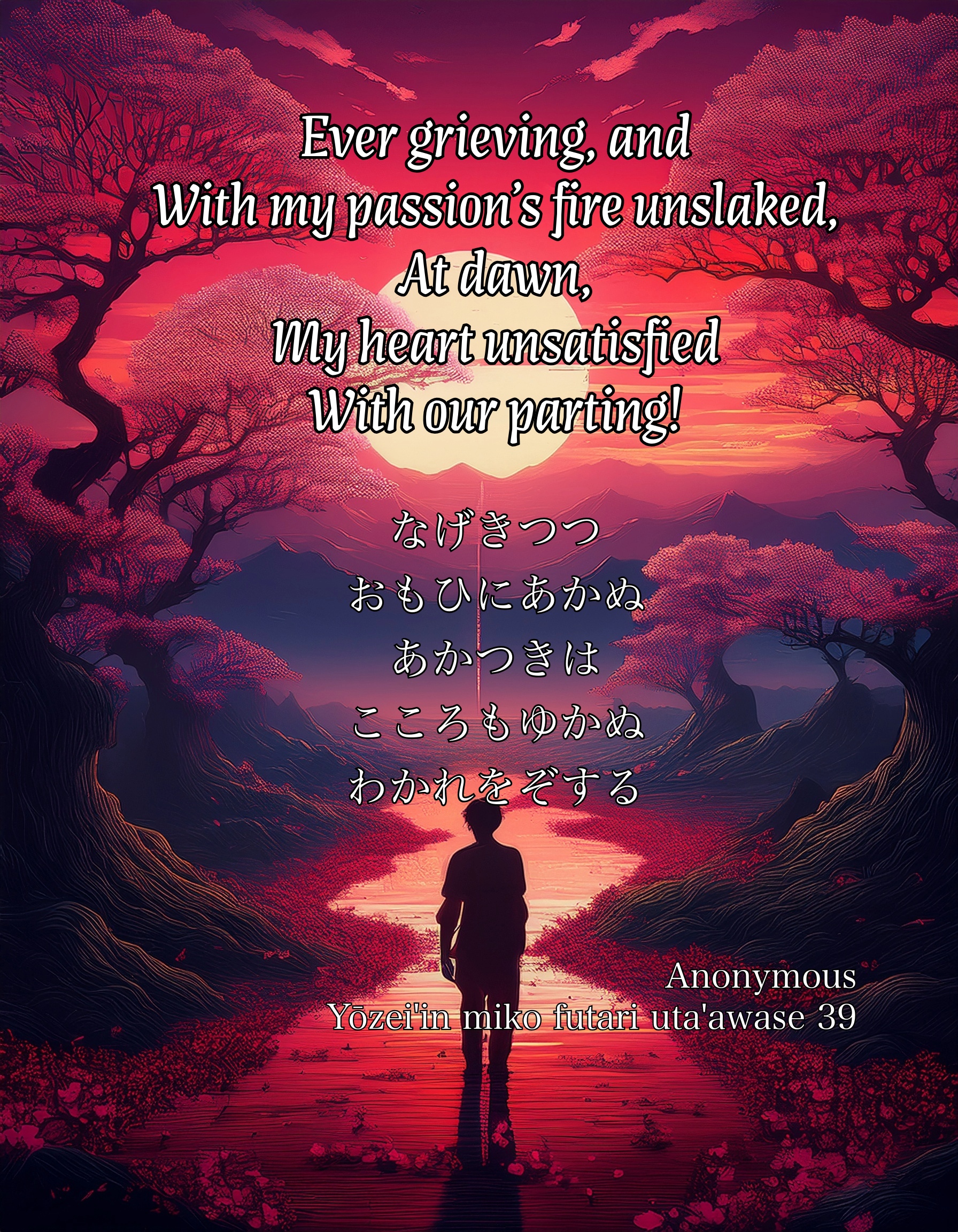
Right

なげきつつおもひにあかぬあかつきはこころもゆかぬわかれをぞする

nagekitsutsu
omoi ni akanu
akatsuki wa
kokoro mo yukanu
wakare o zo suru
Ever grieving, and
With my passion’s fire unslaked,
At dawn,
My heart unsatisfied
With our parting!

39

Yōzei’in miko futari uta’awase 19

Left

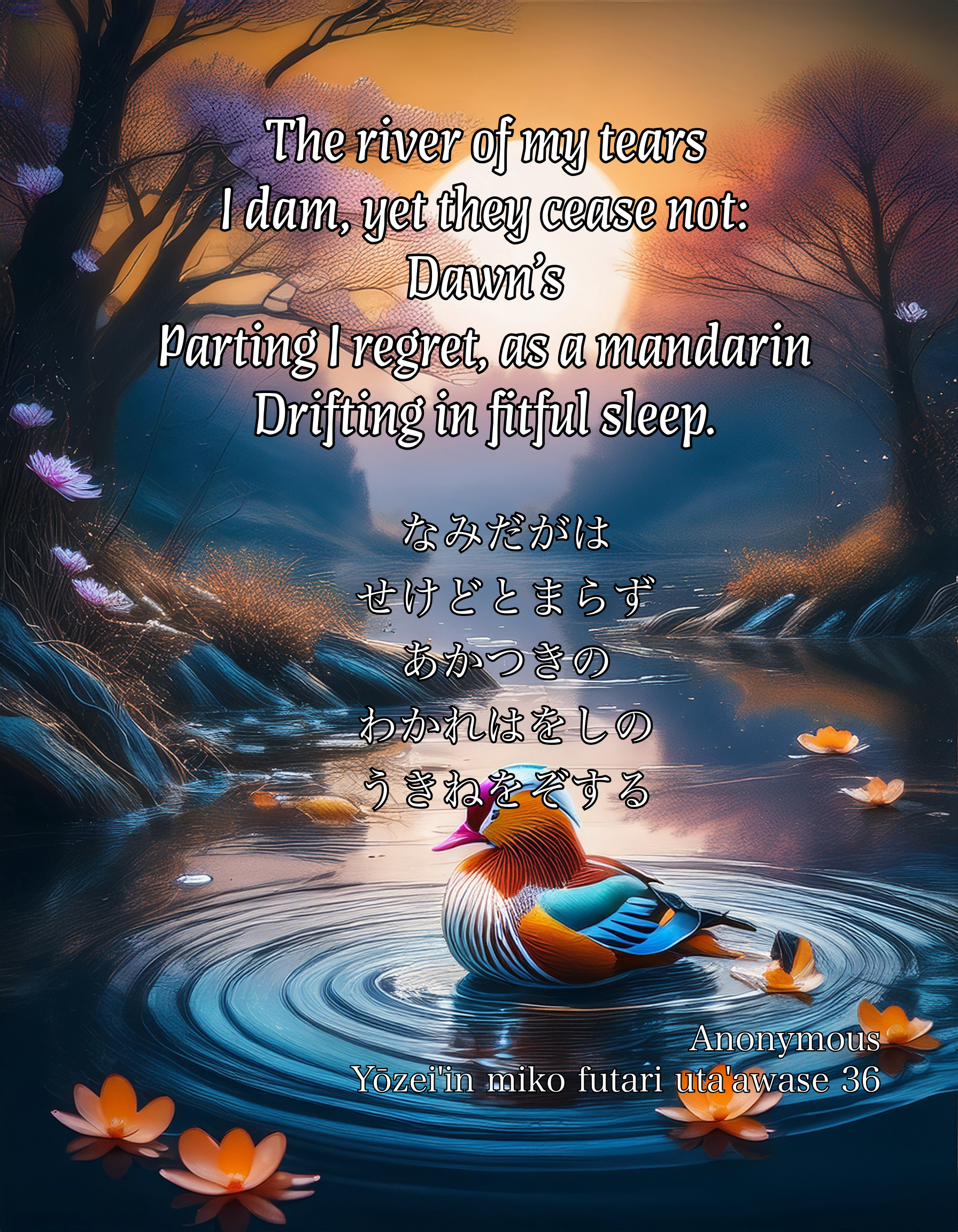
なみだがはせけどとまらずあかつきのわかれはをしのうきねをぞする

namidagawa
sekedo tomarazu
akatsuki no
wakare wa oshi no
ukine o zo suru
The river of my tears
I dam, yet they cease not:
Dawn’s
Parting I regret, as a mandarin
Drifting in fitful sleep.

36

Right

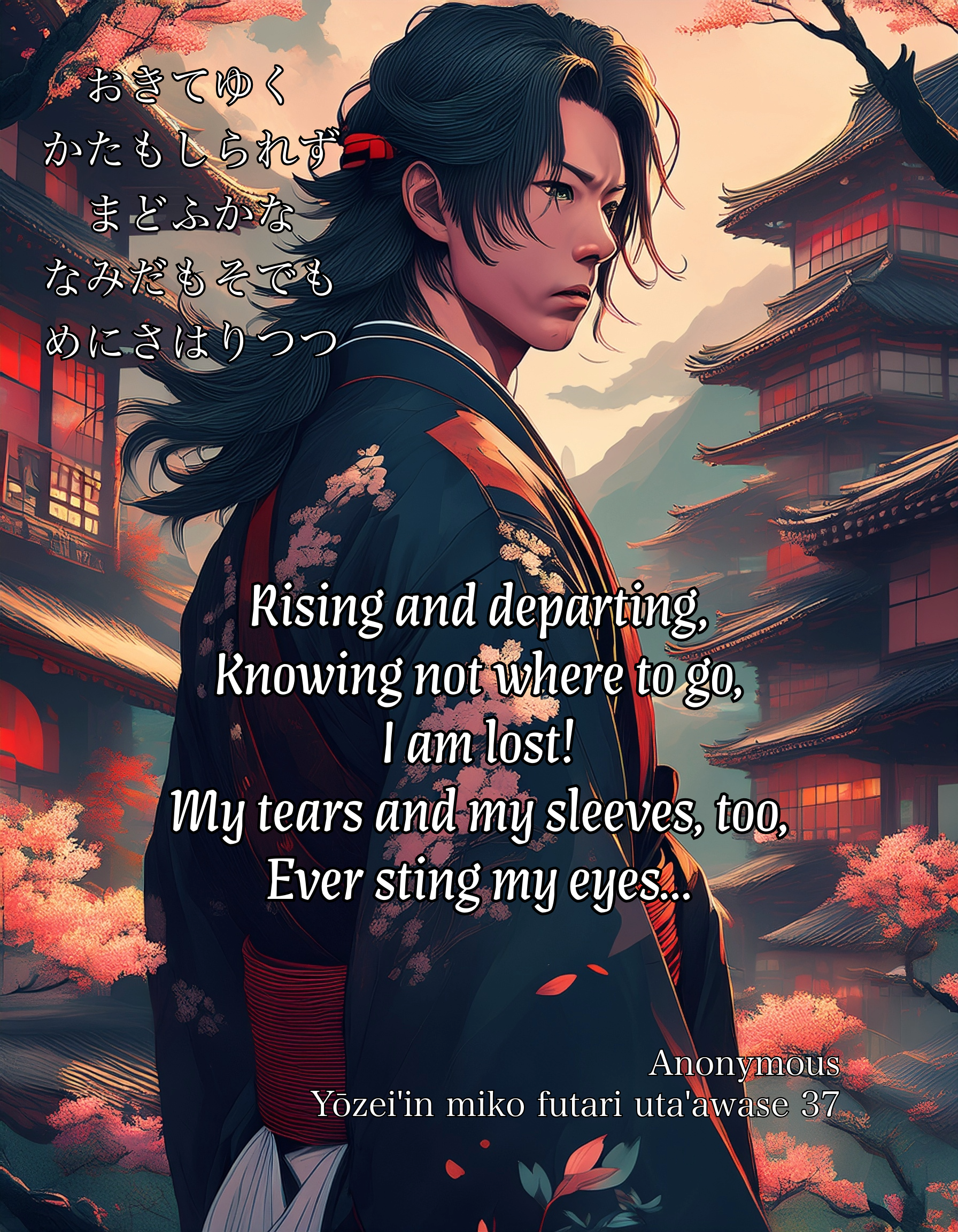
おきてゆくかたもしられずまどふかななみだもそでもめにさはりつつ

okiteyuku
kata mo shirarezu
madou kana
namida mo sode mo
me ni sawaritsutsu
Rising and departing,
Knowing not where to go,
I am lost!
My tears and my sleeves, too,
Ever sting my eyes…

37

Yōzei’in miko futari uta’awase 18

Left

したひもをゆふつけどりのこゑたちてけさのわかれになきぞわびぬる

shitahimo o
yūtsukedori no
koe tachite
kesa no wakare ni
naki zo wabinuru
Underbelt
Tying with the cockerel’s
Crow, arising,
At this morning’s parting
I weep, all forlorn!

34

Right

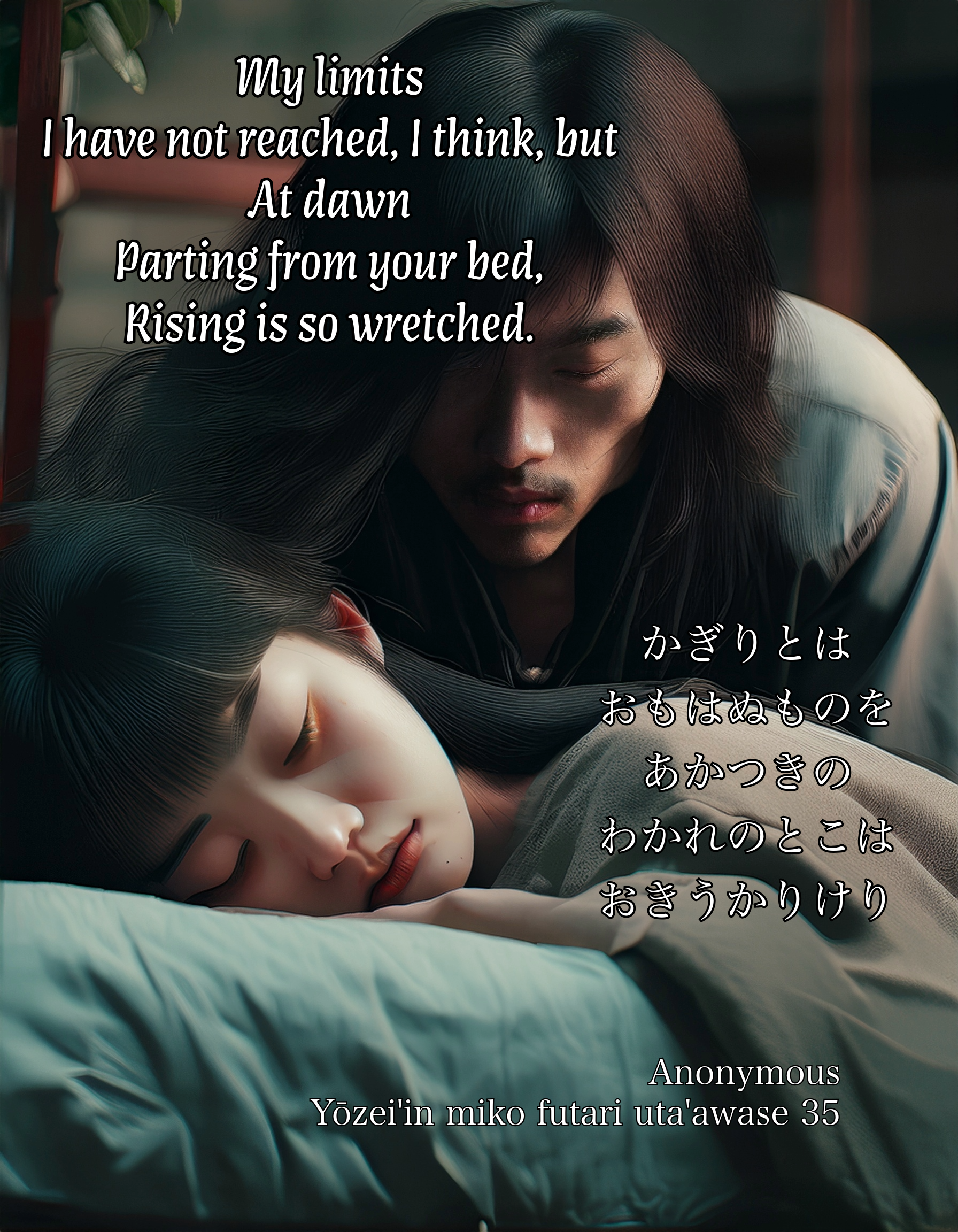
かぎりとはおもはぬものをあかつきのわかれのとこはおきうかりけり

kagiri to wa
omowanu mono o
akatsuki no
wakare no toko wa
oki’ukarikeri
My limits
I have not reached, I think, but
At dawn
Parting from your bed,
Rising is so wretched.

35

Yōzei’in miko futari uta’awase 17

Left

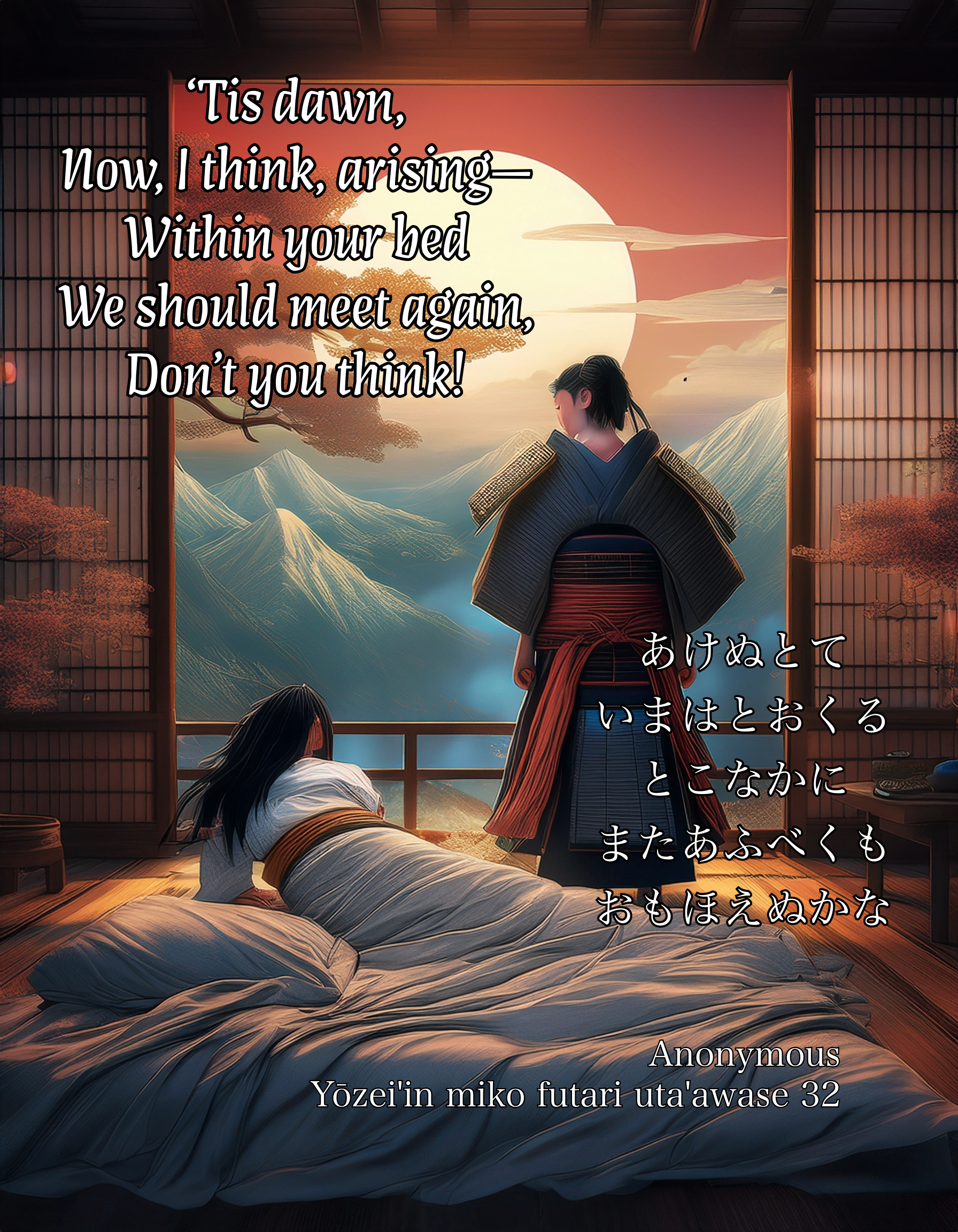
あけぬとていまはとおくるとこなかにまたあふべくもおもほえぬかな

akenu tote
ima wa to okuru
toko naka ni
mata aubeku mo
omohoenu kana
‘Tis dawn,
Now, I think, arising—
Within your bed
We should meet again,
Don’t you think!

32

Right

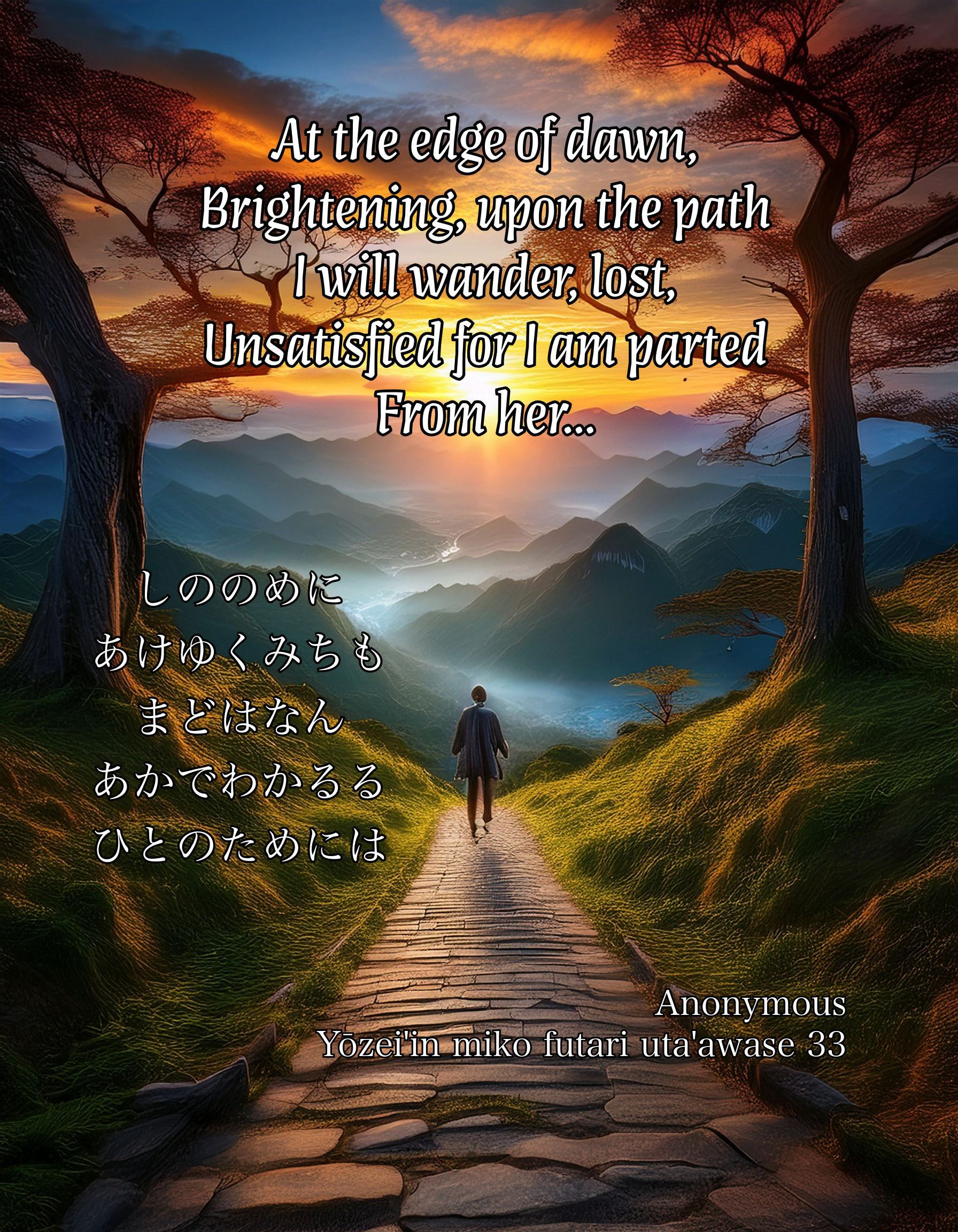
しののめにあけゆくみちもまどはなんあかでわかるるひとのためには

shinonome ni
akeyuku michi mo
madowanan
akade wakaruru
hito no tame ni wa
At the edge of dawn,
Brightening, upon the path
I will wander, lost,
Unsatisfied for I am parted
From her…

33

Nishinomiya uta’awase 18

Round Eighteen

Left

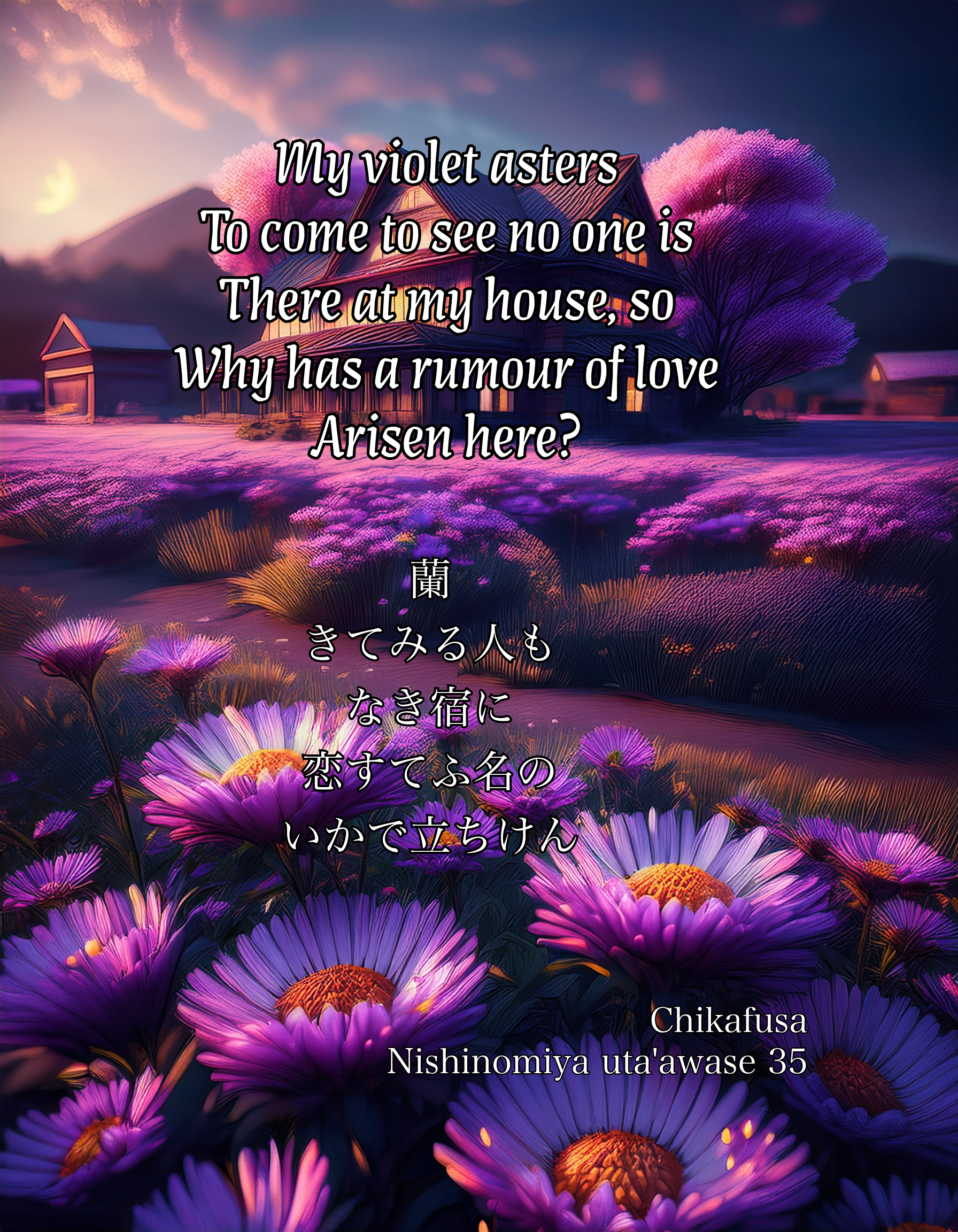
蘭きてみる人もなき宿に恋すてふ名のいかで立ちけん

fujibakama
kitemiru hito mo
naki yado ni
koisu chō na no
ikade tachiken
My violet asters
To come to see no one is
There at my house, so
Why has a rumour of love
Arisen here?

Chikafusa
35

Right

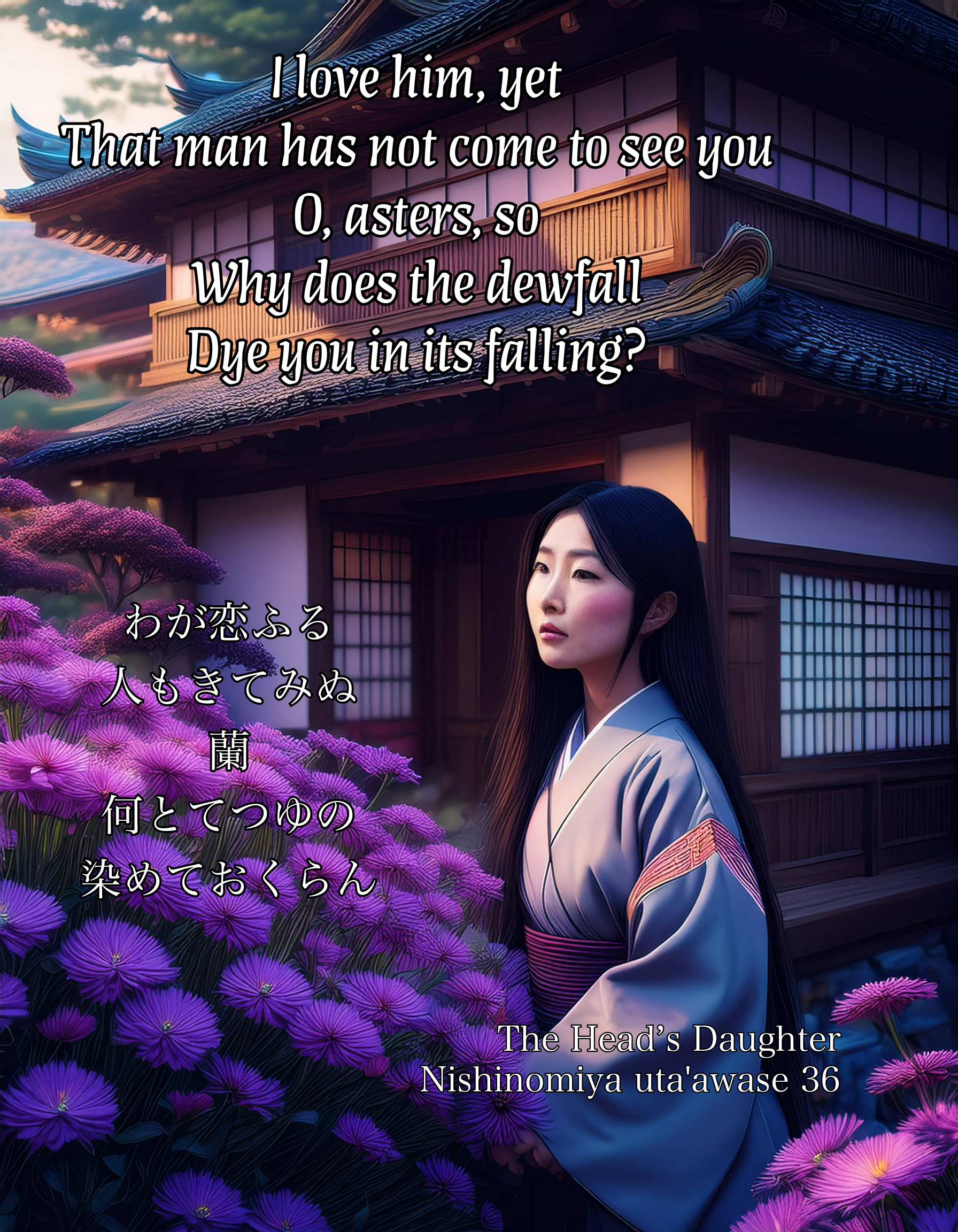
わが恋ふる人もきてみぬ蘭何とてつゆの染めておくらん

wa ga kouru
hito mo kiteminu
fujibakama
nani tote tsuyu no
somete’okuran
I love him, yet
That man has not come to see you
O, asters, so
Why does the dewfall
Dye you in its falling?

The Head’s Daughter
36

The Left’s overall impression is not bad, but I am curious about why a rumour of love should darken the door of a house, if it’s one where ‘no one comes to see’. Then, the Right uses ‘Why does the dewfall / Dye you in its falling?’—this seems like an excessive use of diction and the sequencing doesn’t sound smooth, so these seem of about the same standard.

Nishinomiya uta’awase 17

Asters and the Same

Round Seventeen

Left

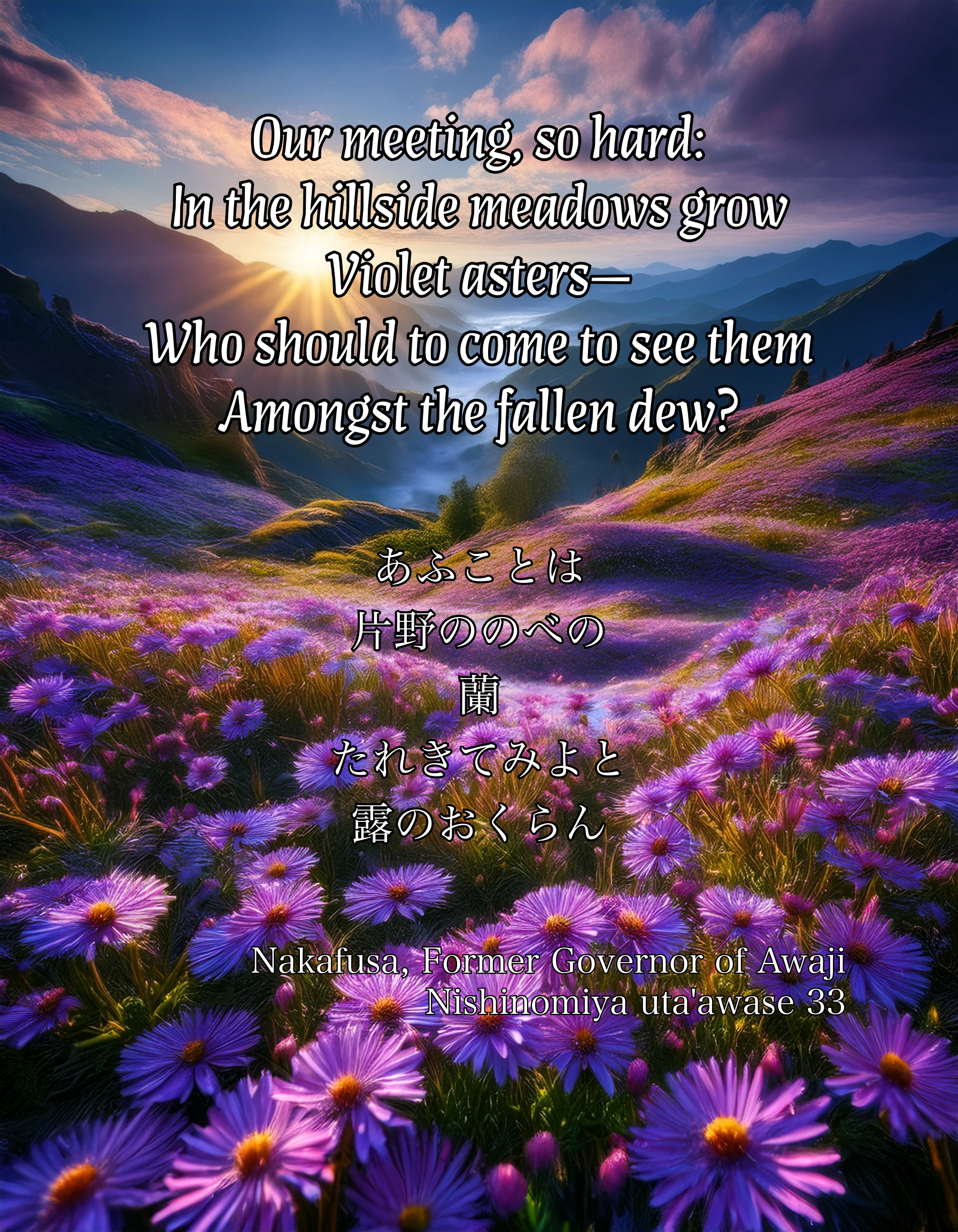
あふことは片野ののべの蘭たれきてみよと露のおくらん

au koto wa
katano no nobe no
fujibakama
tare kitemiyo to
tsuyu no okuran
Our meeting, so hard:
In the hillside meadows grow
Violet asters—
Who should to come to see them
Amongst the fallen dew?

Nakafusa, Former Governor of Awaji
33

Right

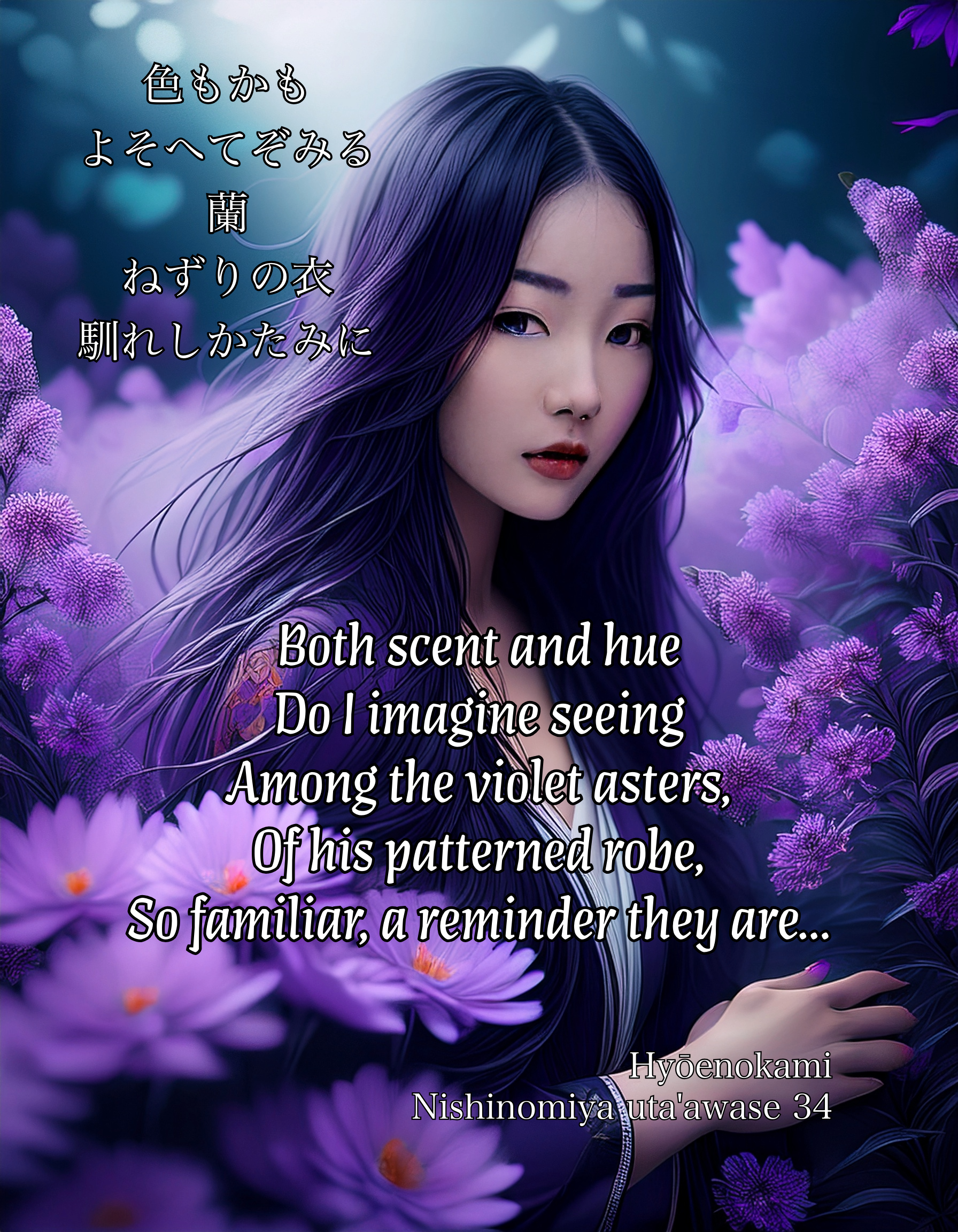
色もかもよそへてぞみる蘭ねずりの衣馴れしかたみに

iro mo ka mo
yosoete zo miru
fujibakama
nezuri no koromo
nareshi katami ni
Both scent and hue
Do I imagine seeing
Among the violet asters,
Of his patterned robe,
So familiar, a reminder they are…

Hyōenokami
34

These poems, both Left and Right, appear to be of about the same quality, but while I am familiar with robes patterned with purple gromwell, I do wonder what it is that is patterning the robes here. Is the poet composing on asters imagining them to be gromwell? Even if that’s the case, the conception is not particularly apparent, so I have to say that the Left is better.

Nishinomiya uta’awase 16

Round Sixteen

Left

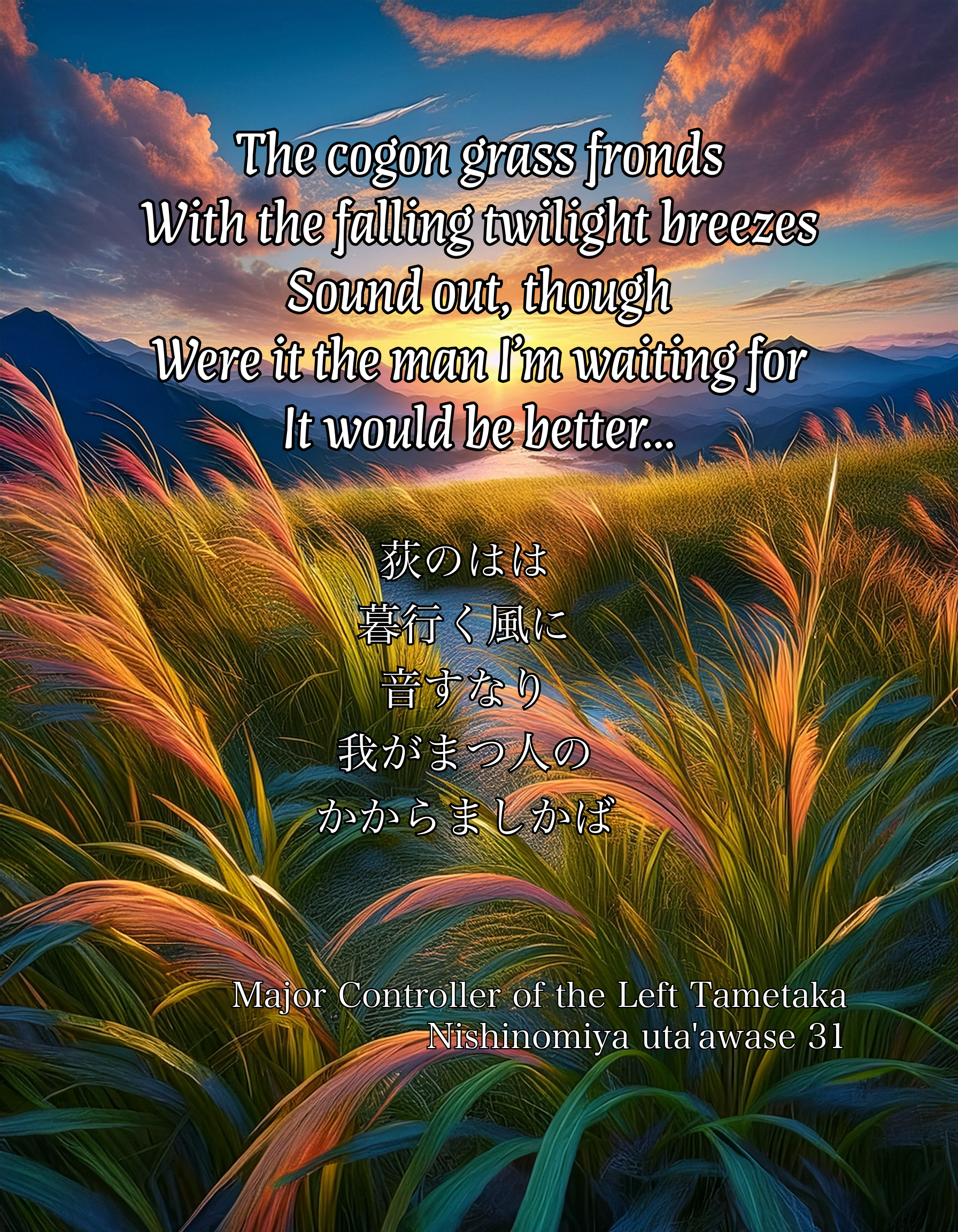
荻のはは暮行く風に音すなり我がまつ人のかからましかば

ogi no ha wa
kureyuku kaze ni
otosu nari
wa ga matsu hito no
kakaramashikaba
The cogon grass fronds
With the falling twilight breezes
Sound out, though
Were it the man I’m waiting for
It would be better…

Major Controller of the Left Tametaka
31

Right

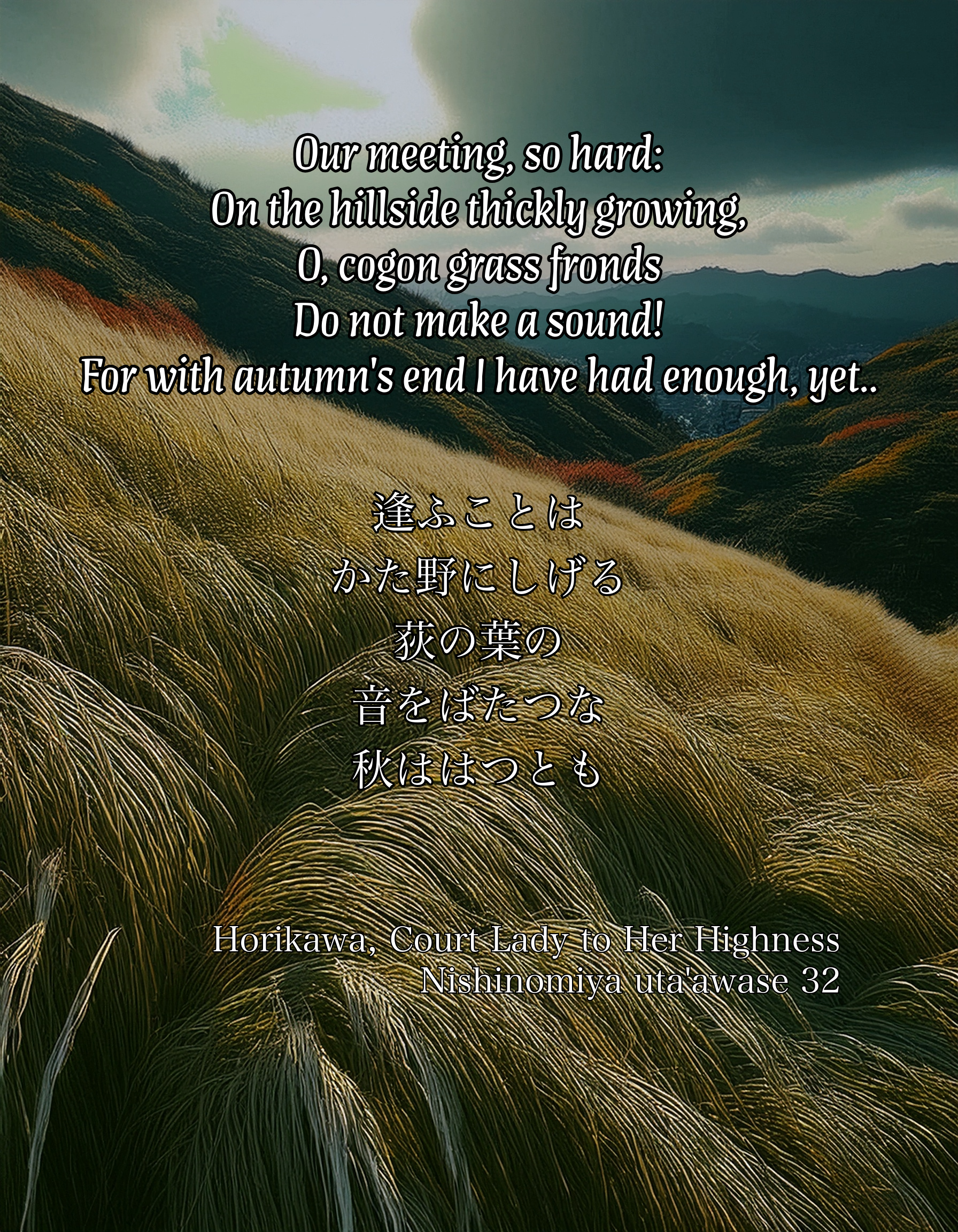
逢ふことはかた野にしげる荻の葉の音をばたつな秋ははつとも

au koto wa
katano ni shigeru
ogi no ha no
oto oba tatsu na
aki wa hatsu tomo
Our meeting, so hard:
On the hillside thickly growing,
O, cogon grass fronds
Do not make a sound!
For with autumn’s end I have had enough, yet..

Horikawa, Court Lady to Her Highness
32

I feel that the emotions encompassed by the sound of the wind in ‘Were it the man I’m waiting for / It would be better’ sounded more striking than ‘On the hillside thickly growing, / O, cogon grass fronds’.