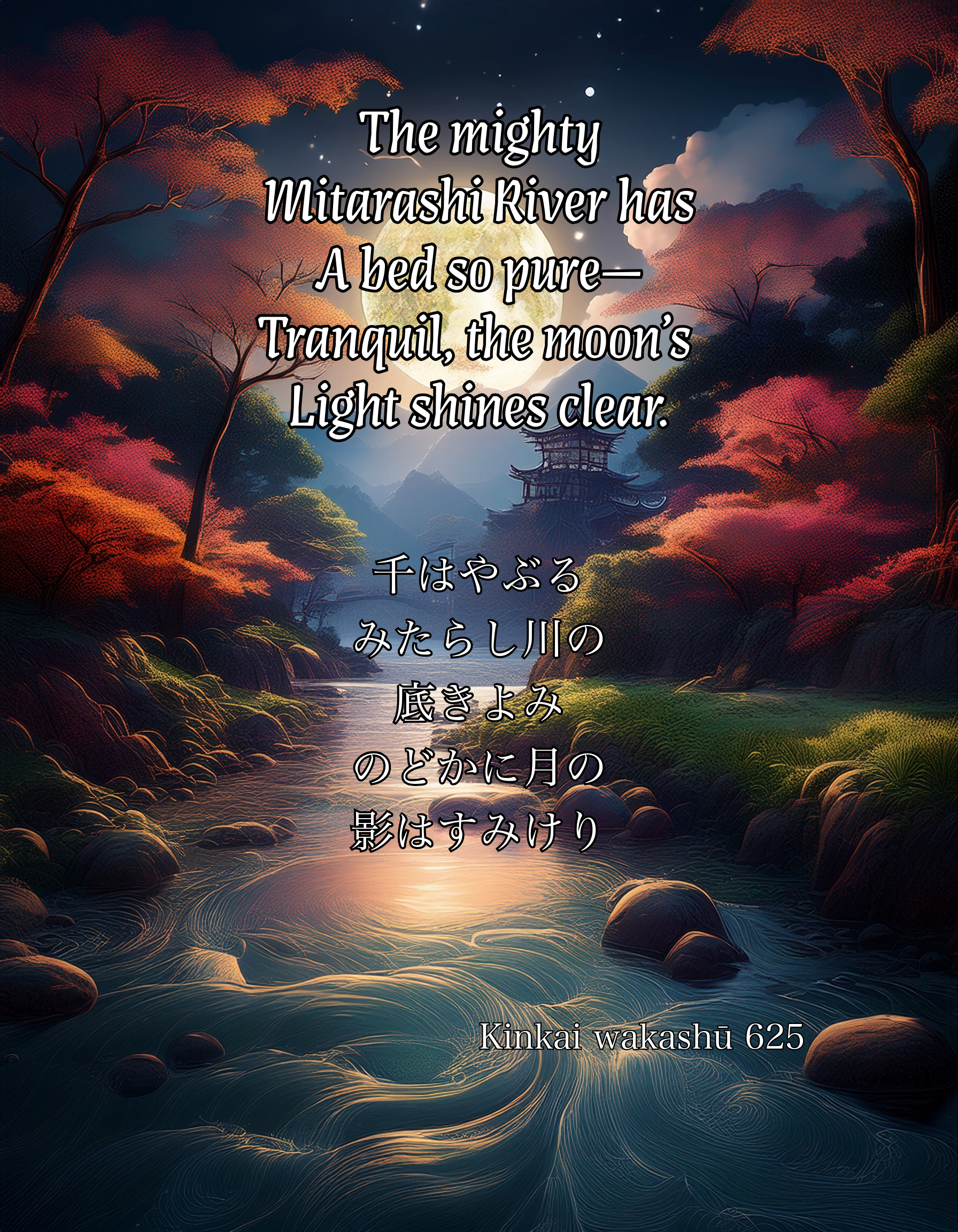
chihayaburu mitarashigawa no soko kiyomi nodoka ni tsuki no kage wa sumikeri
The mighty Mitarashi River has A bed so pure— Tranquil, the moon’s Light shines clear.[ii]
625
[i] Even though it is not specified in the headnote, the poem makes it clear that Sanetomo is referring to a specific river, the Mitarashi here.
[ii] This poem shows influence from Shinkokinshū XIX: 1889, and also: Topic unknown. まこもかる淀のさは水ふかけれどそこまで月の影はすみけり makomo karu / yodo no sawamizu / fukakeredo / soko made tsuki no / kage wa sumikeri ‘Reaping wild rice / In the Yodo’s marsh-waters, / So deep, yet / Right down to the bed, the moon’s / Light is clear.’ Former Major Counsellor Masafusa (Shinkokinshū III: 229)
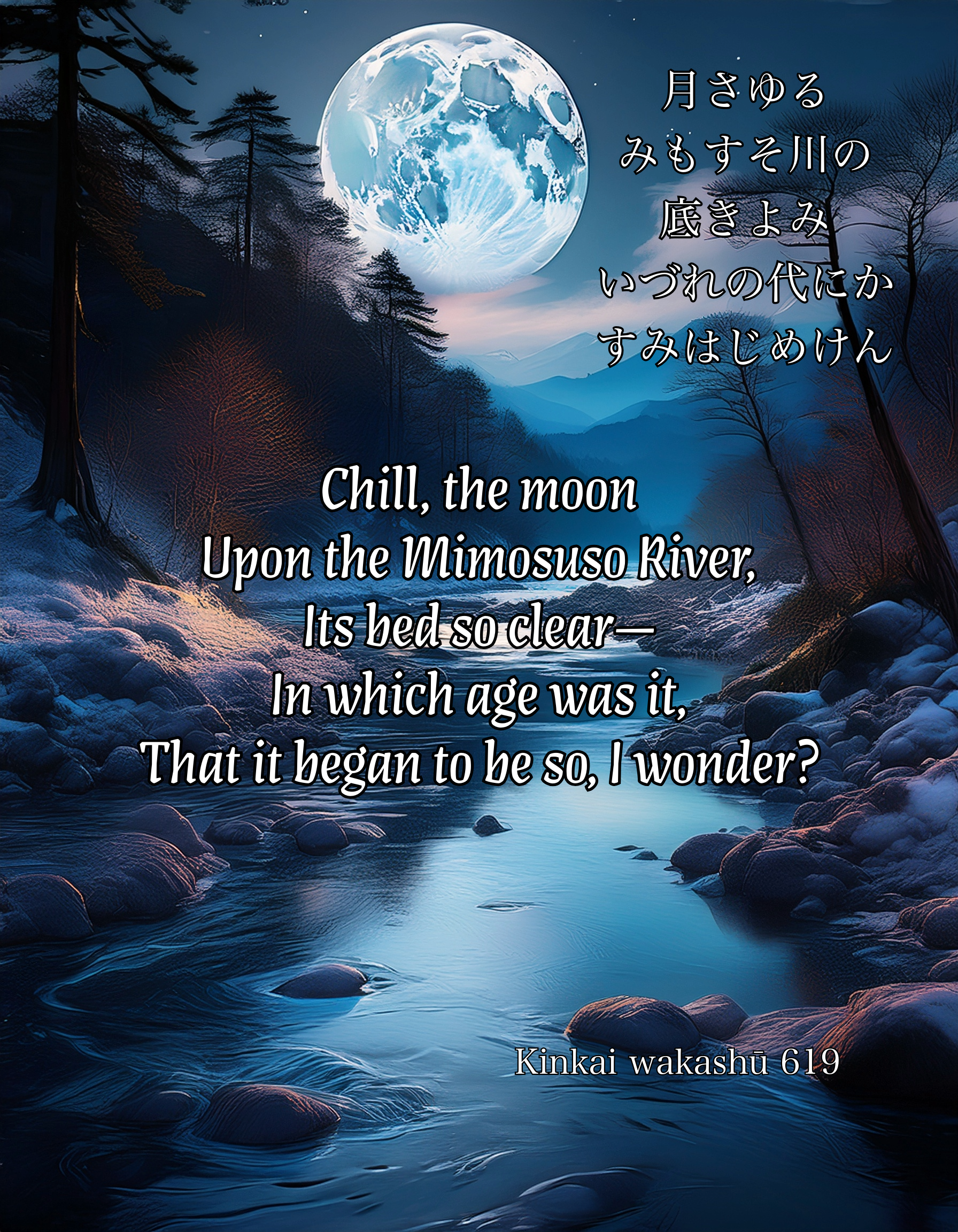
tsuki sayuru mimosusogawa no soko kiyomi izure no yo ni ka sumihajimeken
Chill, the moon Upon the Mimosuso River, Its bed so clear— In which age was it, That it began to be so, I wonder?[i]
619
[i] See: Composed for a picture of the Rinji Festival at the Kamo Shrine on a folding screen prepared for the entrance of a Junior Consort to the palace in the 6th year of Bunji (1190). 月さゆるみたらし河にかげみえてこほりにすれる山あゐの袖 tsuki sayuru / mitarashigawa ni / kage miete / kōri ni sureru / yama’ai no sode ‘Chill, the moon, / Upon the Mitarashi River / Shines, seeming as / A design of ice upon / Indigo sleeves.’ Master of the Dowager Empress’ Household Office Toshinari (Shinkokinshū XIX: 1889)
After a certain lady had set off up to the capital, I composed these and, attaching them to a letter, had it sent to her.
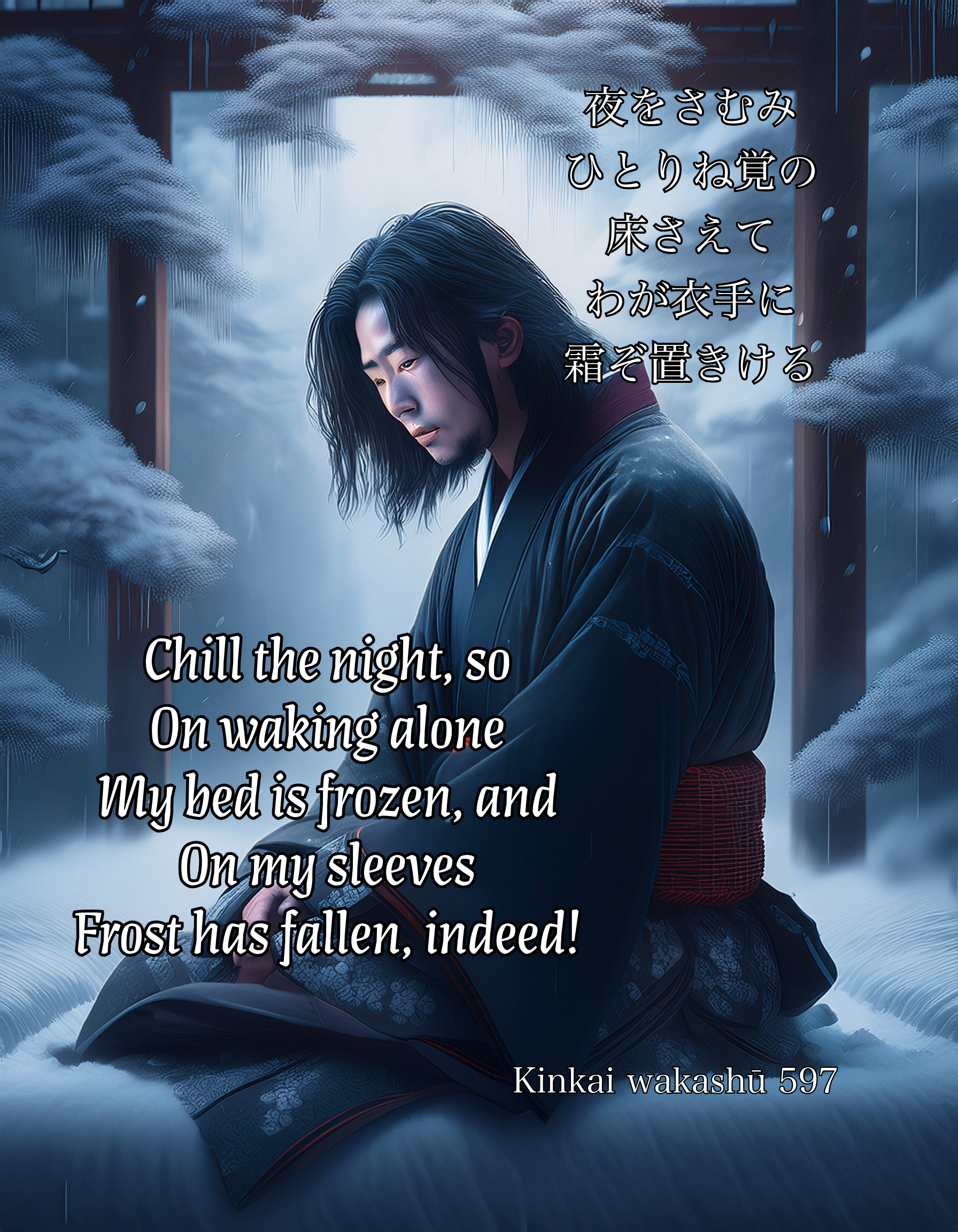
夜をさむみひとりね覚の床さえてわが衣手に霜ぞ置きける
yo o samumi hitori nezame no toko saete wa ga koromode ni shimo zo okikeru
Chill the night, so On waking alone My bed is frozen, and On my sleeves Frost has fallen, indeed![i]
597
[i] See: Topic unknown. 夜をさむみねざめてきけばをしぞなく払ひもあへず霜やおくらん yo o samumi / nezamete kikeba / oshi zo naku / harai mo aezu / shimo ya okuran ‘Chill the night and / On waking, I hear / A mandarin drake a’crying / For he cannot brush away / The fallen frost, it seems.’ Anonymous (Gosenshū VIII: 478)
sode makura shimo oku toko no koke no ue ni akasu bakari no sayo no nakayama
With my sleeve for my pillow, and Frost falling on my bed Atop the moss, Swiftly breaks the dawn At Sayo-no-Nakayama.[i]
582
[i] See: On a storm at one’s lodgings on a journey, for the Iwashimizu Poetry Match. 岩がねのとこに嵐をかたしきてひとりやねなんさよの中山 iwa ga ne no / toko ni arashi o / katashikite / hitori ya nenan / sayo no Nakayama ‘At the crags’ foot / Lies my bed with the storm wind / Alone, spread upon me— / Lonely, must I sleep? / At Sayo-no-Nakayama…’ Lord Ari’ie (Shinkokinshū X: 962)
tabi no sora narenu hanyū no yoru no toko wabishiki made ni moru shigure kana
Beneath a journey’s skies With unfamiliar mud walls Around my bed tonight, Sad and lonely have I become With the shower dripping through![i]
581
[i] See: On disembarking. 旅のそらはにふのこやのいぶせさにふるさといかにこひしかるらん tabi no sora / hanyū no koya no / ibusesa ni / furusato ika ni / koishikaruran ‘Beneath a journey’s skies / Within a mud hut and / Filled with gloom / For my ancient home how much / I do seem to long…’ Captain of the Third Rank Shigehira (Heike monogatari 85)