Topic unknown.
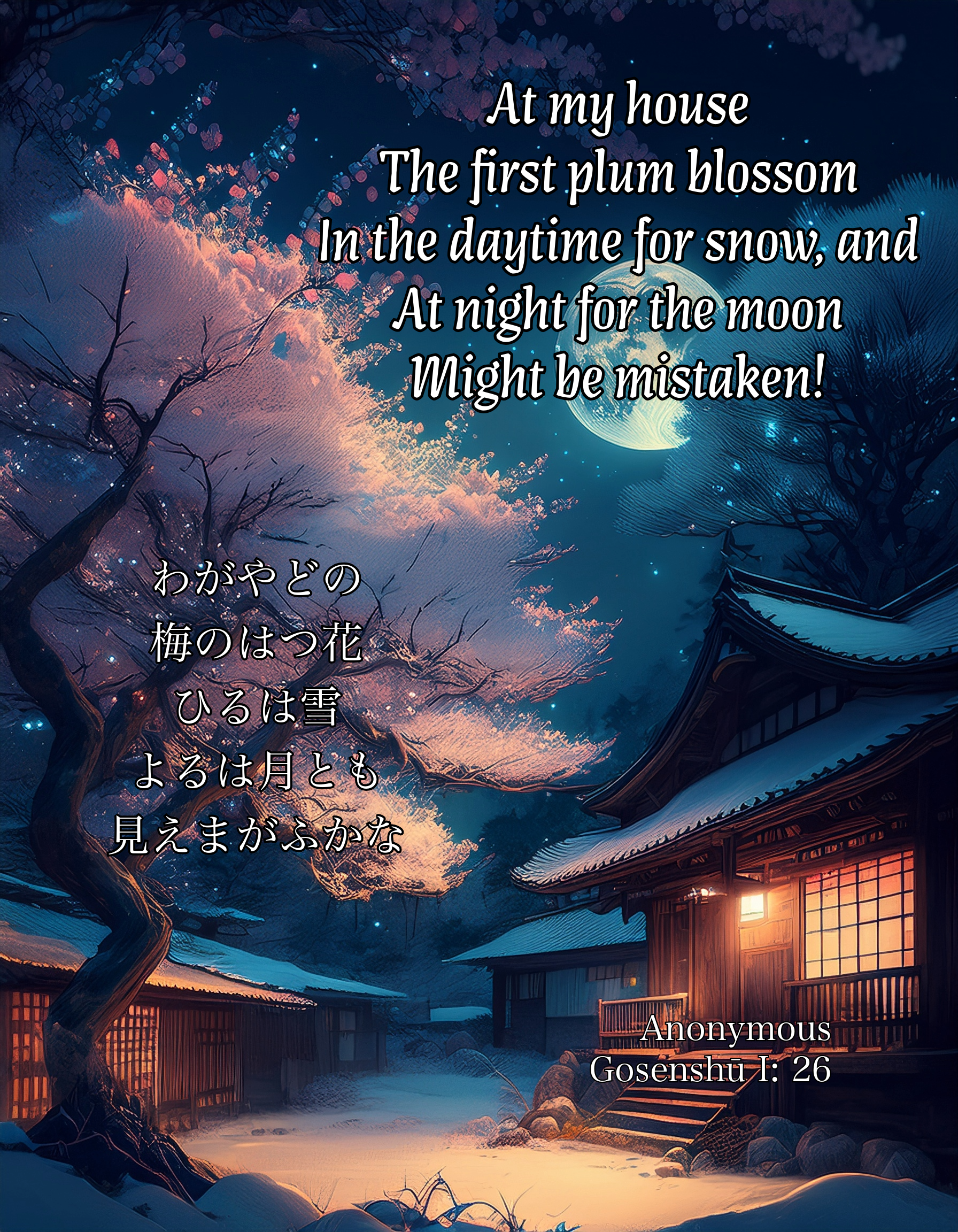
わがやどの梅のはつ花ひるは雪よるは月とも見えまがふかな
| wa ga yado no ume no FatuFana Firu Fa yuki yoru Fa tuki to mo miemagaFu kana | At my house The first plum blossom In the daytime for snow, and At night for the moon Might be mistaken! |
Anonymous
A shower at a journey’s lodging
たびの空なれぬはにふのよるのとこ侘しきまでにもる時雨かな
| tabi no sora narenu hanyū no yoru no toko wabishiki made ni moru shigure kana | Beneath a journey’s skies With unfamiliar mud walls Around my bed tonight, Sad and lonely have I become With the shower dripping through![i] |
581

[i] See: On disembarking. 旅のそらはにふのこやのいぶせさにふるさといかにこひしかるらん tabi no sora / hanyū no koya no / ibusesa ni / furusato ika ni / koishikaruran ‘Beneath a journey’s skies / Within a mud hut and / Filled with gloom / For my ancient home how much / I do seem to long…’ Captain of the Third Rank Shigehira (Heike monogatari 85)
Original
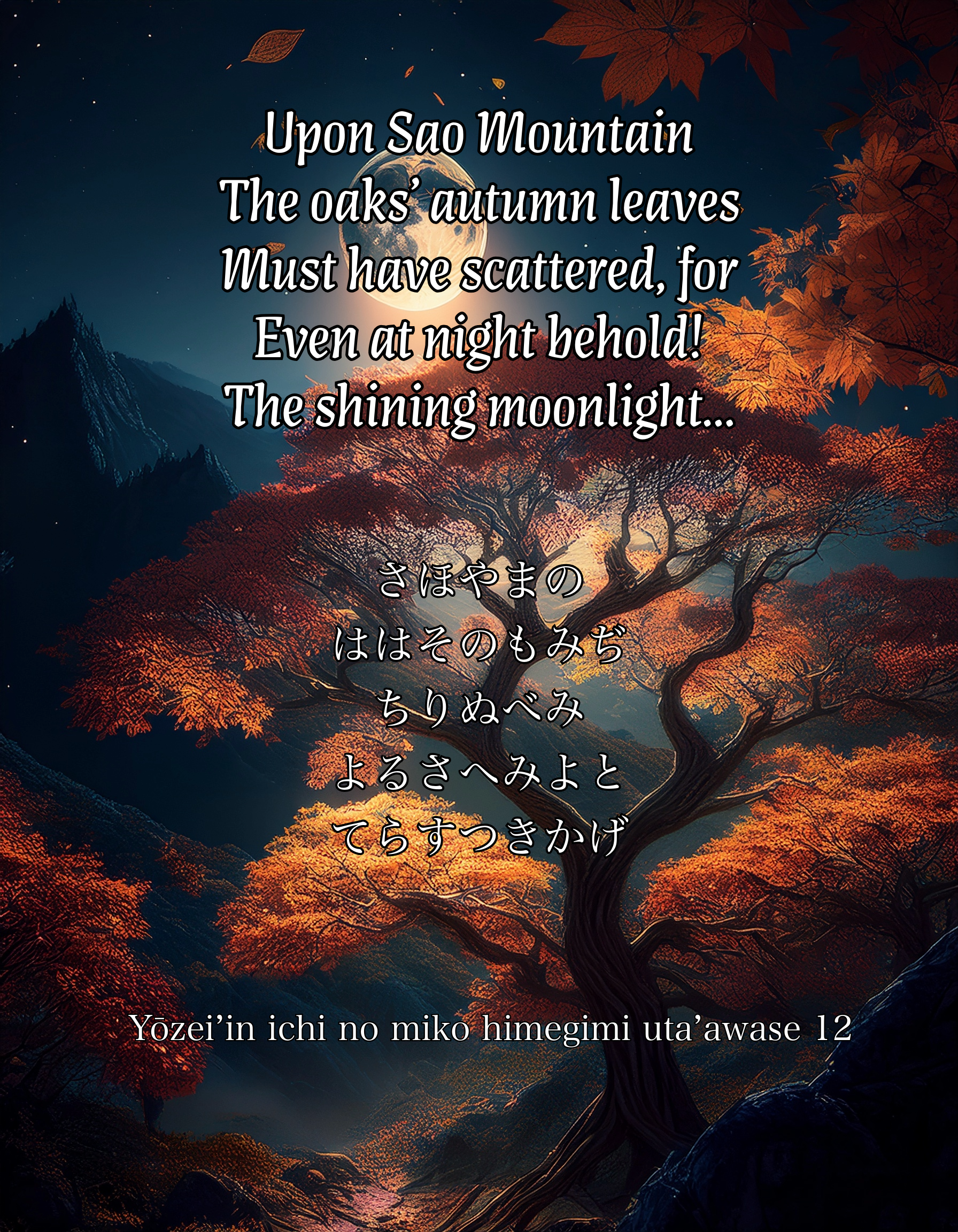
さほやまのははそのもみぢちりぬべみよるさへみよとてらすつきかげ
| saoyama no hahaso no momiji chirinubemi yoru sae miyo to terasu tsukikage | Upon Sao Mountain The oaks’ autumn leaves Must have scattered, for Even at night behold! The shining moonlight… |
12
Left (Win)
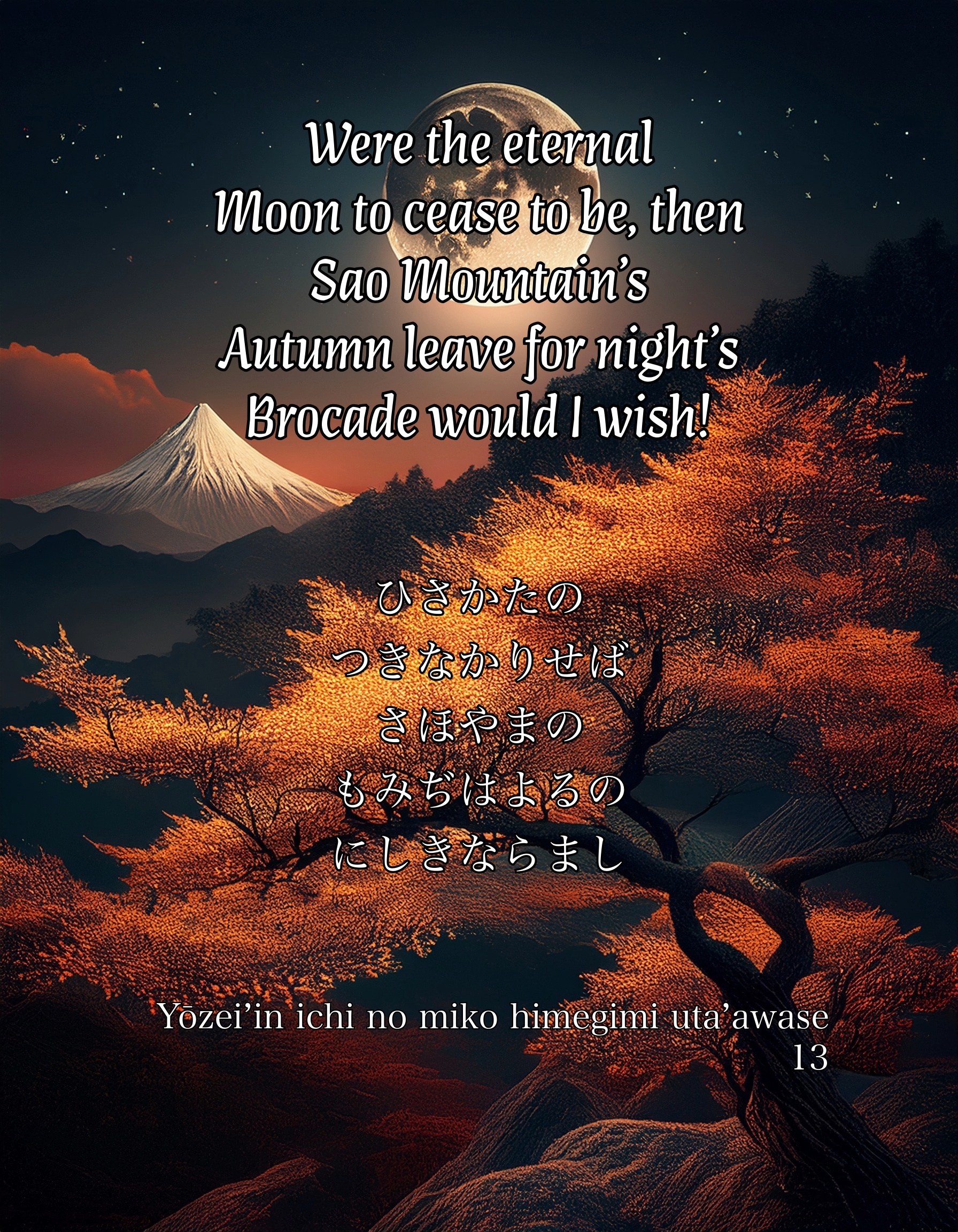
ひさかたのつきなかりせばさほやまのもみぢはよるのにしきならまし
| hisakata no tsuki nakariseba saoyama no momiji wa yoru no nishiki naramashi | Were the eternal Moon to cease to be, then Sao Mountain’s Autumn leaves for night’s Brocade would I wish! |
13
Right
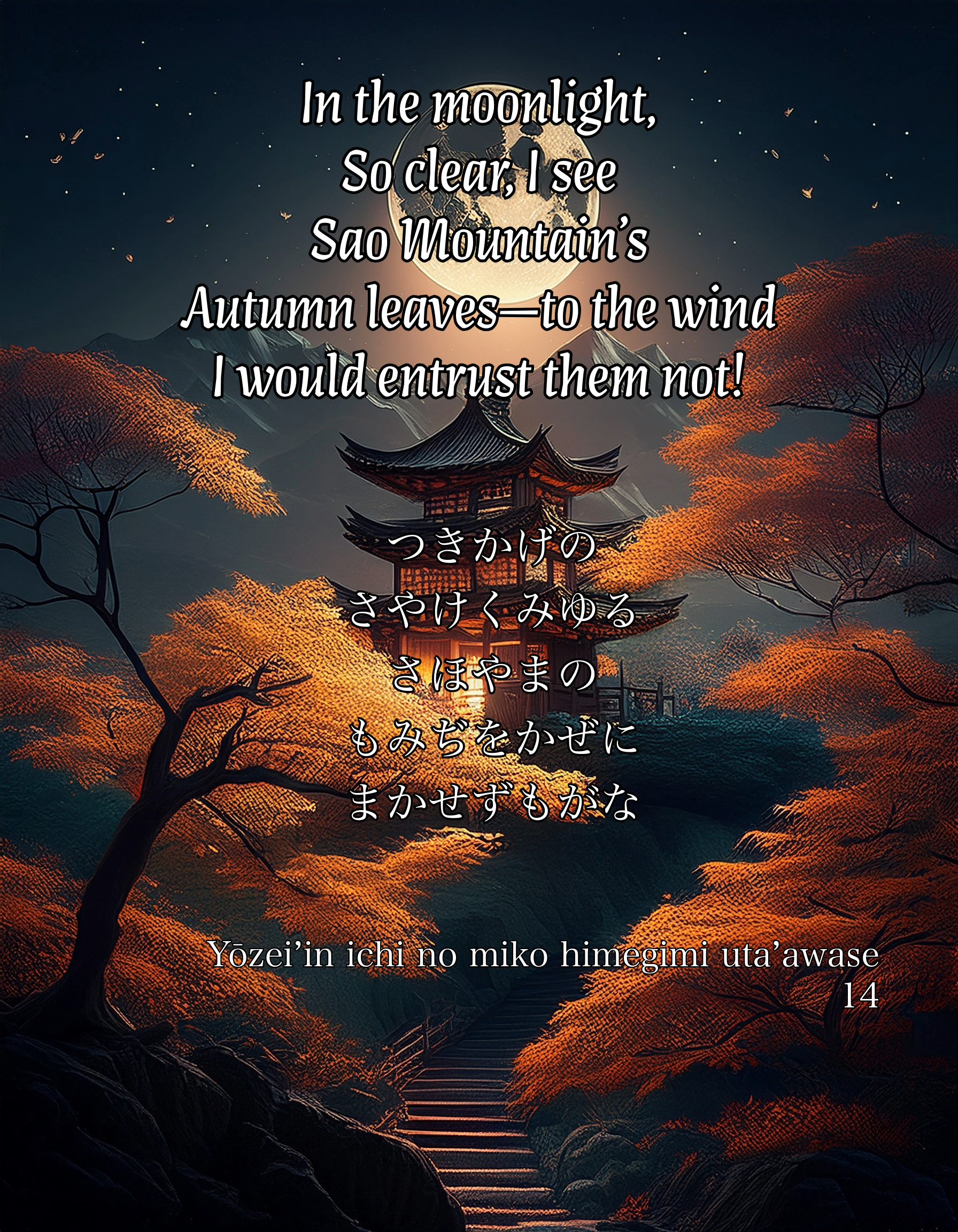
つきかげのさやけくみゆるさほやまのもみぢをかぜにまかせずもがな
| tsukikage no sayakeku miyuru saoyama no momiji o kaze ni makasezu mogana | In the moonlight, So clear, I see Sao Mountain’s Autumn leaves—to the wind I would entrust them not! |
14
Left
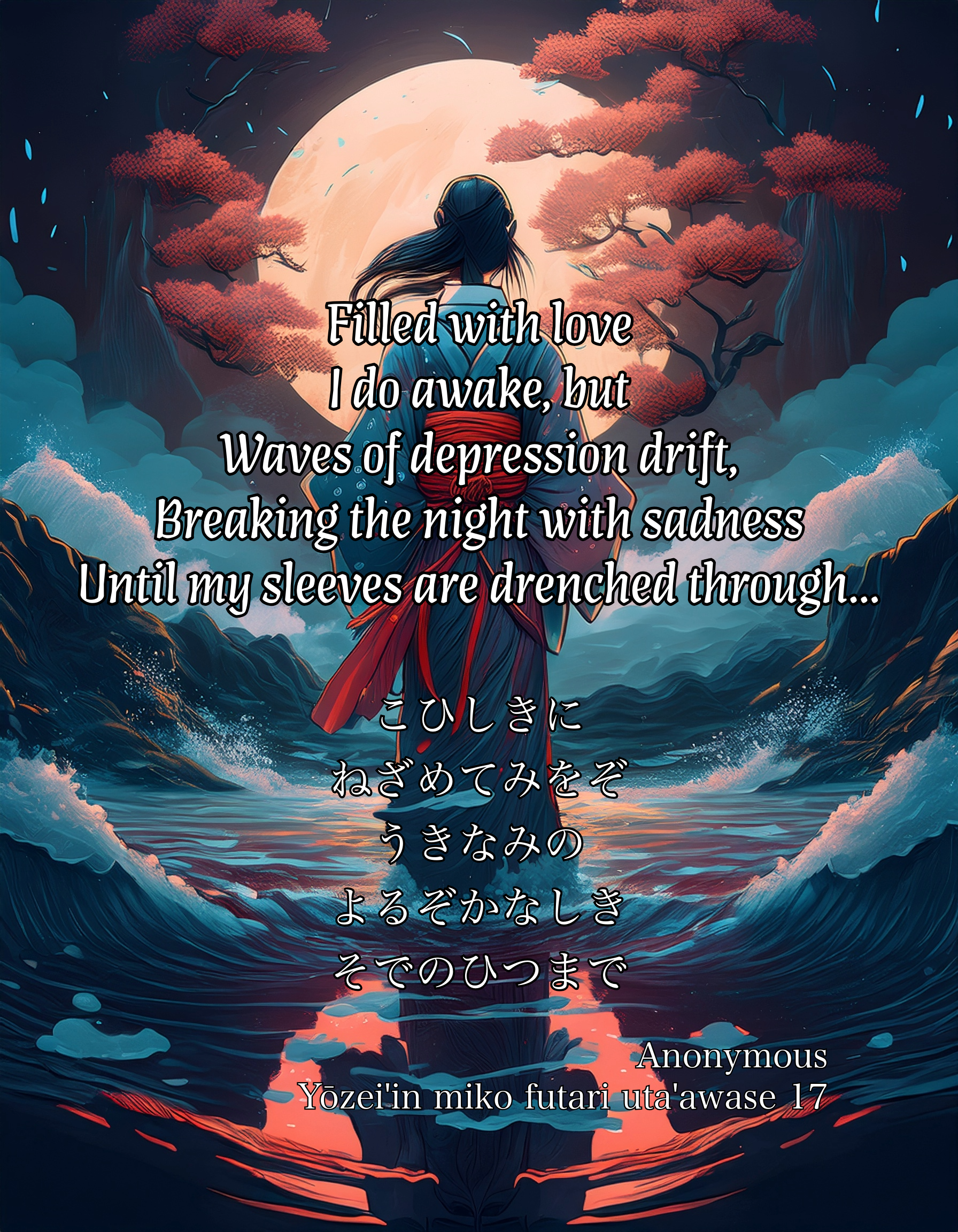
こひしきにねざめてみをぞうきなみのよるぞかなしきそでのひつまで
| koishiki ni nezamete mi o zo ukinami no yoru zo kanashiki sode no hitsu made | Filled with love I do awake, but Waves of depression drift, Breaking the night with sadness Until my sleeves are drenched through… |
17
Right
うつつにもゆめにもみえずなりぬればさむるよなよなねをのみぞなく
| utsutsu ni mo yume ni mo miezu narinureba samuru yonayona ne o nomi zo naku | In both reality, and Dreams I see her not— When it comes to that, then On waking night after night Will I simply weep! |
18

Round Thirty-Nine
Left (Tie)
さをしかのふしどをあさみ吹く風に夜半に鳴く音ぞふかくなりゆく
| saoshika no fushido o asami fuku kaze ni yowa ni naku ne zo fukaku nariyuku | The stag’s Resting place disturbed by The gusting wind At midnight his belling cry Comes from deeper in the mountains. |
Chikanari
77
Right
さらでだにね覚かなしき秋風に夜しもなどか鹿の鳴くらん
| sarade dani nezame kanashiki akikaze ni yoru shimo nado ka shika no nakuran | Even were it not so, To waken is so sad With the cruel autumn wind; Why is it that above all at night The stag should cry so? |
Ie’kiyo
78
The Left poem’s ‘at midnight his belling cry comes from deeper’ does not sound especially elegant. The Right poem composes ‘why is it that above all at night the stag should cry so’, sounding like it is only at night that stags bell, but stags do this all the time in autumn. The Ancient and Modern also has the composition, ‘Mud-daubers buzzing / In the autumn bush clover; / Leaving with morning’.[1] The poems of Left and Right have no merits or faults between them—they should tie.


[1] This is a quotation from: Topic unknown. すがるなく秋のはぎはらあさたちて旅行く人をいつとかまたむ sugaru naku / aki no hagiwara / asa tachite / tabi yuku hito o / itsu to ka matan ‘Mud-daubers buzzing / In the autumn bush clover; / Leaving with morning, / Away on a journey: for him, / How long must I wait?’ Anonymous (KKS VIII: 366)
ももしきにしもはおくともきくの花ちよの冬までうつろふなゆめ
| momoshiki ni shimo wa okutomo kiku no hana chiyo no fuyu made utsurounayume | Upon the hundred-fold palace The frost may fall, yet These chrysanthemum blooms, Though winter last a thousand ages, Will not fade, at all… |
[Minamoto no] Koremochi
5
きくのはなちとせみまくのほしければをしみしよるのあくるもしらず
| kiku no hana chitose mimaku no hoshikereba oshimi yoru no akuru mo shirazu | O, chrysanthemums! For a thousand years to gaze on them Is my desire, then The regrets of night’s Dawn I would never know! |
[Fujiwara no] Kunimoto
6
Left (Tie)
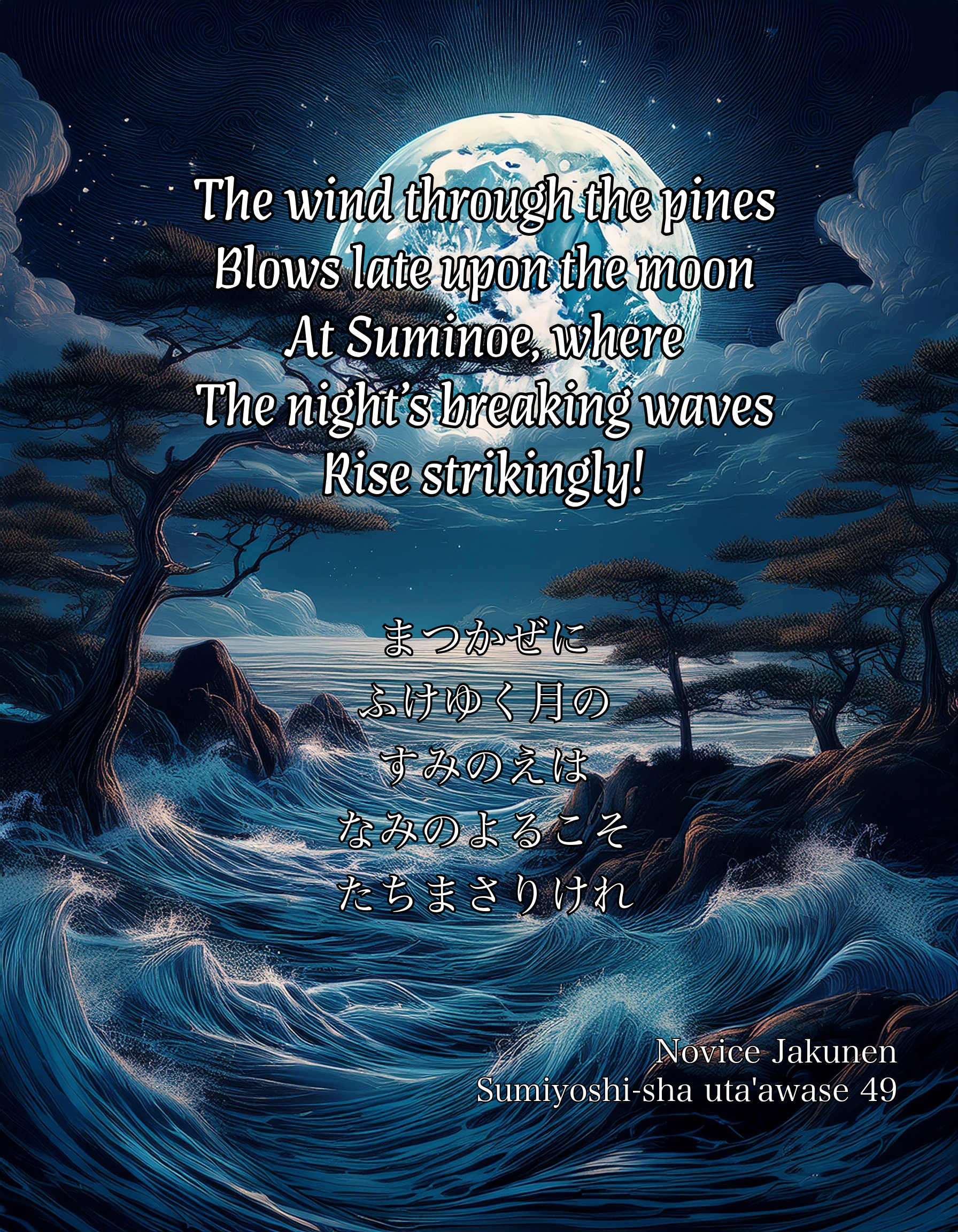
まつかぜにふけゆく月のすみのえはなみのよるこそたちまさりけれ
| matsukaze ni fukeyuku tsuki no suminoe wa nami o yoru koso tachimasarikere | The wind through the pines Blows late upon the moon At Suminoe, where The night’s breaking waves Rise strikingly! |
Novice Jakunen[1]
49
Right
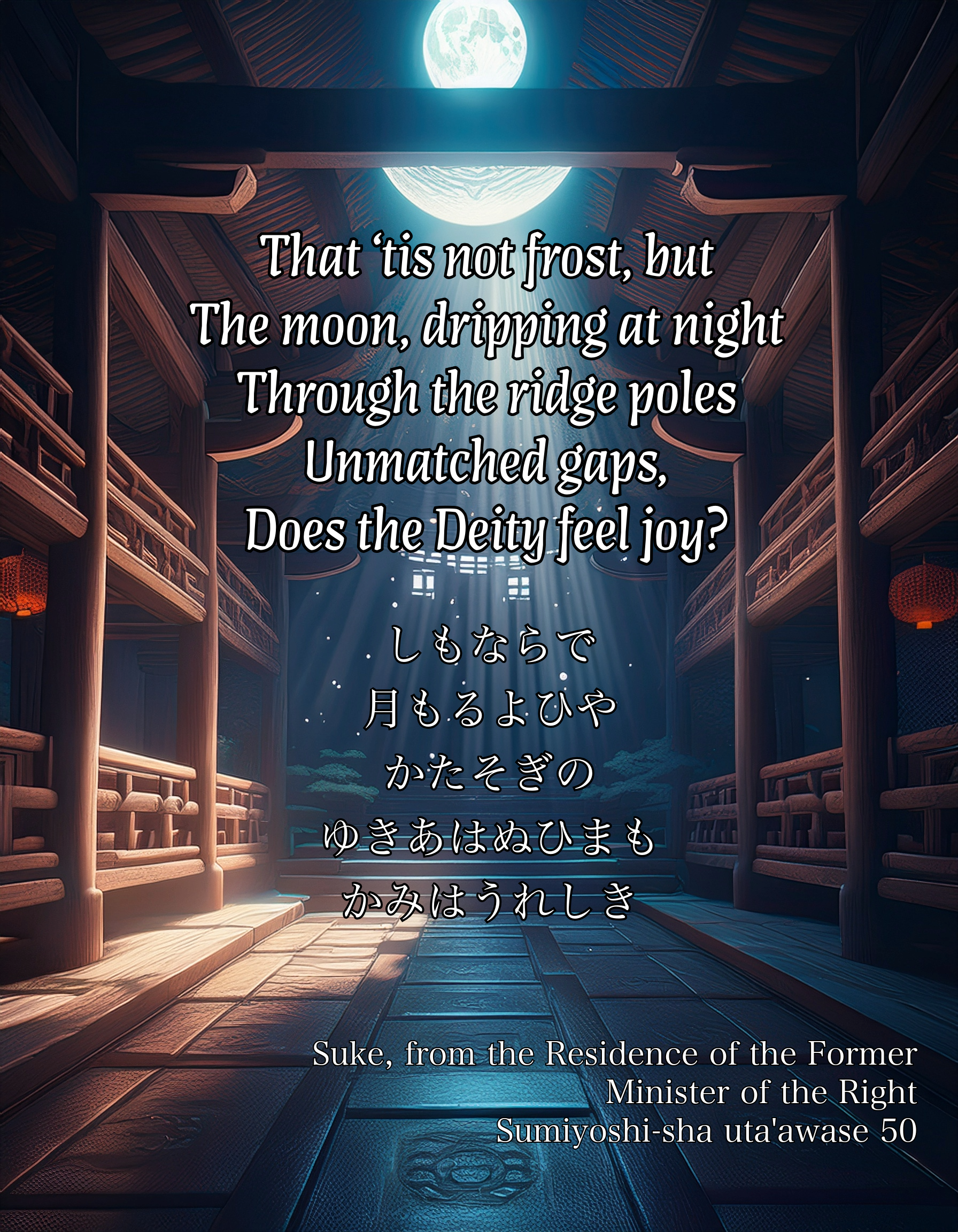
しもならで月もるよひやかたそぎのゆきあはぬひまもかみはうれしき
| shimo narade tsuki moru yoi ya katasogi no yukiawanu hima mo kami wa ureshiki | That ‘tis not frost, but The moon, dripping at night Through the ridge poles Unmatched gaps, Does the Deity feel joy? |
Suke, from the Residence of the Former Minister of the Right[2]
50
The Left poem’s ‘Blows late upon the moon / At Suminoe’ sounds pleasant, but there have been recent poems, such as ‘Brings waves–that / I would tell you!’[3] and ‘Simply with the waves / Did seem to draw near with the night’[4] and while the initial section of the poem here differs, basing a poem on this is not that unusual, I think. The tone of the Right’s poem is charming, but it does not seem likely that the Deity would feel joy simply at the moon coming through the gaps in His ridgepoles. The Deity’s power is limitless and wards eighty isles beyond Sumiyoshi—indeed, there is nowhere in Tsumori’s shore or Sumiyoshi beach, above the waves or in the shad of the pines that it does not reach. I have discussed ridgepoles earlier. Nevertheless, the configuration of the poem isn’t bad, so these should tie, I think.
[1] Shami Jakunen 沙弥寂念
[2] Zen-udaijin no ie no Suke前右大臣家佐
[3] 人しれぬ思ひありそのはま風に浪のよるこそいはまほしけれ hito shirenu omoi ariso no hamakaze ni nami no yoru koso iwamahoshikere ‘Unknown to all / My passion burns—toward a rocky / Beach the breeze / Brings waves–that / I would tell you!’ Middle Captain Toshitada (Horikawa-in enjo awase 17/KYS (2) 468/500)
[4] Composed when he was asked by people in the capital what the moon had been like, when he had returned there, after going to Akashi to gaze upon it, at a time when it was particularly bright. 有明の月もあかしの浦風に波ばかりこそよるとみえしか ariake no tsuki mo akashi no urakaze ni nami bakari koso yoru to mieshika ‘The dawntime Moon’s brightness, with Akashi’s / Beach breezes / Simply with the waves / Did seem to draw near with the night…’ Taira no Tadamori (KYS (2) III: 216/KYS (3) III: 212)


