Tag Archives: shika

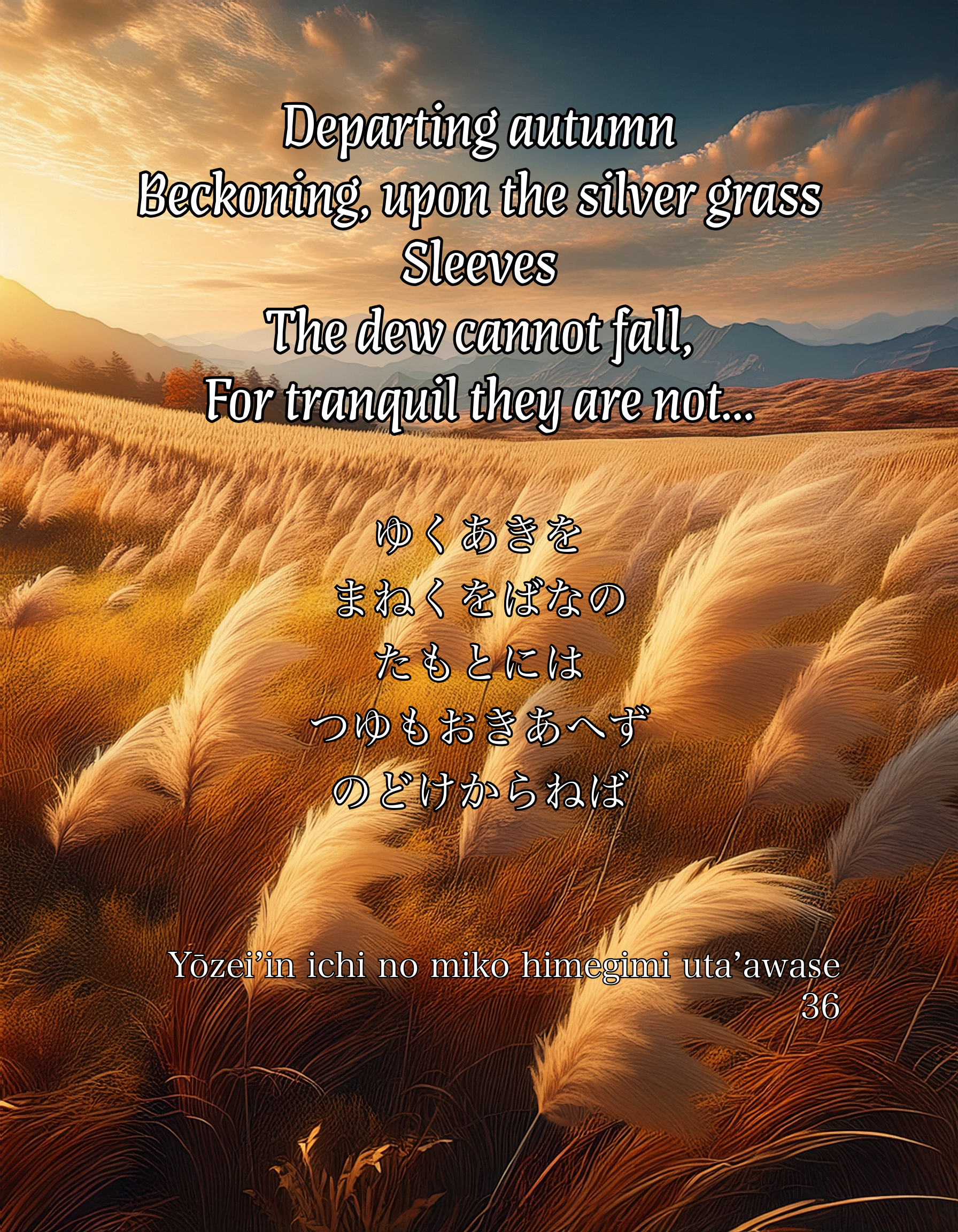
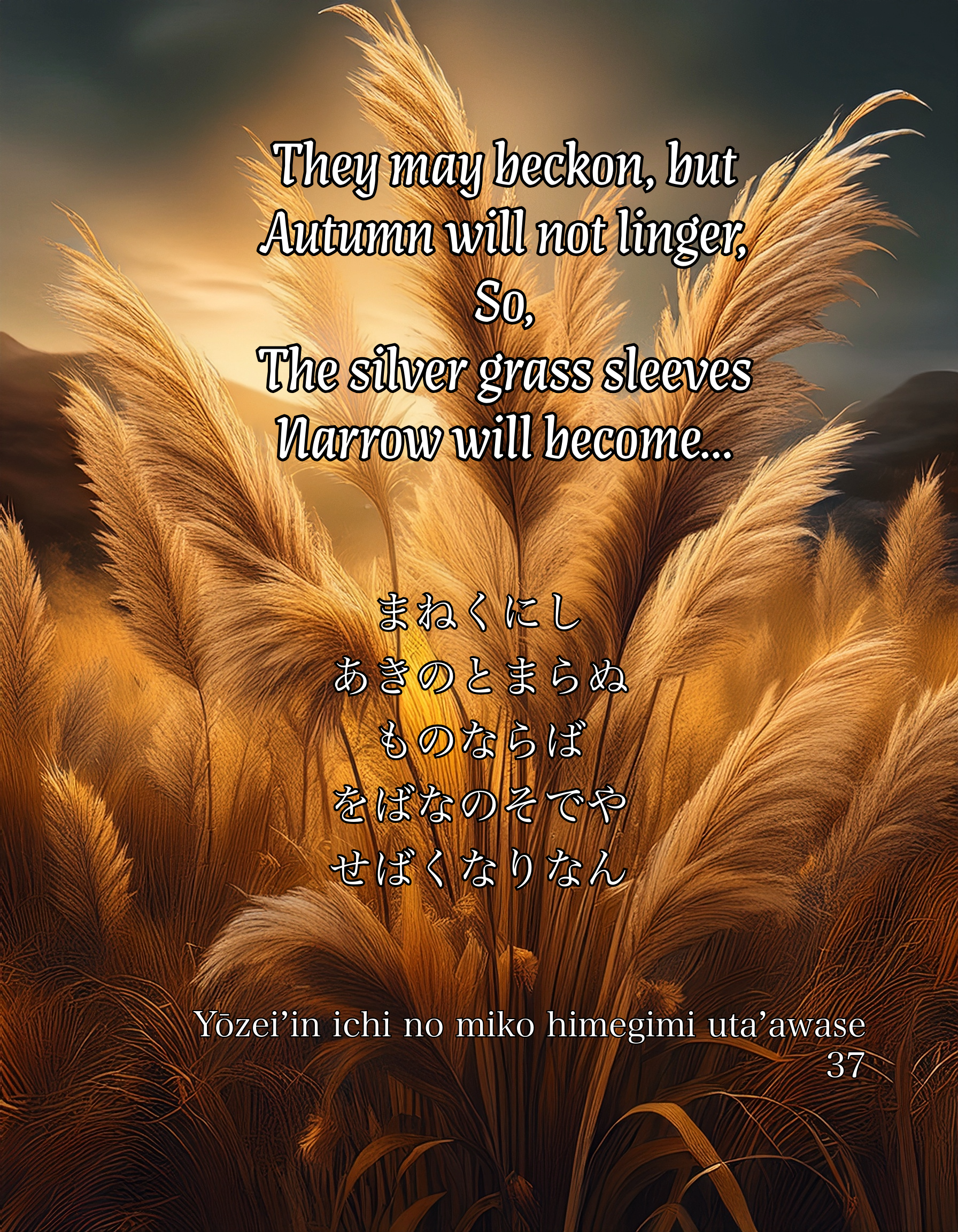
Yōzei’in ichi no miko himegimi uta’awase 03

Original

やまざとはふゆぞさびしさまさりけるひとめもくさもかれぬとおもへば

yamazato wa
fuyu zo sabishisa
masarikeru
hitome mo kusa mo
karenu to omoeba
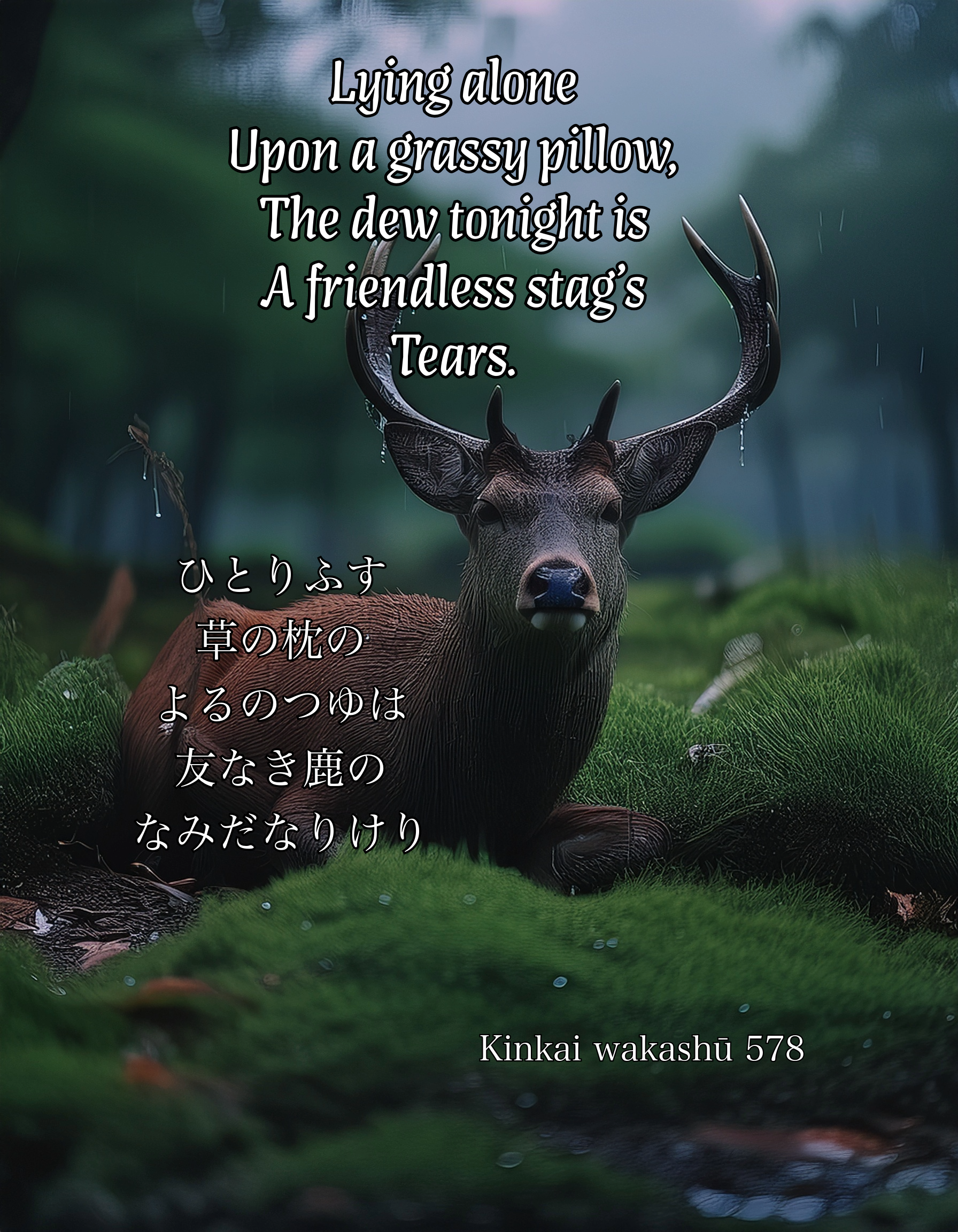
In a mountain retreat
Winter’s loneliness
Overwhelms
As both folks’ gaze and the grasses, too
Have withered away, I feel…

Minamoto no Toshiyuki
6

Left (Tie)

おほかたのあきはあはれのふかければやまざとならでなほぞかなしき

ōkata no
aki wa aware no
fukakereba
yamazato narade
nao zo kanashiki
In general, when
Autumn’s sorrow
Is at its deepest
‘Tis not only a mountain retreat
That is still sunk in sadness!

7

Right

やまざとはいつともわかじいとどしくあきはしかこそかなしかるらめ

yamazato wa
itsu to mo wakaji
itodoshiku
aki wa shika koso
kanashikarurame
A mountain retreat
Fails to stand out—
Most of all
In autumn does the stag
Seem so sad!

8

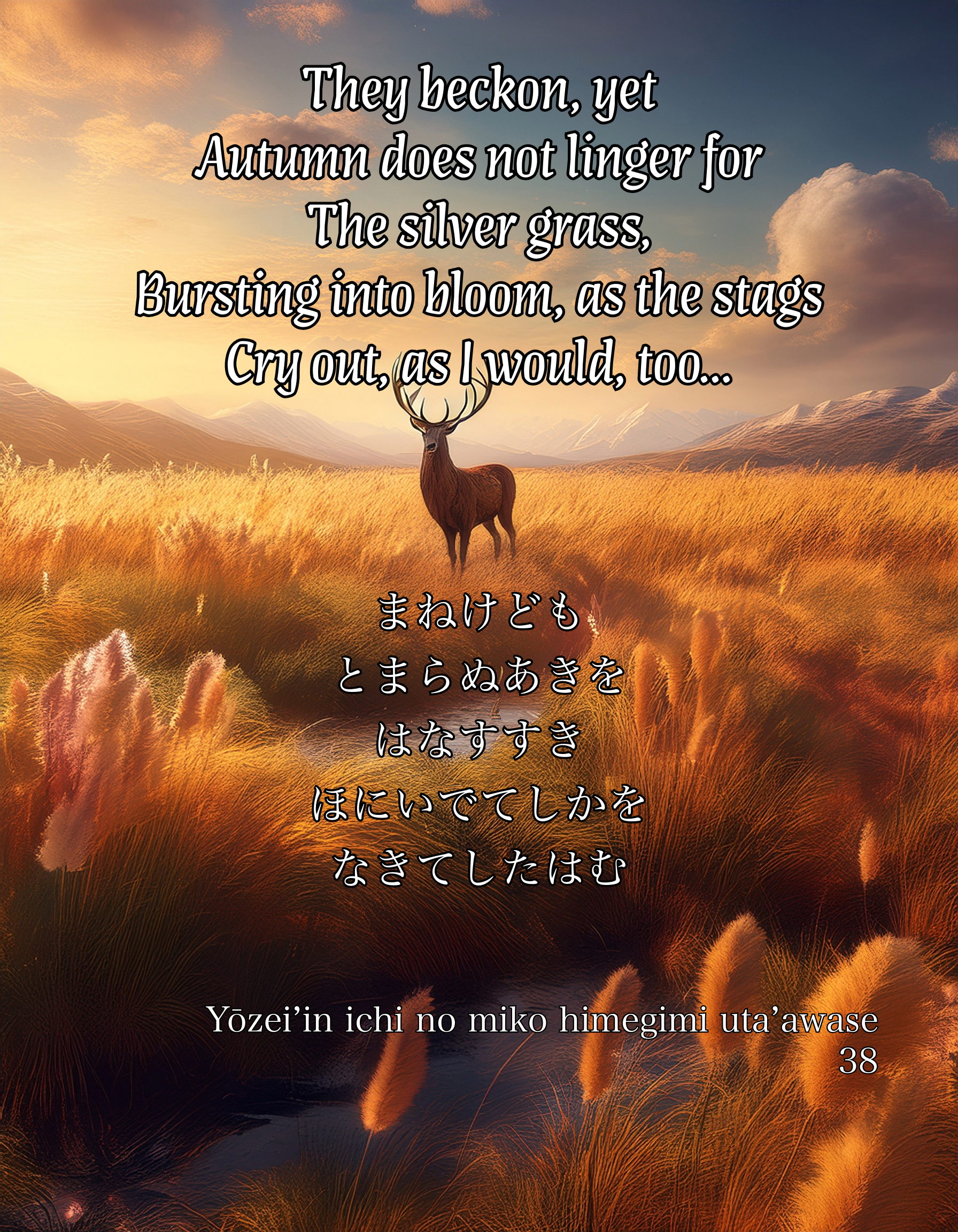
Yōzei’in ichi no miko himegimi uta’awase 02

Original

さよふかくこひするしかのこゑきけばわれさへあやなそでのひづかな

sayo fukaku
koisuru shika no
koe kikeba
ware sae ayana
sode no hizu kana
Deep within a night so brief,
A’loving, the stag’s
Cry I hear
Even my sleeves, strangely,
Never dry at all!

4

きくひとのそでさへひづるしかのねにあきのしぐれのふりでてぞなく

kiku hito no
sode sae hizuru
shika no ne ni
aki no shigure no
furidete zo naku
Folk hearing,
With even their sleeves never drying,
At a stag’s bell—
An autumn shower
Falling with a cry!

5

Only one poem was requested in response this round.

Nishinomiya uta’awase 05

Stags and the Dawn

Round Five

Left

暁になりやしぬらん小倉山なく鹿のねに月かたぶきぬ

akatsuki ni
nari ya shinuran
ogurayama
naku shika no ne ni
tsuki katabukinu
Is the dawning
On its way, I wonder?
On gloomy Mount Ogura
Crying, a stag bell out
As the moon sets.

Mototoshi, Former Assistant Captain in the Palace Guards, Left Division
9

Right

暁や声高砂になく鹿をほのかにやきく沖の舟人

akatsuki ya
koe takasago ni
naku shika o
honoka ni ya kiku
oki no funabito
At the dawning
From the heights, the bell, at Takasago
Of a stag
Is faintly heard, perhaps,
By the boatmen on the offing…

Head
10

The Left’s poem lacks any superlative diction, yet does not appear to have any glaring faults either. As for the Right’s poem, I do question the placement of ‘at’ in ‘at the dawning’ and, in addition, the order seems reversed in ‘From the heights, the bell, at Takasago / Of a stag’—so much so that I find it difficult to grasp the sense. If the poem had been composed to put ‘stag’ before ‘heights of Takasago’, the poem would feel more trustworthy, wouldn’t it.

Entō ōn’uta’awase 39

Round Thirty-Nine

Left (Tie)

さをしかのふしどをあさみ吹く風に夜半に鳴く音ぞふかくなりゆく

saoshika no
fushido o asami
fuku kaze ni
yowa ni naku ne zo
fukaku nariyuku
The stag’s
Resting place disturbed by
The gusting wind
At midnight his belling cry
Comes from deeper in the mountains.

Chikanari
77

Right

さらでだにね覚かなしき秋風に夜しもなどか鹿の鳴くらん

sarade dani
nezame kanashiki
akikaze ni
yoru shimo nado ka
shika no nakuran
Even were it not so,
To waken is so sad
With the cruel autumn wind;
Why is it that above all at night
The stag should cry so?

Ie’kiyo
78

The Left poem’s ‘at midnight his belling cry comes from deeper’ does not sound especially elegant. The Right poem composes ‘why is it that above all at night the stag should cry so’, sounding like it is only at night that stags bell, but stags do this all the time in autumn. The Ancient and Modern also has the composition, ‘Mud-daubers buzzing / In the autumn bush clover; / Leaving with morning’.[1] The poems of Left and Right have no merits or faults between them—they should tie.


[1] This is a quotation from: Topic unknown. すがるなく秋のはぎはらあさたちて旅行く人をいつとかまたむ sugaru naku / aki no hagiwara / asa tachite / tabi yuku hito o / itsu to ka matan ‘Mud-daubers buzzing / In the autumn bush clover; / Leaving with morning, / Away on a journey: for him, / How long must I wait?’ Anonymous (KKS VIII: 366)

Entō ōn’uta’awase 38

Round Thirty-Eight

Left

今更にふしもさだめぬ鹿の音よ木葉の数のつもるよごとに

ima sara ni
fushi mo sadamenu
shika no ne yo
ko no ha no kazu no
tsumoru goto ni
At around this time,
With his bedding undecided,
The stag bells out!
Just as the leaves’ from on the trees numbers
Do mount up…

Shō
75

Right (Win)

木葉ちる夜半の嵐の月影に心すみてや鹿も鳴くらん

ko no ha chiru
yowa no arashi no
tsukikage ni
kokoro sumite ya
shika mo nakuran
Leaves scatter from the trees
In the midnight storm
In the moonlight
From his wild and earthy thoughts
Does the stag, too, cry out?

Nagatsuna
76

The Left’s ‘just as the leaves from on the trees numbers do mount up’ at night and so forth, appears to be a novel style, yet the Right poem sounds more gorgeous, so it wins.

Entō ōn’uta’awase 36

Round Thirty-Six

Left

秋をおもふ涙やもろき夕月夜木葉がくれに鹿ぞ鳴くなる

aki o omou
namida ya moroki
yūzukuyo
ko no hagakure ni
shika zo nakunaru
Filled with autumn feelings
Do tears drip down?
On a moonlit evening
Hidden ‘mong the leafy trees,
A stag does call.

Dōchin
71

Right (Win)

を山田に風の吹きしくいなむしろよなよな鹿のふしどなりけり

oyamada ni
kaze no fukishiku
inamushiro
yonayona shika no
fushidonarikeri
Across the mountain paddies
The wind blows, spreading
The rice into a coverlet, where
Night after night, the stag
Does lay his head.

Dharma Master Nyokan
72

The Left’s poem does not appear to have any faults worth indicating, yet the Right’s poem is still more pleasant. It should win.

Entō ōn’uta’awase 35

Round Thirty-Five

Left (Tie)

おのがすむ嶺の木がらし寒き夜は鹿も紅葉の衣きるらし

ono ga sumu
mine no kogarashi
samuki yo wa
shika mo momiji no
koromo kirurashi
Where he dwells upon
The peak, the bitter wind
On a night so chill, for
The stag, of scarlet leaves
Does seem to make a robe.

The Supernumerary Major Counsellor
69

Right

すみのぼる月にうらむる声すなりねられぬ鹿や夜寒なるらん

suminoboru
tsuki ni uramuru
koesunari
nerarenu shika ya
yozamu naruran
Climbing clearly
At the moon, in despair
Does he cry—
Sleepless, does the stag
Feel night’s chill, perhaps?

Nobunari
70

The Left’s poem has ‘the stag, of scarlet leaves does seem to make a robe’ which sounds charming, and the Right’s poem has ‘sleepless, does the stag feel night’s chill, perhaps’, which appears refined. Thus, they tie.

Entō ōn’uta’awase 34

Round Thirty-Four

Left

もののふもあはれとおもへあづさ弓ひきのの夜半のさをしかの声

mononofu mo
aware to omoe
azusayumi
hikino no yowa no
saoshika no koe
Let even a warrior
Feel pity!
A catalpa bow drawn
On Hiki Plain at a midnight
Stag’s call.

The Former Minister of the Centre
67

Right (Win)

つれもなきつまをやたのむ秋風の身にさむき夜は鹿も鳴くなり

tsure mo naki
tsuma o ya tanomu
akikaze no
mi ni samuki yo wa
shika mo nakunari
Is it his heartless
Bride he seeks?
The autumn wind
Chills the bones at night
As the stag, too, does cry.[1]

Kozaishō
68

The Left’s poem seems to have no faults worth mentioning, but the Right’s poem is composed with the poem ‘The autumn wind / Chills my bones / As cold as / The woman I hope for / In the dark, night after night’ in mind and seems particularly pleasant, so it wins.


[1] An allusive variation on: Topic unknown. 秋風の身にさむければつれもなき人をぞたのむくるる夜ごとに aki kaze no / mi ni samukereba / tsuremonaki / hito o zo tanomu / kururu yo goto ni ‘The autumn wind / Chills my bones / As cold as / The woman I hope for / In the dark, night after night.’ Dharma Master Sosei (KKS XII: 555)

Entō ōn’uta’awase 33

Round Thirty-Three

Stags in the Night[1]

Left

久方のかつらの陰に鳴く鹿は光をかけて声ぞさやけき

hisakata no
katsura no kage ni
naku shika wa
hikari o kakete
koe zo sayakeki
In the eternal
Silver trees’ glow
The belling stag
Is limned with light, and
His voice sounds clear, indeed!

A Court Lady
65

Right (Win)

天川秋の一夜のちぎりだにかた野に鹿の音をや鳴くらん

ama no kawa
aki no hitoyo no
chigiri dani
katano ni shika no
ne o ya nakuran
By the River of Heaven
For a single autumn night’s
Brief bond—
Is that why a stag at Katano
Does cry out so?

Ietaka
66

The Right’s poem, by beginning with ‘By the River of Heaven / For a single autumn night’s / Brief bond’ and then continuing with ‘a stag at Katano’ sounds particularly refined, evoking memories of bygone days when Prince Koretaka sought lodging from the Weaver Maid when hunting at Katano—how charming it is.[2] The Left’s poem overall is not particularly bad and seems to lack any obvious faults, but the Right’s poem surpasses it in every way: it is not one of the normal run of compositions and thus, it must win.


[1] 夜鹿 – there are early examples of poems on related topics in Kin’yōshū and Senzaishū.

[2] Gotoba is referring to a pair of poems in Kokinshū which are contextualized by an account of a hunting expedition by Prince Koretaka 惟喬 (844-897): Once, when he had gone hunting in the company of Prince Koretaka, they dismounted by the banks of a river called Ama no Gawa (River of Heaven), and while they were tippling, the Prince commanded that Narihira offer him a wine cup with a poem expressing the feelings of a hunter arriving at the river of Heaven, so he composed the following: かりくらしたなばたつめにやどからむあまのかはらに我はきにけり kari kurashi / tanabatatsume ni / yado karamu / ama no kawara ni / ware wa kinkeri  ‘While hunting night is falling, / So from the Weaver Maid / Let us beg lodging / For to the Riverbank of Heaven / Have we come!’ Ariwara no Narihira (KKS IX: 418); The prince recited the above poem many times, but was unable to think of a reply so, being one of the party, Aritsune composed this: ひととせにひとたびきます君まてばやどかす人もあらじとぞ思ふ hito tose ni / hito tabi kimasu / kimi mateba / yado kasu hito mo / araji to zo omou ‘In a single year / But once comes / The Lord she awaits, so / One who provides lodging / She is not, I’d say!’ Ki no Aritsune (KKS IX: 419). These poems were famously incorporated into chapter 82 of Ise monogatari with four others to provide an expanded context. See Horiuchi and Akiyama (1997, 157-160) for the original text and Mostow and Tyler (2010, 175-179) for an English translation and commentary.