asitadu no saFabe ni tosi Fa Fenuredomo kokoro Fa kumo no uFe ni nomi koso
Among the reeds, a crane, By the marsh’s edge years Have passed, yet, His heart is for the clouds’ Heights, alone…
The Minister of the Right 753
[i] Princess Isoko (Kinshi) 勤子 (904-938), the fifth daughter of Emperor Daigo 醍醐 (885-930; r. 897-930) (her sobriquet comes from her rank – shihon 四品 (‘Fourth Order’). She was to marry Fujiwara no Morosuke 藤原師輔 (909-960), who writes to her here, in 930, after a secret affair, becoming the first imperial princess to marry a commoner. She is chiefly remembered today, however, as the patron of Minamoto no Shitagō 源順 (911-983) who ordered him to produce Japan’s first dictionary, Wamyō ruijushō 和名類聚抄 (931-938).
Around autumn, when someone with whom I had been accustomed to speaking had gone somewhere, I took the opportunity to send these by messenger.
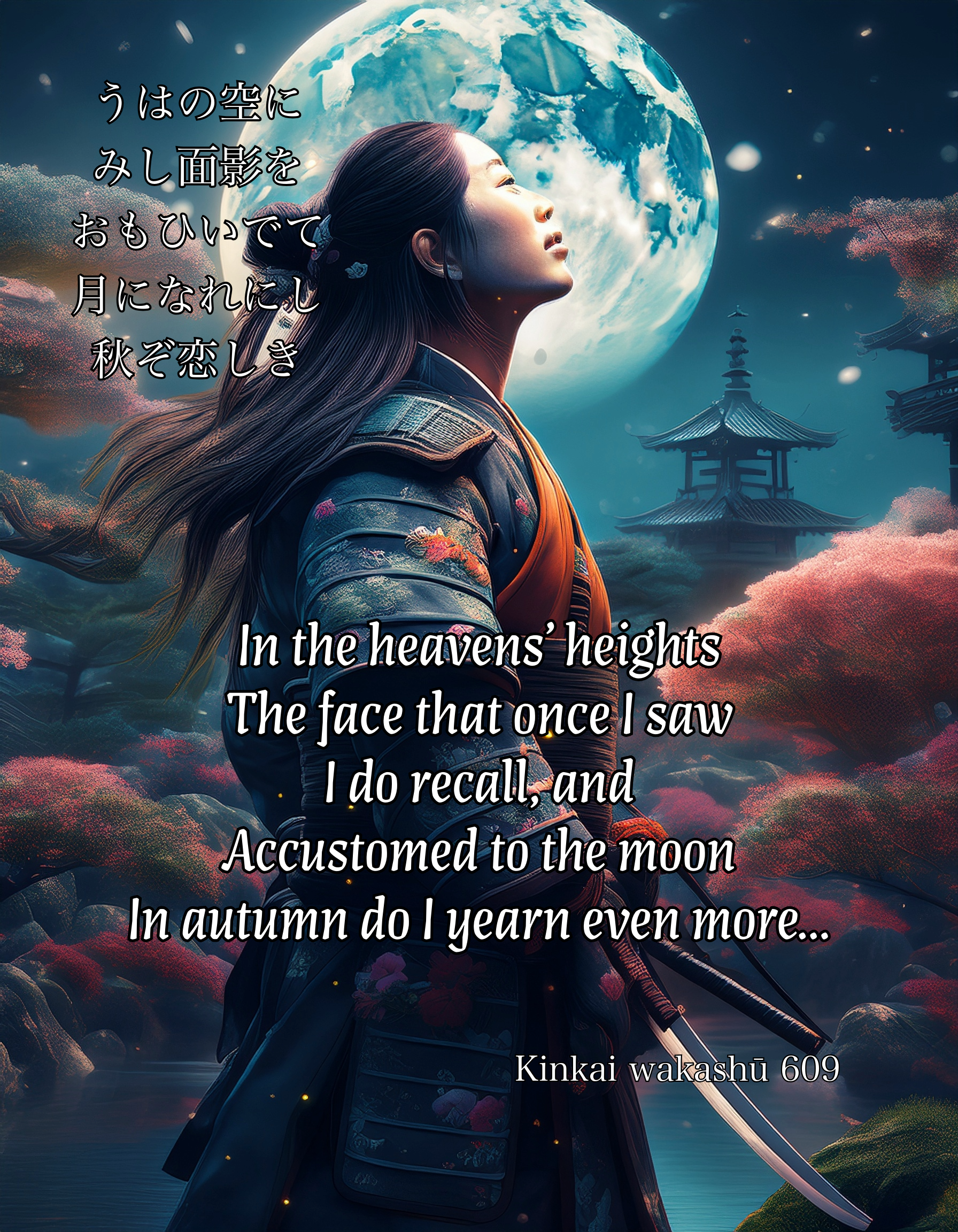
うはの空にみし面影をおもひいでて月になれにし秋ぞ恋しき
uwa no sora ni mishi omokage o omoi’idete tsuki ni narenishi aki zo koishiki
In the heavens’ heights The face that once I saw I do recall, and Accustomed to the moon In autumn do I yearn even more…[i]
609
[i] See: On the conception of ‘love, having once met, but no longer’ for the Poetry Match held at the Poetry Office. ゆめかとよみし面影もちぎりしもわすれずながらうつつならねば yume ka to yo / mishi omokage mo / chigiri shi mo / wasurezu nagara / utsutsu naraneba ‘Was it a dream? Or not? / That face I saw, and / His promises, too, / I cannot forget, / Though real they were not…’ The Daughter of Toshinari, Assistant Master of the Dowager Empress Household Office (Shinkokinshū XV: 1391)
I sent this to the residence of someone, who had gone to a distant province, when they had said they’d return around the Eighth Month and there had been no sign of them by the Ninth.
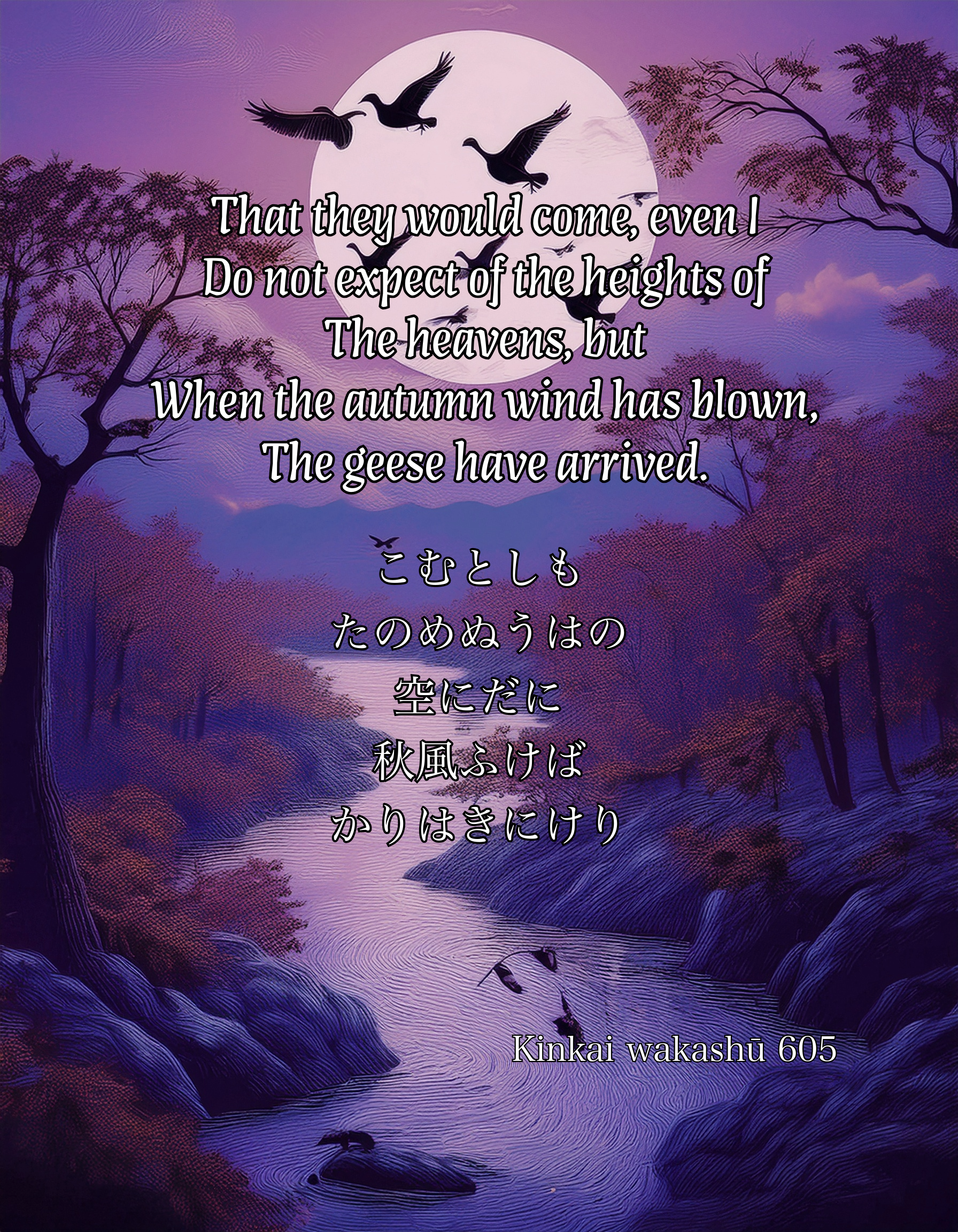
こむとしもたのめぬうはの空にだに秋風ふけばかりはきにけり
komu to shimo tanomenu uwa no sora ni dani akikaze fukeba kari wa kinikeri
That they would come, even I Do not expect of the heights of The heavens, but When the autumn wind has blown, The geese have arrived.[i]
605
[i] See: Love carried on the wind. きくやいかにうはのそらなる風だにもまつにおとするならひありとは kiku ya ika ni / uwa no sora naru / kaze dani mo / matsu ni otosuru / narai ari to wa ‘Do you hear it? Well? / From the heavens’ heights / Even the wind, / To come whispering among the pines / Has grown accustomed.’ Kunaikyō (Shinkokinshū XIII: 1199); and: A poem from the poetry competition at Prince Koresada’s house. 秋風にはつかりがねぞきこゆなるたがたまづさをかけてきつらむ akikaze ni / hatsukari ga ne zo / kikoyunaru / ta ga tamazusa o / kaketekitsuran ‘On the autumn wind / Come the first goose cries. / I hear them; / Whose letters / Do they bring, I wonder?’ Ki no Tomonori (Kokinshū IV: 207)
akatsuki ni nari ya shinuran ogurayama naku shika no ne ni tsuki katabukinu
Is the dawning On its way, I wonder? On gloomy Mount Ogura Crying, a stag bell out As the moon sets.
Mototoshi, Former Assistant Captain in the Palace Guards, Left Division 9
Right
暁や声高砂になく鹿をほのかにやきく沖の舟人
akatsuki ya koe takasago ni naku shika o honoka ni ya kiku oki no funabito
At the dawning From the heights, the bell, at Takasago Of a stag Is faintly heard, perhaps, By the boatmen on the offing…
Head 10
The Left’s poem lacks any superlative diction, yet does not appear to have any glaring faults either. As for the Right’s poem, I do question the placement of ‘at’ in ‘at the dawning’ and, in addition, the order seems reversed in ‘From the heights, the bell, at Takasago / Of a stag’—so much so that I find it difficult to grasp the sense. If the poem had been composed to put ‘stag’ before ‘heights of Takasago’, the poem would feel more trustworthy, wouldn’t it.
Composed on the conception of gazing at mountain cherries in the distance, when people were drinking wine and composing poetry at the residence of the Minister of the Centre.
高砂の尾上のさくらさきにけりと山のかすみたたずもあらなん
takasago no wonoFe no sakura sakinikeri toyama no kasumi tatazu mo aranan
On Takasago’s Heights the cherries Have bloomed; O, I wish the haze around the nearby peaks Would not rise at all!