Black.
うば玉ややみのくらきにあま雲のやへ雲がくれかりぞなくなる
| ubatama ya yami no kuraki ni amagumo no yaegumo gakure kari zo nakunaru | Lily seed Dark and gloomy The clouds within the heavens Eightfold layers conceal The geese, a’crying. |
706

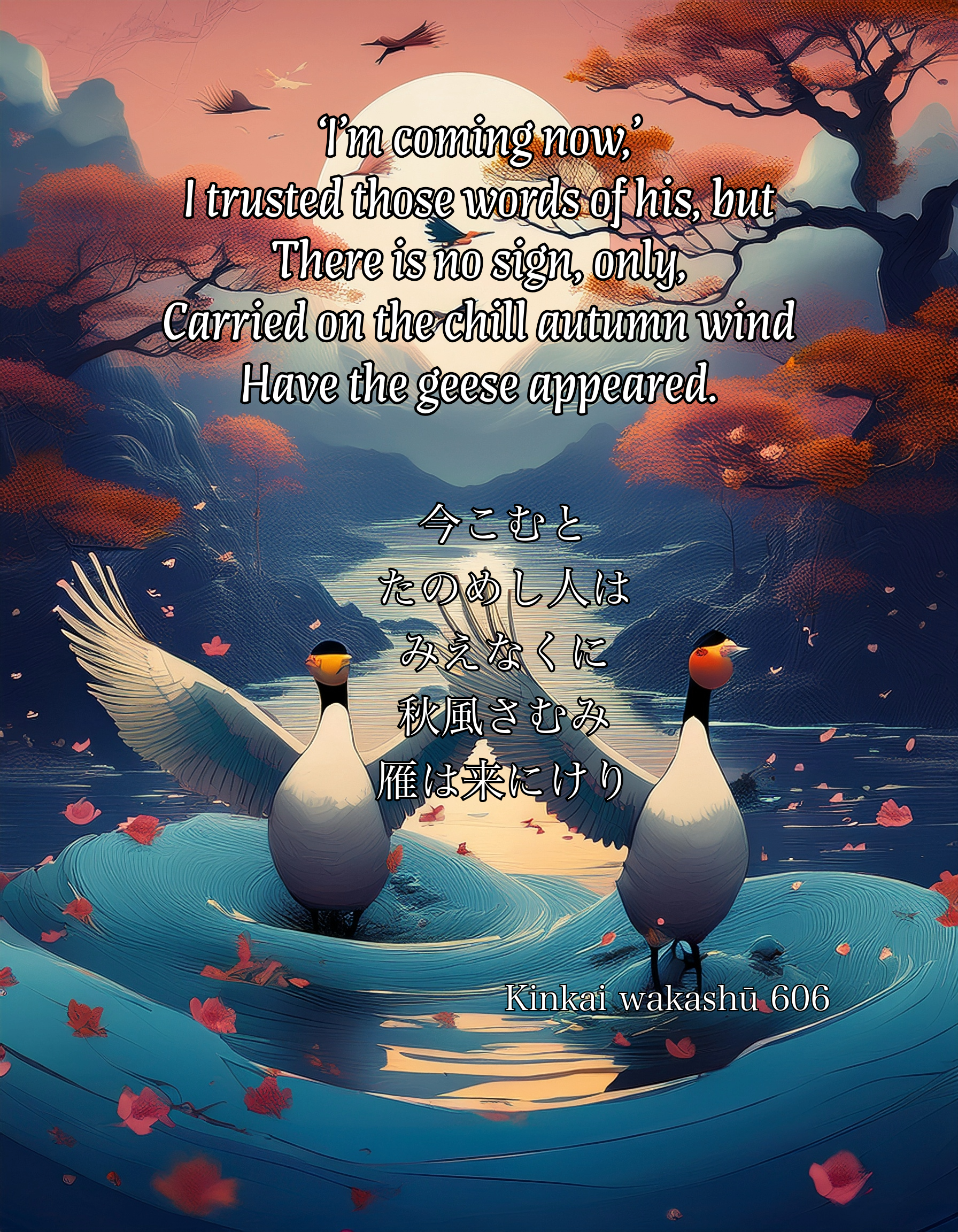
今こむとたのめし人はみえなくに秋風さむみ雁は来にけり
| ima komu to tanomeshi hito wa mienaku ni akikaze samumi kari wa kinikeri | ‘I’m coming now,’ I trusted those words of his, but There is no sign, only, Carried on the chill autumn wind Have the geese appeared.[i] |
606
[i] See: Topic unknown. いまこむとたのめしことをわすれずはこのゆふぐれの月やまつらん ima komu to / tanomeshi koto o / wasurezu wa / kono yūgure no / tsuki ya matsuran ‘ “I’m coming now,” / If, that she trusted those words of mine / She has not forgotten, then / This evening / The moon might she be awaiting, too? ’ Fujiwara no Hideyoshi (Shinkokinshū XIII: 1203)
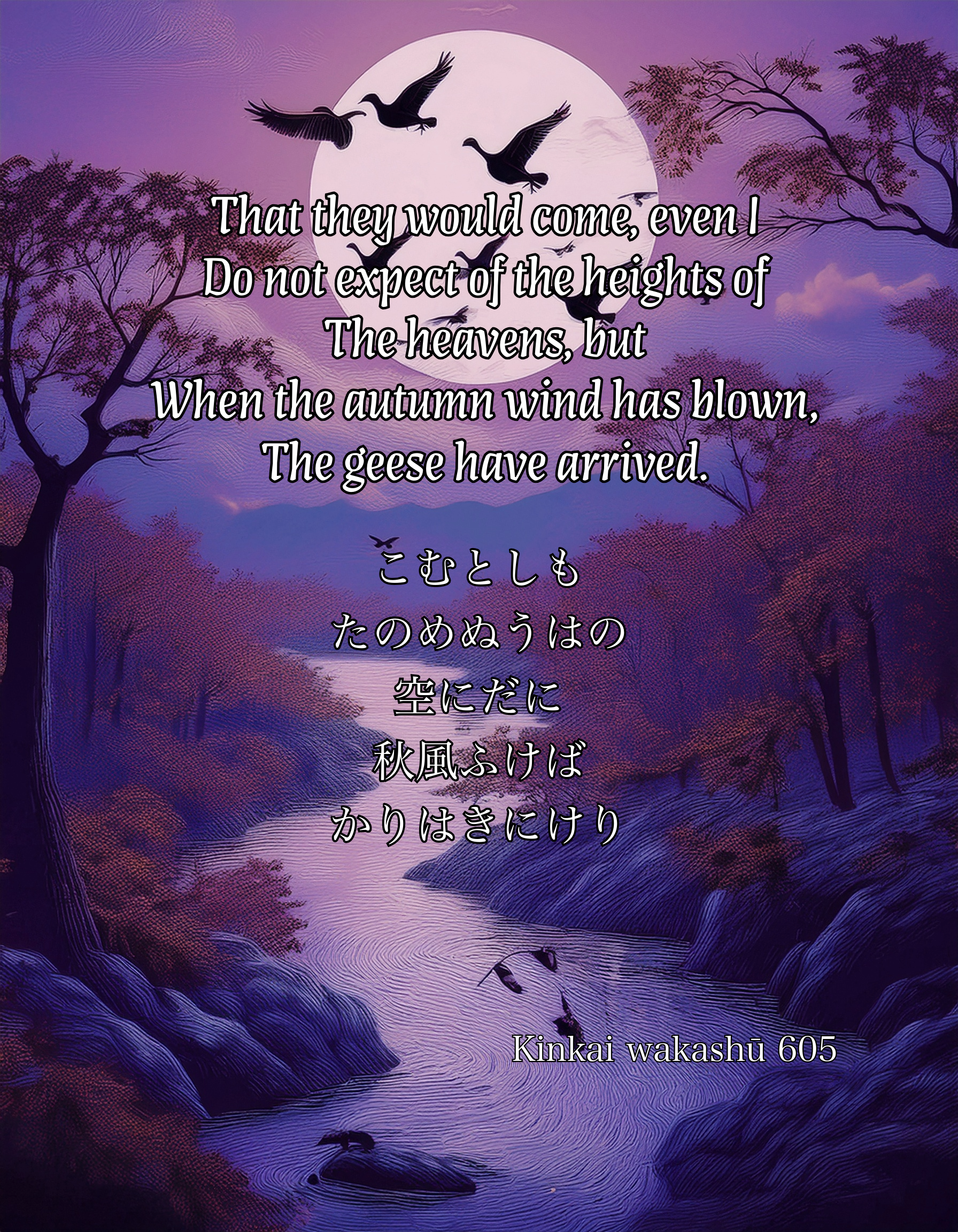
I sent this to the residence of someone, who had gone to a distant province, when they had said they’d return around the Eighth Month and there had been no sign of them by the Ninth.
| komu to shimo tanomenu uwa no sora ni dani akikaze fukeba kari wa kinikeri | That they would come, even I Do not expect of the heights of The heavens, but When the autumn wind has blown, The geese have arrived.[i] |
605
[i] See: Love carried on the wind. きくやいかにうはのそらなる風だにもまつにおとするならひありとは kiku ya ika ni / uwa no sora naru / kaze dani mo / matsu ni otosuru / narai ari to wa ‘Do you hear it? Well? / From the heavens’ heights / Even the wind, / To come whispering among the pines / Has grown accustomed.’ Kunaikyō (Shinkokinshū XIII: 1199); and: A poem from the poetry competition at Prince Koresada’s house. 秋風にはつかりがねぞきこゆなるたがたまづさをかけてきつらむ akikaze ni / hatsukari ga ne zo / kikoyunaru / ta ga tamazusa o / kaketekitsuran ‘On the autumn wind / Come the first goose cries. / I hear them; / Whose letters / Do they bring, I wonder?’ Ki no Tomonori (Kokinshū IV: 207)
Love
Left
あまぐもに鳴きわたるなる雁がねはおくれし秋や恋しかるらむ
| amagumo ni nakiwataru naru kari ga ne wa okureshi aki ya koishikaruramu | Through the heavens’ clouds Crying, crossing go The geese, their calls, Delayed, might autumn’s surfeit Make me yearn for you more? |
21
Right
わが心あやしかりけり秋果ててゆくとみるみるなほぞ恋しき
| wa ga kokoro ayashikarikeri aki hatete yuku to mirumiru nao zo koishiki | My heart Feels strange, indeed! Autumn’s done, and I ever watch it leave, yet Still I yearn so strongly… |
22


Love
Left
秋萩におく白露の消えかへり人をこひしとおもふころかな
| akihagi ni oku shiratsuyu no kiekaeri hito o koishi to omou koro kana | In autumn upon the bush clover Fall silver dewdrops, Vanishing away, with Her I loved— My feelings in those days! |
17[i]
Right
寒き夜はさごろも雁の声きけばかへすがへすぞ人はこひしき
| samuki yo wa sagoromo kari no koe kikeba kaesugaesu zo hito wa koishiki | On a night so chill, In a scanty robe, when the goose Cries I hear, Again and yet again Do I long for her… |
18


[i] This poem is included in Shinshūishū (XII: 1011), with the headnote, ‘From the poetry match at Tsurayuki’s house’. A variant of it also appears in some Mandaishū (XV: 2458) texts; in others the version provided is as in the contest: From the poetry match held when Tsuryuki was in Suo province. 秋萩におく白露の澄みかへり人をこひしとおもふころかな aki hagi ni / oku shiratsuyu no / sumikaeri / hito o koishi to / omou koro kana ‘In autumn upon the bush-clover / Fall silver dewdrops / Ever clear / Her I loved— / My feelings in those days’.
Written on the edge of a folding screen by a painting of geese flying in the clouds, when His Majesty ordered a celebration for the Junior Principal Handmaid.
白雲の中にまがひてゆく雁もこゑはかくれぬ物にざりける
| shirakumo no naka ni magaite yuku kari mo koe wa kakurenu mono ni zarikeru | Within the clouds, so white, Entangled Goes a goose, Unable to conceal his cry With anything at all! |


Round Thirty-One
Left
露すがる庭の萩原色付きぬいかなる人の思ひそむらん
| tsuyu sugaru niwa no hagiwara irozukinu ika naru hito no omoisomuran | All clung with dew, The bush clover grove in the grounds Has taken on such hues, that I wonder who it is Might have just fallen into passion’s flames? |
Chikanari
61
Right (Win)
おく露は秋のならひの萩が枝にあまるや雁の涙なるらん
| oku tsuyu wa aki no narai no hagi ga e ni amaru ya kari no namida naruran | Dewdrops falling is Autumn’s custom for The bush clover branches, but Added to them are the goose Tears, perhaps?[1] |
Ie’kiyo
62
The Left’s poem has a person’s feelings being dyed by the bush-clover, but I cannot think why this should be? The Right’s poem seems particularly pleasant. Thus, it wins.


[1] An allusive variation on: Composed on the occasion of a poetry competition at Prince Koresada’s house. 秋の夜のつゆをばつゆとおきながらかりの涙やのべをそむらむ aki no yo no / tsuyu oba tsuyu to / okinagara / kari no namida ya / nobe o somuran ‘On Autumn nights / The dew as dewdrops / Falls, but, / Perhaps goose tears / Stain the fields?’ Mibu no Tadamine (KKS V: 258)


