すそのやくけぶりぞ春はよしの山花をへだつる霞なりける
| susuno yaku keburi zo haru wa yoshinoyama hana o hedatsuru kasumi narikeru | From burning meadows on the mountain slopes The smoke in springtime In the Yoshino Mountains Is blocked by blossom’s Haze! |
85

Round Thirteen
Left
山がつのかた岡かけてしむるののさかひにたてる玉のを柳
| yamagatsu no kataoka kakete shimuru no no sakai ni tateru tama no oyanagi | A mountain man Clinging to the slopes Marking out his meadows, Standing on the border, Jewelled tiny willow threads.[i] |
25
Right (Win)
ふりつみしたかねのみ雪とけにけり清滝河の水のしらなみ
| furutsumishi takane no miyuki tokenikeri kiyotakigawa no mizu no shiranami | Fallen and drifted, The fair snows on the high peaks Have melted; The Kiyotaki River’s cataracts bring White caps to the waters… |
26
The Left poem has a rare style and give me the impression that it is a realistic depiction, but I do wonder about the use of ‘tiny’ in the final line—does one really compose this way? The configuration of the Right poem is extremely charming, and so I say it wins.


[i] See:
Composed on ‘willows by a fence’ for the Poetry Match held at the residence of His Excellency, Supernumerary Middle Counsellor Toshitada.
あたらしやしづの柴垣かきつくるたよりにたてる玉のをやなぎ
| atarashi ya shizu no shibagaki kakitsukuru tayori ni tateru tama no oyanagi | How regrettable! A peasant’s brushwood fence Fenced in With the support of Jewelled tiny willow threads… |
Minamoto no Nakamasa
Tsukimōdeshū 83
A willow by a mountain hut.
山がつのかたをかかけてしむるいほのさかひにみゆるたまのをやなぎ
| yamagatsu no kataoka kakete shimuru io no sakai ni miyuru tama no oyanagi | A mountain man Clinging to the slopes Marking out his hut’s Border, it appears, with Jewelled tiny willow threads. |
52[i]

[i] Saigyō included a variant of this poem in Mimosugawa uta’awase (25)—this version was also later included in Shinkokinshū (XVII: 1677):
山がつのかた岡かけてしむるののさかひにたてる玉のを柳
| yamagatsu no kataoka kakete shimuru no no sakai ni tateru tama no oyanagi | A mountain man Clinging to the slopes Marking out his meadows, Standing on the border, Jewelled tiny willow threads. |
This poem lost the round in which it was included, with Shunzei, although praising the its style and ‘realistic depiction’ , being dissatisfied with the final line and querying whether it was appropriate to use ‘tiny’ (o を) as a modifier for ‘willow’ (yanagi 柳).
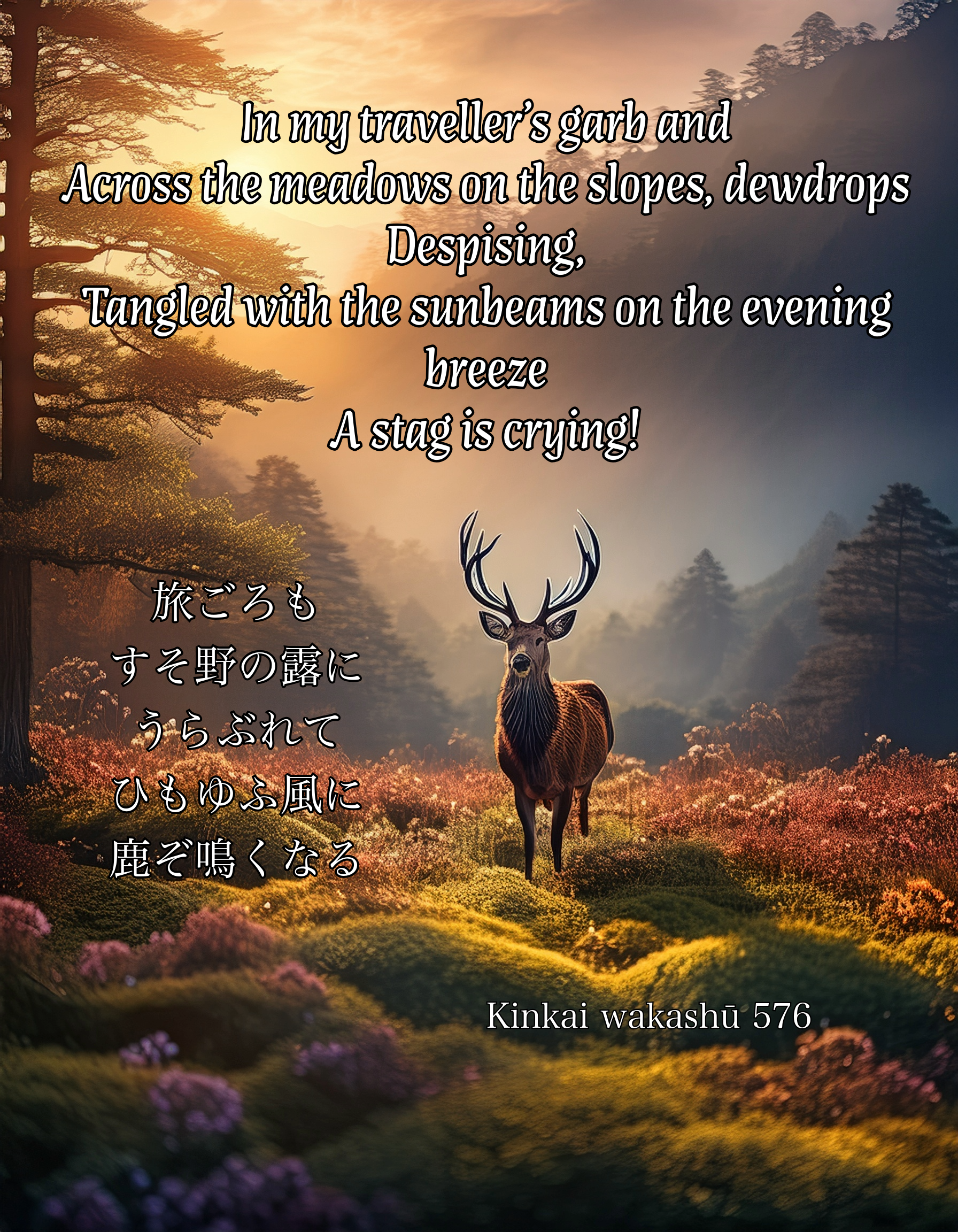
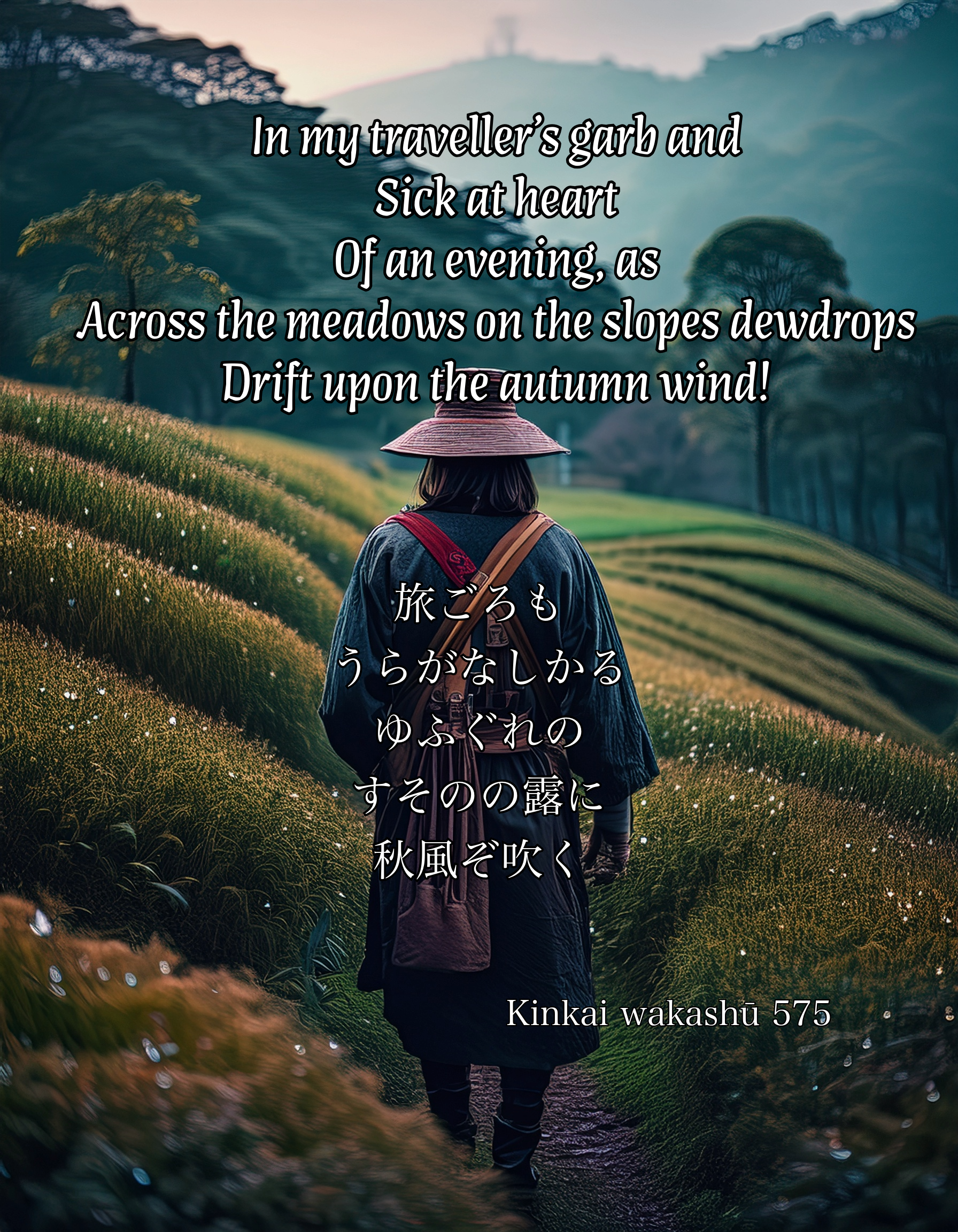
旅ごろもうらがなしかるゆふぐれのすそのの露に秋風ぞ吹く
| tabigoromo uraganashikaru yūgure no susono no tsuyu ni akikaze zo fuku | In my traveller’s garb and Sick at heart Of an evening, as Across the meadows on the slopes dewdrops Drift upon the autumn wind! [i] |
575
[i] See: 旅ごろもうらがなしさにあかしかね草の枕は夢もむすばず tabigoromo / uraganashisa ni / akashikane / kusa no makura wa / yume mo musabazu ‘In my traveller’s garb / My heart-sickness / I cannot lift, for / My grassy pillow / Brings no dreams, at all…’ Hikaru Genji (Genji monogatari 223); and: たびごろもうらがなしかるあさぢふによはのしぐれよいかにせよとぞ tabigoromo / uraganashikaru / asajū ni / yowa no shigure yo / ika ni seyo to zo ‘In my traveller’s garb and / Sad at heart among / The clumps of cogon grass, / O, midnight shower, / Tell me, what I am I to do?’ Jakuchō (Sumiyoshi-sha uta’awase kaō ni-nen 54)
Round Six
Left
雲かかる高志のやまの明暮に妻まどはせるを鹿鳴くなり
| kumo kakaru takashi no yama no akegure ni tsuma madowaseru oshika naku nari | All hung about with cloud On Takashi Mountain In the gloaming Having lost his mate A stag bells out. |
Nakamasa
11
Right
山がつの先あかつきをしりがほに裾野に出でて鹿ぞ鳴くなる
| yamagatsu no mazu akatsuki o shirigao ni susono ni idete shika zo naku naru | A mountain man First of all, that ‘tis dawn Knows plain upon his face, As he sets out upon the slopes As a stag bells out! |
Head
12
The Left poem’s conclusion, ‘Having lost his mate / A stag bells out’ seems no different from that of a poem by Gō no Jijū in poetry match held by the First Princess.[1] As for the poem of the Right’s ‘A mountain man / Awaits the dawn / Knowing plain upon his face’—what on earth might a mountain man look like while waiting for dawn? There is the tale of Hangu Pass in Cathay, where the barrier guard was waiting for dawn and opened the gate after hearing a cock’s crow, but the expression ‘a mountain man awaits the dawn’ has never appeared before in a poem—either one of Cathay or in the words of Yamato, so I feel that both Left and Right lack any superlative qualities.


[1] Stags. をぐら山たちどもみえぬゆふぎりにつままどはせるしかぞなくなる ogurayama / tachidomo mienu / yūgiri ni / tsuma madowaseru / shika zo nakunaru ‘On gloomy Ogura Mountain / Stands unseen / Among the evening mists / Having lost his mate / A belling stag.’ (Yūshi naishinnō-ke uta’awase eishō go-nen 27). This event was held at the residence of Imperial Princess Sukeko (Yūshi) on the 5th day of the Sixth Month, Eishō 5 [26.10.1050]. The poem won its round, and was later included in Goshūishū (IV: 292).
Round Twenty-Seven
Left (Tie)
高砂のすそ野の真萩露ふかし嶺の秋風ふかずもあらなむ
| takasago no susono no ma’hagi tsuyu fukashi mine no akikaze fukazu mo aranamu | On Takasago’s Slopes the fair bush clover is Deep in dew— O, that the autumn winds from the peak Would fail to blow… |
The Supernumerary Major Counsellor
53
Right
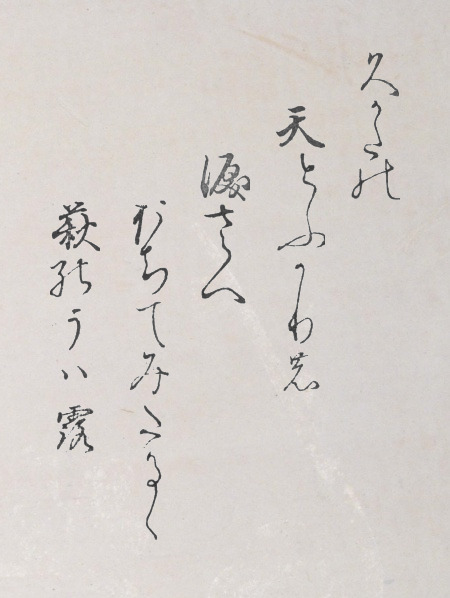
久かたの天とぶかりの涙さへおちてみだるる萩のうは露
| hisakata no ama tobu kari no namida sae ochite midaruru hagi no uwazuyu | From the eternal Heavens flying, even the goose Tears Drop in confusion Overlaying the dew upon the bush clover.[1] |
Nobunari
54
Both Left and Right seem particularly pleasant. Thus, they tie.


[1] An allusive variation on: Topic unknown. なきわたるかりの涙やおちつらむ物思ふやどの萩のうへのつゆ nakiwataru / kari no namida ya / ochitsuran / mono’omou yado no / hagi no ue no tsuyu ‘Calling across / Did the geese let tears / Fall? / My dwelling, lost in thought, / Has dew upon the bush clover.’ Anonymous (KKS IV: 221)
Winter
Left
冬くれば紅葉ふりしく神無月佐保の山辺はむべもりぬらん
| fuyu kureba momiji furishiku kaminazuki saho no yamabe wa mube morinuran | When the winter comes, Scarlet leaves, falling and scattering In the Godless Month, Upon the slopes of Mount Saho, Indeed, are at their finest. |
19
冬ごもりかれてみゆらん梅がえは今はた花の春はにほはん
| fuyugomori karete miyuran ume ga e wa ima hata hana no haru wa niowan | Sealed in winter, and All withered seeming, The plum tree’s branches, Now, for sure, the blossoms’ Spring will scent. |
20
冬みれば水もまかせぬ小山田にいつすき返し種をまきけん
| fuyu mireba mizu mo makasenu oyamada ni itsu sukikaeshi tane o makiken | ‘Tis winter, I see, so There’s no water to draw for The little mountain paddies: O, when might I till them, and Sow my seeds, I wonder? |
21
Right
時雨降る宿にすまへば冬の夜に錦とみゆる木木の花かな
| shigure furu yado ni sumaeba fuyu no yo ni nishiki to miyuru kigi no hana kana | Showers fall Upon the house where I do dwell, so Upon a winter’s night As brocade do seem The blossoming trees! |
22
ゆふだすき神の社にかけつればしもし降るにもたのもしきかな
| yūdasuki kami no yashiro ni kaketsureba shimo shi furu ni mo tanomashiki kana | Sacred mulberry cords Around the God’s shrine Are hung, so Even amidst the frost fall, The future does seem bright! |
23
白雲のふたへふりしくときは山うらはへとしはみどりなりけれ
| shiragumo no futae furishiku tokiwa yama ura hae toshi wa midori narikere | Clouds of white Lie scattered, twofold, upon The unchanging mountain: Stretching out behind, the year Is simply green. |
24