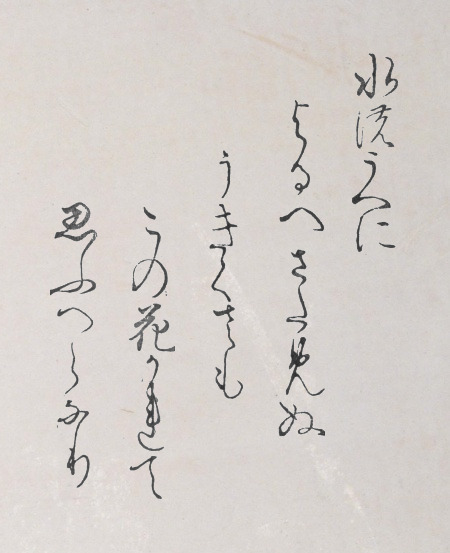
春たてば雪げの水やぬるからん先もえ出づる下蕨かな
| haru tateba yukige no mizu ya nurukaran mazu moe’izuru sawarabi kana | When spring has risen, is it that The snow-touched waters are But a trickle, that First smoulders into bud Fresh bracken? |
[Minamoto no] Akinaka 顕仲
When returning from a pilgrimage to the twin shrines, there was a river called the Maekawa running before my beachside lodging.[i] Rain had been falling, so the waters were extremely high—I composed this when we crossed the river at sunset.
浜べなるまへの川せを行く水のはやくもけふのくれにけるかな
| hamabe naru mae no kawase o yuku mizu no hayaku mo kyō no kurenikeru kana | On the beachside The Mae’s river rapids’ Waters flow As fast as today Draws into evening. |
702

[i] This lodging was at what is now Sakawa 酒匂 within the bounds of Odawara 小田原 on the coast of Sagami Bay (Higuchi 2016, 181)
水の泡や種となるらむ浮草のまく人なみの上に生ふれば
| mizu no awa ya tane to naruramu ukikusa no maku hitonami no ue ni oureba | Might the foam upon the waters Be its seeds, perhaps? When the drifting waterweed Twines atop a wave Where it does grow… |
1[i]
山里は冬ぞさびしさまさりける人めも草もかれぬとおもへば
| yamazato wa fuyu zo sabishisa masarikeru hitome mo kusa mo karenu to omoeba | In a mountain retreat Winter’s loneliness Overwhelms As both folks’ gaze and the grasses, too Have withered away, I feel… |
2[ii]
今日人をこふる心はあすか川流るる水に劣らざりけり
| kyō hito o kouru kokoro wa asukagawa nagaruru mizu ni otorazarikeri | Today, for her The love within my heart, By the River Asuka’s Running waters Will not be outdone! |
[i] This poem is included in Shūishū (IX: 524) as an anonymous poem with the headnote ‘Produced but not matched in a poetry contest.’
[ii] This poem is included in Muneyuki-shū (15) with the headnote ‘For a poetry match’.
[iii] This poem is included in Muneyuki-shū (16) with the headnote ‘For a poetry match’.
Round Four
Left
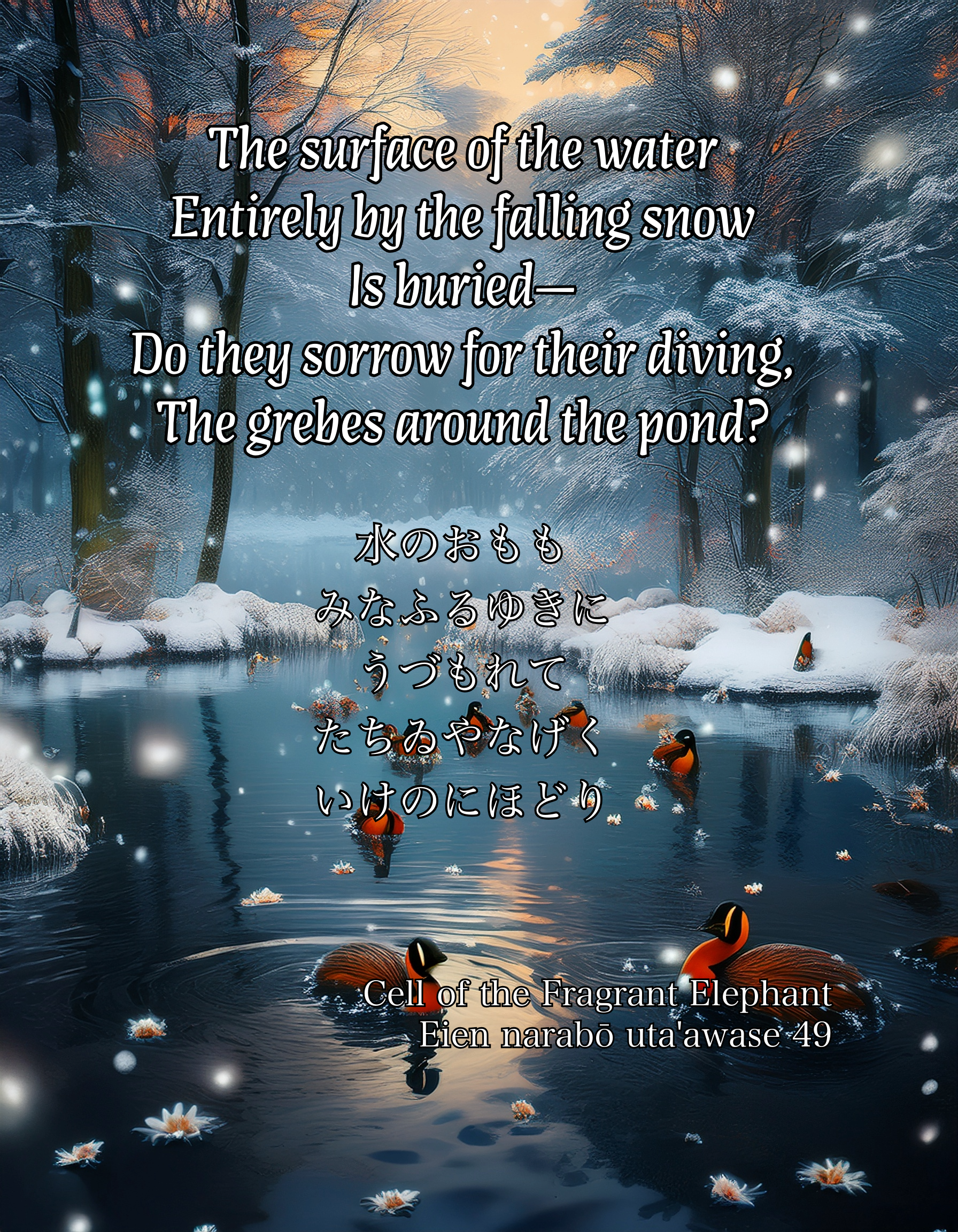
水のおももみなふるゆきにうづもれてたちゐやなげくいけのにほどり
| mizu no omo mo mina furu yuki ni uzumorete tachi’i ya nageku ike no niodori | The surface of the water Entirely by the falling snow Is buried— Do they sorrow for their diving, The grebes around the pond? |
Cell of the Fragrant Elephant
49
Right (Win)
みよしのに雪ふりぬれば我がやどのならのかれ葉はいとどさびしも
| miyoshino ni yuki furinureba wa ga yado no nara no kareba wa itodo sabishi mo | In fair Yoshino Snow has fallen, so At my house The withered oak leaves are All the more alone… |
Cell of the Everlasting Truth
50
The poem of the Left’s ‘surface of the water entirely buried by snow’ is something that I have never heard before. ‘Grieving grebes’, too, are something I have yet to encounter. Really, what sort of poem is this? As for the poem of the Right, while ‘all the more alone’ and what precedes it fails to sound elegant, at the current time I feel it’s a little bit superior.
It’s extremely difficult to conceive of the surface of a body of what which hasn’t yet frozen being buried in snow. If snow fell extremely heavily, then, surely, the water would overflow, then freeze, and then get buried, wouldn’t it? I might be going a little too far here, though. As for the Right’s poem, is ‘my house’ in Yoshino? Or is it on an estate elsewhere? If it’s on an estate, is the poet looking at the falling snow and imagining Yoshino? It’s vague. Then again, as the poem doesn’t say explicitly that the oaks are buried by the snow, is it only imagining this? How might something be which has not been seen for sure? The oaks here, too, would be like that, as snow is something which doesn’t distinguish where it falls…