Tenryaku jū-nen san-gatsu goro reikeiden no nyōgo ōnkata tōka 天暦十年三月比麗景殿女御御方闘歌 (‘Poetry Contest held by the retainers of the Reikeiden Junior Consort in the Third Month, Tenryaku 10’); Reikeiden no nyōgo sōshi joō uta’awase 麗景殿女御荘子女王歌合 (‘Poetry Match held by Princess Sōshi, the Reikeiden Junior Consort’)
Haze (kasumi 霞); Spring breezes (harukaze 春風); Plum blossom (ume no hana 梅花); Bush warblers (uguisu 鶯); Spring showers (harusame春雨); Fresh herbs (wakana 若菜); Cherry blossom (sakurabana 桜花); Willows (yanagi 柳); Kerria (yamabuki 款冬); Wisteria blossom (fuji no hana 藤花); Love without meeting (awanu koi 不会恋); Love on meeting (au koi 会恋)
[i] This poem is not included the extant texts of the match, but from its headnote must have been composed for it and been subsequently lost among with the others.
[i] This poem is included in Gyokuyōshū (V: 794/795) with the headnote, ‘For the scarlet leaves match during the reign of the Tenryaku emperor’.
[ii] This poem is included in Gyokuyōshū (V: 795/796) with the headnote, ‘For the scarlet leaves match during the reign of the Tenryaku emperor’. It is also included in Mandaishū (V: 1223) with the headnote, ‘A poem from the autumn leaves match held at the palace in the intercalary Ninth Month, Tenryaku 9’ and in Kiyotada-shū (38), with the headnote ‘From an autumn leaves match at the palace, in a year when there were two ninth months’.
On the 28th day of the Tenth Month, Tenryaku 7, a chrysanthemum match was held at the palace. On that day, His Majesty’s courtiers and retainers were divided into teams of the Left and Right, and competed with chrysanthemums. Courtiers, Princes and senior nobles were ordered to attend at the hour of the Monkey. Both Left and Right presented chrysanthemum blooms. The Left’s victory performance was ‘Prince of Langling’. The page Tachibana no Nobuyuki danced. Following this, Left and Right performed music one after another. The event ended with the award of gifts to the Princes, senior nobles and retainers according to rank.
Palace Chrysanthemum Match, Tenth Month Tenryaku 7: The courtiers were divided into teams and the Left wore robes of deep green overlaid with purple, while the Right both under- and over-robes of scarlet. Every single one of the chamberlains was assigned to a team. The leader of the Left team was Lord Arisuke and the leader of the Right was Lord Nobumitsu. Poems were placed on the diorama.
千歳経る霜の露をばおきながら菊の花こそひさしかりけれ
chitose furu shimo no tsuyu oba okinagara kiku no hana koso hisashikarikere
O’er a thousand years Frosty dew Does fall, but The chrysanthemum blooms, above all, Last forever!
[i] A minor variant of this poem is included in Fubokushō (XXVII: 12611), with the headnote, ‘A poem from the Palace Chrysanthemum Match, Tenth Month Tenryaku 7’ 千年ふる霜のつるをばおきながらきくの華こそひさしかりけれ chitose furu / shimo no tsuru oba / okinagara / kiku no hana koso / hisashikarikere ‘O’er a thousand years / Frost upon the cranes / Does fall, but / The chrysanthemum blooms, above all, / Last forever!’ Anonymous. This poem is included in Tadami-shū (116) with the headnote, ‘There were chrysanthemums planted on the diorama, with cranes standing among them.’
[ii] This poem is included in Gyokuyōshū (V: 779/780) with the headnote, ‘Composed for the Palace Poetry Match, Tenryaku 7’. It is also included in two separate versions Nakatsukasa’s personal collection, Nakatsukasa-shū, first with the headnote ‘For a chrysanthemum match held during the reign of the Murakami Emperor, when there were cranes and chrysanthemums on the diorama’, and also ‘For the Left, when there were cranes on the ‘rama, at a chrysanthemum match held during the reign of the Murakami emperor’. A minor variant, which differs only in the intial line, tazu no iru たづのゐる ‘Where cranes rest…’occurs in Fubokushō (XIV: 5898) with the headnote, ‘For a chrysanthemum match held at the palace in the Tenth Month, Tenryaku 7, when there were cranes and chrysanthemums on the diorama.’
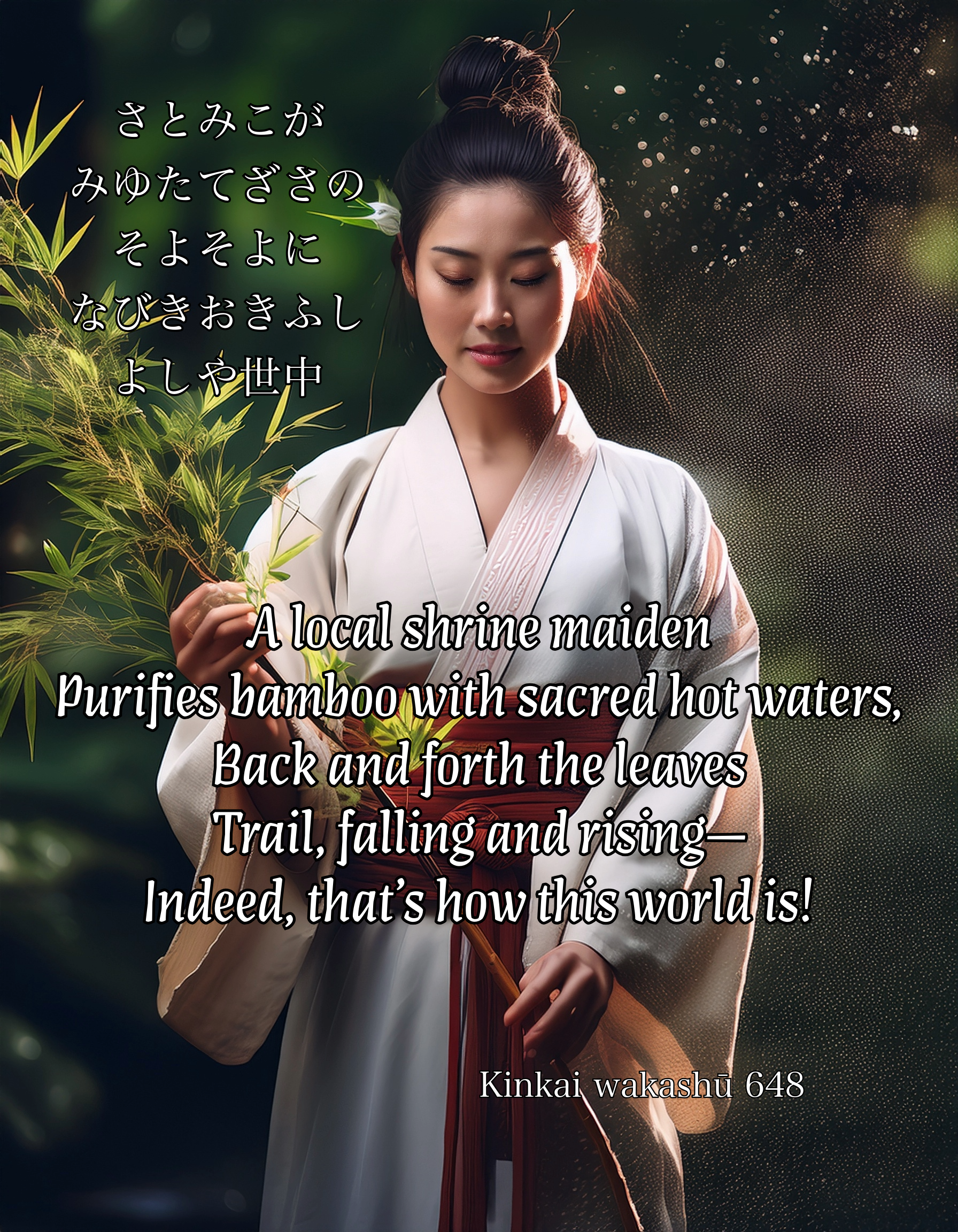
satomiko ga miyu tatezasa no soyosoyo ni nabiki okifushi yoshi ya yo no naka
A local shrine maiden Purifies bamboo with sacred hot waters, Back and forth the leaves Trail, falling and rising— Indeed, that’s how this world is![i]
648
[i] There was a shrine purification ritual whereby a shrine maiden (miko 巫女) would soak a branch of dwarf bamboo (sasa 笹) in water which she had heated, and then shake the water from the leaves, moving the branch up and down, scattering the droplets over both herself and pilgrims to the shrine. Sanetomo’s poem uses a description of this ritual as a preface (jo 序), before pivoting at the end of the fourth stanza to say that everyday life is just a sequence of both getting up and then going back to sleep (lying down) again and again (Higuchi 2016, 148).
When I had composed a large number of poems on Shintō themes.
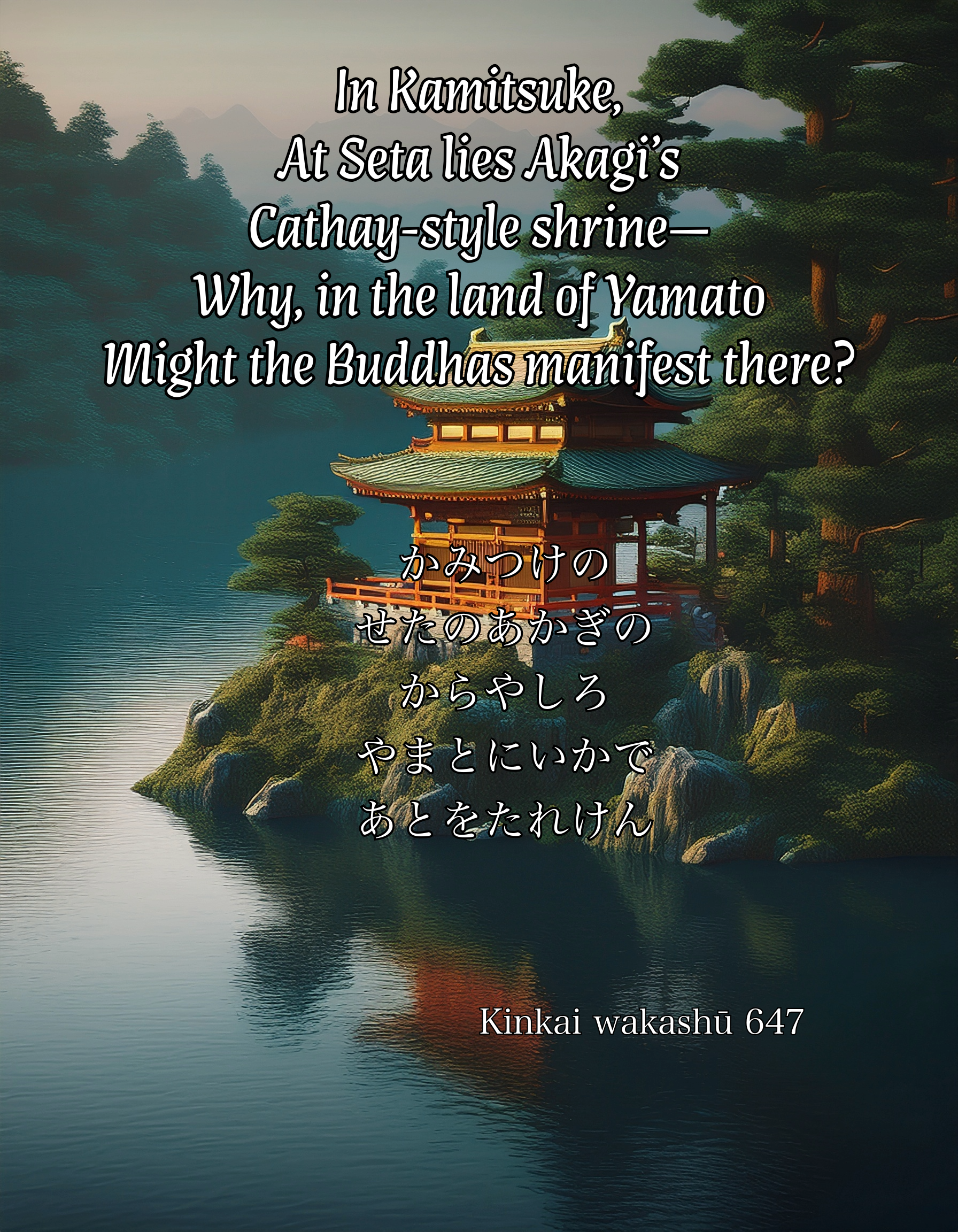
かみつけのせたのあかぎのからやしろやまとにいかであとをたれけん
kamitsuke no seta no akagi no karayashiro yamato ni ikade ato o tareken
In Kamitsuke, At Seta lies Akagi’s Cathay-style shrine— Why, in the land of Yamato Might the Buddhas manifest there? [i]
647
[i] Akagi Shrine (akagi jinja 赤城神社) lay (and still lies) on the banks of Lake Ōnuma 大沼 in Kōzuke (Kamitsuke) 上野 province (modern Gunma 群馬 prefecture). Under the belief that various Buddhist deities manifested themselves in Japan as Shintō kami in order to better provide salvation to the people there (honji suijaku-setsu 本地垂迹説) its principal deity, Akagi Daimyōjin 赤城大明神 was believed to be a manifestation of Thousand-Armed Avalokitesvara (Senju kannon 千手觀音), Ākāśagarbha (Kokuzō bosatsu 虛空藏菩薩) and Kṣitigarbha (Jizō bosatsu 地藏菩薩). Sanetomo’s poem queries why, if the bodhisattvas have chosen to manifest as kami, they should do so at a shrine built in a foreign style.