Category Archives: 1001-1050

Tōgū gakushi noritada uta’awase 07

The scent of orange blossom incense on the breeze[i]

Left

ふくかぜに花たちばなぞにほふなるむかしのそでにあやまたれつつ

fuku kaze ni
hanatachibana zo
niou naru
mukashi no sode ni
ayamataretsutsu
With the gusting breeze
Orange blossom’s
Fragrance comes—
For those sleeves of bygone days
Do I ever mistake it…

13

Right

つねよりもことにもあるかなけふをまつはなたちばなのかぜのにほひは

tsune yori mo
koto ni mo aru kana
kyō o matsu
hanatachibana no
kaze no nioi wa
More than ever
So special it is!
For today have I awaited,
Orange blossom’s
Scented breeze…

14

In general, orange blossom is scented during early summer showers or has its fragrance carried on the evening breeze, so I wonder about the folk of bygone days: there’s nothing to compare it with, making the Left’s poem as hackneyed as one on Isonokami, yet there’s nothing special about it, like a weed growing under the eaves. The Right’s poem has ‘for today have I awaited’, which I think requires a reference to sweet-flags. My overall impression of both poems is that their conceptions are unclear.

[Judge’s poem missing]


[i] Rōkitsu bōfū 盧橘芳風
Tōgū gakushi noritada uta’awase 06

Dark shade beneath the mountain trees[i]

Left

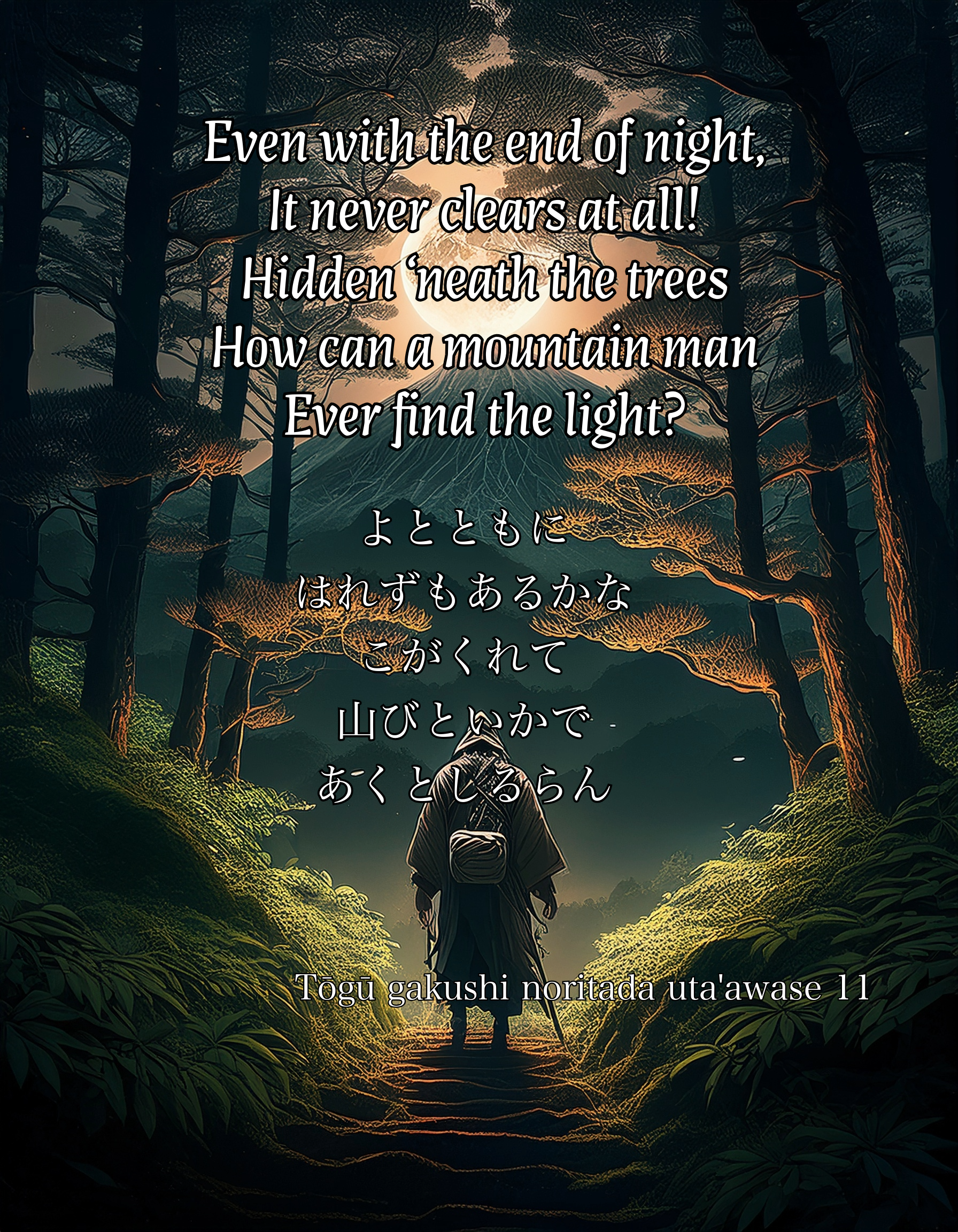
よとともにはれずもあるかなこがくれて山びといかであくとしるらん

yo to tomo ni
harezu mo aru kana
kogakurete
yamabito ikade
aku to shiruran
Even with the end of night,
It never clears at all!
Hidden ‘neath the trees
How can a mountain man
Ever find the light?

11

Right

よもの山こぐらくなりてなつのよの月ばかりこそもりてみゆらめ

yomo no yama
koguraku narite
natsu no yo no
tsuki bakari koso
morite miyurame
All around, the mountains
Are dark beneath the trees;
On a summer night
‘Tis truly only the moon
That one might see dripping between them!

12

This topic refers to a hunted stag concealed among the trees in the summer mountains. There is not a particular strong feeling of either evergreen or other types of mountain forests,[ii] but the Left’s poem has ‘Even with the end of night’, forgetting that this implies a season of biting wind and showers striking the leaves on the trees—thus the darkness here is excessively conceived. While the Right takes ‘dark shade’ as an opportunity to compose with the elevated conception of the moon dripping between the trees—and surpasses the peaks in doing this—I wonder if the conceptions of both poems don’t contain brightness? Thus, both Left and Right are examples of the ‘Reizei Palace’,[iii] so I would decide on a tie for these.

さ月山こぐらきかげのしげしさはまさりてみゆる人もなきかな

satsuki yama
koguraki kage no
shigeshisa wa
masarite miyuru
hito mo naki kana
The Fifth Month mountains
Dark shade beneath the trees is
So deep that
Skillfully seeing—
There no one who can do that!

Judge 6


[i] Yamagi no kagegurashi山樹蔭暗

[ii] The expression Noritada uses here Tokiwayama makeyama is obscure, so this interpretation is speculative.

[iii] Another unclear expression, but from the context apparently an idiom that means ‘poems not matching the topic’.

Tōgū gakushi noritada uta’awase 05

Hidden in the grass on the path o’er the plains[i]

Left

なつくればのべのくさばもしげりあひていづれかみちとみえぞわかれぬ

natsu kureba
nobe no kusaba mo
shigeriaite
izure ka michi to
mie zo wakarenu
When the summer comes,
The blades of grass upon the plains
Grow lushly together, so
Which is the path to take
I cannot tell by looking!

9

Right

をちこちのみちみえぬまでなつののはくさばしげくもなりにけるかな

ochikochi no
michi mienu made
natsuno no wa
kusaba shigeku mo
narinikeru kana
Until both distant and nearby
Paths I cannot see
Across the summer plains
Have the blades of grass so lushly
Grown, indeed!

10

Do they not know the features of the summer plains conveyed by ‘Hidden in the grass on the path o’er the plains’? While both Left and Right use ‘blades of grass’, this puts one in mind of fresh grass sprouting in spring showers; and then of the two of them, the Right uses ‘distant and nearby’, which is nothing more than an archaic expression from the Age of Gods used for leg-wearying mountain paths, while at least the Left does not have a tangled argument.

ato miezu
natsuno no kusaba
shigeku tomo
yamaji o kakete
madoubeshi ya wa
No folk’s tracks visible
Upon the summer plains—the blades of grass
Lush, yet
I wonder if upon mountain paths
One would lose ones way?

Judge 5


[i] Yasō no michi shigeshi 野草路滋

Tōgū gakushi noritada uta’awase 04

Maidens spinning thread

Left

てにかけてくるなつごとにわぎもこがおほくのいとをひきてけるかな

te ni kakete
kuru natsu goto ni
wagimoko ga
ōku no ito o
hikitekeru kana
Through her hands a’running
Again, with every summer’s coming,
My darling girl
So much thread
Has spun!

7

Right

てもたゆくひきおくいとのたえまなくきみがみちよのさかゆべきかな

te mo tayuku
hiki’oku ito no
taemanaku
kimi ga michiyo no
sakayubeki kana
Her weary hands
A’spinning thread,
Never ending
My Lord’s reign through three thousand years
Of prosperity!

8

‘Maidens spinning’ is about their expertise at it, and is not something that you need to need to ponder over and over like a peasant’s hempen thread or struggle to pull apart like a hardened silk cocoon, but both Left and Right really seem to have spun things out, and I feel that, although there’s an air of elegance to start with, the diction at the end of both poems is confused, so I would make these a tie.

hidari migi
hiku te mo tayuku
tatsu ito wa
izukata e ka wa
yorubekaruran
Left and Right,
The hands spinning wearily,
Produce thread that
Heads off but,
I wonder where to?

Judge 4

Tōgū gakushi noritada uta’awase 03

Rice seedling Planters[i]

Left

てもたゆくむろのはやなへとりもあへずおのがおのがもいそぐめるかな

te mo tayuku
muro no hanae
tori mo aezu
ono ga ono ga mo
isogumeru kana
With gentle hands
The young seedlings in the root-house
Swiftly taking
Each and every one
Hurries along!

5

Right

なはしろとはるみしものをいつのまにたごおりたちてさなへとるらん

nawashiro to
haru mishi mono o
itsu no ma ni
tago oritachite
sanae toruran
The seed-shoots that
I saw in springtime have,
In but a moment, by
The lads standing in the paddies,
Taken for seedlings.

6

While it lacks a depth of conception of fallow paddies resembling the marshy mud between the reeds, surveying the scene in line with this time of year, it is certainly the case that men planting rice-seedlings appear—this is the superficial content of the Left’s poem, but its diction is somewhat stiff. The Right seem superior for its balance between the initial and latter section of the poem, it’s bright overall impression and its configuration implying the swift flow of water around the seedlings.

tori mo aezu
kokorogokoro ni
isogedomo
ama wa so shiranu
muro no hayanae
Swiftly over
Both conceptions
Have I hurried, yet
As a fisherman, am ignorant of
Young seedlings in the root-house!

Judge 3


[i] Torinaehito 取苗人

Tōgū gakushi noritada uta’awase 02

Mugwort in the Grounds[i]

Left

よろづよもときはならなんけふのためいはひておほすそののよもぎは

yorozuyo mo
tokiwa naranan
kyō no tame
iwaite ōsu
sono no yomogi wa
For ten thousand ages more
Evergreen, I would you be!
For today’s
Celebration, lushly growing
Mugwort in the grounds…

3

Right

そののうちにおふるよもぎのえだしげみすゑさかゆべくみゆるきみかな

sono no uchi ni
ouru yomogi no
eda shigemi
sue sakayubeku
miyuru kimi kana
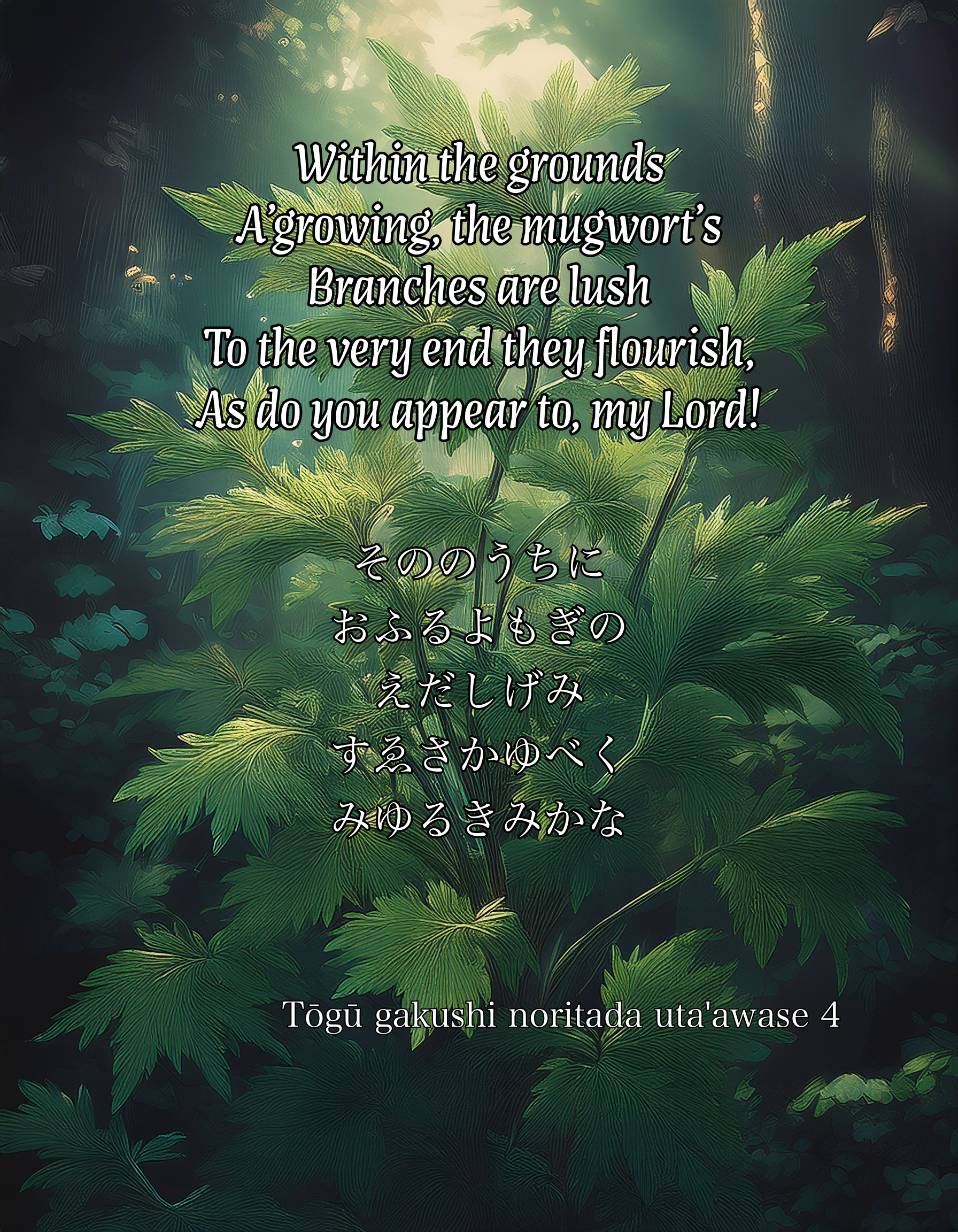
Within the grounds
A’growing, the mugwort’s
Branches are lush
To the very end they flourish,
As do you appear to, my Lord!

4

In ancient times, folk arose on this day with the dawn together with the birds and, taking those branches of mugwort from within their grounds that resembled people, dried them in the shade and made medicinal draughts—I wonder, were both Left and Right unaware of this? There is not even a dewdrop’s worth of diction in accordance with the topic, so I must make this round a tie.

かたかたにとるかたもなきよもぎぐさひとかずならぬここちこそすれ

katakata ni
toru kata mo naki
yomogigusa
hito kazu naranu
kokochi koso sure
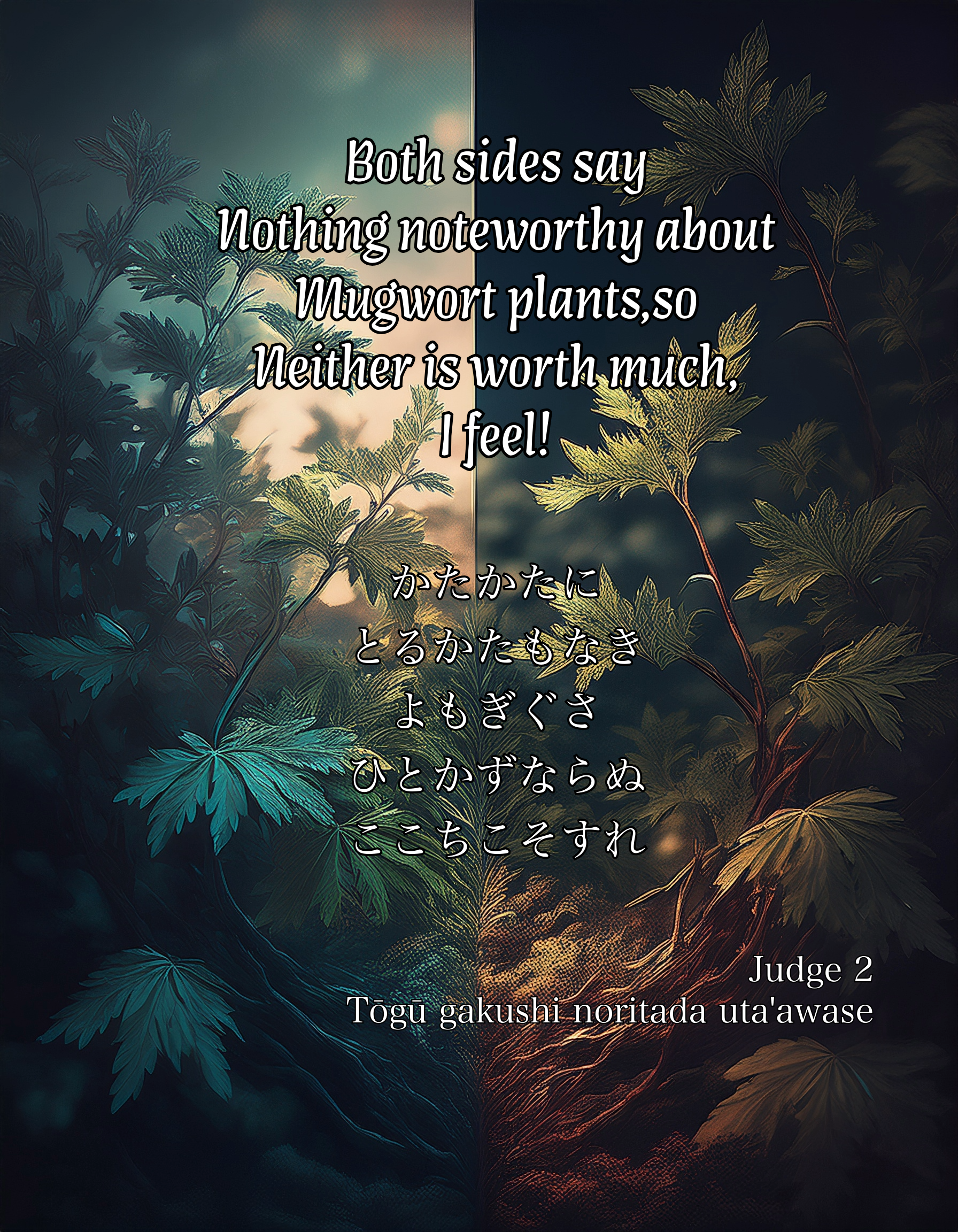
Both sides say
Nothing noteworthy about
Mugwort plants,so
Neither is worth much,
I feel!

Judge 2


[i] Sono no naka no yomogi 園中蓬

Tōgū gakushi noritada uta’awase 01

Poetry Match held by Noritada, Confucian Tutor to the Heir Apparent[i]

Topics

Poets

Judge

Sweet-flags in the Valley

Left

たにふかみたづねてぞひくあやめぐさちとせあるべきくすりとおもへば

tani fukami
tazunete zo hiku
ayamegusa
chitose arubeki
kusuri to omoeba
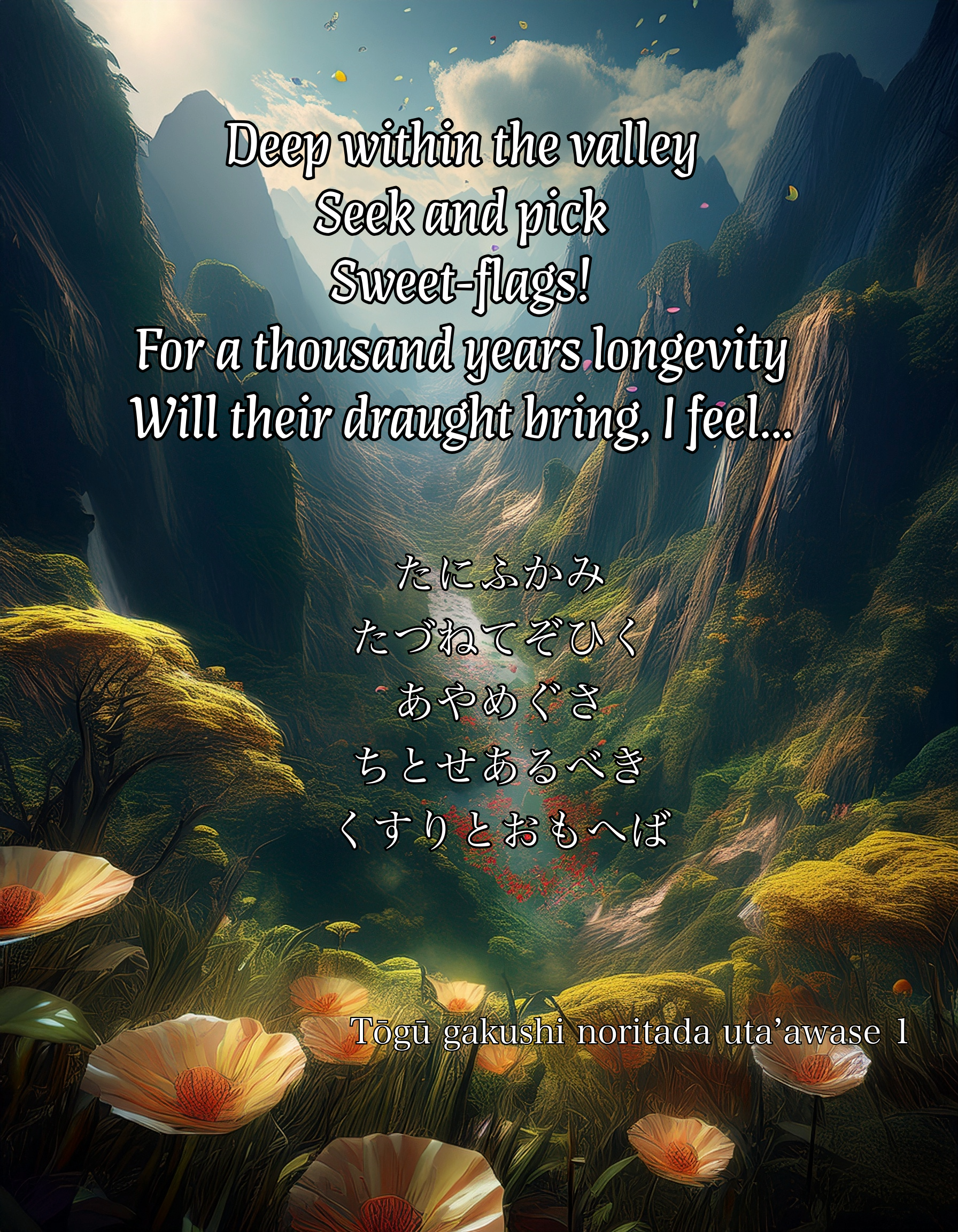
Deep within the valley
Seek and pick
Sweet-flags!
For a thousand years longevity
Will their draught bring, I feel…

1

Right

たにふかみおふるあやめのながきねはひきかつ人もあらじとぞおもふ

tani fukami
ouru ayame no
nagaki ne wa
hiki katsu hito mo
araji to zo omou
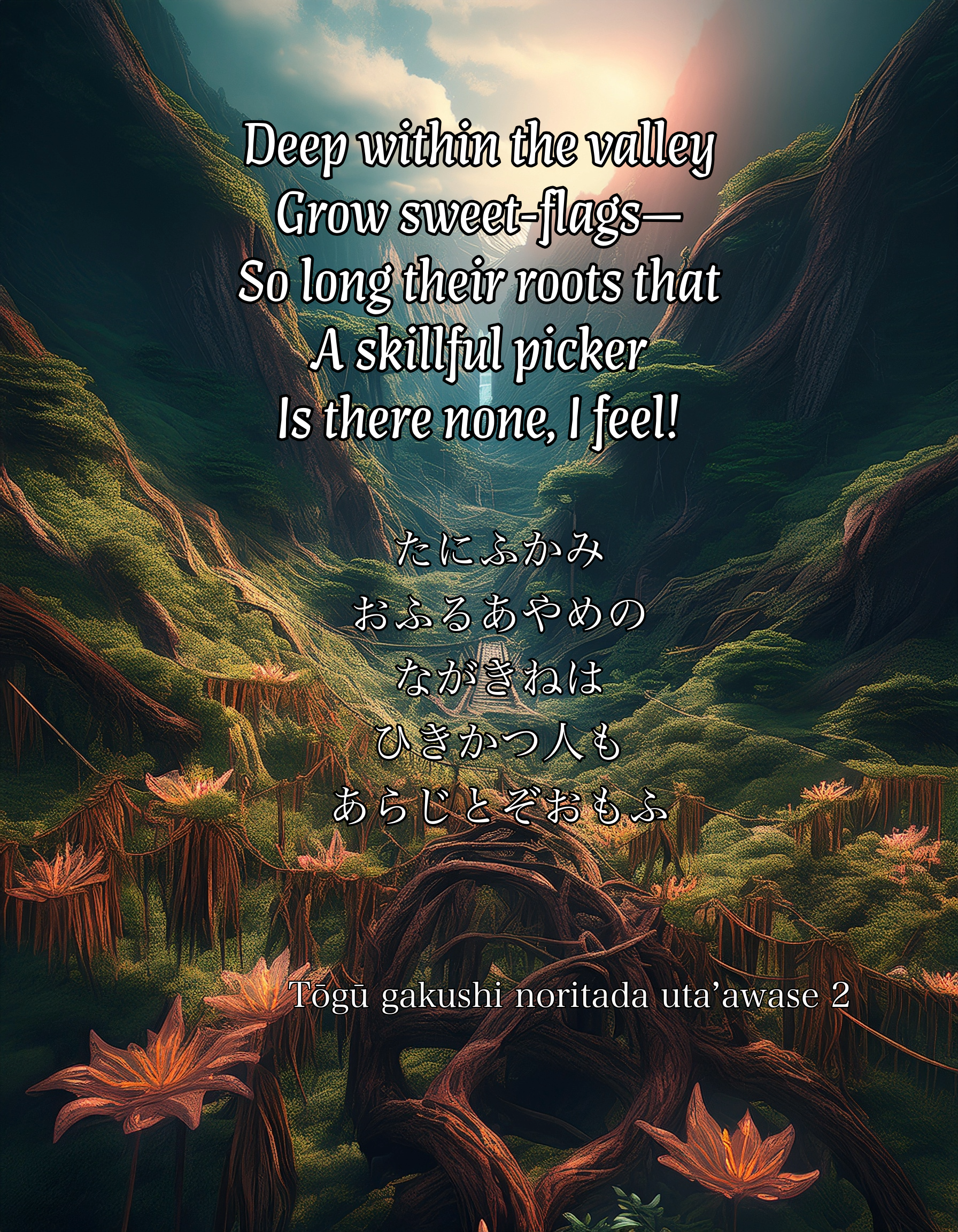
Deep within the valley
Grow sweet-flags—
So long their roots that
A skillful picker
Is there none, I feel!

2

Nine-knotted sweet-flags grow in valleys atop rocks, so every year on this day, folk gather together and pick sweet-flag roots to make medicine from them, so one should compose as though cupping the water of this conception in one’s hands. The overall impression of the Right’s poem, while it may be something encountered occasionally, is that it shows ignorance of the conception of the topic and only refers to how long the roots are—it loses, but there may be some depth there.

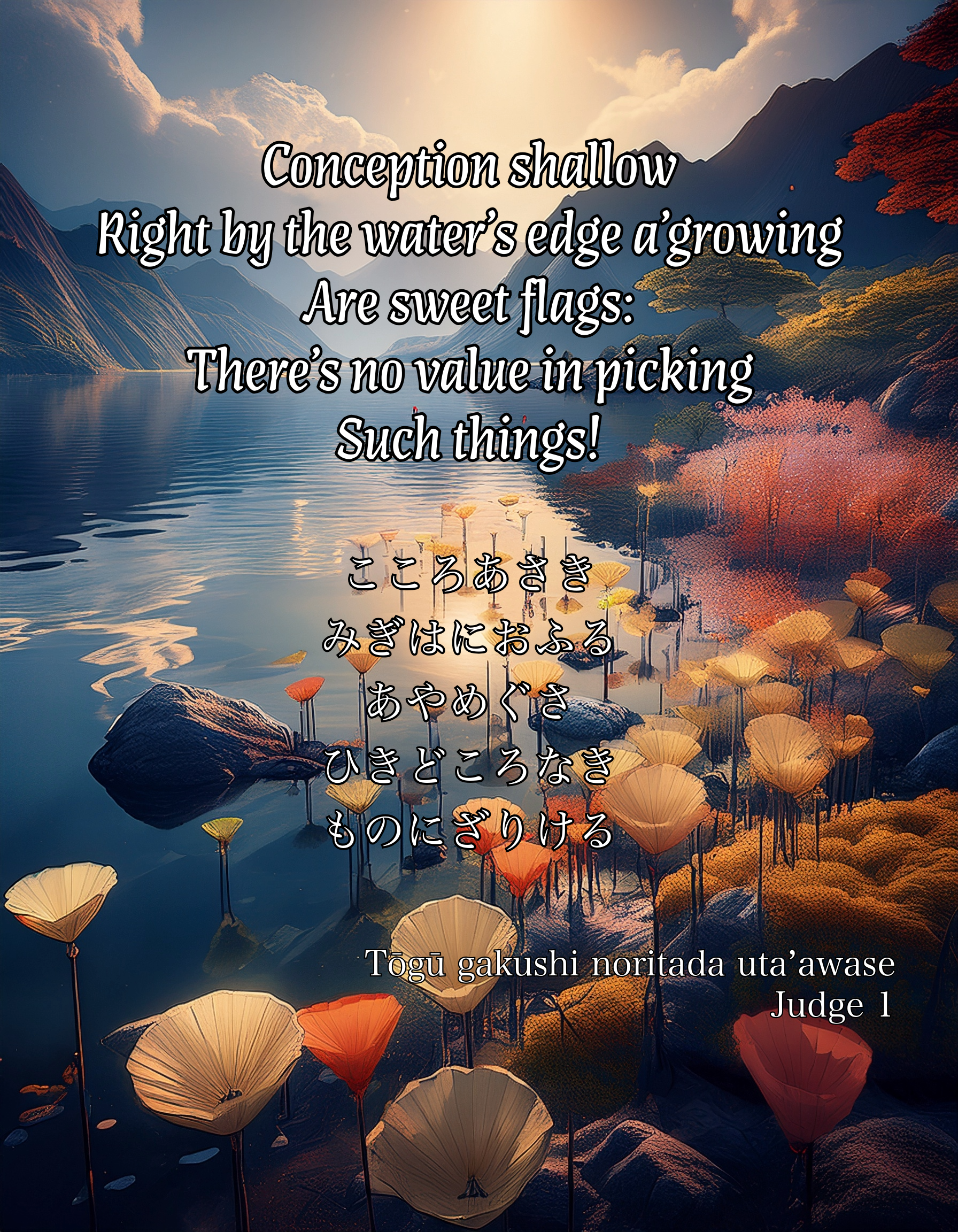
こころあさきみぎはにおふるあやめぐさひきどころなきものにざりける

kokoro asaki
migiwa ni ouru
ayamegusa
hikidokoro naki
mono ni zarikeru
Conception shallow
Right by the water’s edge a’growing
Are sweet flags:
There’s no value in picking
Such things!

Judge 1


[i] Tōgū gakushi noritada uta’awase 東宮学士義忠歌合

Tōgū gakushi noritada uta’awase – Preface

Lord Fujiwara no Noritada, Governor of Awa and Confucian Tutor to the Heir Apparent, was in high good humour and, thinking that he did not wish to idle away his hours at such a time of celebration,[i] gathered sundry folk of a poetic disposition, who thought only of the dew upon blades of grass, of the poems of ages past, each proceeding as knots on a bamboo stalk,[ii] as many and as indistinct as ears of rice in the autumn paddies. He hoped that his own innumerable words would be as strung gems passing into the world to come, yet it is also the case that they say ‘Traces will a thousand years’,[1] so praying that they would be transmitted into the future,[iii] he produced ten poetic topics, dividing his guests into Left and Right and, so that their words, which he had them compose with the strains of flute and zither in their ears, would be passed down to the future and not vanish like tracks of birds on the beach—for he worried that folk seeing them might feel that the poems of today’s folk seemed many as blades of grass in summer—he decided on winners and losers and, desiring to reveal the conception of the matter, he was able decide upon and compose himself ten poems as judgements: it appears he produced ten judgements in all—how wonderful that is!


[1] Letters. かひなしと思ひなけちそ水ぐきのあとぞ千とせのかたみともなる kai nashi to / omoi na kechi so / mizuguki no / ato zo chitose no / katami to mo naru ‘As pointless / O, don’t belittle me! / For these waterweed / Traces will a thousand years’ / Memento become!’ Anonymous (Kokin rokujō V: 3379)


[i] Wife of Heir Apparent give birth

[ii] A reference to the Kokinshu kana preface suguretaru hito mo, kureteke no, yoyo ni kikoete 優れたる人も、呉竹の、世世に聞こえて ‘…other superlative poets were heard each proceeding as knots on a bamboo stalk…’ (Kojima and Arai 1989, 12).

[iii] Kokinshū kana preface. 後の世にも伝はれとて nochi no yo ni mo tsutaware tote ‘…desiring that they be transmitted to the future…’ (Kojima and Arai 1989, 16).