The only record of this poetry match’s existence is in the headnote to the poems in Motozane-shū (180, 181), which simply reads ‘From a poetry match’. Hagitani (1958, 418) suggests that, as these poems are recorded separately in this work from Motozane’s other poems for poetry matches, they are most likely from a different contest, the details of which have now been lost. Given the topic of ‘Cuckoos’, however, it most likely will have taken place in the late spring or early summer.
うのはなの影にかくれて今日までぞ山時鳥声はをしまむ
unohana no kage ni kakurete kyō made zo yama hototogisu koe wa oshimamu
Within the deutzia’s Shade concealed Until today The mountain cuckoo Seems to regret his song.
1
いまよりは声なをしみそ時鳥五月待つまのほどぞあるらし
ima yori wa koe na oshimi so hototogisu satsuki matsu ma no hodo zo arurashi
From now on Your song do not regret, O, cuckoo, For to await the Fifth Month Some time there still seems to be!
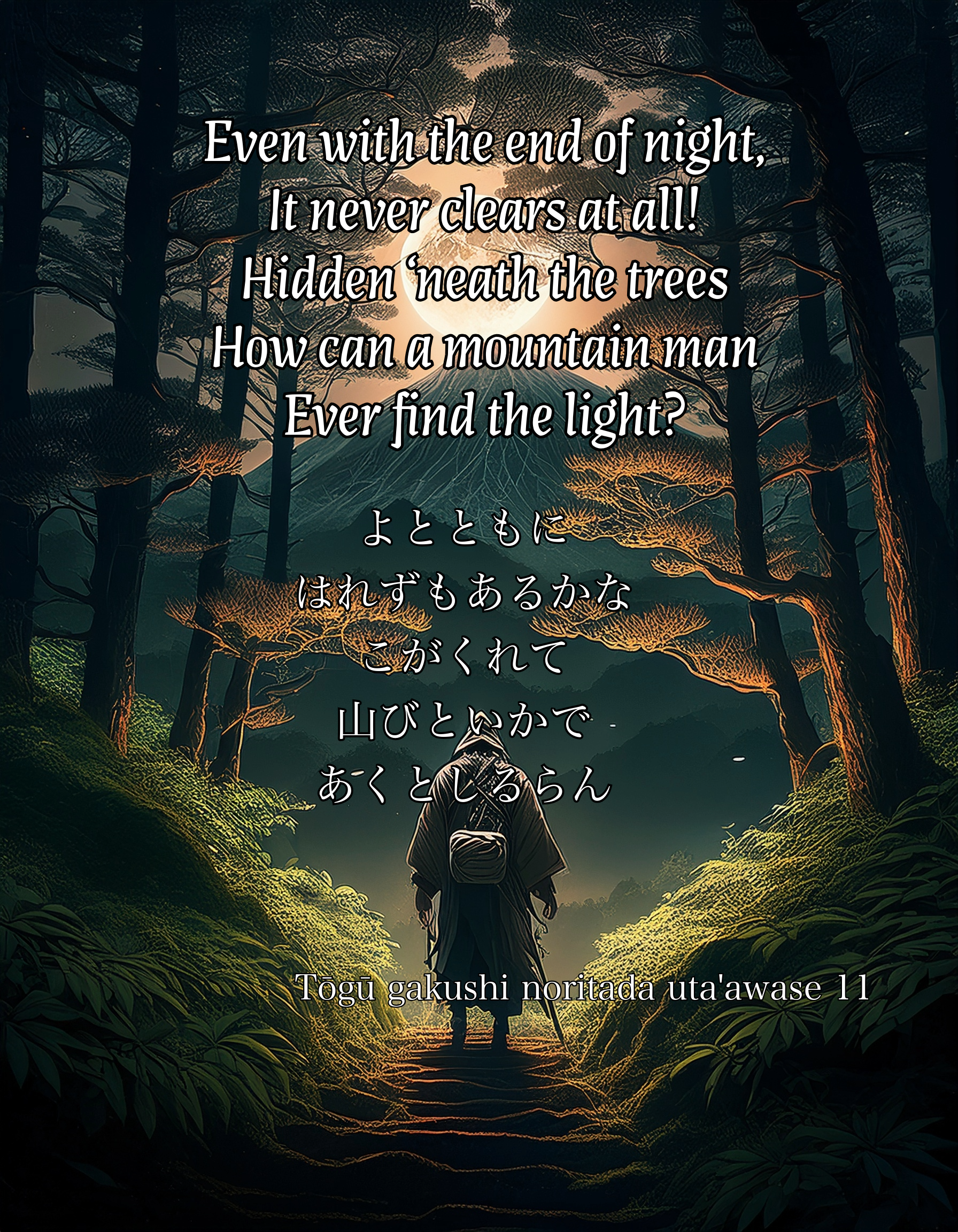
yo to tomo ni harezu mo aru kana kogakurete yamabito ikade aku to shiruran
Even with the end of night, It never clears at all! Hidden ‘neath the trees How can a mountain man Ever find the light?
11
Right
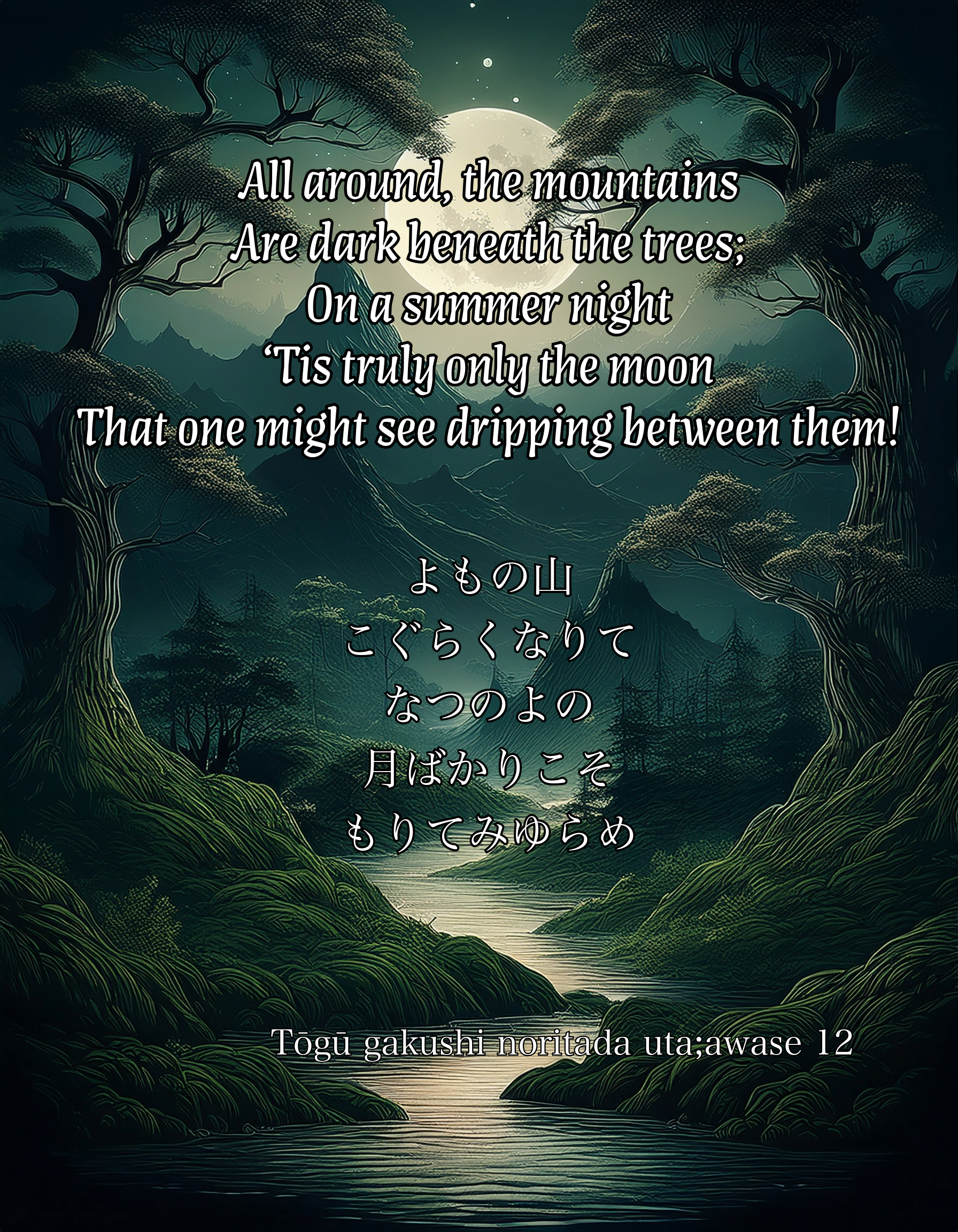
よもの山こぐらくなりてなつのよの月ばかりこそもりてみゆらめ
yomo no yama koguraku narite natsu no yo no tsuki bakari koso morite miyurame
All around, the mountains Are dark beneath the trees; On a summer night ‘Tis truly only the moon That one might see dripping between them!
12
This topic refers to a hunted stag concealed among the trees in the summer mountains. There is not a particular strong feeling of either evergreen or other types of mountain forests,[ii] but the Left’s poem has ‘Even with the end of night’, forgetting that this implies a season of biting wind and showers striking the leaves on the trees—thus the darkness here is excessively conceived. While the Right takes ‘dark shade’ as an opportunity to compose with the elevated conception of the moon dripping between the trees—and surpasses the peaks in doing this—I wonder if the conceptions of both poems don’t contain brightness? Thus, both Left and Right are examples of the ‘Reizei Palace’,[iii] so I would decide on a tie for these.
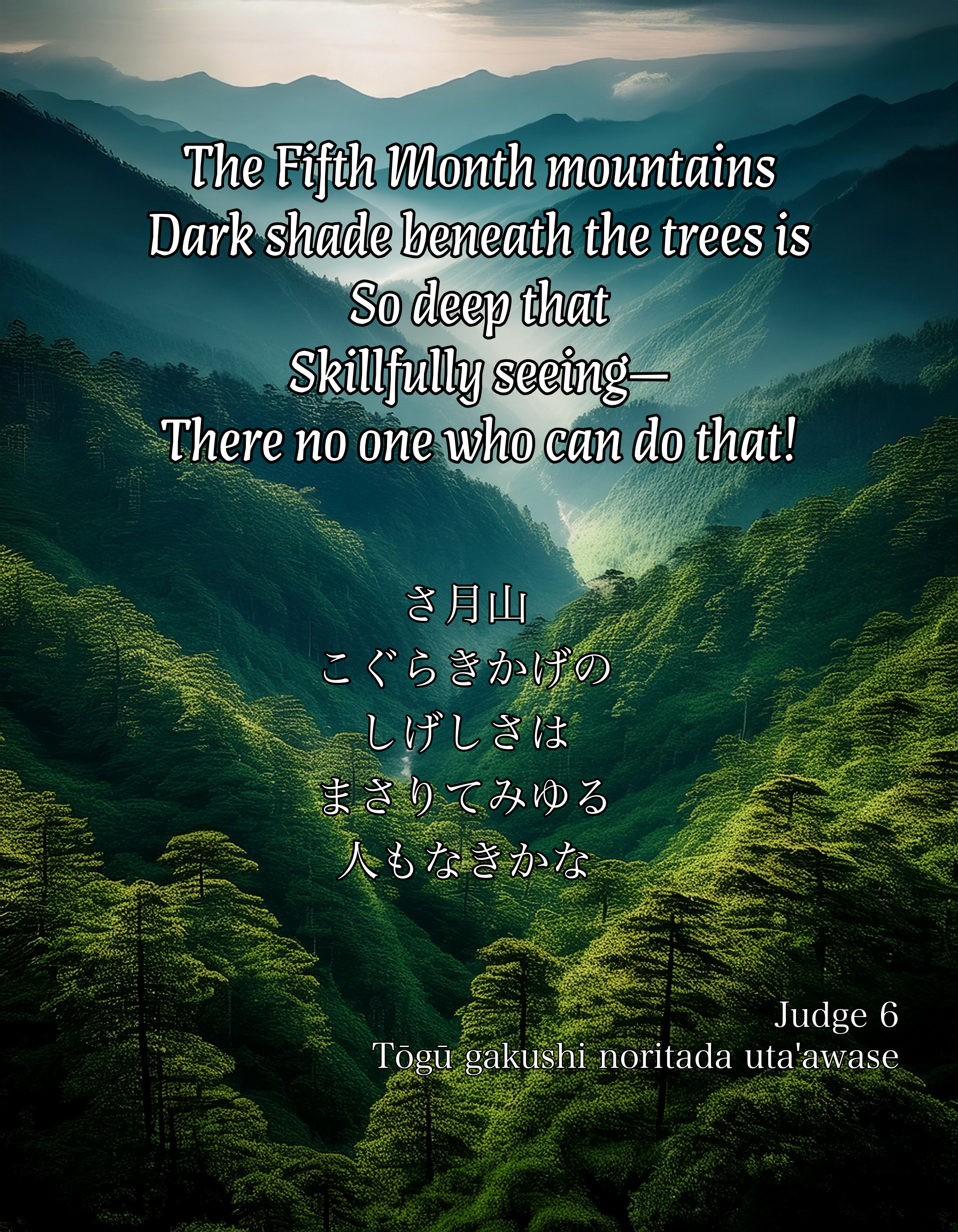
さ月山こぐらきかげのしげしさはまさりてみゆる人もなきかな
satsuki yama koguraki kage no shigeshisa wa masarite miyuru hito mo naki kana
The Fifth Month mountains Dark shade beneath the trees is So deep that Skillfully seeing— There no one who can do that!
yomosugara matsu ni wa nakade hototogisu ashita no hara ni hitokoe zo kiku
All through the night I pined without a song, O, cuckoo Then with the morn on Ashita plain I hear a single call!
Cell of Fragrant Cloud 25
Right (Win)
五月にはしばなくやとぞほととぎすなほうらまちにさぬるよもなし
satsuki ni wa shiba naku ya to zo hototogisu nao uramachi ni sanuru yo mo nashi
In the Fifth Month Incessantly might he sing—I think, so The cuckoo I am already eagerly awaiting, Sleeping not at all on any night!
Cell of Compassionate Light 26
The Left’s poem seems to have an extraordinary conception, yet its diction is insufficient. The Right’s poem is old-fashionedly artless and thus has elements which are entirely poetically backward-looking.
The Left’s poem is particularly oddly composed in that is fails to account for the essential meaning of Ashita Plain. Does saying a ‘single call now’[1] mean that that one could wait expectantly during the day, too?
As for the Right’s poem, a cuckoo is not something that calls incessantly, yet I wonder if this composition is not, in some form, a plea that it would? As for ‘eagerly await’, well, I feel that it would be better to have ‘awaited’ rather than ‘awaiting’—that sounds like something one would have done ‘nothing but’ first. It seems a bit distasteful, like a poem by someone who has been perusing the Collection of a Myriad Leaves.
[1] On a folding screen for the Coming-of-Age Ceremony of the Northern Princess. 行きやらで山ぢくらしつほととぎす今ひとこゑのきかまほしさに yukiyarade / yamaji kurashitsu / hototogisu / ima hitokoe no / kikamahoshisa ni ‘I cannot go ahead / As twilight falls upon the mountain paths / For a cuckoo’s / Single call now / Is what I long to hear…’ Minamoto no Kintada (SIS II: 106)
samidare ni nuru to mo yukamu hototogisu futakoe kinaku sato wa ari ya to
By the summer showers We will be drenched, yet let’s away! For the cuckoo Has come to sing and sing again At that estate, perchance…
Retired from the world 19
Right
さ月やみくらくはくらくほととぎすこゑはかくれぬ物にぞありける
satsuki yami kuraku wa kuraku hototogisu koe wa kakurenu mono ni zo arikeru
In the Fifth Month’s gloomy Darkness deep, The cuckoo Is unable to conceal his cry With anything at all!
Senior Assistant Minister Past Lecturer 20
Both Left and Right are workmanlike poems with little evidence of thought. With that being said, however, the conclusion of the Right’s poem is identical to that of a famous work by the Horikawa Minister. That poem is ‘The River Sao: / Mist rises, and from beyond / Come plover cries, / Their calls uninterrupted / By anything.’[1] And the Right here is, at the very least, extraordinarily redolent of it! Still, I feel the Left does linger in the heart.
The Left’s poem is not particularly remarkable, yet it has no faults worth mentioning. It doesn’t contain any distasteful expressions and resembles familiar compositions. The poem of the Right’s ‘darkness deep’ sounds like something said by a black-hearted scoundrel—I don’t feel it’s poetic diction at all! In addition, on the matter of the concluding ‘unable to conceal his cry’,[i] well, this appears in a range of earlier poems, as does ‘his cry uninterrupted’, so one should be hesitant about using it. I make the faultless Left the winner.
[1] Composed on plovers for a poetry competition in Eishō 4 [1050]. 佐保川の霧のあなたに鳴く千鳥聲は隔てぬ物にぞ有ける saogawa no / kiri no anata ni / naku chidori / koe wa hedatenu / mono ni zo arikeru ‘The River Sao: / Mist rises, and from beyond / Come plover cries, / Their calls uninterrupted / By anything.’ The Horikawa Minister of the Right [Fujiwara no Yorimune] (GSIS VI: 388)
[i] The only surviving example of this usage pre-dating this match is: Written on the edge of a folding screen by a painting of geese flying in the clouds, when His Majesty ordered a celebration for the Junior Principal Handmaid. 白雲の中にまがひてゆく雁もこゑはかくれぬ物にざりける shirakumo no / naka ni magaite / yuku kari mo / koe wa kakurenu / mono ni zarikeru ‘Within the clouds, so white, / Entangled / Goes a goose, / Unable to conceal his cry / With anything at all!’ Fujiwara no Kanesuke (Kanesuke-shū 48). There is also one further example in later poetry: Composed and sent when he heard that Inspector Kinmichi had had a number of people compose poems on the bush warbler at his residence. 春霞たちへだつれど鶯の声はかくれぬものとしらずや harugasumi / tachihedatsuredo / uguisu no / koe wa kakurenu / mono to shirazu ya ‘The haze of spring / Arising, interferes, yet / The warbler / Is unable to conceal his cry— / I wonder if he know it?’ Former Consultant Tsunemori (GYS I: 50)
kamu saburu nageki no mori no hototogisu hiku shimenawa mo nakunaku ya koshi
In divine Nageki’s sacred grove Does the cuckoo to Where the holy garlands Are hung not, come to sing?[1]
The Former Minister of the Centre 35
Right
さとわかずなけや五月の郭公忍びし比は恨みやはせし
sato wakazu nake ya satsuki no hototogisu shinobishi koro wa urami ya wa seshi
In every hamlet Sing, O, Fifth Month Cuckoo! For when you chirped before, I did not hate you for it…
Kozaishō 36
The Left’s poem is based on ‘Prayers / Alone I seem to hear at / This shrine, indeed, but / In the end, passion to grief’s / Grove will turn, no doubt…’ and sounds pleasant. The Right’s poem says ‘For when you chirped before, / I did not hate you for it’ and has a graceful style—thus, they tie.
[1] An allusive variation on: Topic unknown. ねぎ事をさのみききけむやしろこそはてはなげきのもりとなるらめnegigoto o / sanomi kikikemu / yashiro koso / hate wa nageki no / mori to narurame ‘Prayers / Alone I seem to hear at / This shrine, indeed, but / In the end, passion to grief’s / Grove will turn, no doubt…’ Sanuki (KKS XIX: 1055)