When returning from a pilgrimage to the twin shrines, there was a river called the Maekawa running before my beachside lodging.[i] Rain had been falling, so the waters were extremely high—I composed this when we crossed the river at sunset.
浜べなるまへの川せを行く水のはやくもけふのくれにけるかな
hamabe naru mae no kawase o yuku mizu no hayaku mo kyō no kurenikeru kana
On the beachside The Mae’s river rapids’ Waters flow As fast as today Draws into evening.
702
[i] This lodging was at what is now Sakawa 酒匂 within the bounds of Odawara 小田原 on the coast of Sagami Bay (Higuchi 2016, 181)
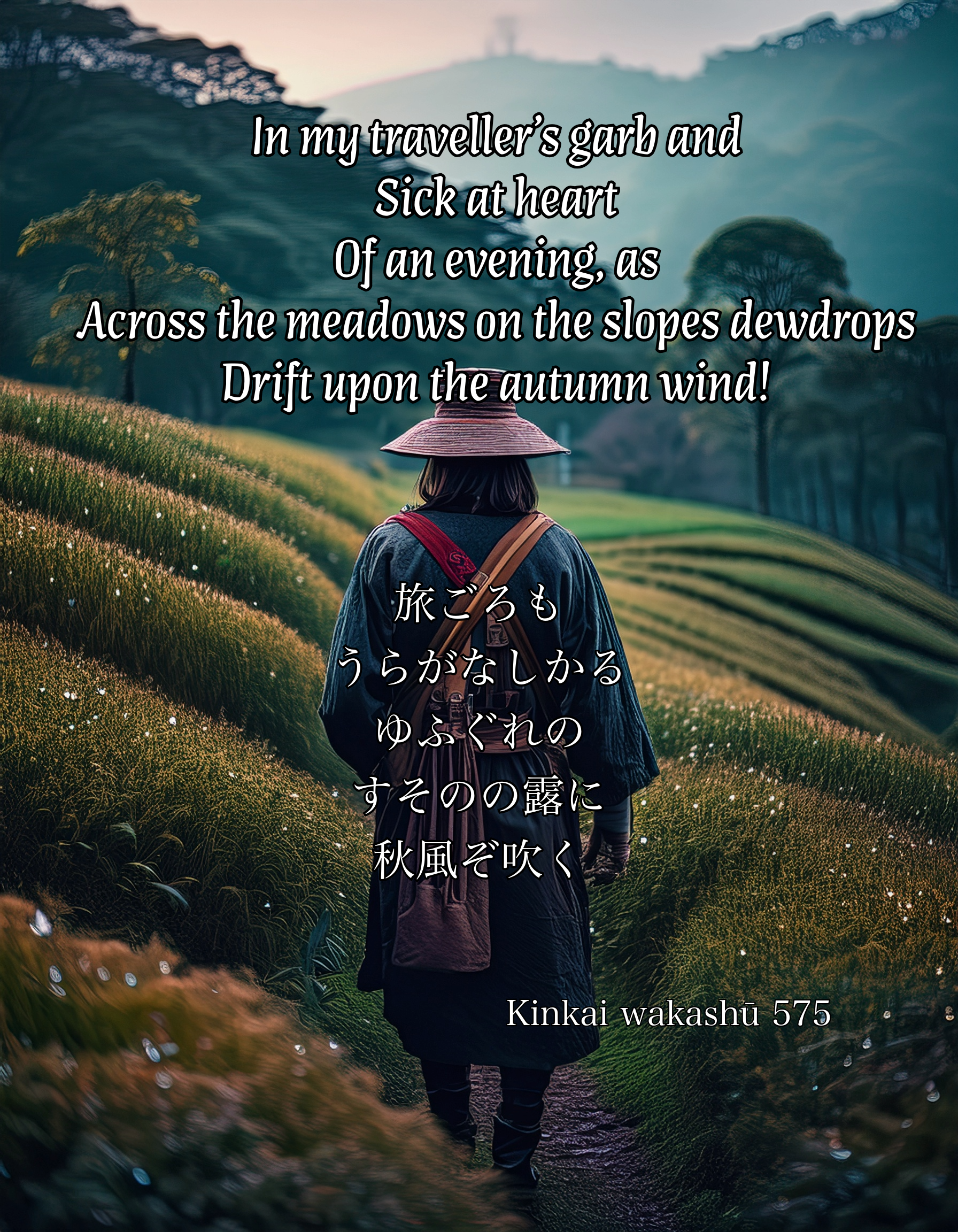
tabigoromo uraganashikaru yūgure no susono no tsuyu ni akikaze zo fuku
In my traveller’s garb and Sick at heart Of an evening, as Across the meadows on the slopes dewdrops Drift upon the autumn wind! [i]
575
[i] See: 旅ごろもうらがなしさにあかしかね草の枕は夢もむすばず tabigoromo / uraganashisa ni / akashikane / kusa no makura wa / yume mo musabazu ‘In my traveller’s garb / My heart-sickness / I cannot lift, for / My grassy pillow / Brings no dreams, at all…’ Hikaru Genji (Genji monogatari 223); and: たびごろもうらがなしかるあさぢふによはのしぐれよいかにせよとぞ tabigoromo / uraganashikaru / asajū ni / yowa no shigure yo / ika ni seyo to zo ‘In my traveller’s garb and / Sad at heart among / The clumps of cogon grass, / O, midnight shower, / Tell me, what I am I to do?’ Jakuchō (Sumiyoshi-sha uta’awase kaō ni-nen 54)
kaze samumi yūkage kusa ni kakuroete hataorumushi no koe kikoyu nari
Chill the wind Upon the evening grasses, from Whence, concealed, The crickets’ Cries I hear.
Chikafusa 15
Right
誰がためとあやめも見えぬ夕ざれにはたおる虫の声聞ゆらん
ta ga tame to ayame mo mienu yūzare ni hataorumushi no koe kikoyuran
For whose sake Amidst the gloam Of eventide, might The crickets’ Cries I hear?
Lady Hȳoe 16
At present, ‘Amidst the gloam / Of eventide’ appears to have a bit more conception than ‘the evening grasses, from / Whence, concealed, / The crickets’.