ukibito o wasurehatenade wasuregawa nani tote taezu koi wataruran
That cruel girl I am unable to ever forget, Even by Wasure—Forgetting—River Why is it that endlessly My love continues on?
Lord Tadafusa 67
Right
恋すてふこひはこれにて限りてん後にもかかる物をこそおもへ
koisu chō koi wa kore nite kagiriten nochi ni mo kakaru mono o koso omoe
Love, they say, Of love right here Let’s make an end! But later, still such Painful feelings will I have…
Lord Munekuni 68
Toshiyori states: the first poem has nothing special about it—poems of this quality are unremarkable. The later poem says, ‘Of love right here / Let’s make an end!’—is it saying that the poet will fall in love with someone else? It’s difficult to say that he’d do that from the following day. It’s vague and doesn’t sound clear. These poems are of the same quality, aren’t they.
Mototoshi states: while neither of these has any faults, the Right’s ‘right here let’s make an end’ seems particularly undesirable. ‘Why is it that endlessly’ is slightly more poetic in the current context, I feel.
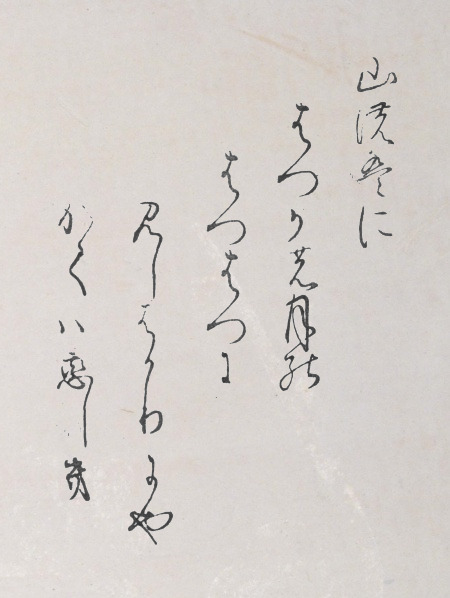
yama no ha ni hatsuka no tsuki no hatsuhatsu ni mishi bakari ni ya kaku wa koishiki
By the mountains’ edge The Twentieth’s moon Just for a moment Did I simply see, so how Am I so in love?
Lord Morikata 63
Right
恋すてふ皆人ごとにとひみばやいと我ばかりあらじとぞおもふ
koisu chō mina hito goto ni toimiba ya ito ware bakari araji to zo omou
Saying they are in love— To all those folk Would I enquire, for Surely, I, alone Do not endure such feelings?
Lord Nobutada 64
Toshiyori states: I may be mistaken, but I get the feeling the first poem resembles an earlier work, with only the ending changed somewhat. The second poem sounds stilted. They are of the same quality.
Mototoshi states: the poem of Left lacks originality, being based earlier poems from the emergence ‘the Twentieth’s moon’ at the beginning, then continuing with ‘for coarse cloth a bobbin turning’ and then finally ‘here at Isonokami, in the ancient’ at the end, yet this is more poetic than ‘To all those folk’, so this is still win for the Left.
akugaruru tama to miekemu natsumushi no omoi wa ima zo omoishirinuru
As my wandering Soul do appear The fireflies— Those feelings, now, How well I know!
Kojijū 107
Right (Win)
いはずともおもひはそらにしりぬらむあまくだりますすみよしのかみ
iwazu tomo omoi wa sora ni shirinuramu amakudarimasu sumiyoshi no kami
Needless to say My feelings within the skies Are well-known by The heaven-descended God of Sumiyoshi!
Lord Sanemori 108
The poem of the Left appears to have a deep conception. However, this poem should be composed about the emotions expressed in Izumi Shikibu’s poem ‘Fireflies by the marsh: / From my breast’.[1] If so, then by having something like ‘As my wandering / Soul the fireflies / Do appear’, it appears as if you know how Izumi Shikibu felt. Here, though, we have ‘As my wandering / Soul do appear / The fireflies’ and this sounds as if you know how the fireflies feel—in which case it seems more in keeping with the poem by the Katsura Princess which says, ‘Their bodies bringing an excess / Of passion’s fires’.[2] Then again, does the diction, ‘As my wandering / Soul do appear’, perhaps, differ from this? The poem of the Right has nothing particularly evocative in its use of diction, but ‘My feelings within the skies’ and following this with ‘The heaven-descended’ at least sounds as if has a purpose to it. The Right wins, I should say.
[1] When she had been forgotten by a man, she went to Kibune, and composed this on seeing fireflies flitting about by the Mitarashi River. 物思へば澤の螢も我身よりあくがれ出づる玉かとぞみる mono’omoeba / sawa no hotaru mo / wa ga mi yori / akugare izuru / tama ka to zo miru ‘I’m at such a loss; / Fireflies by the marsh: / From my breast / Wanders out / My soul, or so it seems.’ Izumi Shikibu (GSIS XX: 1162)
[2] When Princess Katsura had said ‘Catch some fireflies,’ and one of the boys had them wrapped up in the sleeves of his jacket. つつめどもかくれぬ物は夏虫の身よりあまれる思ひなりけり tsutsumedomo / kakurenu mono wa / natsumushi no / mi yori amareru / omoinarikeri ‘Wrapped up, yet / Unconcealable are / The summer insects: / Their bodies bringing an excess / Of passion’s fires.’ Anonymous (GSS IV: 209)
Composed when I was at a certain place and telling tales with sundry others before a lady’s curtains and heard a woman’s voice – one of her attendants, no doubt – say, ‘He seems to be strangely knowledgeable about matters of the heart for such an old man!’
あはれてふ事にしるしはなけれどもいはではえこそあらぬ物なれ
aFare teFu koto ni sirusi Fa nakeredomo iFade Fa e koso aranu mono nare
Of sensitivity Surface signs Are their none, yet Saying nothing, indeed, is What makes it plain!