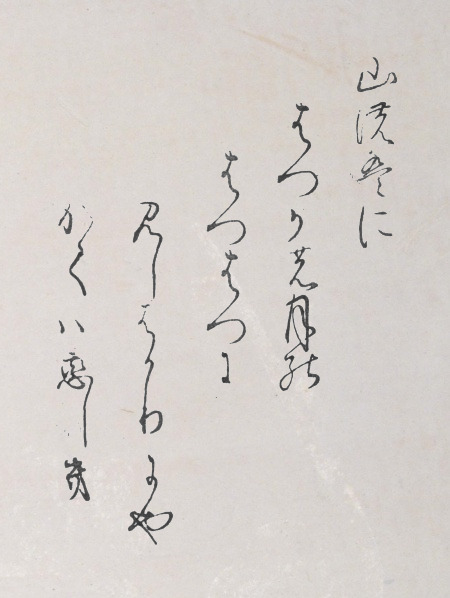
年に有りてひとよいもにあふひこぼしも我にまさりて思ふらんやぞ
| tosi arite Fito yoFi mo ni aFu Fikobosi mo ware ni masarite omoFuran ya zo | Within the year On but one night Meeting, is the Herd Boy, Far more than I, Filled with gloomy thoughts? |
Hitomaro
For a painting on a folding screen of a woman with a torn robe passing by a spot on the plains with three aged pines.
おのづから我をたづぬる人もあらば野中の松よみきとかたるな
| onozukara ware o tazunuru hito mo araba nonaka no matsu yo miki to kataru na | If, from time to time, Enquiring after me A man should come, O, pines upon the plains, Say not that you’ve seen me![i] |
694

[i] See: Topic unknown. それをだに思ふ事とてわがやどを見きとないひそ人のきかくに sore o dani / omou koto tote / wa ga yado o / miki to na ii so / hito no kikaku ni ‘Simply on those times / Do my thoughts dwell, so / That my house / You’ve seen, say not! / Lest others hear of it…’ Anonymous (Kokinshū XV: 811)
I sent this in parting to a court lady who had served me closely, when she said she was going to a distant province.
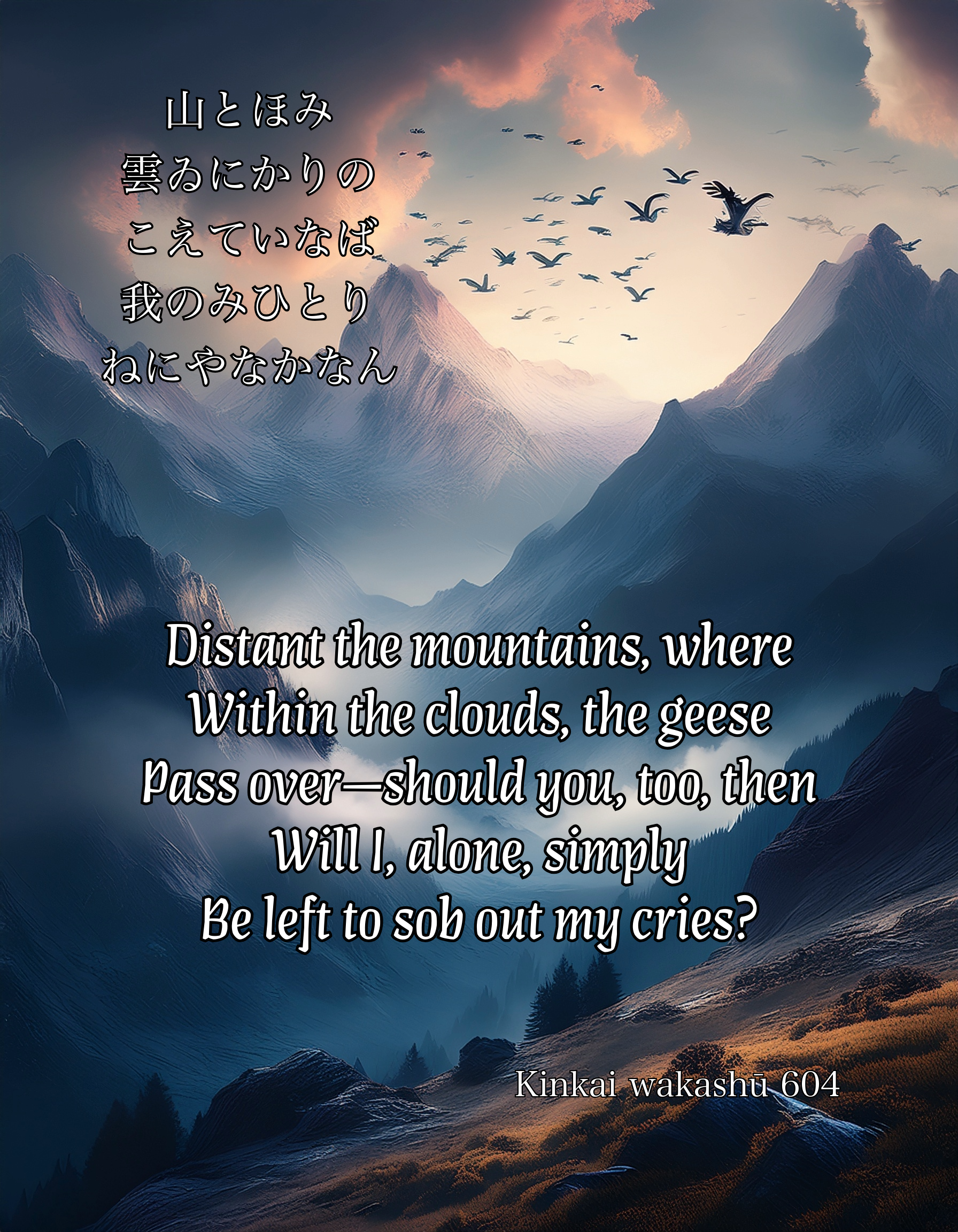
山とほみ雲ゐにかりのこえていなば我のみひとりねにやなかなん
| yama tōmi kumoi ni kari no koeteinaba ware nomi hitori ne ni ya nakanan | Distant the mountains, where Within the clouds, the geese Pass over—should you, too, then Will I, alone, simply Be left to sob out my cries?[i] |
604
[i] See: 朝霞 蒙山乎 越而去者 吾波将恋奈 至于相日 asagasumi / tanabiku yama o / koete’inaba / are wa koimu na / awamu hi made ni ‘The morning haze / Trailed mountains / Should you pass beyond, then / Will I ever yearn for you / Until the day we meet once more…’ (Man’yōshū XII: 3188)
Original
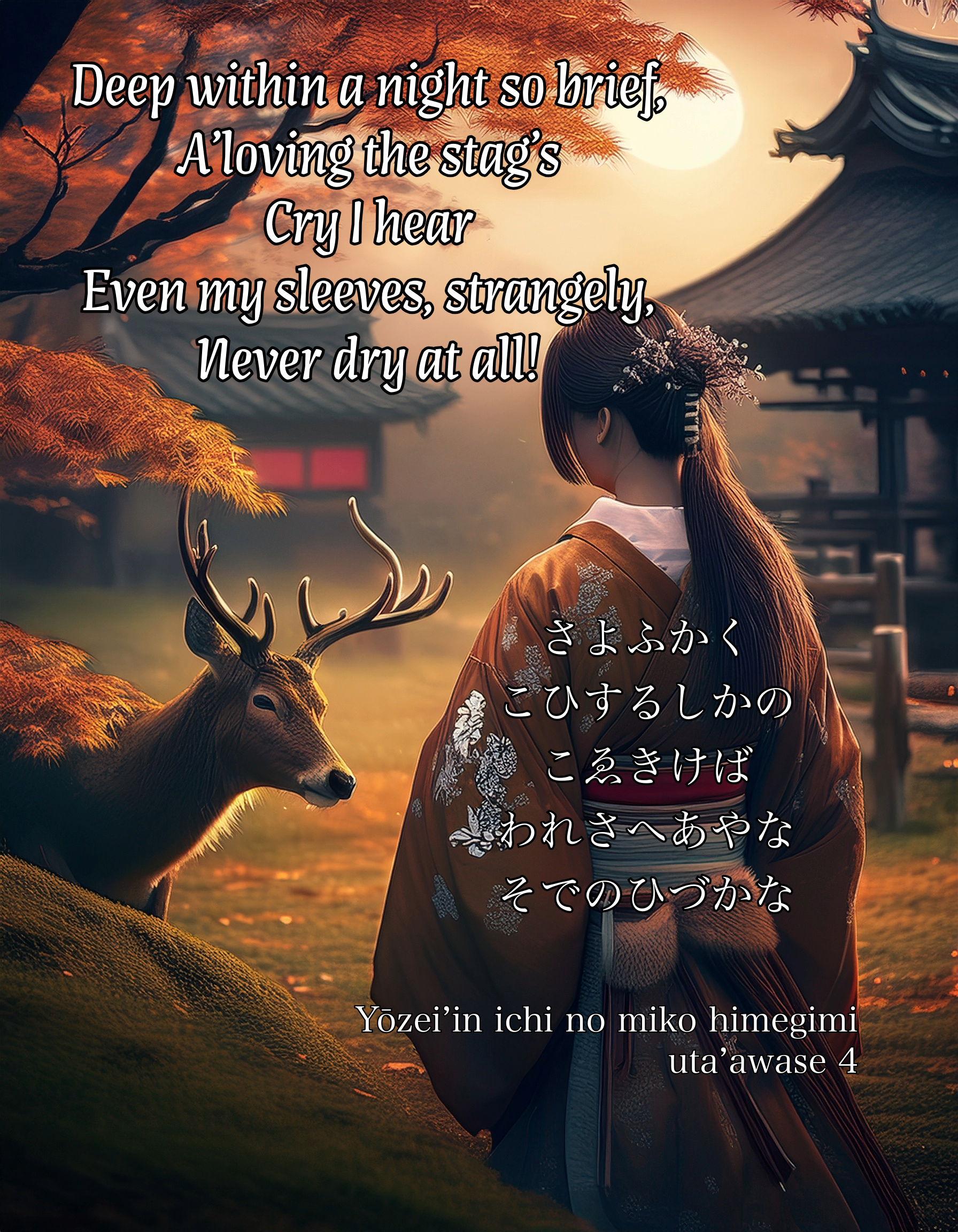
さよふかくこひするしかのこゑきけばわれさへあやなそでのひづかな
| sayo fukaku koisuru shika no koe kikeba ware sae ayana sode no hizu kana | Deep within a night so brief, A’loving, the stag’s Cry I hear Even my sleeves, strangely, Never dry at all! |
4
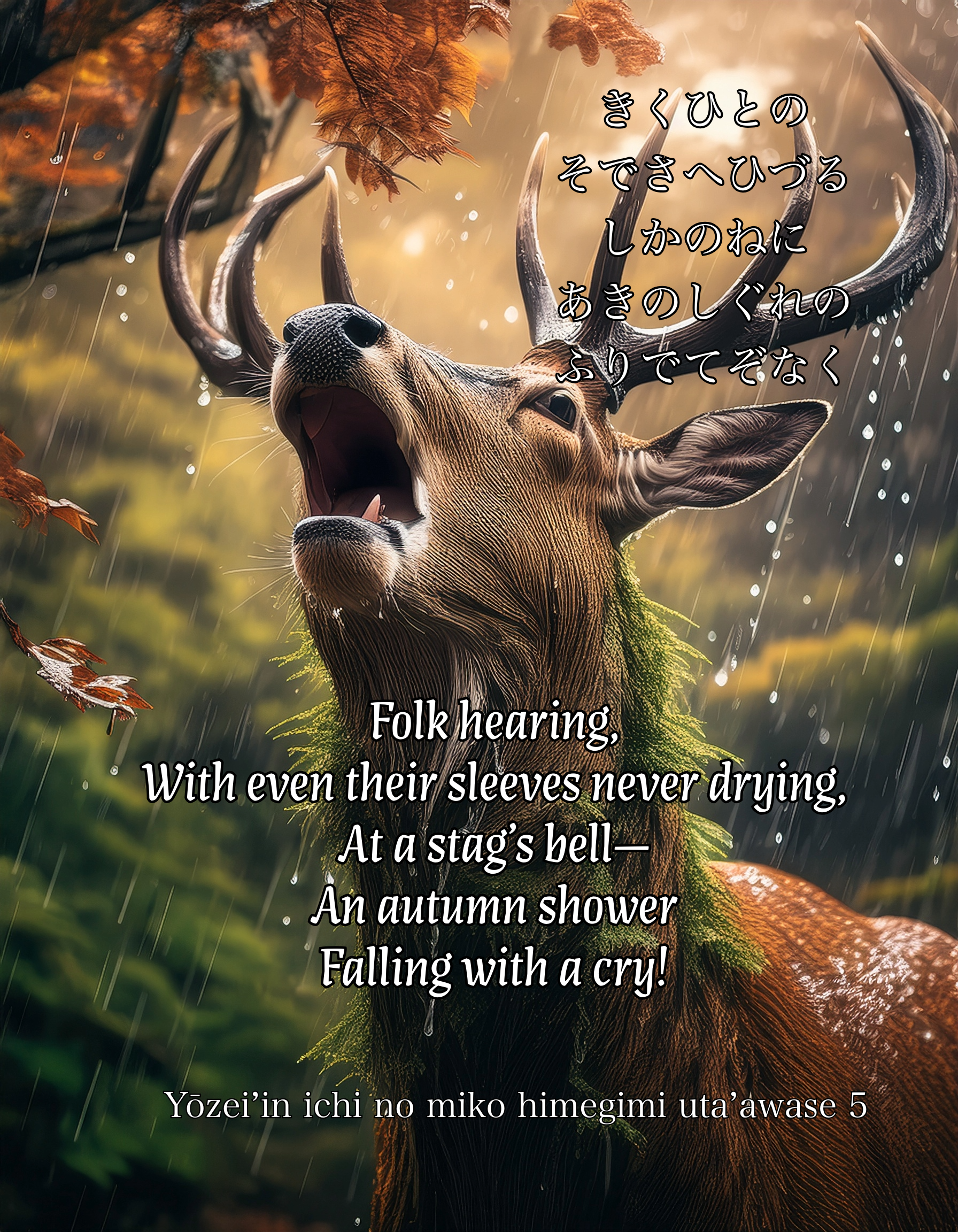
きくひとのそでさへひづるしかのねにあきのしぐれのふりでてぞなく
| kiku hito no sode sae hizuru shika no ne ni aki no shigure no furidete zo naku | Folk hearing, With even their sleeves never drying, At a stag’s bell— An autumn shower Falling with a cry! |
5
Only one poem was requested in response this round.
Left
きみをわれおきてしゆけばあさつゆのきえかへりてもあはむとぞおもふ
| kimi o ware okiteshi yukeba asatsuyu no kiekaerite mo awamu to zo omou | With you, my love, I Having risen and departed With the morning dew, Vanishing away, only To meet once more, I feel. |
28
Right
あさぼらけあかぬわかれをわびつつもゆふぐれをこそなぐさめにすれ
| asaborake akanu wakare o wabitsutsu mo yūgure o koso nagusame ni sure | At the pale edge of dawn, Unsatisfied, parting Leaves me ever desolate— The evening is sure to be My consolation! |
29
Round Eight
Left (T – Tie; M – Win)
山のはにはつかの月のはつはつにみしばかりにやかくは恋しき
| yama no ha ni hatsuka no tsuki no hatsuhatsu ni mishi bakari ni ya kaku wa koishiki | By the mountains’ edge The Twentieth’s moon Just for a moment Did I simply see, so how Am I so in love? |
Lord Morikata
63
Right
恋すてふ皆人ごとにとひみばやいと我ばかりあらじとぞおもふ
| koisu chō mina hito goto ni toimiba ya ito ware bakari araji to zo omou | Saying they are in love— To all those folk Would I enquire, for Surely, I, alone Do not endure such feelings? |
Lord Nobutada
64
Toshiyori states: I may be mistaken, but I get the feeling the first poem resembles an earlier work, with only the ending changed somewhat. The second poem sounds stilted. They are of the same quality.
Mototoshi states: the poem of Left lacks originality, being based earlier poems from the emergence ‘the Twentieth’s moon’ at the beginning, then continuing with ‘for coarse cloth a bobbin turning’ and then finally ‘here at Isonokami, in the ancient’ at the end, yet this is more poetic than ‘To all those folk’, so this is still win for the Left.