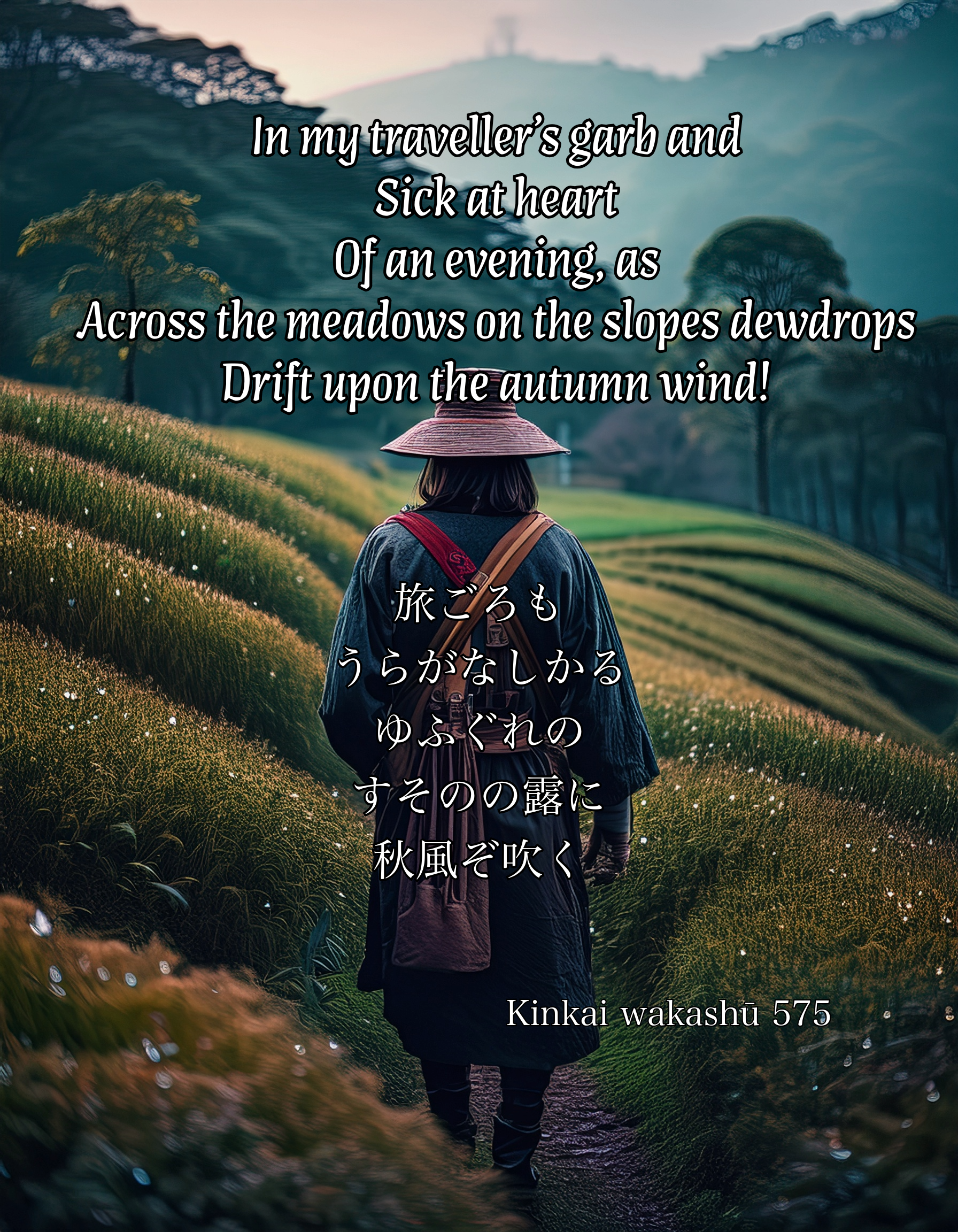
tabigoromo uraganashikaru yūgure no susono no tsuyu ni akikaze zo fuku
In my traveller’s garb and Sick at heart Of an evening, as Across the meadows on the slopes dewdrops Drift upon the autumn wind! [i]
575
[i] See: 旅ごろもうらがなしさにあかしかね草の枕は夢もむすばず tabigoromo / uraganashisa ni / akashikane / kusa no makura wa / yume mo musabazu ‘In my traveller’s garb / My heart-sickness / I cannot lift, for / My grassy pillow / Brings no dreams, at all…’ Hikaru Genji (Genji monogatari 223); and: たびごろもうらがなしかるあさぢふによはのしぐれよいかにせよとぞ tabigoromo / uraganashikaru / asajū ni / yowa no shigure yo / ika ni seyo to zo ‘In my traveller’s garb and / Sad at heart among / The clumps of cogon grass, / O, midnight shower, / Tell me, what I am I to do?’ Jakuchō (Sumiyoshi-sha uta’awase kaō ni-nen 54)
kumo kakaru takashi no yama no akegure ni tsuma madowaseru oshika naku nari
All hung about with cloud On Takashi Mountain In the gloaming Having lost his mate A stag bells out.
Nakamasa 11
Right
山がつの先あかつきをしりがほに裾野に出でて鹿ぞ鳴くなる
yamagatsu no mazu akatsuki o shirigao ni susono ni idete shika zo naku naru
A mountain man First of all, that ‘tis dawn Knows plain upon his face, As he sets out upon the slopes As a stag bells out!
Head 12
The Left poem’s conclusion, ‘Having lost his mate / A stag bells out’ seems no different from that of a poem by Gō no Jijū in poetry match held by the First Princess.[1] As for the poem of the Right’s ‘A mountain man / Awaits the dawn / Knowing plain upon his face’—what on earth might a mountain man look like while waiting for dawn? There is the tale of Hangu Pass in Cathay, where the barrier guard was waiting for dawn and opened the gate after hearing a cock’s crow, but the expression ‘a mountain man awaits the dawn’ has never appeared before in a poem—either one of Cathay or in the words of Yamato, so I feel that both Left and Right lack any superlative qualities.
[1] Stags. をぐら山たちどもみえぬゆふぎりにつままどはせるしかぞなくなる ogurayama / tachidomo mienu / yūgiri ni / tsuma madowaseru / shika zo nakunaru ‘On gloomy Ogura Mountain / Stands unseen / Among the evening mists / Having lost his mate / A belling stag.’ (Yūshi naishinnō-ke uta’awase eishō go-nen 27). This event was held at the residence of Imperial Princess Sukeko (Yūshi) on the 5th day of the Sixth Month, Eishō 5 [26.10.1050]. The poem won its round, and was later included in Goshūishū (IV: 292).
takasago no susono no ma’hagi tsuyu fukashi mine no akikaze fukazu mo aranamu
On Takasago’s Slopes the fair bush clover is Deep in dew— O, that the autumn winds from the peak Would fail to blow…
The Supernumerary Major Counsellor 53
Right
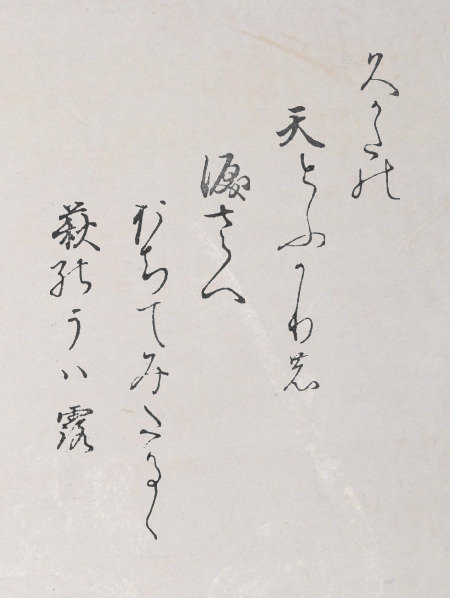
久かたの天とぶかりの涙さへおちてみだるる萩のうは露
hisakata no ama tobu kari no namida sae ochite midaruru hagi no uwazuyu
From the eternal Heavens flying, even the goose Tears Drop in confusion Overlaying the dew upon the bush clover.[1]
Nobunari 54
Both Left and Right seem particularly pleasant. Thus, they tie.
[1] An allusive variation on: Topic unknown. なきわたるかりの涙やおちつらむ物思ふやどの萩のうへのつゆ nakiwataru / kari no namida ya / ochitsuran / mono’omou yado no / hagi no ue no tsuyu ‘Calling across / Did the geese let tears / Fall? / My dwelling, lost in thought, / Has dew upon the bush clover.’ Anonymous (KKS IV: 221)
The Right query whether it is possible to draw an association between ‘Cathay robes’ and snipe? The Left wonder about the usage of’lonely reverie as beating wings’.
Shunzei’s judgement: The criticisms from both teams are ones I have encountered before. As the poet has used ‘My sleeve – from which the snipe’ (sode yori shigi), and ‘a hut at Susono’ (susono no io), it requires the use of ‘Cathay robes’ (kara koromo) – there is no more to it than that. As for the Right, saying ‘Snipe start from the fields’ (shigi tatsu nobe) and ‘All night long in lonely reverie as beating wings time and again’ (yowa no aware mo momohagaki) – there is no fault to be found here, either. However, saying ‘My sleeve – from which the snipe’ is better. It must win.