Tag Archives: kari

Entō ōn’uta’awase 27

Round Twenty-Seven

Left (Tie)

高砂のすそ野の真萩露ふかし嶺の秋風ふかずもあらなむ

takasago no
susono no ma’hagi
tsuyu fukashi
mine no akikaze
fukazu mo aranamu
On Takasago’s
Slopes the fair bush clover is
Deep in dew—
O, that the autumn winds from the peak
Would fail to blow…

The Supernumerary Major Counsellor
53

Right

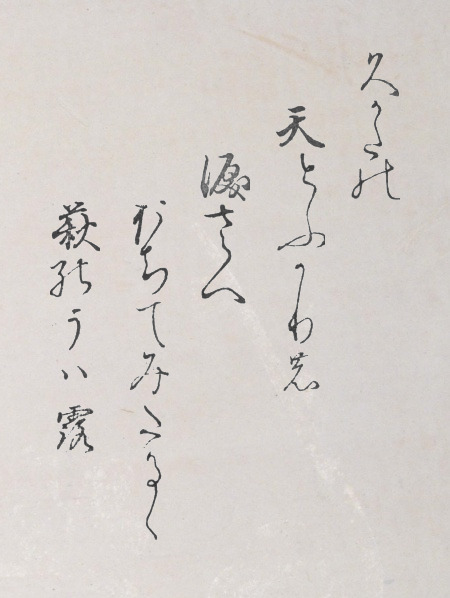
久かたの天とぶかりの涙さへおちてみだるる萩のうは露

hisakata no
ama tobu kari no
namida sae
ochite midaruru
hagi no uwazuyu
From the eternal
Heavens flying, even the goose
Tears
Drop in confusion
Overlaying the dew upon the bush clover.[1]

Nobunari
54

Both Left and Right seem particularly pleasant. Thus, they tie.


[1] An allusive variation on: Topic unknown. なきわたるかりの涙やおちつらむ物思ふやどの萩のうへのつゆ nakiwataru / kari no namida ya / ochitsuran / mono’omou yado no / hagi no ue no tsuyu ‘Calling across / Did the geese let tears / Fall? / My dwelling, lost in thought, / Has dew upon the bush clover.’ Anonymous (KKS IV: 221)

Shikibukyō atsuyoshi shinnō senzai awase 01

草のかう色変わりぬる白露は心おきても思ふべきかな

kusa no kō
iro kawarinuru
shiratsuyu wa
kokoro okitemo
omoubeki kana
The grasses have such
Changing hues with
The silver dewdrops
Fall upon my heart, yet
I am filled with longing!

1[i]

風寒み鳴くなる雁の声によりうたむ衣をまづやからまし

kaze samumi
nakunaru kari no
koe ni yori
utamu koromo o
mazu ya karamashi
Chill will turn the wind as
Calling come the goose
Cries, so
The robes upon the fulling block—
First would I borrow one!

2[ii]


[i] This poem is included in Kokin rokujō (VI: 3768), attributed to Ise, with the headnote ‘The scent of grasses’. It is also included in Ise-shū (88), with the headnote ‘The scent of grasses, in the Minister of Ceremonial’s Garden Match’.

[ii] This poem is included in Ise-shū (89), with the headnote ‘Gentian’ (rindō 竜胆).

Sumiyoshi-sha uta’awase kaō ni-nen 57

Round Seven

Left (Tie)

わがさかりやよいづかたへゆきにけむしらぬおきなにみをばゆづりて

wa ga sakari
yayo izukata e
yukinikemu
shiranu okina ni
mi oba yuzurite
My glory days,
O, where have they
Gone?
An unfamiliar old man
Has taken my place…

Lord Kiyosuke
113

Right

いかなればわがひとつらのかかるらむうらやましきはあきのかりがね

ika nareba
wa ga hitotsura no
kakaruramu
urayamashiki wa
aki no kari ga ne
What has happened, that
My brothers, one and all,
Should go so far?
How I envy
The cries of autumn geese…

Lord Sanetsuna
114

Both of these poems of the Left and Right are, once again, suited to their poets. The Left appears to have a charming conception, looking back on more prosperous times which have now gone—just as anyone would. This is certainly something to resent and yet, in his glory days he was a man of high renown, or someone with great responsibilities among lower officialdom, or even in the Inner Palace Guards or Great Council of State—to hear a man recollecting this and asking ‘where have my glory days gone’—speaking of such things sounds charming, in the end. Truly charming. The poem of the Right finds fault with ‘What has happened, that /My brothers, one and all’ and the poet says ‘How I envy / The cries of autumn geese’. The line of geese in the autumn appears unmistakably to refer to the ordering of brothers—perhaps that order has been disrupted? If so, this, too, is extremely charming. To the extent that these, too, express the writer’s troubles, for the moment, I make them a tie.

Yasuakira shinnō tachihaki no jin uta’awase 06

Geese

Left (Tie)

あきのそらかりのなきくるくもゐをばよそなるひとのふみとこそみれ

aki no sora
kari no nakikuru
kumoi oba
yoso naru hito no
fumi to koso mire
In the autumn skies
Geese call
Beyond the clouds,
To someone so far away
A letter, they do seem.

Fujiwara no Akane
(Arimasa in  a certain text)
11

Right


まだきかぬみみにやあるらむはつかりのおとだにもせぬあきはきにしを

mada kikanu
mimi ni ya aruramu
hatsukari no
oto dani mo senu
aki wa kinishi o
I have yet to hear
Them with my ears, it seems—
The first geese
Have made not a sound, but
Autumn has come…

Miharu no Miyakoe
12