Love and Clouds.
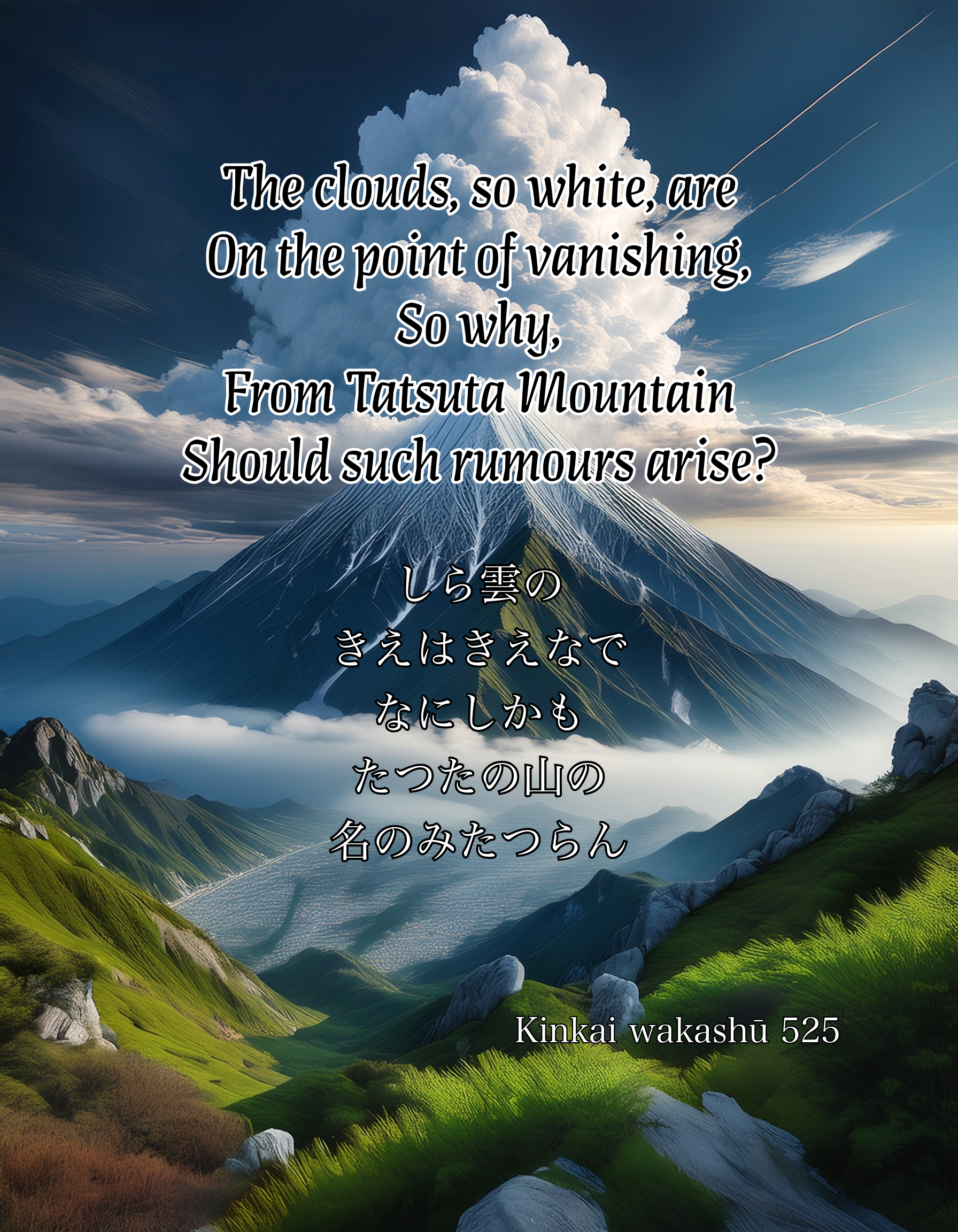
しら雲のきえはきえなでなにしかもたつたの山の名のみたつらん
| shirakumo no kie wa kienade nani shika mo tatsuta no yama no na nomi tatsuran | The clouds, so white, are On the point of vanishing, So why, From Tatsuta Mountain Should such rumours arise? |
525
Round Seven
Left
しらなみのたつたのかはにしきるかな山のさくらはちりにけらしも
| shiranami no tatsuta no kawa ni shikiru kana yama no sakura wa chirinikerashi mo | Whitecaps On Tatsuta River Constant are! Upon it the mountain cherries Have scattered it seems… |
Lady Kazusa
13
Right
花ざかりゆきとぞ見ゆるとしをへてよしのの山はふゆはふたたび
| hanazakari yuki to zo miyuru toshi o hete yoshino no yama wa fuyu wa futatabi | The profusion of blossom Seems like snow, so Passing through the year To Mount Yoshino Winter comes twice! |
Lady Shikibu
14
The poem of the Left’s ‘Whitecaps / On Tatsuta River / Constant are!’ is an expression I have not heard before. I have reviewed a large number of collections, and it has not been previously used. The Right’s poem is one from the Poetry Match held by the Sage of Ungo Temple.[i] Thus, it is difficult to determine a winner or loser.
The Left poem’s central line ‘constant are!’ sounds a bit distant. In addition, looking at the flowing of water is not part of the essential meaning of the topic. If one views the treetops, then one should say something like ‘Hidden in the mountains’ depths / These blossoms – would any wish to see them?’[1] –that’s an appropriate expression to be directed toward such blossoms. This poem is lacking in the sentiments required for a poetry match. The poem of the Right, stating that blossoms resemble snow, is something that has been used frequently and so sounds very well-worn, indeed. The final ‘Winter comes twice!’ also lacks elegance and, in addition, seems insufficient. I would think these should tie?


[1] A poem from a poetry competition held by Her Majesty, the Empress, during the Kanpyō period. 吹風と谷の水としなかりせば深山がくれの花を見ましや fuku kaze to / tani no mizu to shi / nakariseba / miyama gakure no / hana o mimashi ya ‘The gusting wind and / The valley’s waters / Were there none, then / Hidden in the mountains’ depths / These blossoms – would there be any chance to see them?’ Tsurayuki (KKS II: 118)
[i] It is unclear which poetry match Mototoshi is referring to here. The Sage of Ungo Temple (Ungoji no hijiri 雲居寺聖) was a sobriquet given to Senzai瞻西 (?-1127), after he reconstructed the temple in Higashiyama to the east of the capital after a long period of abeyance. There are surviving records of three poetry matches held at the temple in which Senzai took part: the ‘Poetry Match at the Ungo Temple’ (Ungoji uta’awase 雲居寺歌合); the ‘Poetry Match held at the Celebration after Sutra-copying at the Ungo Temple’ (Ungoji kechiengyō goen uta’awase 雲居寺結縁経後宴歌合); and the ‘Later Match Contest held at the Ungo Temple’ (Ungoji goban uta’awase 雲居寺後番歌合). All of these took place in Eikyū 4 (1116), but the first and last are fragmentary and only identifiable from the headnote to poems included in other collections. Ungoji kechiengyō goen uta’awase, however, is extant and was judged by Mototoshi, so we can definitively say that he was present. This match, though, took place in the Eighth Month, and so was devoted to autumn topics; Shikibu is also not listed among the participants, although a number of other court ladies well-known as poets do take part. The other two matches took place in the summer, or later in the autumn, and so it seems unlikely that a spring topic, such as cherry blossom, would have been assigned. The likelihood, therefore, is that either Mototoshi is referring to another match held at the temple in the spring, no record of which has survived, or that he has misremember the occasion on which he encountered Shikibu’s poem. A slight variant of this poem does occur in the anthology Konsen wakashū 今撰和歌集 (‘Anthology of Current Poetry’) (27), a private collection believed to have been put together by Kenshō in 1165-66, but the headnote there references this match, and there appear to be no records of this poem elsewhere in the canon.
Round Ten
Left (Win)
一たびは風にちりにし紅葉ばをとなせの滝の猶おとすかな
| hitotabi wa kaze ni chirinishi momijiba o tonase no taki no nao otosu kana | Once Scattered by the wind Scarlet leaves Down the cateract at Tonase Fall once more! |
Arifusa
91
Right
色ふかき紅葉うつらぬ所こそ立田の川のあさせなりけれ
| iro fukaki momiji utsuranu tokoro koso tatsuta no kawa no asase narikere | Deep the hues of Scarlet leaves, reflected not In this place above all: The River Tatsuta’s Shallow rapids. |
Lay Priest Sanekiyo
92
The Left appears charming, but might have been slightly improved had it been composed about pleasure boating on the Ōi. As for the Right, it is erroneous to specify the shallow rapids as a place where scarlet leave are not reflected. Taken as a whole it is inferior.


Round Three
Left (Win)
春の夜のあくる霞の立田山これや神代の衣なるらん
| haru no yo no akuru kasumi no tatsutayama kore ya kamiyo no koromo naruran | At a spring night’s Dawn the haze around Tatsuta Mountain— Is this how in the age of gods Raiment might have been? |
Supernumerary Major Counsellor Moto’ie
5
Right
朝霞雲居をかけて見わたせばいたりいたらぬ山の端もなし
| asagasumi kumoi o kakete miwataseba itari itaranu yama no ha mo nashi | When, upon the morning haze Draping from the clouds, I turn my gaze, it Spread out, and fails to reach, Not a single mountain’s edge. |
Nobunari, Senior Third Rank
6
Both Left and Right are difficult to tell apart, yet the Left’s ‘clothing of the Age of Gods’ would seem to be superior.
Composed as a spring poem, when he presented poems to the Poetry Office.
葛城やたかまの桜さきにけりたつたのおくにかかる白雲
| kazuragi ya takama no sakura sakinikeri tatsuta no oku ni kakaru shirakumo | In Kazuragi, On Takama peak the cherry Has bloomed! To the heart of Tatsuta Cling clouds of white…[1] |
Jakuren

[1] An allusive variation on KKS I: 59 and Wakan rōeishū II: 409/SKKS XI: 990.
Composed for the Palace Poetry Match in Eishō 4.
あらしふくみむろの山のもみぢばはたつたの川のにしきなりけり
| arasi Fuku mimuro no yama no momidiba Fa tatuta no kaFa no nisiki narikeri | The storm wind blowing Down Mimuro Mountain makes The scarlet leaves Upon the Tatsuta River A fine brocade. |
Monk Nōin


